Castle of Sancho Abarca: A Medieval Frontier Fortress in Spain
Site at a Glance
- Popularity
- Medium
- Country
- Spain
- Primary era
- Medieval
- Eras represented
- Medieval
- Civilizations
- Kingdom of Navarre
- Site type
- Military
- Remains
- Castle
On this page11 sections
History
The Castle of Sancho Abarca is a medieval frontier fortress on Cabezo del Fraile in Navarre, Spain, built in 1220 during the reign of Sancho VII the Strong. The king provided its garrison. For nearly four centuries, the castle served as a lookout and part of Navarre’s first line of defence against Aragon.
Possible earlier origins and the name
Medieval historian Antonio Ubieto considered it likely that the 1220 castle replaced an earlier position, perhaps dating to the twelfth century. A more ancient origin as a lookout in the Umayyad frontier network of al-Andalus, the Muslim-ruled territories of the Iberian Peninsula, has also been proposed, but remains uncertain. Regional fighting offers context rather than proof of an early fortification here. In 915, Sancho Garcés I, an earlier king of Pamplona, fought near Tudela, captured its lord, Abdalah ben Muhammad ben Lubb, for ransom, and killed many of his soldiers in the Bardenas.
A history published by José de Moret in 1654 attributed the fortress to Sancho Garcés II, a tenth-century king of Pamplona also known as Sancho Abarca. This dating is considered implausible: the site would have been isolated within the Upper March, the northern frontier region of al-Andalus, among important Muslim-held centres. The campaigns of the Umayyad ruler Abd al-Rahman III in the Ebro region would likely have eliminated a Christian foothold there.
The origin of the castle’s name is also uncertain. One tradition says Sancho Garcés II briefly occupied an existing lookout, leaving his name attached to it. Ubieto suggested instead that a different Navarrese man called Sancho Abarca may have commissioned a watchtower. This man held property in Tudela in 1158, served as a tenente, a territorial officeholder, at Ejea de los Caballeros, and was connected with a will at Uncastillo in 1163. Language and place-name scholar Marcelino Cortés proposed another explanation, interpreting the place-name at Tauste as tautological, with elements that repeat a meaning associated with a valley or ravine.
Frontier service
The castle guarded the Navarre-Aragon frontier from the thirteenth to the sixteenth century. Its duties included watching the border and protecting herders and livestock from bandits who took refuge in the unpopulated Bardenas. It belonged to a wider chain of local watchtowers that included Aguilar, Estaca, Sanchico Rota, Puy Águila, Peñaflor, and Mirapeix. In a 1921 article, Juan P. Esteban Chavarría connected the castle with Fustiñana’s jurisdiction, which he described as reaching back to time immemorial.
In peacetime, about six members of the garrison carried crossbows and javelins; during conflict, the force could grow to 50. Local livelihoods included raising livestock for meat and wool, using timber, and moving herds seasonally between pastures. In 1311, James II of Aragon asked Garracón, Navarre’s governor, for permission to take up to 100 dozen stakes from Mount Sancho Abarca. The wood was intended to protect a reedbed planted beside the Ebro near Novillas, where suitable timber was unavailable in the surrounding Aragonese area.
Abandonment and later traditions
After Ferdinand the Catholic took control of Navarre in 1512, the castle’s custody was abandoned. In 1515, the Bardenas castles were listed as having no wardens, and the region was described as uninhabited. Demolition apparently began in 1516 and continued through 1521.
Navarrese oral tradition tells of a cave and passage cut through the rock towards the Ebro by Arab workers. In the tale, a woman was enchanted and turned to stone after seeing them at work. Later Christians who tried to enter the passage found their lights repeatedly extinguished. Juan P. Esteban Chavarría reshaped the story in a 1911 tale, presenting the woman as an embodiment of Navarre’s troubles. Aragonese traditions also tell of mysterious tunnels. In Ramón J. Sender’s novel Crónica del Alba, a fictional boy loses his way in them and encounters a vision of medieval knights.
Remains
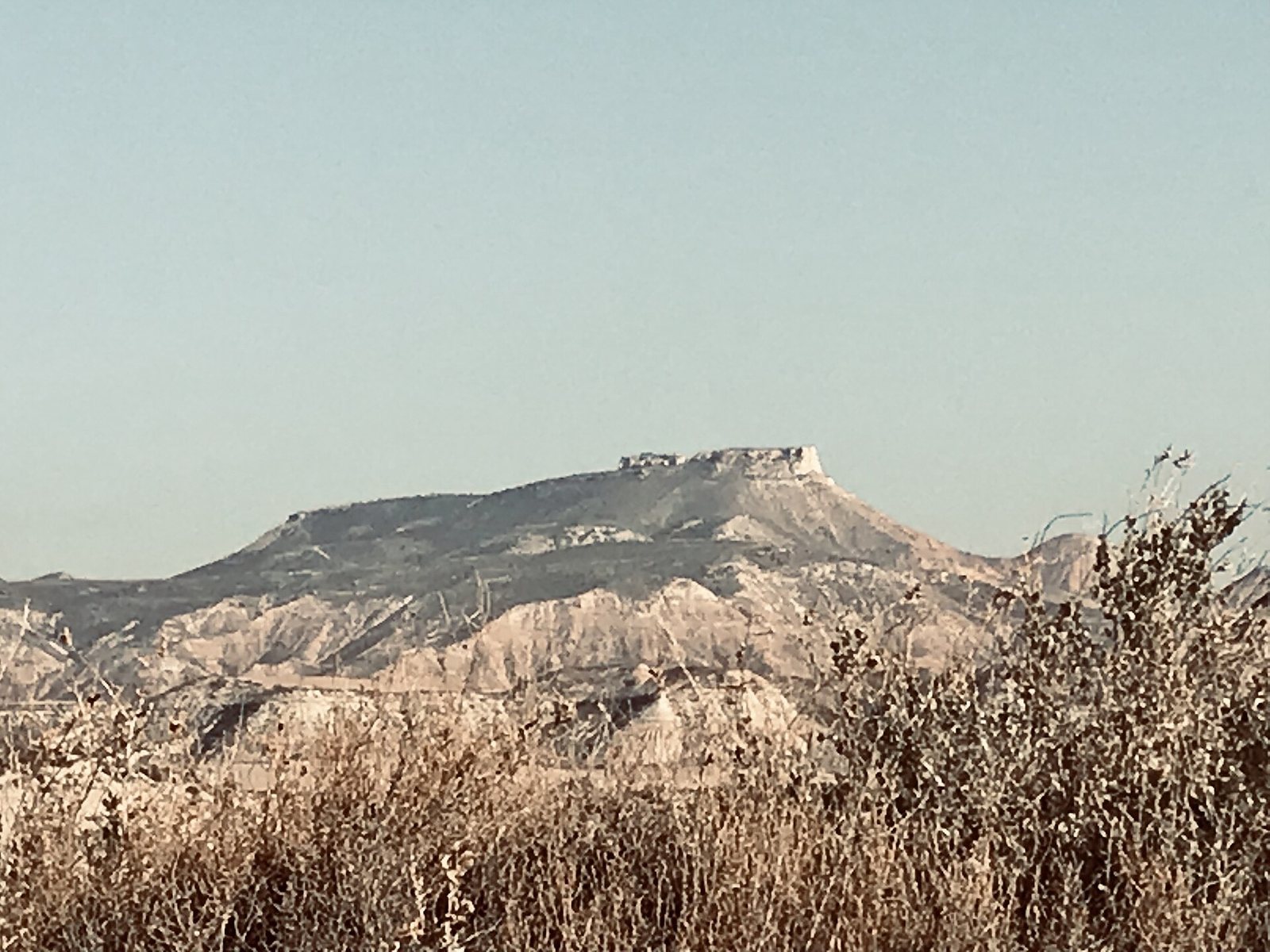
The ruins stand on Cabezo del Fraile, south of the Bardenas Reales in Navarre. The summit rises to 557 metres, above the middle Ebro valley at about 250 metres. The position overlooks the valley, Moncayo’s northern slopes, the Bardena Negra, and settlements on both sides of the Navarre-Aragon border. The fortresses of Ferrera and Peña Redonda are also visible, while ruins extend around the summit and down its slopes.
Fortress layout and defences
Summit and approaches
The castle occupied a rocky platform about 70 metres long and 15 metres wide. A steep-sided ravine falls vertically along its southern face, while the eastern and western approaches become steep over their final 100 metres. On the north, a ditch about three metres deep was cut into the rock, dividing the platform and reducing the area that needed defence.
Walls and towers
The defensive circuit included an outer defensive wall with towers, some used as lookout posts, and a large tower that rose above the wall. The tower was built from ashlar, stone shaped into regular blocks, and ashlar masonry also survives among the ruins.
Buildings and rock-cut spaces
Castle buildings
The complex included a cellar, a principal residence, a church, stables, and sheds. These structures formed part of the castle’s arrangement on the narrow summit.
Rooms beneath the platform
A water cistern, other rooms used for survival, and a prison were cut into the rock beneath the platform’s flat surface of white limestone. Navarre’s royal accounts record people held in the castle prison in 1362.