Castle of Csővár: A Medieval Fortress and Renaissance Residential Castle in Hungary
Site at a Glance
- Rating
- 4.7
- Popularity
- Low
- Country
- Hungary
- Primary era
- Medieval
- Eras represented
- Medieval, Early Modern
- Civilizations
- Hungarian
- Site type
- Military
- Remains
- Castle
On this page12 sections
History
Castle of Csővár is a medieval castle ruin in Csővár, Hungary, about 20 kilometers east of Vác. Its smaller predecessor is traditionally associated with the thirteenth-century reign of King Béla IV, whose rule followed the Mongol invasion of 1241–1242 and saw extensive castle construction and rebuilding. The prosperous Csői and Nézsai families probably initiated the early stronghold, and silver coins found at the site support this dating.
Early castle and fifteenth-century struggles
Troops commanded by Matthew Csák, a powerful early fourteenth-century Hungarian magnate with his own military forces, besieged and destroyed the first castle. It was rebuilt nearly a century later, although the identities of its owners during this phase are unknown. In 1423, King Sigismund attempted to place the castle in the possession of Garai János, but Chapy András, one of the king’s favored men, opposed the plan and prevented it.
In 1444, the impoverished and dispossessed Csői and Nézsai families seized the castle with the help of Hussite forces led by Giskra. The Hussites followed the reforming religious movement associated with Jan Hus, while Giskra was a military leader active in the Kingdom of Hungary. During the following decades, Csővár gained a reputation as a robber stronghold, and its lords repeatedly plundered nearby villages.
Royal control and Renaissance rebuilding
Csői Miklós lost his estates in 1470 for fratricide and disorderly conduct. The castle remained with the Nézsai family, but Nézsai László and Nézsai János were later declared disloyal by King Matthias, usually known as Matthias Corvinus, because they had taken part in the conspiracy associated with Vitéz János. Both men died without male heirs, and in 1474 the estate and castle returned to the royal treasury.
Matthias subsequently pawned Csővár to Parlaghy György. After redeeming the pledge, he granted the castle and other estates to his son, Corvin János, who retained it for a time after Matthias’s death. The next owner was Ráskay Balázs, a high-ranking figure at Matthias’s court who had remained loyal to Corvin János. Ráskay acquired the castle after Corvin’s fall, and under the following owners Csővár entered its most prosperous period. Major rebuilding transformed the isolated stronghold into a Renaissance residential castle, reflecting the period’s preference for more courtly and domestic architectural forms.
Ottoman occupation and later decline
After the Ottoman capture of Buda in 1541, Csővár again acquired greater military importance. The defenses were strengthened against artillery, an outer castle was added, and a roughly 20-meter rounded artillery fortification was built on the side facing the gentler, more vulnerable approach. As Ottoman forces advanced through Nógrád, however, the castle became increasingly difficult to defend. A small Ottoman force captured it in 1551 and held it for several decades before abandoning it and probably setting it on fire.
Following the expulsion of the Ottomans, the castle passed to the Ráskay heirs. Marriage later brought it to the Károlyi family, who exchanged it with the Prónay family around 1730. The Prónays retained the property until 1945. During the 1730s, parts of the ruins were demolished, and some stone was reused in the construction of Prónay Castle at Acsa. The first investigations of Csővár also took place during this period.
Documentation and twentieth-century stabilization
A forester’s house was established within the castle in the early nineteenth century but did not remain there for long. By the middle of that century, the site was an abandoned ruin being used as a stone quarry. In 1875, the Hungarian antiquarian and monument documenter Arányi Lajos György prepared drawings and a written description of the remains.
Between 1954 and 1961, work directed by the historian and researcher Jakus Lajos cleared the site, strengthened the tower because it was dangerously unstable, and excavated the cistern. The work later stopped, and the castle has not undergone a detailed archaeological excavation.
Remains
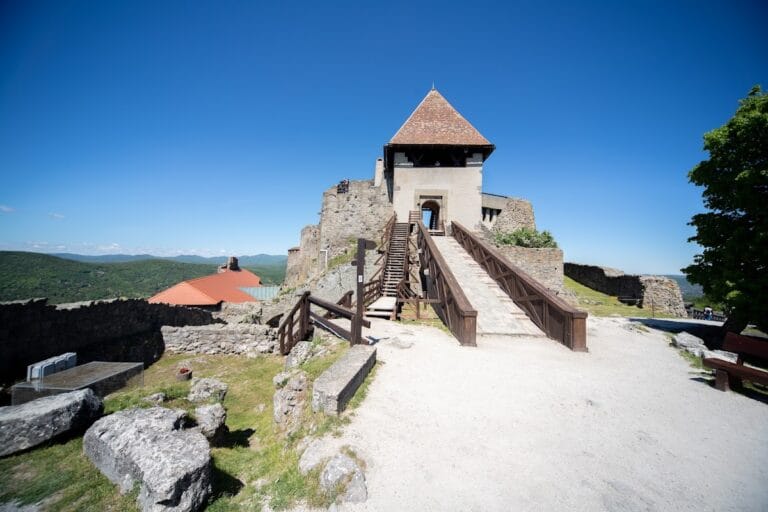
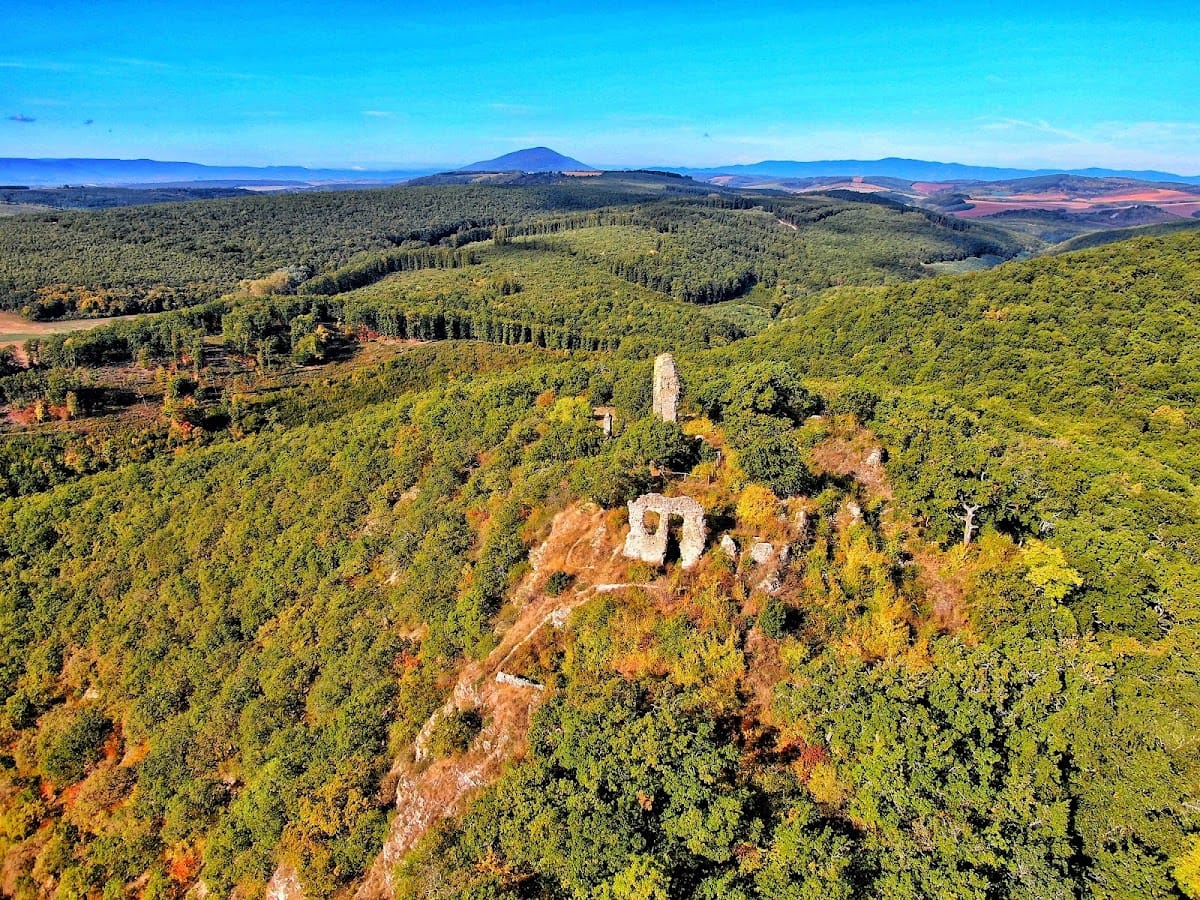
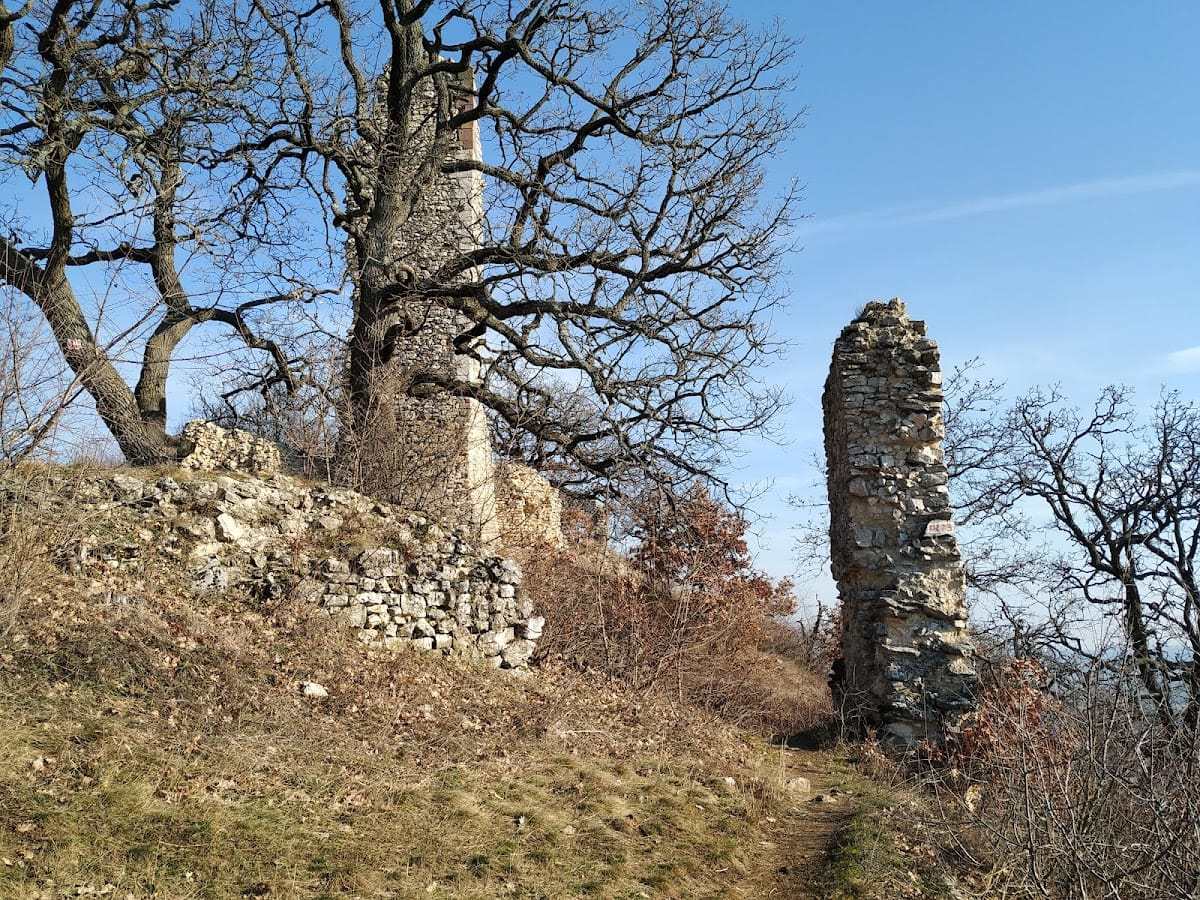
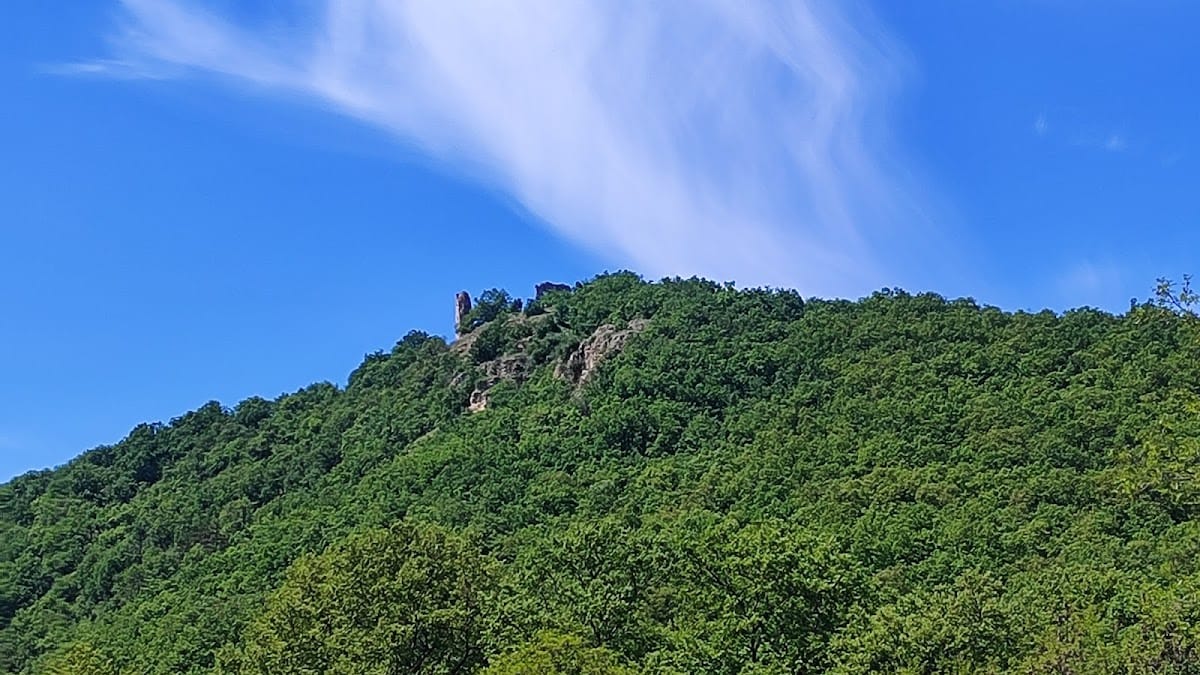
Castle of Csővár survives as a stone-built ruin at an elevation of approximately 302 meters. The original stronghold was considerably smaller than the later complex. The surviving layout includes a tower, the former castle courtyard, an outer castle, a rounded artillery defense, and a cistern within the courtyard.
Defensive and residential structures
Rondel
The roughly 20-meter rondel occupies the side where the gentler terrain created a more vulnerable approach. This rounded artillery fortification was designed to accommodate cannon fire and formed part of the castle’s later defenses. It belongs to the phase when Csővár’s military role increased after the Ottoman capture of Buda.
Chapel wall
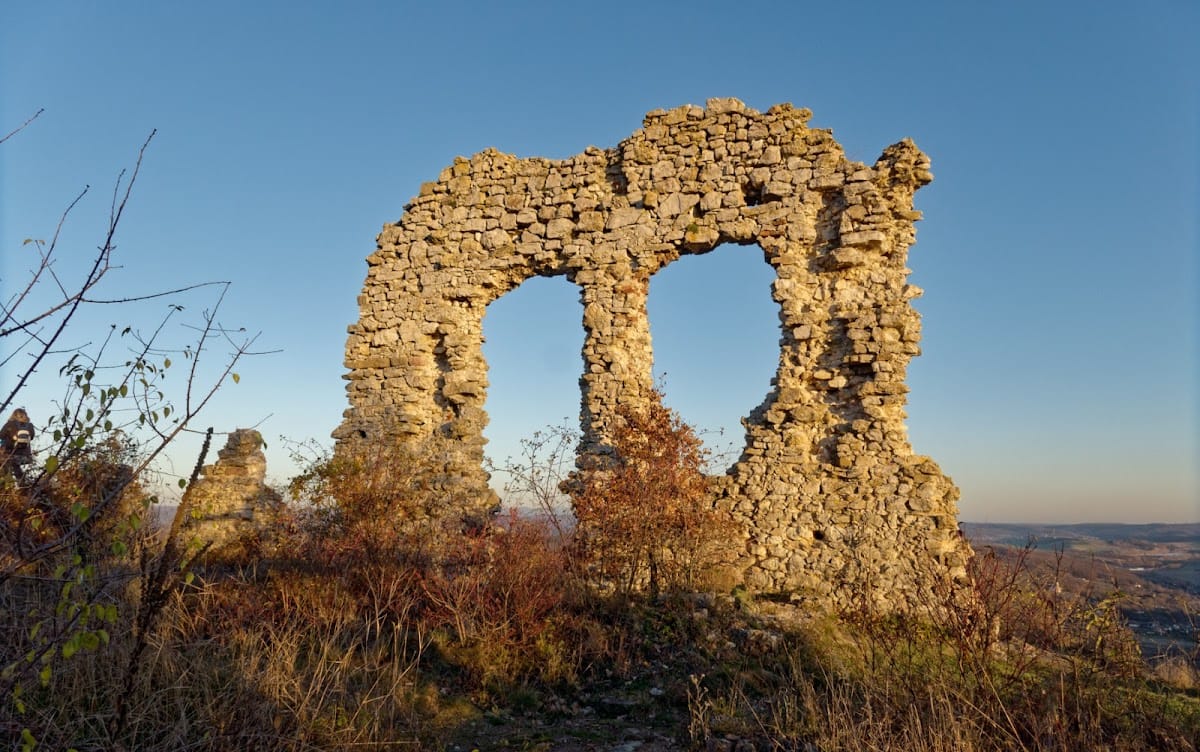
The former castle chapel is represented by a surviving wall with Gothic windows. Gothic architecture was a medieval style associated with pointed arches and elaborate window tracery. The openings in this wall were cut by the Prónay family after the castle had become a ruin, leaving the chapel remains as part of the later history of the site.
Courtyard and surviving fabric
Cistern
A cistern lies in the former castle courtyard. It was excavated during the 1954–1961 stabilization work and is now protected by a fence, preserving a feature associated with the castle’s internal water supply.
Tower and outer castle
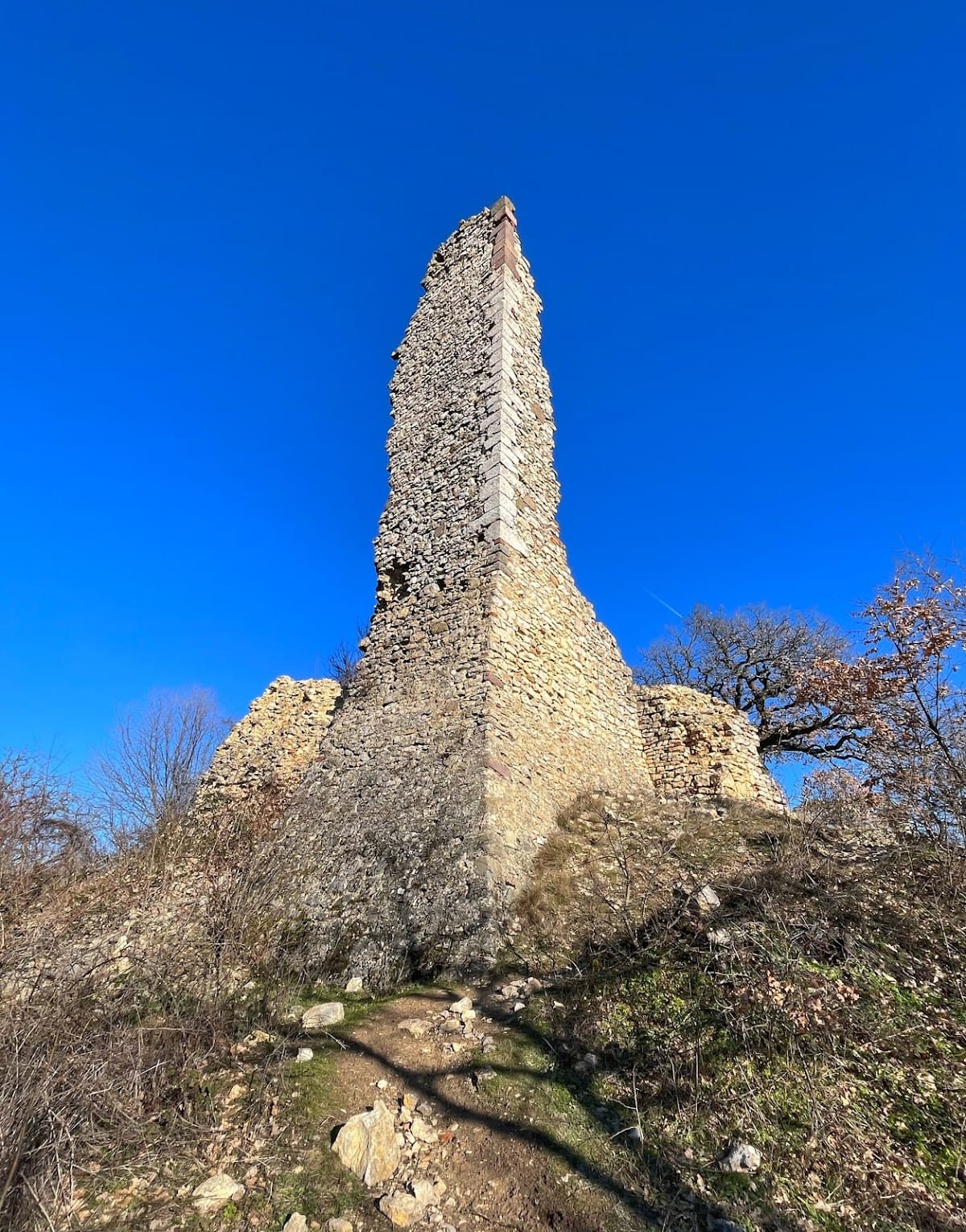
The tower and outer castle remain as parts of the substantially ruined complex. The tower was strengthened during the twentieth-century works because it faced the danger of collapse. The castle’s physical fabric was also reduced by eighteenth-century demolition and later stone quarrying, while the surviving remains have not been fully archaeologically excavated.