Castle of Calice al Cornoviglio: A Medieval Fortress and Residential Palace in Italy


Site at a Glance
- Rating
- 4.5
- Popularity
- Very Low
- Country
- Italy
- Primary era
- Medieval
- External website
- Open
- Eras represented
- Medieval, Early Modern
- Civilizations
- Unclassified
- Site type
- Domestic
- Remains
- Castle
On this page6 sections
History
The Castle of Calice al Cornoviglio is a historic castle-residence in Italy, originating in the eleventh century as a fortification or residence, probably an outpost of the Obertenghi, a powerful medieval aristocratic dynasty in northern Italy. Documents mention it in 1077. Built above the village of Calice al Cornoviglio, it protected the settlement and controlled communication routes between the Vara Valley and Lunigiana, two adjoining historical regions. Its strategic military role ended in the nineteenth century.
Malaspina and Fieschi control
The Malaspina family owned the castle from the thirteenth century. Count-Bishop Gualtiero II of Luni occupied it, leading to a dispute that ended in 1206 when Tancredi Onesto judged that ownership of the castrum calisi, meaning the fortified site of Calice, should return to Guglielmo and Corrado Malaspina.
The castle passed indirectly to the Fieschi family through the marriage of Alagia Fieschi, daughter of Count Niccolò, to Morello II in 1266 or 1272. Political pressure led the Fieschi to cede much of their property, including Calice Castle, to the Republic of Genoa in 1276. Genoa nevertheless retained the family as feudatories, holders of territory granted in return for allegiance and service.
During the first half of the fourteenth century, the castle returned to the Malaspina branch of Villafranca. From 1355 it belonged to Azzone of the Malaspina branch of Lusuolo. These transfers between Malaspina branches ended in 1416, when Genoa occupied the castle and later granted it, together with fourteen other conquered castles, to the Fieschi as a fief.
Doria rule and residential transformation
In 1547, following Gian Luigi Fieschi’s attempted conspiracy, the Republic of Genoa transferred the castle and the other Fieschi fiefs to the Doria family. Emperor Charles V gave Calice Castle to Andrea Doria.
Bands connected with the Fieschi later attacked the castle in an attempt to capture Marchioness Placidia I Doria Spinola, who administered the fief for her husband. She escaped with her children, probably taking refuge in Veppo, while the castle and nearby houses were set on fire. A later Marchioness Placidia Doria, who married into the Del Carretto family and descended from the admiral Andrea Doria, transformed the structure into a residential palace.
Government, war, and cultural reuse
In 1772, when the entire fief passed to the Grand Duchy of Tuscany, the castle became the seat of the local podesta, a locally appointed civic official, and a Florentine garrison. It retained these functions after the territory passed to the Duchy of Modena.
Under the Kingdom of Italy, the former seigneurial residence housed the district magistrate, a station of the Royal Carabinieri, Italy’s national gendarmerie and military police, and later municipal offices and an elementary school. After 8 September 1943, it served as a headquarters of the Republican National Guard, the armed security organization of the Italian Social Republic during the German-backed regime of 1943 to 1945. Partisan units commanded by Daniele Bucchioni and Gordon Lett later attacked the headquarters.
From the second half of the twentieth century, the castle was reused as a cultural center with museums, an art gallery, and related spaces. It is owned by the Municipality of Calice al Cornoviglio and now combines municipal, environmental-education, and museum functions. Since 2013, it has also housed the Val di Vara Brigade Museum.
Remains
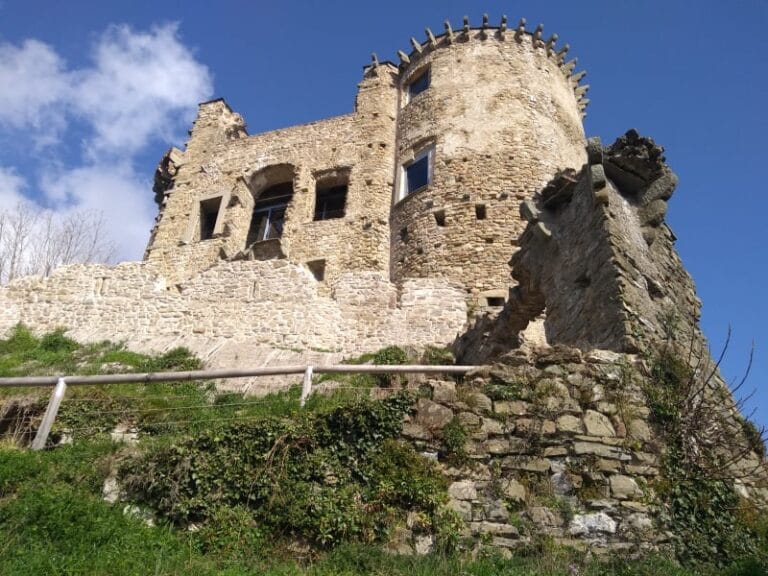
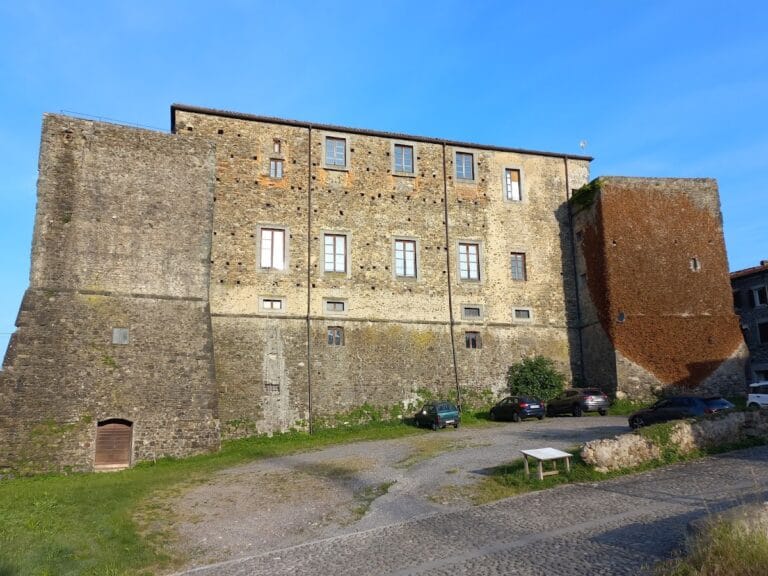
The Castle of Calice al Cornoviglio, also known as the Doria-Malaspina Castle, is a castle-residence situated on Castle Street above the village, in the middle and lower Vara Valley. The complex developed through construction phases extending from the eleventh to the seventeenth century. Its present character combines an earlier defensive foundation with the later form of a residential palace, and the building is in good condition.
Palace interiors and museums
The palace contains municipal and tourism offices together with the Environmental Education Center of the Montemarcello-Magra Regional Natural Park. Two other floors contain the Beekeeping Museum, the David Beghè Art Gallery, and the small Pietro Rosa Museum. The Val di Vara Brigade Museum, established in the castle in 2013, forms part of the building’s current cultural use.
Nearby sites