Castle Katzenzungen: A Renaissance Castle in South Tyrol


Site at a Glance
- Rating
- 4.5
- Popularity
- Low
- Country
- Italy
- Primary era
- Early Modern
- External website
- Open
- Eras represented
- Medieval, Early Modern
- Civilizations
- Habsburg, Holy Roman Empire
- Site type
- Military
- Remains
- Castle
On this page6 sections
History
Castle Katzenzungen is a hill castle at Prissian in the municipality of Tesimo, Italy, whose oldest parts date to the twelfth century and whose present character reflects a sixteenth-century Renaissance rebuilding. It probably arose before 1200 under the Katzenzungen family, medieval ministerials who held offices, estates, or military duties for more powerful lords, on a site that already contained an enclosed tower.
Medieval origins and feudal ownership
The first secure written reference dates to 1244, when Henricus de Cazenzunge was recorded. By that time, the castle had passed to the lords of Schlandersberg. In 1350, Josephus Fink, identified as a knight of Katzenzungen, pledged to Ludwig V, Margrave of Brandenburg, that the castle would remain permanently open to him. Ludwig V was a fourteenth-century member of the House of Wittelsbach.
In 1379, Heinrich Fink sold Katzenzungen to his cousin Hans von Schlandersberg. Anton von Thun later received the castle as a fief in 1496. A fief was property or a right granted by a superior lord in return for service. Jakob Fuchs of Fuchsberg acquired Katzenzungen in 1517, and ownership subsequently passed to Franz Ritter von Breisach. By 1535, the castle belonged to the Breisach family.
Renaissance rebuilding and later changes
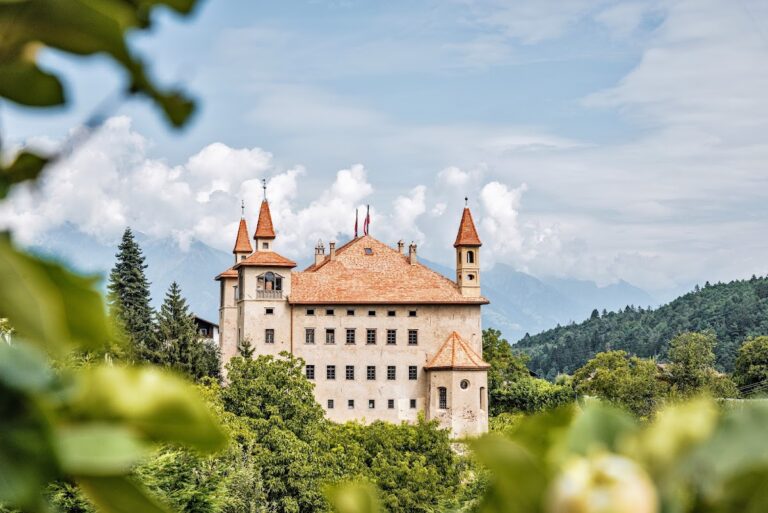
The lords of Breisach extensively rebuilt Katzenzungen during the sixteenth century. This work brought the complex’s structural components beneath a single roof and created the Renaissance appearance that defines the castle today.
After Gregor von Breisach died in 1706 and the family became extinct, the inheritance passed to Jakob Lidl von Mayenburg through his mother, Magdalena, who was born a von Breisach. Franz Anton von Lidl died childless in 1791, and Alois Graf von Sarnthein then received Katzenzungen as a male fief, a feudal tenure normally inherited through the male line. The castle was auctioned in 1795, with the proceeds of 5,000 gulden forming the capital of the fief. In 1812, it became an allodial property, meaning that it was held as independent ownership rather than as a feudal tenure.
During the nineteenth century, the castle was temporarily divided among three farming families from Prissian. As the noble families declined, Katzenzungen lost its former importance and became occupied by farming households. The Pobitzer family purchased it in 1978 and completely restored the complex. It is now used for congresses, conferences, banquets, and other events, and it is protected as a cultural heritage monument in South Tyrol.
Remains
Castle Katzenzungen is a fortified residence built on elevated ground, incorporating an earlier enclosed tower. The sixteenth-century reconstruction unified the castle’s structural elements beneath one roof and gave the complex its current Renaissance form. Its defenses include a ring of machicolations, projecting structures or openings through which defenders could watch or attack people below.
Castle entrance and defensive features
The round-arched entrance gate carries a coat of arms of the Breisach family above it. The emblem is dated 1548 and belongs to the period when the family was reshaping the complex. A stone bridge stands beside the castle and provides the setting for the Versoaln grapevine.
Versoaln grapevine
Versoaln is a cultivated grapevine whose fruit can be used for eating or wine production. The vine beside Castle Katzenzungen is described as one of the world’s oldest, as well as Europe’s largest and oldest vine.