Bila Tserkva Castle: A Polish-Lithuanian Fortress in Ukraine


Site at a Glance
- Rating
- 4.6
- Popularity
- Low
- Country
- Ukraine
- Primary era
- Unclassified
- Eras represented
- Unclassified
- Civilizations
- Unclassified
- Site type
- Military
- Remains
- Castle
On this page12 sections
History
Bila Tserkva Castle was a sixteenth-century defensive stronghold in Ukraine, built in Bila Tserkva in the mid-sixteenth century to protect the town and the Grand Duchy of Lithuania from raids by the Crimean Tatars, a Tatar state centered in Crimea. Its foundation is attributed to the Kyiv voivode Fryderyk Proński, and the town itself was protected by a palisade. The castle’s position on major transit routes later made it a focal point in the armed conflicts that affected the region.
Rebuilding and early conflicts
In 1570, Konstanty-Wasyl Ostrogski substantially rebuilt the stronghold. A permanent Polish-Lithuanian garrison later occupied the castle, numbering as many as 2,000 soldiers and officers. Cossacks, organized military communities whose armies shaped the region’s later conflicts, captured it in 1591. In 1596, Prince Roman Różyński defended the fortress against Severyn Nalyvaiko.
The castle was taken by Bohdan Khmelnytsky in 1648. Polish-Lithuanian forces recovered the fortifications in 1649, after which Stefan Czarniecki, voivode of Ruthenia and Crown field hetman, enlarged and strengthened them and reorganized the defense. The fortress continued to change hands during uprisings against the Polish-Lithuanian Commonwealth and served as a base for the forces of Kryštof Kosiński, Severyn Nalyvaiko, and Semen Palii.
A contested military stronghold
Bila Tserkva Castle was drawn into conflicts involving Crimean Khanate cavalry, Polish-Lithuanian troops, European mercenaries, Moscow voivodes supported by streltsy and Kalmyk cavalry, and Cossack armies associated with Petro Sahaidachny, Khmelnytsky, and later leaders through Pylyp Orlyk. Major battles were fought under the leadership of Nalyvaiko, Khmelnytsky, Ivan Briukhovetsky, Petro Doroshenko, Palii, and Orlyk. A local legend held that Palii lived in the castle, while Haidamaks reportedly hoped to seize the fortress from positions in Zarechye.
From 1664 to 1668, General Jan Stachórski commanded the fortress and held it through interrupted supplies and repeated sieges. Other commanders included Jan Zygmunt Löbel, Gerhard Fitinghof, Ernest Otto Rappe, Ludwik de Orgewalt, and Jan Gałecki. Dominik Ignacy Bekierski remained in command until 1739. On 23 October 1663, during a campaign east of the Dnieper, the castle hosted a council of war attended by King John II Casimir, John Sobieski, Stefan Czarniecki, Stanisław Rewera Potocki, the Cossack hetman Pavlo Teteria, and Szymon Kawiecki.
Dismantling and later occupation
Following the Second Partition of Poland in 1793, the castle came under the Russian Empire. During the Kościuszko Uprising of 1794, the Polish-Lithuanian revolt against Russian and Prussian control, Alexander Suvorov conducted the fortress’s final siege and accepted its capitulation. Empress Catherine II then ordered the fortifications dismantled, and the stronghold did not survive beyond the end of the eighteenth century.
In the late eighteenth or early nineteenth century, Franciszek Ksawery Branicki built a winter palace on Castle Hill. Participants in the 1917 Revolution looted and burned the building.
Remains
The castle stood on Castle Hill above the Ros River. From the second half of the seventeenth century through the eighteenth century, its defenses were divided into an upper castle and a lower castle. A moat separated the two sections and was crossed by a drawbridge. The castle ruins remained visible at the site until the middle of the nineteenth century.
Upper and lower fortifications
Lower castle
The lower castle occupied the area of the modern Castle Lanes. Its large courtyard was intended for residents bringing carts loaded with their most valuable possessions. A moat surrounded this section, which was considered the most vulnerable part of the fortifications because of its position.
Upper castle
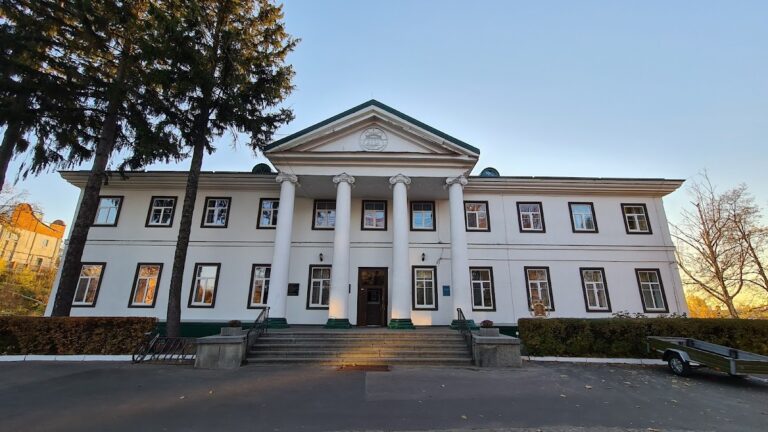
The upper castle occupied Castle Hill and included four named bastions, projecting fortifications that allowed defenders to fire along the faces of the surrounding walls. One was the Commandant’s Bastion, on the site now occupied by the Bila Tserkva Local History Museum. A Jesuit chapel stood beside the bastion site. The location of the chapel is now marked by a cross.
Buildings and defensive equipment
Seventeenth-century structures
A 1612 inspection listed a Catholic chapel, the deputy starosta’s residence, a stable, a kitchen, an artillery arsenal for weapons and artillery equipment, a powder magazine for protected gunpowder storage, and four corner towers. During the seventeenth century, the fortress contained five wooden towers and about thirty houses within its defenses. Military and utility buildings also stood in and below the upper castle.
Eighteenth-century defenses
A description from 1765 recorded twenty-five cannons, two mortars, four bastions, and surrounding moats, with the Ros River forming part of the defensive setting. These details reflect the fortress’s continued military organization shortly before its final destruction as a stronghold.
Branicki winter palace
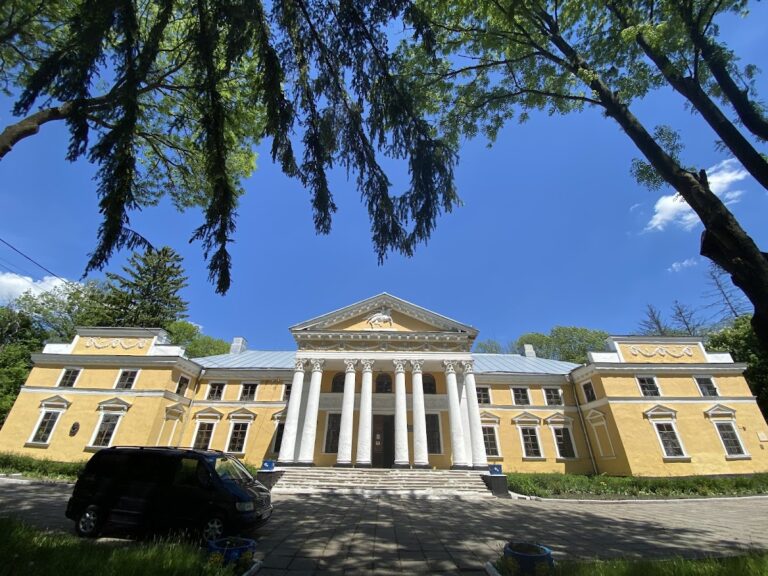
The winter palace built on Castle Hill was an eleven-bay, two-storey wooden building set on a high masonry base and designed in a restrained Classical style. Its interiors followed the Empire style, an early nineteenth-century decorative style associated with imperial Classicism, and included a bust of King Stanisław August Poniatowski. A two-storey, thirteen-bay service wing with a recessed portico supported by eight columns stood to its left. A treasury building, a second service wing, and a gate were located nearby. The palace was later looted and burned during the 1917 Revolution.