Castillo del Ocaive: A Muslim Watchtower and Fortress in Spain


Site at a Glance
- Rating
- 4.3
- Popularity
- Very Low
- Country
- Spain
- Primary era
- Medieval
- External website
- Open
- Eras represented
- Medieval
- Civilizations
- Taifa Kingdoms
- Site type
- Military
- Remains
- Castle
On this page8 sections
History
Castillo del Ocaive is a former Muslim watchtower and fortress in Spain, standing southwest of Pedreguer on the Muntanya Gran. Originating in the post-Caliphate period, the site guarded the route from the interior at Cocentaina to the port of Dénia and formed part of a defensive network around Castillo de Dénia.
Muslim origins
Castillo del Ocaive, also known as Castellet de l’Ocaive or Castell d’Olocaiba, probably began as an isolated watchtower. It was later converted into a fortress, possibly shortly before the Christian conquest, to protect nearby Muslim farmsteads and the area administered or defended by the castle from attacks by Christian troops.
The fortress was historically connected with the castles of Segària, Laguar, Pop, Xaló, Calp, and Polop. Its earlier settlement was a Muslim farmstead, known as an alqueria, a rural settlement with agricultural land and associated habitation.
Christian rule and later history
After the Christian conquest in 1244, the castle and the Ocaive farmstead belonged to Admiral Pere Ximén Carroç. He granted them to Andrés and Albero Flix in 1249. In 1260, the property passed with the farmstead to Sancho Ruiz de Corella, and in 1271 to Pere Rodríguez de Corella. Ownership later passed to the Pujadas, the Counts of Anna, and finally the Counts of Cervelló.
Castillo del Ocaive was involved in several military actions during the War of the Germanies, a major revolt in the Crown of Aragon, particularly in Valencia and Mallorca, during the early sixteenth century. The castle was probably abandoned at an early date after the Christian conquest, and later references to it ceased.
After the expulsion of the Moriscos in 1609, the settlement had to be repopulated with Christians, chiefly from the Balearic Islands and Valencia. The Moriscos were Muslims who had been forcibly converted to Christianity, or their descendants, and their expulsion affected many former Muslim settlements. Castillo del Ocaive is protected under the general declaration established by the Decree of 22 April 1949 and under Spain’s Law 16/1985 on Historical Heritage. It entered the General Register of Assets of Cultural Interest in 2016 with identification code 17829 and also carries the Valencian cultural-interest code 03.101-9999-000004.
Remains
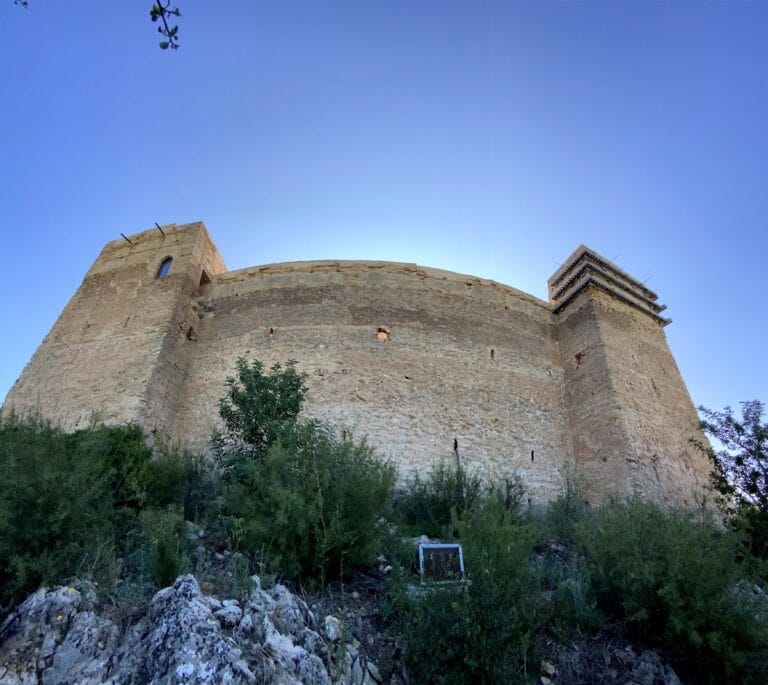
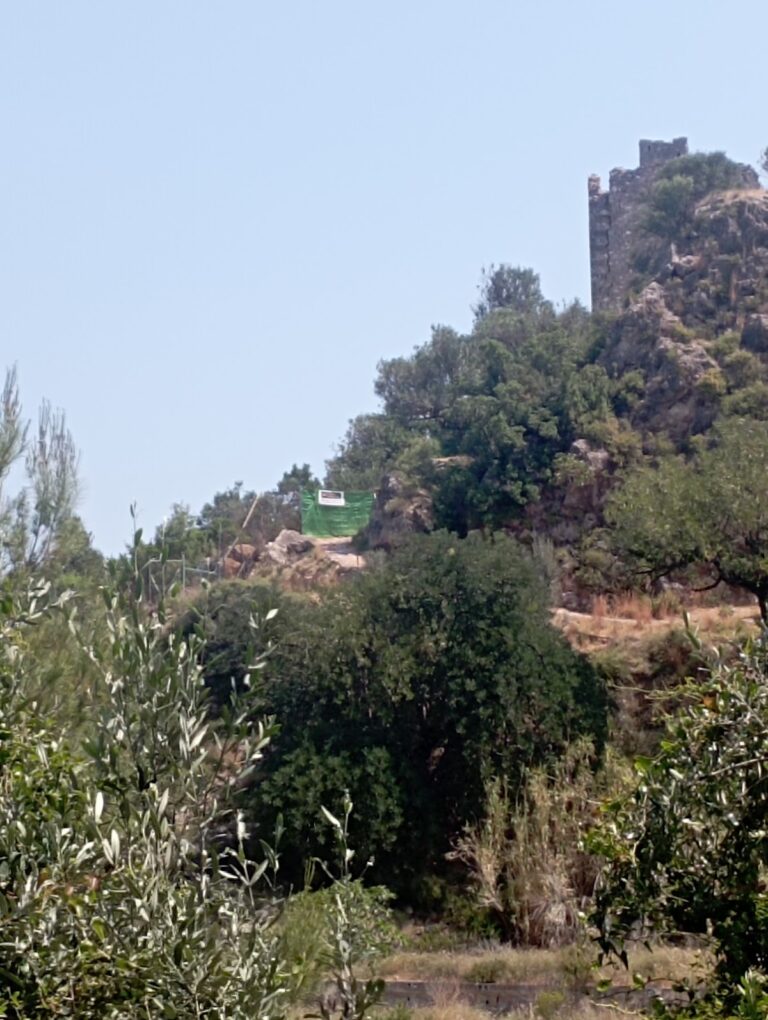
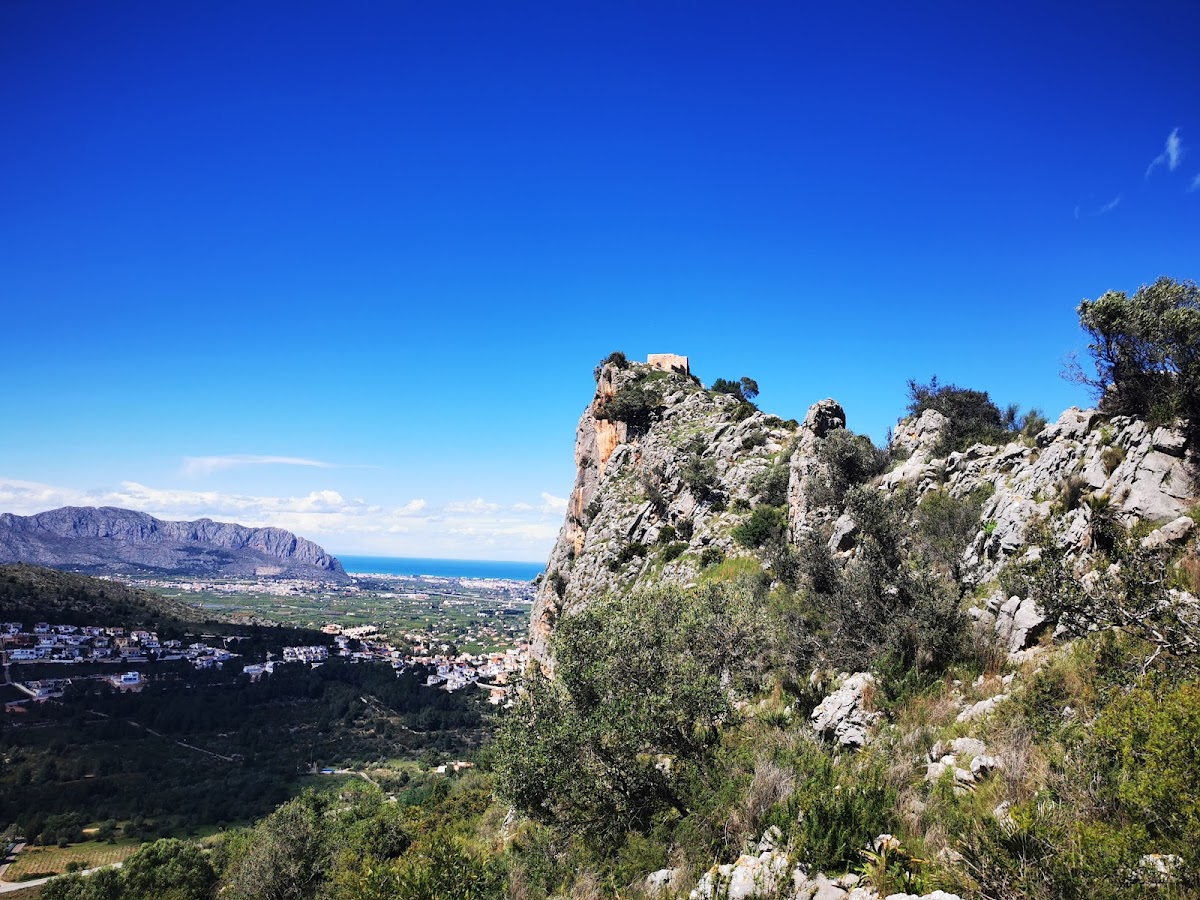
The remains occupy a rocky site on the Muntanya Gran, southwest of Pedreguer and in the direction of Llosa de Camatxo. The surviving fortifications consist of a keep, sections of curtain wall, and a cistern on a lower level. The name Olocaiba derives from Al-Uqayba, a diminutive of uqab, a term associated with an elevated place and, by extension, with an eagle.
Fortified structures
Keep
The remains of the keep survive as the principal fortified tower of Castillo del Ocaive. Its position formed part of the elevated defensive site and reflects the castle’s origins as a watchtower before its conversion into a larger fortress.
Curtain walls
Several sections of curtain wall remain around the fortified area. These defensive walls linked the castle’s fortified elements and survive in fragmentary sections alongside the remains of the keep.
Cistern
A cistern survives on a lower level of the site. This water-storage structure formed part of the practical infrastructure of the fortress and remains among the physical features of Castillo del Ocaive.