Benimaquia: A Fortified Settlement of the Sixth Century BC
Site at a Glance
- Popularity
- Low
- Country
- Spain
- Primary era
- Iron Age
- Eras represented
- Iron Age
- Civilizations
- Iberian
- Site type
- Military
- Remains
- Fortified Town
On this page20 sections
History
Benimaquia is a fortified settlement on the northwestern edge of the Montgó massif near Dénia, in Alicante, Spain. Its main occupation belongs to the sixth century BC, spanning the Orientalizing period, when western Mediterranean communities adopted and adapted eastern Mediterranean practices, and the emergence of Early Iberian culture in the peninsula’s east.
The first occupation
The earliest phase began around 600 BC. A Phoenician plate with a red surface finish lay beneath wine-making installations. Phoenicians were seafaring people from the eastern Mediterranean whose trade networks carried goods west. Phoenician amphorae, two-handled containers used to store and transport goods, in the destruction deposits place the phase’s end around 580–560 BC. Fire and violent destruction brought this occupation to a close.
Early Iberian reoccupation
The settlement was occupied again around 550–500 BC, during the Early Iberian period. Fills that covered and levelled the earlier settlement contained amphora types also found in its destruction deposits. The later phase’s endpoint is uncertain. Sparse pottery from Department 12, including painted Iberian vessels, has been assigned to the late sixth or early fifth century BC.
Excavation and interpretation
Hermanfrid Schubart of the German Institute in Madrid and Domingo Fletcher of Valencia’s Prehistoric Research Service carried out an initial excavation in the 1960s, including a trial trench to establish the settlement’s chronology. Carlos Gómez Bellard and Pierre Guérin co-directed systematic excavations from 1989 to 1992, substantially expanding knowledge of the site.
Benimaquia’s planned settlement and finds provide important evidence for the transition between Orientalizing and Early Iberian culture in the eastern Iberian Peninsula. The wine-making evidence places indigenous production near the beginnings of Iberian culture, rather than only in a later phase. The monumental enclosure and emerging wine production have been interpreted as expressions of a local leader’s authority, exercised through control of prestigious goods and monumental building. The enclosure departed from local Late Bronze Age traditions, from the period before iron became established, and seems to have drawn on models from the central or eastern Mediterranean. Its military effectiveness is uncertain.
Remains
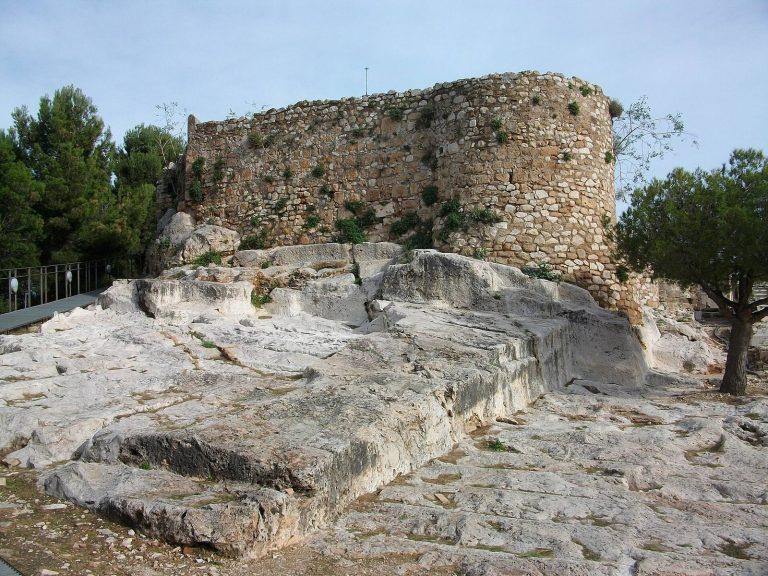
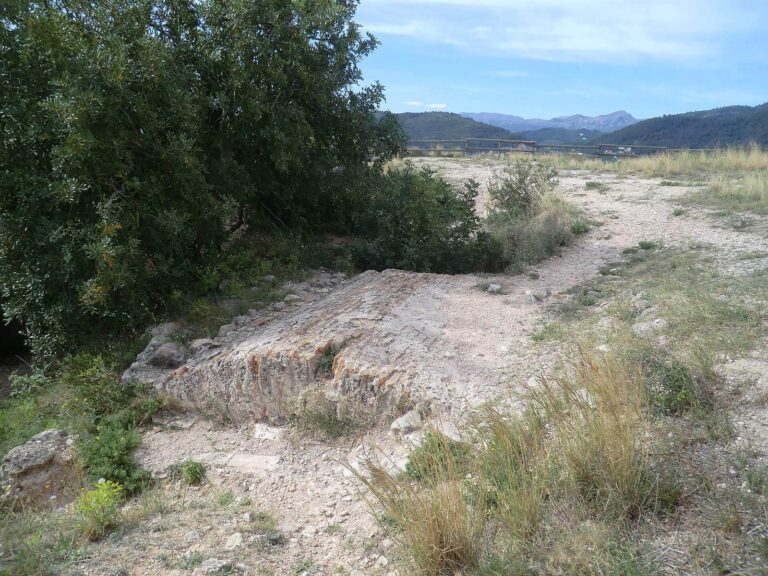
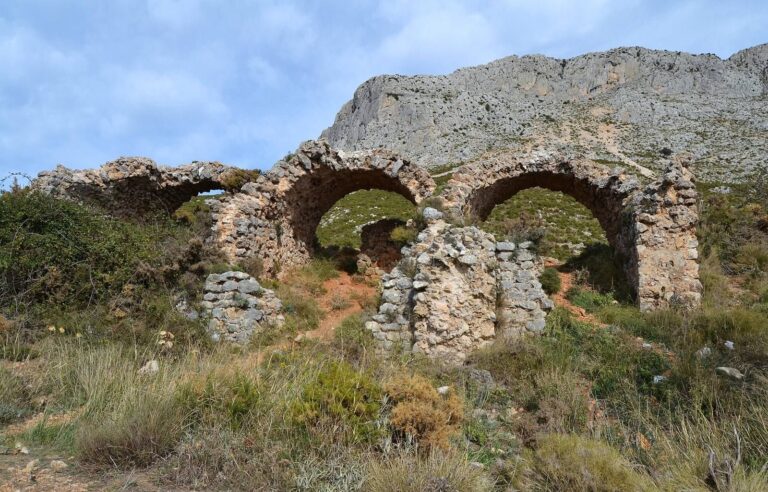
Benimaquia occupied a rocky spur. Its built enclosure protected the northern and western sides, while a steep slope provided natural protection to the south. Within the enclosed area, rooms and work spaces were arranged across a series of terraces.
Enclosure and settlement plan
Wall
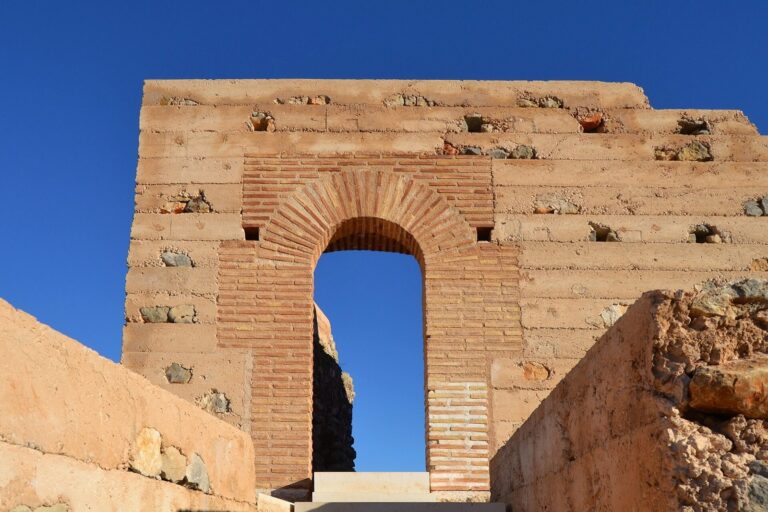
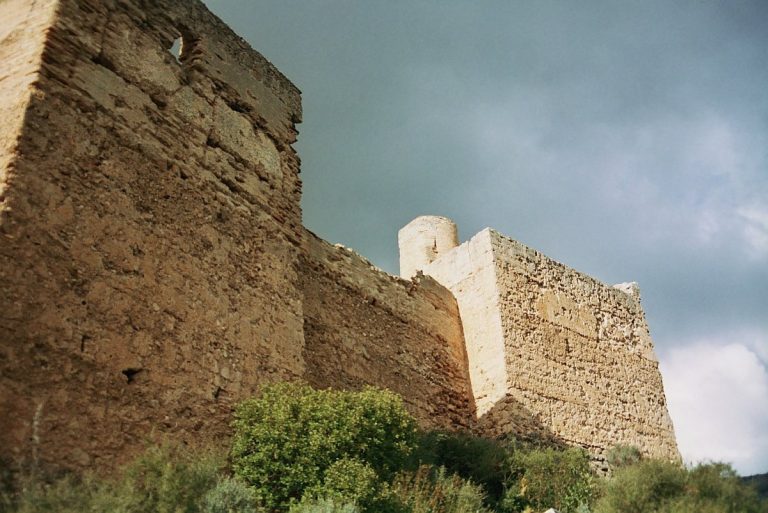
The surviving enclosure wall is about 147 metres long and defines a terraced area of roughly 4,500 square metres. Its northern and western sections meet at a right angle. A further section, parallel to the first, appears to have extended to a cliff and completed the perimeter. The wall is 1.25–2 metres wide and spans the change in height from the limestone crest to the gentler northern slope. Its inner face rises no more than about a metre, while the outer face reaches 3–4 metres. The inner face is vertical and uses masonry resembling domestic construction; the outer face slopes slightly. The two faces have different masonry arrangements.
Towers
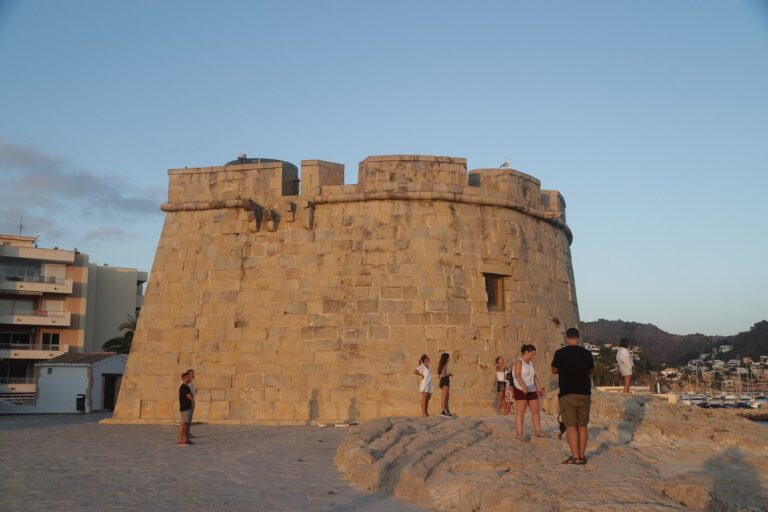
Six regularly spaced square towers reinforce the wall in the plan made by Schubart. They vary in size and are not arranged according to a uniform geometric pattern. Additional masonry supports or faces some tower bases. Aerial photographs show the northern wall continuing farther down the eastern slope and suggest a strengthened corner that may have carried a seventh tower.
Room arrangement
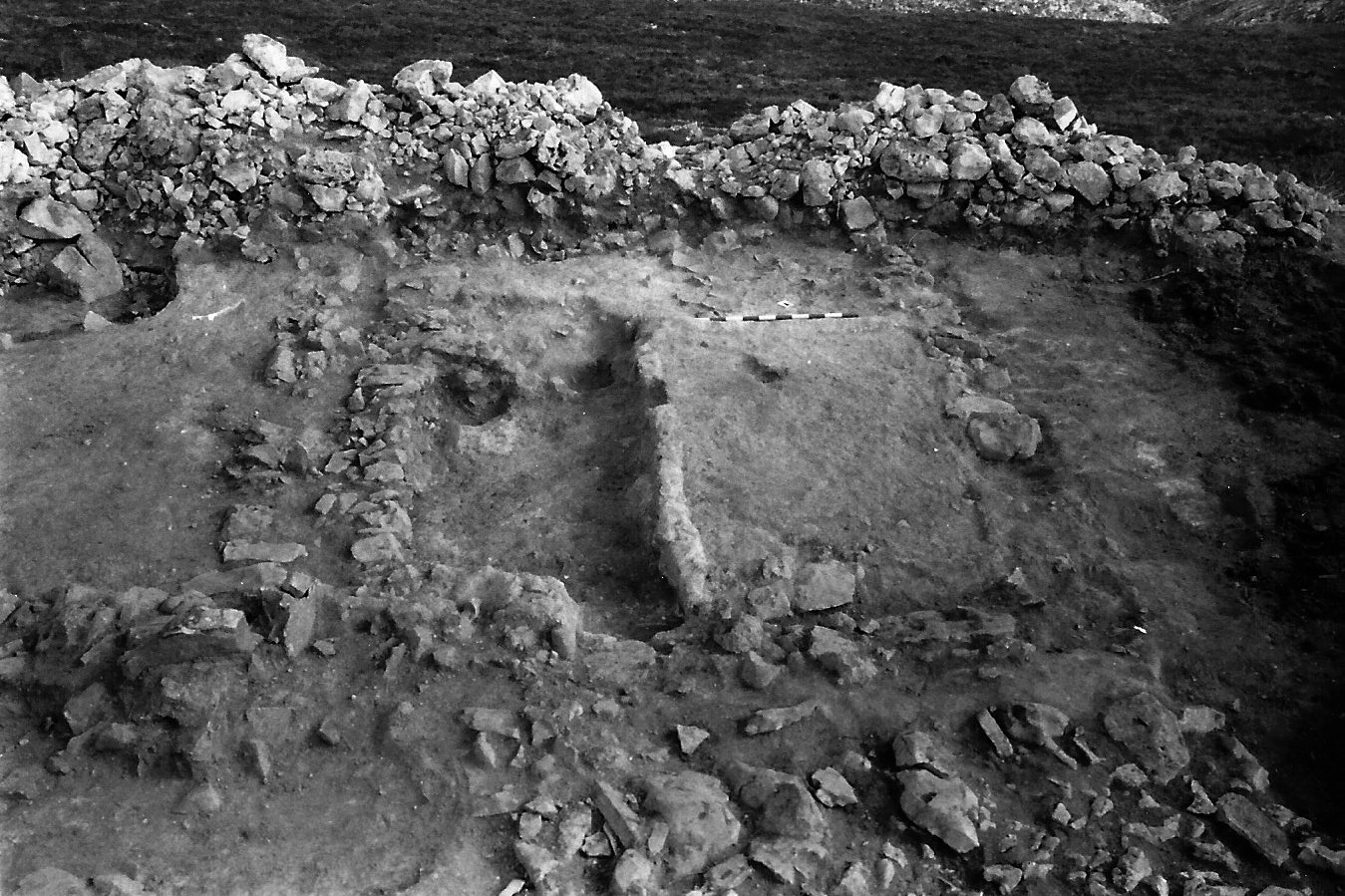
Excavated buildings form two rows of rooms beside a central passage. Where the rocky terrace narrows at a corner, the passage and second row give way to two rooms occupying the full width of the upper terrace. The wider settlement may have had adjoining rows of rooms separated by parallel streets, although erosion and agricultural terracing have removed evidence beyond the enclosure. Erosion also stripped away much of the uppermost occupation. Two adjoining rooms in the central area, against the northern enclosure, retain traces of the later settlement.
Domestic and industrial areas
The rooms indicate different kinds of activity across the settlement. Hearths point to domestic use, while basins and platforms served more specialized purposes. These installations form a western industrial area; the eastern domestic area contains more everyday pottery and other household materials.
Wine-making installations
Pressing areas and basins
In Departments 2, 4 and 5, installations interpreted as wine presses combine platforms or pressing surfaces of sun-dried mudbrick and rammed earth with plastered basins. The proposed process involved crushing grapes on the platforms, then collecting the juice and skins in the basins for an initial fermentation of about two days. The liquid was subsequently transferred to amphorae for a second fermentation. Erosion and the loss of components that were probably wooden make the original arrangement difficult to reconstruct.
Grape seeds and storage vessels
Beside a basin in Department 2, excavators found several thousand grape seeds identified as Vitis vinifera vinifera, together with Phoenician amphorae and Iberian copies. The concentration is interpreted as evidence of wine production: filtering the contents of a basin during transfer could have gathered the seeds in one place. The imported Phoenician vessels are more consistent in date and type than the varied Iberian copies. They may have been reused for locally made wine, as they were well suited to storage and transport.
Pottery and small finds
Pottery materials and manufacture
Most of the pottery comes from the destruction deposits of the first occupation. Wheel-made vessels, shaped on a potter’s wheel, were made from carefully prepared clay with few inclusions and fired at high temperatures in enclosed kilns with a firing chamber. Their surfaces are commonly orange, with paint in wine-red tones. They occur alongside handmade pots with curved profiles and flat bases. At Benimaquia, handmade vessels continued to serve cooking and storage needs. A small group of decorated pottery has also been tentatively assigned to the fifth through third centuries BC.
Amphorae
Three groups of amphorae are represented. The largest comprises R.1 vessels, a classification for a particular amphora shape, imported from Phoenician workshops in Andalusia. Some resemble vessels from Cerro del Villar, a Phoenician archaeological site in Andalusia; these examples date to about 580–560 BC. A few imports from Sardinia, Sicily or Carthage belong to the Cintas 268 shape classification and are assigned the same date. Iberian copies of the R.1 form include a reconstructed vessel with an angled shoulder, flat base and two upright handles. Department 5 contained both an imported Phoenician R.1 vessel and an Iberian copy. A small Phoenician amphora came from Department 8.
Handmade vessels
The handmade pottery follows local Valencian Early Iron Age traditions. A common cooking pot has a curved S-shaped profile, a flat, heel-like base and clay temper, material mixed into the clay to help it withstand heat. It usually has two or four small handles below the rim. Examples range from about 15 centimetres high to a vessel around 60 centimetres tall, found in Department 6 with barley remains. One form has an inner ledge that could have supported another vessel, perhaps for steaming couscous. Other finds include a flared-rim storage vessel with an angled body profile and flat base, a roughly made small dish, and a polished black cup with a flaring rim and a central knob beneath its base. The cup’s metallic-looking surface and shape suggest an origin farther south.
Wheel-made plates and serving vessels
Plates are especially common among the wheel-made pottery. Many have a projecting rim, a slight angle below it and a partly flattened base. Orange examples may carry concentric wine-red bands and fine lines across both surfaces and the rim; grey and black examples are unpainted. Plates with straight or inward-turning rims represent an early form of the shallow dish later widely known as a patera. Bottles and jugs generally have oval bodies, narrowed necks with sloping sides, and flaring rims. One well-preserved vessel has two vertical handles running from the lip to the base of the neck. Wine-red bands and lines decorate these vessels.
Other wheel-made forms
Other wheel-made finds include a rounded cup with a partly formed base and flaring lip, a high-footed incense burner whose bowl appears inspired by Phoenician red-coated plates, and a bowl on three legs that may also have served as an incense burner. Department 6 contained a bottle, painted and plain plates, a bowl and an incense burner. Department 8 yielded a painted jug and a bowl that may have been made by cutting down a pot.
Bronze clothing fasteners
Four bronze fibulae, brooch-like fasteners for securing clothing, date to the first half of the sixth century BC. The group includes two fasteners with paired coils, one with springs on both sides, and an elbow-shaped example of the Los Alcores form. The larger paired-coil specimen is complete and has a rounded bow; the second is incomplete and has a flat bow. The fastener with springs on both sides preserves its bow and cone-shaped end. The Los Alcores example has lost its pin and bears stamped-circle decoration. Department 6 contained two fibulae, while Department 8 yielded a Los Alcores example.