Castillo de Montemolín: An Almohad Frontier Fortress in Spain


Site at a Glance
- Rating
- 4
- Popularity
- Very Low
- Country
- Spain
- Primary era
- Medieval
- Eras represented
- Medieval
- Civilizations
- Almohad
- Site type
- Military
- Remains
- Castle
On this page11 sections
History
Before and During Roman Rule
Castillo de Montemolín is a ruined fortress in Spain, built under the Almohads in the late twelfth century as part of a strategic Islamic frontier stronghold. The settlement was occupied before the Common Era and was influenced by the Lusitanians, Baeturians, Turduli, and Celtici. Rome annexed the territory in the early second century BC and incorporated it into Hispania Ulterior.
An Almohad Frontier Stronghold
Under Muslim rule, Montemolín became an important strategic enclave between Andalusia and Extremadura. The Almohads, a Berber Muslim dynasty and religious movement that ruled much of the western Islamic world during the twelfth and thirteenth centuries, developed the fortress as a powerful citadel, or principal fortified stronghold. Together with the fortresses at Reina, Alange, and Hornachos, it helped control communications between Córdoba, Seville, and Mérida. The exact construction date remains uncertain, but its military design and building methods place it in the late twelfth century.
Christian Conquest and the Order of Santiago
Christian forces captured Montemolín in 1246, ending Muslim rule in the Extremadura region after more than five centuries. The fortress was then given to the Order of Santiago under its master, Pelayo Pérez Correa. This medieval military-religious order fought Muslim forces and protected Christian territories in the Iberian Peninsula. At Montemolín, its responsibilities included repopulating the area and securing the defenses against nearby Muslim fortresses in the Sierra Morena.
The Order carried out little maintenance or restoration. Inspection records from 1550 reflect the limited upkeep that the fortress received during its period of Santiago control.
Royal Alienation and Legal Protection
In 1608, King Philip III transferred the town and fortress and granted the title of Marquisate of Montemolín to Genoese bankers as settlement for royal debts. The town purchased its jurisdiction in 1779, ending that dependence. In 1819, King Ferdinand VII again transferred Montemolín, this time to his brother Carlos, but the town was definitively freed from that control shortly afterward.
Castillo de Montemolín was designated a Historic Complex of Cultural Interest on 3 September 1991. It also receives the general protection established by the Decree of 22 April 1949 and Spain’s 1985 Historical Heritage Law.
Remains
Hilltop Enclosure
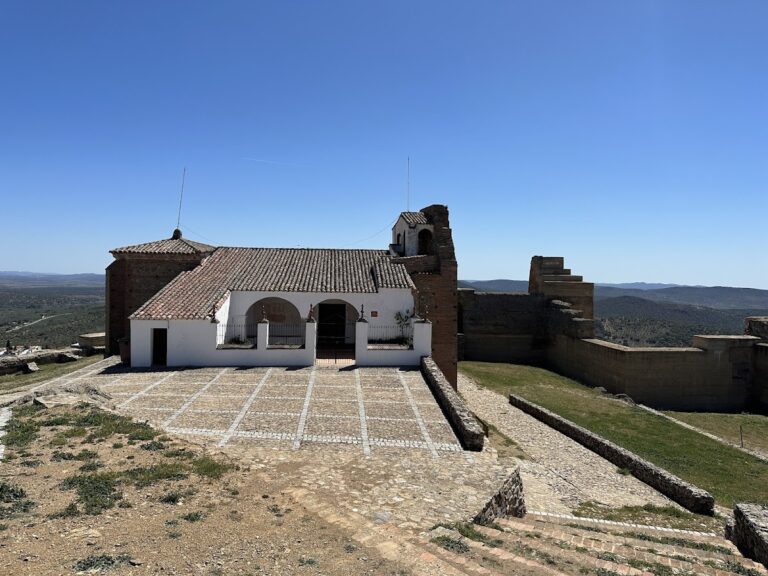
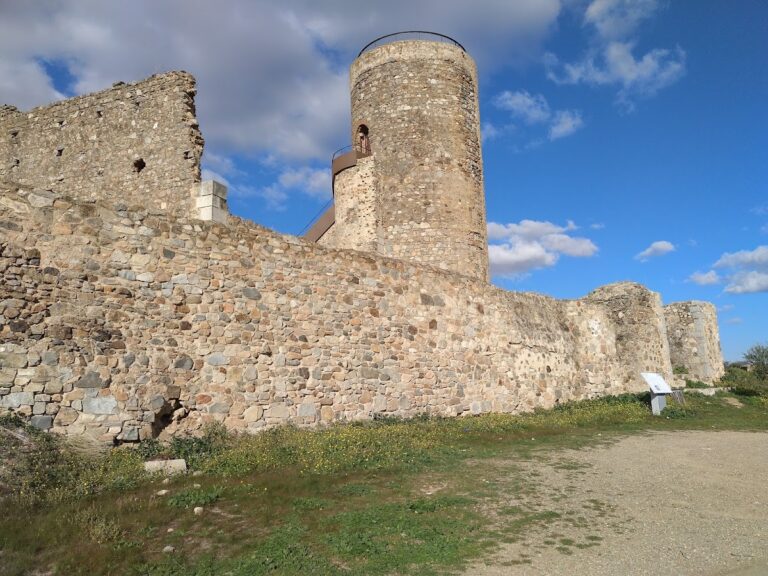
The ruined fortress occupies the summit of a hill about 640 metres above sea level. The surrounding hill consists of dehesa, scrubland, and areas without vegetation, while the castle overlooks Montemolín and extensive distances around it. Its irregular rectangular enclosure follows the contours of the summit, measuring approximately 130 metres in length and 50 metres in width. This arrangement adapted the fortress to the natural defensive advantages of the terrain.
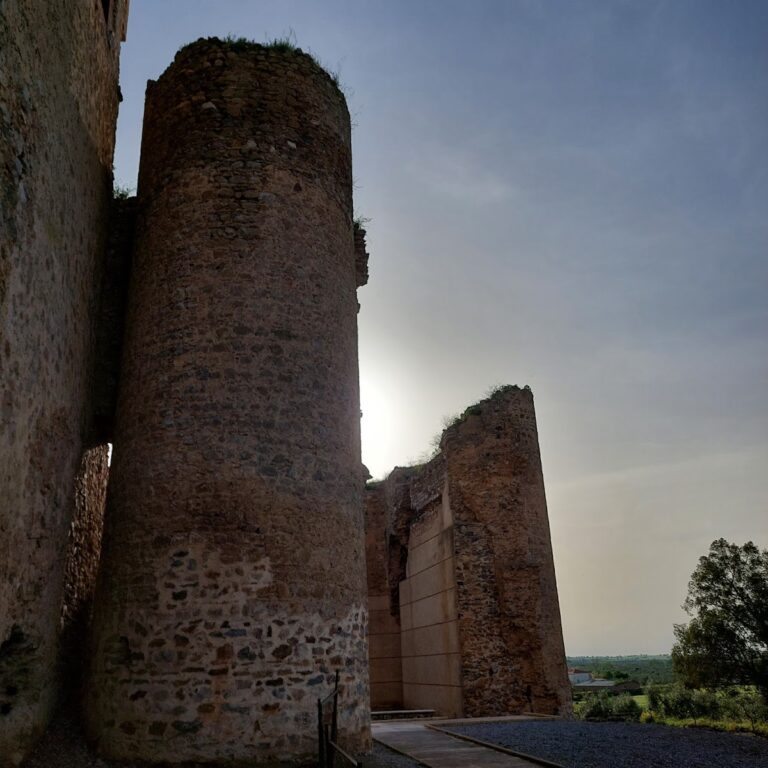
Long stretches of wall surround the hilltop. Most of the enclosure walls were made with rammed earth, a technique in which earth or a similar mixture is compressed inside temporary formwork to form solid walls. Some foundations use rubble masonry. Prism-shaped towers are attached at intervals along the defenses, and the surviving main enclosure contains seven solid towers, including two covered towers and five freestanding ones.
Towers and Entrance Defenses
Miramontes Tower and Keep
The main enclosure is accompanied by the Miramontes Tower and the Keep. These structures form part of the surviving defensive complex, whose walls and towers occupy the summit within the irregular hilltop plan.
Southeastern Barbican
On the southeastern side, the remains of a barbican protect the principal entrance. A barbican is an advanced defensive work placed before an entrance or other vulnerable point. Two strongly projecting chamfered or octagonal towers flanked the gateway, which had a brick arch more than three metres thick.
Religious Reuse
The fortress may have been erected over the remains of a mosque. Those remains were incorporated into the nearby Ermita de la Granada, preserving a physical connection between the earlier Islamic occupation and the later religious use of the site.