Castelo de Messejana: A Ruined Medieval Castle in Portugal


Site at a Glance
- Rating
- 3.5
- Popularity
- Very Low
- Country
- Portugal
- Primary era
- Medieval
- Eras represented
- Medieval
- Civilizations
- Portuguese
- Site type
- Military
- Remains
- Castle
On this page7 sections
History
Castelo de Messejana is a ruined medieval castle in Portugal, at the northern edge of the settlement of Messejana. The defended settlement was probably established during the Muslim period of the Iberian Peninsula, when much of the region was under Muslim rule. Its name derives from the Arabic masjana, meaning “prison,” from sajana, “to imprison.”
Muslim origins and Portuguese reconquest
Messejana was taken from Muslim forces in 1235 by troops acting for Sancho II of Portugal. This formed part of the Reconquista, the centuries-long Christian expansion that brought Muslim-ruled territories of the Iberian Peninsula under Christian control. The settlement retained a defensive role after the conquest and later became connected with the administrative and military institutions of the Portuguese crown.
Royal administration and the Order of Santiago
During the reign of Dinis of Portugal, Messejana became a town council. In 1288, Dinis gave the town and its surrounding domains to the Order of Santiago, a medieval military-religious order whose members combined religious life with the defence and administration of Christian territories. The donation included instructions to restore the castle. The castle remained in the order’s possession until the sixteenth century.
John II of Portugal stopped at Messejana between 8 and 9 October 1495 while travelling in ill health to Caldas de Monchique. Manuel I granted the town a new charter on 1 July 1512. During the reign of John III, the domains passed to João da Silva, sixth Lord of Vagos, known as the Great Regent. His son, Lourenço da Silva, seventh Lord of Vagos, later succeeded him.
Sixteenth-century patronage and decline
Between 1566 and 1570, Lourenço da Silva ordered the construction of a Franciscan convent and the Church of Mercy at Messejana. He and five of his brothers died at the Battle of Alcazarquivir in 1578. Their participation followed a request from their mother, who had received Sebastian of Portugal at Messejana in 1573.
After the sixteenth century, the castle was abandoned. Local inhabitants used its stone as a quarry, leaving the structure in an advanced state of ruin. During the Portuguese Civil War of 1828–1834, fought between supporters of Maria II and her uncle Miguel, the Duke of Terceira and his forces stayed in Messejana. On 17 July 1833, he met his council of brigadiers there, and they decided to seize Lisbon. The operation contributed to the Liberal victory over the Miguelists on 24 July 1833.
Messejana’s town council was abolished on 24 October 1835 by Rodrigo da Fonseca, Minister of the Kingdom. The ruins are regarded as an important monument of the parish because of their historical associations. The property belongs to the Portuguese state and remains in poor condition.
Remains
Hilltop fortifications
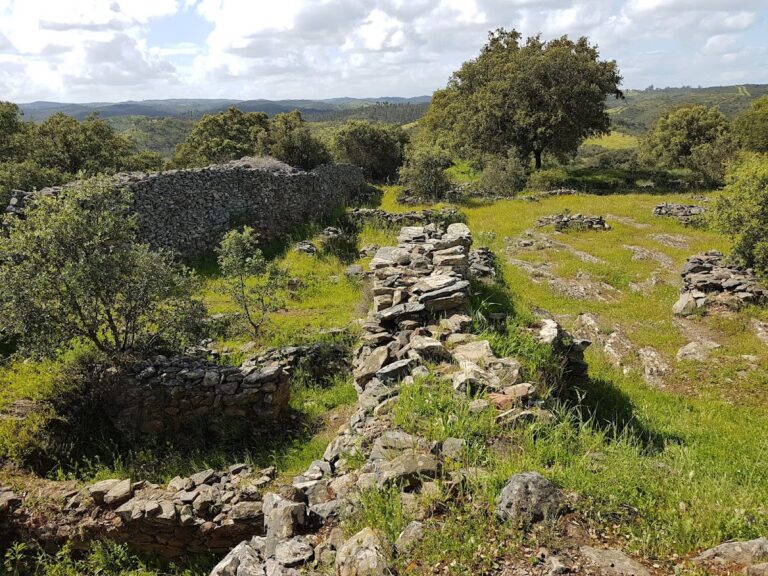
The castle occupies an isolated rural hill at the highest point on the northern edge of Messejana, near the parish church of Nossa Senhora dos Remédios. The principal surviving structure is a severely ruined rectangular building, probably a watchtower, a defensive structure intended for observation and warning. It stands on an artificial platform, and only three of its walls remain.
Two rows of terraces on the platform may preserve parts of the castle walls. Another description identifies the site as having been enclosed by three lines of fortifications. These defensive remains are all in an advanced state of ruin. The masonry uses slate and sandstone set in lime-and-sand mortar.
Inscribed arch
An arch incorporated into a local dwelling provides a further trace of the site’s medieval history. Its Latin inscription refers to the year 1300 and states that, at the age of 26, the writer completed work made by or for Pero Soudo. The wording and the precise meaning of the inscription remain uncertain, including whether it refers to construction carried out by or for him.