Castello di Montesegale: A Medieval Hilltop Fortress in Italy


Site at a Glance
- Rating
- 4.2
- Popularity
- Very Low
- Country
- Italy
- Primary era
- Medieval
- External website
- Open
- Eras represented
- Medieval
- Civilizations
- Holy Roman Empire
- Site type
- Military
- Remains
- Castle
On this page10 sections
History
Castello di Montesegale is a medieval hilltop fortification in Italy, above the village of Montesegale in Lombardy’s Oltrepo Pavese. Its construction date is uncertain, although it may have developed from an eleventh-century tower. The castle served a strategic defensive role above the valley of the Ardivestra stream and grew into a complex of buildings and courtyards formed over several historical phases.
Imperial and feudal possession
On 8 August 1164, Federico Barbarossa, the Holy Roman Emperor from 1155 to 1190, granted the castle or fortress at Montesegale, together with other castles in the Staffora valley, to Pavia. Within a few years, possession passed to the Palatine Counts of Lomello, nobles holding the hereditary or honorific title of count palatine. By 1311, the Gambarana family controlled Montesegale and had become its ruling lords.
In 1412, Facino Cane, a professional military commander, confirmed the Gambarana possession after besieging Pavia. Three years later, the castle was drawn into the conflict surrounding Filippo Maria Visconti, Duke of Milan from 1412 to 1447. In September 1415, the military commander Carmagnola captured and destroyed Montesegale after its lords refused to submit to Visconti. The defending soldiers were taken prisoner to Voghera and Pavia, while Count Guido Gambarana was captured, tortured, and executed. Filippo Maria Visconti recovered the castle in 1416.
Restoration of the fief and later ownership
On 4 July 1432, Paolo Serratico received the fiefs of Montesegale and Pizzocorno. On 22 April 1451, Ottino Gambarana obtained from Francesco I Sforza, later Duke of Milan, the restoration of possessions held by other members of the Gambarana family, including Montesegale. Bishops of Tortona subsequently confirmed the family’s claim to the fief on several occasions. It passed through Andrea, Ludovico, and Angelo Marco Gambarana, and Count Gerolamo Gambarana received an investiture in 1646.
Emperor Charles V confirmed the position of the Counts of Montesegale in 1525. During the nineteenth century, the property passed to the Giussani family and later to the Jannuzzelli family. Agostino Gambarotta restored the interior walls in 1900. The Jannuzzelli family has owned the castle since 1970 and undertook a careful restoration using traditional materials while seeking to recover its former appearance.
Cultural use in the modern period
During the second half of the twentieth century, a wing of the castle became a contemporary art museum that hosted exhibitions by important living artists. Classical-music concerts were also held in the amphitheatre within that wing. The castle remains privately owned and is in good condition.
Remains
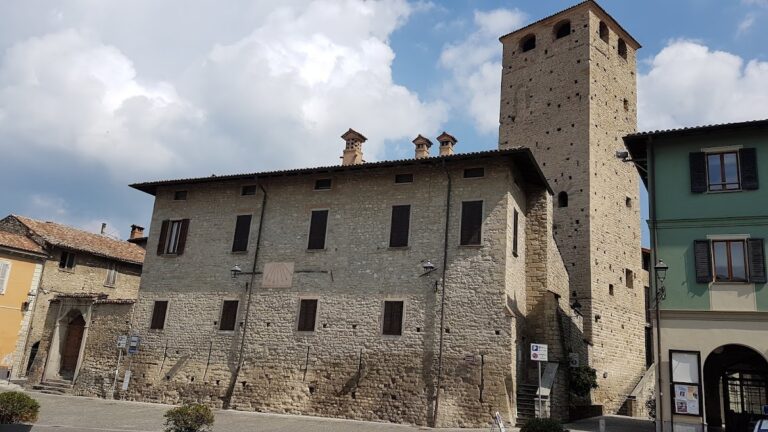
Castello di Montesegale stands at about 350 metres above sea level on a height overlooking the Ardivestra valley. It is a rural hilltop fortress built of stone, with a highly articulated arrangement of courtyards, defensive walls, towers, and buildings from different periods. The complex reflects successive construction, destruction, and rebuilding, rather than a single unified building campaign.
Walls, towers, and entrance court
Fortified enclosure
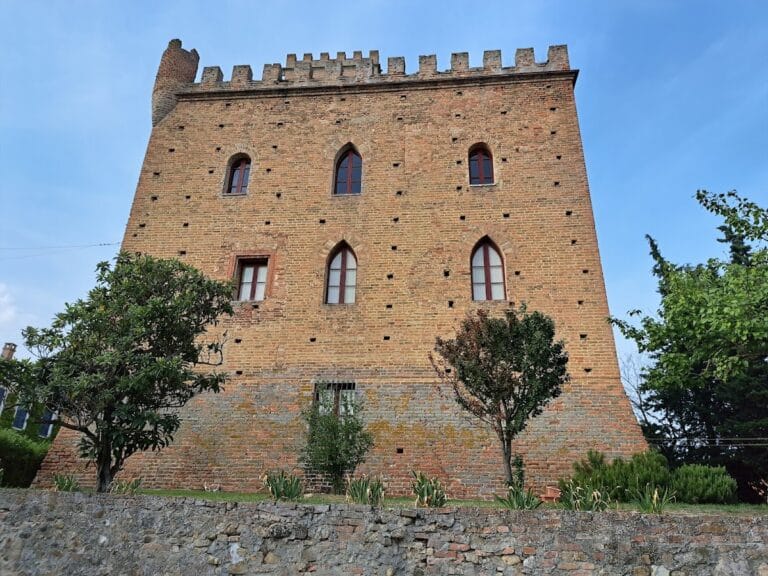
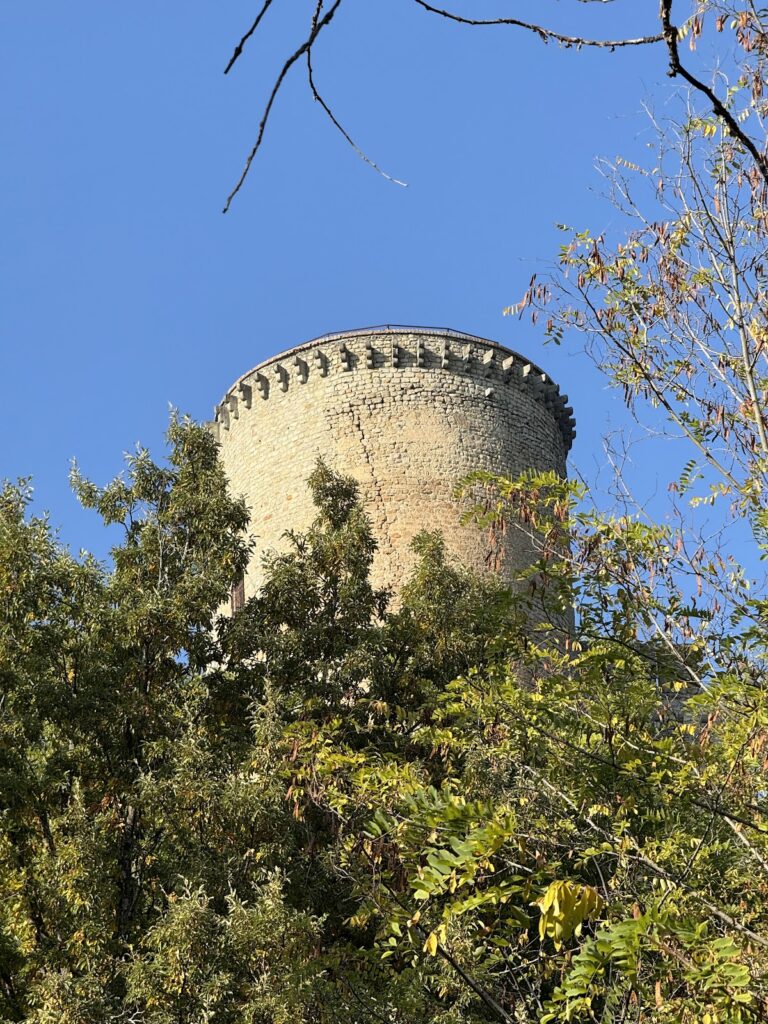
Fortified walls enclose the castle and incorporate square-based towers. Their lower sections have sloping bases, while the upper edges retain Ghibelline crenellations, battlements traditionally associated with the imperial faction in medieval Italy. The outer walls surround an inner walled keep, the principal fortified enclosure and defensive core of the castle.
Portal and inner courtyard
A portal leads into the inner courtyard. Its Latin inscription reads Fiat pax in virtute tua et habondantia in turribus tuis, meaning “May there be peace in your strength and prosperity within your towers.” The portico displays heraldic shields of the Gambarana family, linking the entrance to the family that held the fief for much of the castle’s recorded history.
Upper defensive works
Bastioned platform
The upper part of the site contains a large bastioned earthwork platform. A bastion is a projecting fortified position designed to strengthen defence. On this platform stand a small fortified stronghold and a tower. Their position and documentary associations have led them to be regarded as the original part of the castle, possibly connected with the earlier defensive phase from which the later complex developed.