Castello della Manta: A Medieval Castle and Noble Residence in Italy


Site at a Glance
- Rating
- 4.6
- Popularity
- Medium
- Country
- Italy
- Primary era
- Medieval
- External website
- Open
- Eras represented
- Medieval, Early Modern
- Civilizations
- French
- Site type
- Domestic
- Remains
- Castle
On this page13 sections
History
Castello della Manta is a medieval castle in Italy, situated at Manta near Saluzzo in Piedmont. Its origins reach back to the twelfth century, when the site became part of the margraviate of Saluzzo, a principality ruled by margraves in northwestern Italy. In 1175, Manta became a fief of Saluzzo, and the castle later formed part of a defensive line along the Alpine foothills.
From fortress to noble residence
Margrave Tommaso I built a castle on the foundations of an older fortification. Together with the castles of Revello, Verzuolo, Costigliole, and Busca, it helped protect the territory of Saluzzo. The original defensive stronghold was gradually reshaped for aristocratic life. Tommaso III enlarged it in Gothic style in 1370, and in 1416 the castle passed to his illegitimate son, Valerano del Vasto.
Valerano established the Saluzzo della Manta branch, which made the castle its residence. The family gave the complex much of its present form through substantial additions made around the transition from the fourteenth to the fifteenth century. After 1420, Valerano commissioned the decoration of the ceremonial Sala Baronale. Its anonymous painter is conventionally called the Master of the Castle of Manta. Jacques Iverni, Giacomo Jaquerio, and Jean Bap(t)e have all been proposed as possible identifications, while Jacques Iverni is known to have worked in the region between 1411 and 1435.
The frescoes in the Sala Baronale draw on Tommaso III’s poem Le Chevalier Errant. Their courtly imagery is generally understood to refer to the rulers of Saluzzo and their families, who controlled Manta and the surrounding lands. The decoration therefore joined literary themes with the public presentation of the ruling dynasty.
Later transformation and decline
Around 1560, Michelantonio del Vasto commissioned a representative apartment and the Sala delle Grottesche, introducing a later Mannerist phase. Mannerism was a sixteenth-century style associated with refined, artificial forms, elaborate ornament, and sophisticated references to earlier art. In 1587, the castle was remodelled in a more residential form.
After the Valerano branch became extinct, the castle was abandoned and declined. Its last descendant died in 1793. Ownership passed from the Saluzzo family to the Radicati, then to the Provana, and finally to the de Rege Thesauro family. The defensive works were demolished in 1860, changing the character of the former fortress.
Preservation in the modern period
In 1984, Countess Elisabetta de Rege Thesauro di Donato Provana del Sabbione entrusted the castle to the Fondo Ambiente Italiano, or FAI, an Italian heritage foundation that conserves and presents historic buildings, landscapes, and works of art. Recovery and restoration began in 1985 and brought the complex closer to its earlier condition. Castello della Manta now forms part of the Castelli Aperti cultural circuit of southern Piedmont, a network of historic castles managed by the FAI, and is recognized as part of Italy’s national heritage.
Remains
Castle complex and medieval buildings
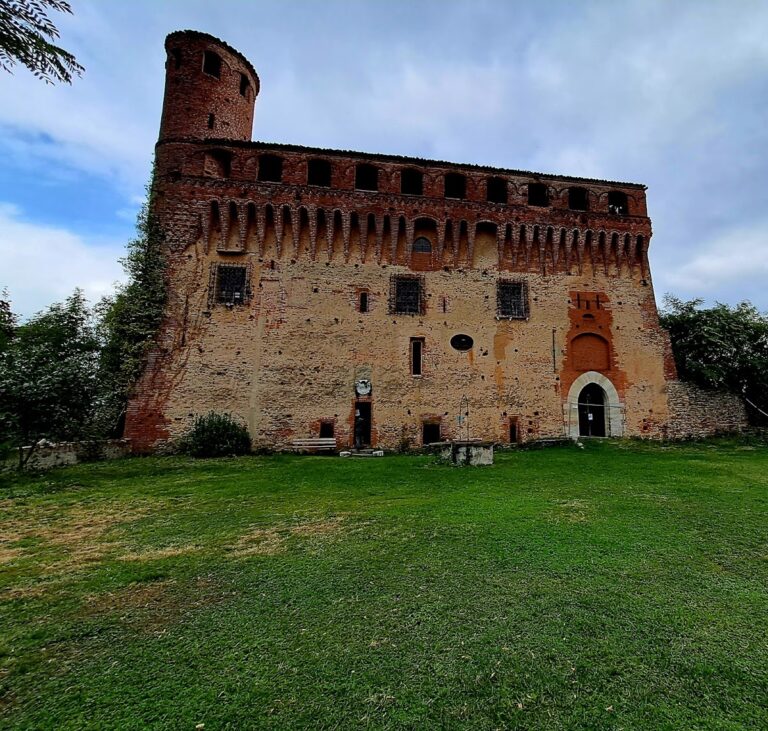
The complex occupies approximately 1,200 square metres on Manta Hill. Buildings added around the original fortress create a group whose exterior is comparatively plain, unlike the elaborate palaces associated with the fifteenth to seventeenth centuries. A round tower survives, and much of the visible exterior retains the appearance of a thirteenth- and fourteenth-century castle. The complex is enclosed by a sixteenth-century park.
The castle kitchen and chapel belong among the late medieval elements that survived without major rebuilding or substantial damage. Their survival helps preserve the relationship between the castle’s domestic functions and its religious spaces.
Religious spaces
Church of Santa Maria al Castello
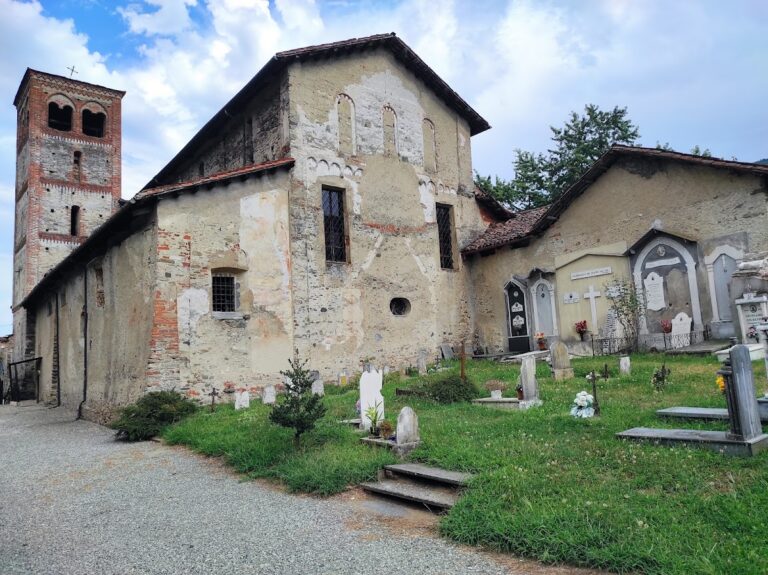
The Church of Santa Maria al Castello stands slightly below the main castle and dates from the fourteenth century. Its apse, the curved end of the church, contains frescoes showing episodes from the life of Jesus Christ. These paintings were produced around the period when the Sala Baronale was decorated.
Michelantonio’s funerary chapel
Michelantonio’s funerary chapel contains rich stucco decoration and paintings in the Mannerist style. The chapel represents the sixteenth-century transformation of the complex, when parts of the former fortress were adapted for aristocratic residence and commemoration.
The Sala Baronale fresco cycle
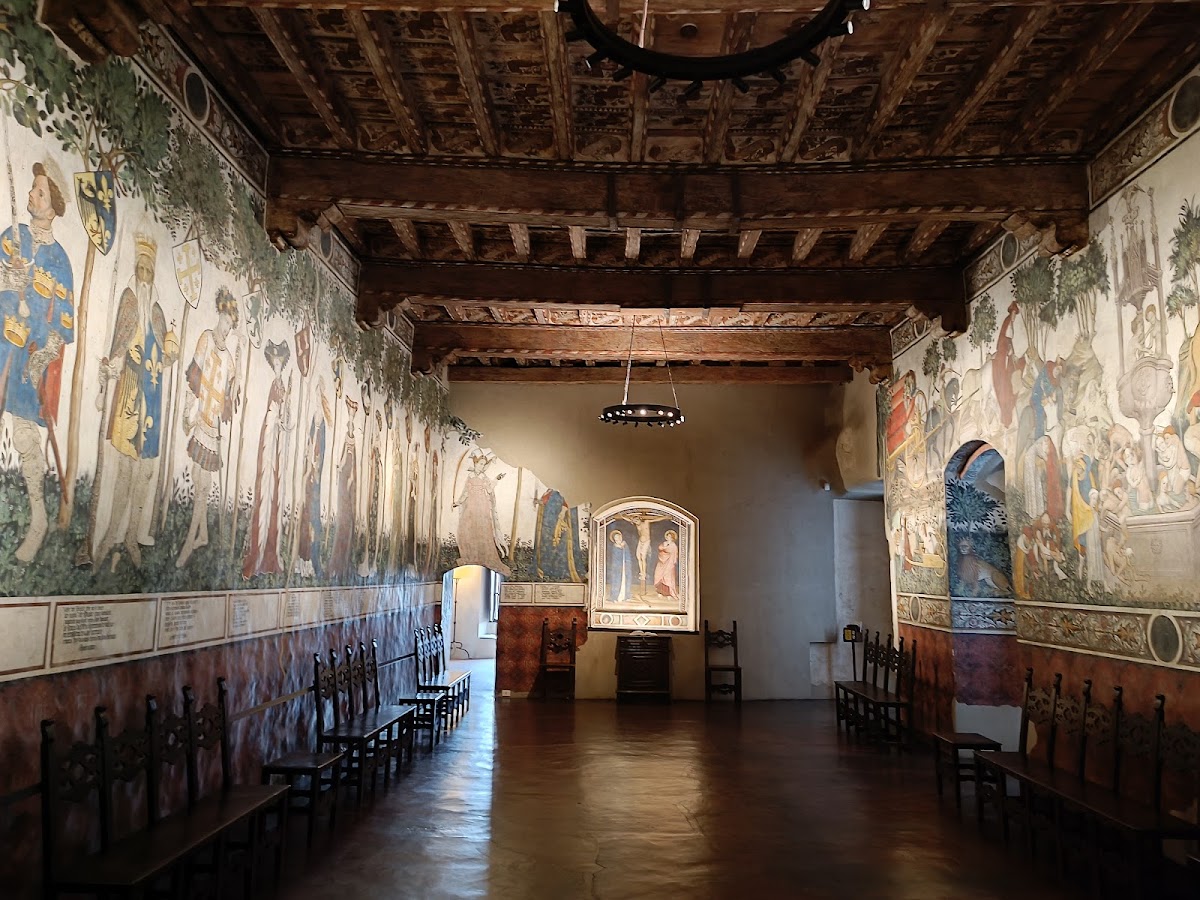
The Sala Baronale is a large ceremonial room whose walls preserve an extensive late Gothic fresco cycle, painted around 1420. On the window wall, the Fountain of Youth provides the central setting. This legendary source was believed to restore youth, and here it is surrounded by idealized heroes and heroines.
The other three walls contain eighteen larger-than-life figures set within a garden and dressed in sumptuous contemporary clothing. The men are Hector, Alexander the Great, Julius Caesar, Joshua, David, Judas Maccabeus, King Arthur, Charlemagne, and Godfrey of Bouillon. The women are Deiphyle, Sinope, Hippolyta, Semiramis, Ethiopia, Lampeto, Tomyris, Teuca, and Penthesilea. The figures are generally interpreted as artistic representations of nine Saluzzo margraves and their wives. Penthesilea is the only heroine described as damaged by the collapse of plaster.
Coats of arms belonging to noble families appear on the garden’s tree branches. Youthful idealization, elegant poses, carefully rendered clothing and vegetation, and individualized faces give the cycle both courtly and portrait-like qualities. It is regarded as an outstanding example of early fifteenth-century Gothic painting in the region and has survived into the twenty-first century almost intact. The repeated word “Leit” appears within the painted cycles, but its meaning remains uncertain. Interpretations connect it with an archaic German word for guide or leader, a Provençal term meaning joyful or happy, or an expression conveying slowness or calm.
Sixteenth-century decorative rooms
Sala delle Grottesche
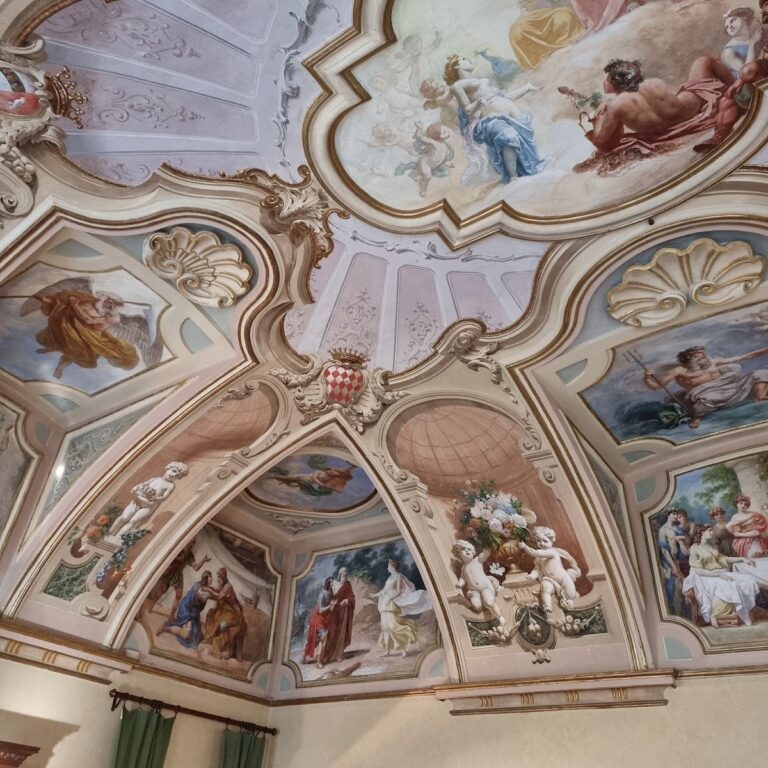
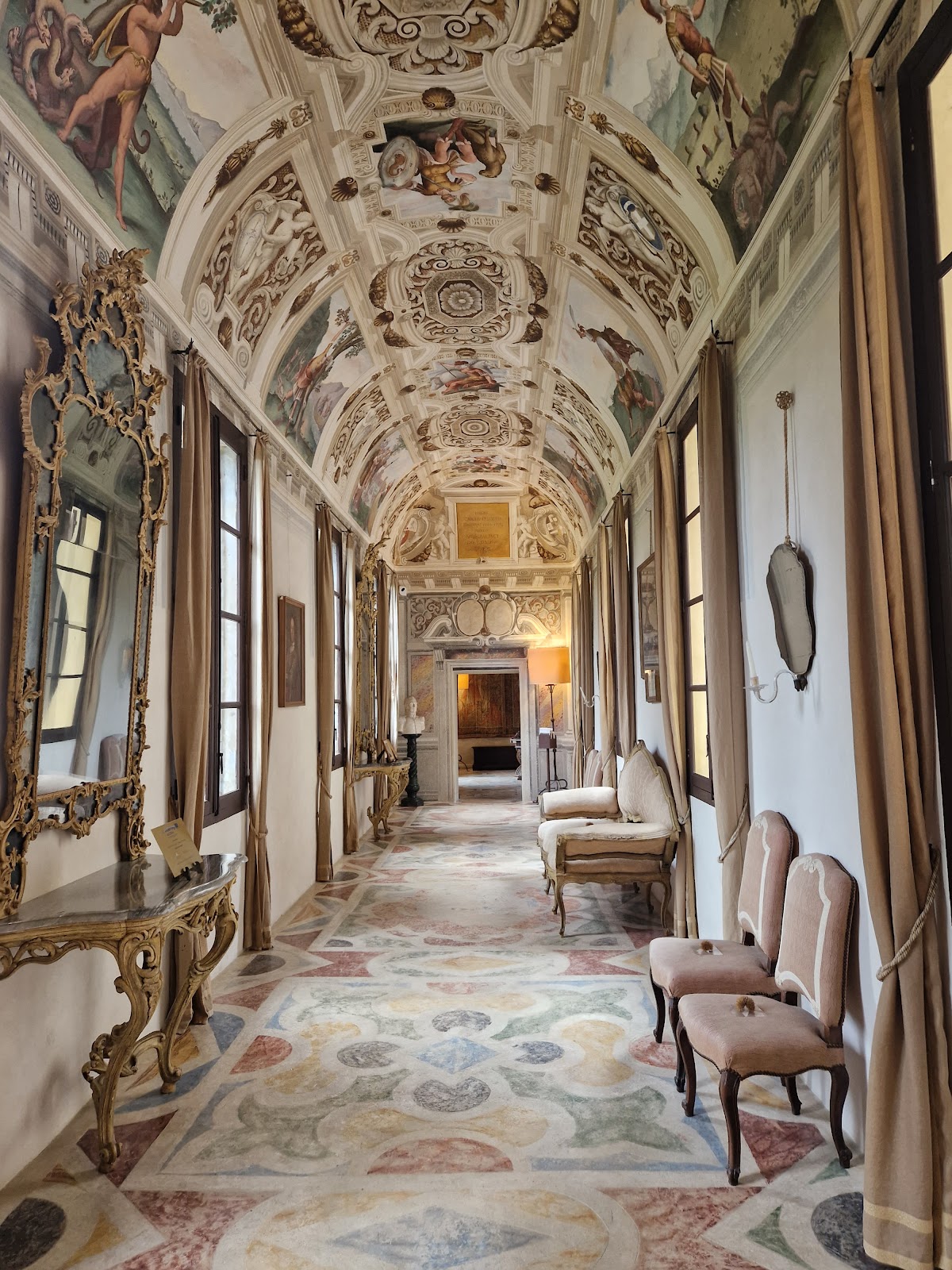
The Sala delle Grottesche, also called the great festive hall or Sala delle Feste, was developed around 1560. Its ceiling is finely painted and enriched with stucco, while its walls and vault display Mannerist frescoes of landscapes, ancient ruins, grotesques, and Renaissance architecture. Grotesques are ornamental compositions of figures, plants, animals, and fantastic forms derived from ancient Roman decorative painting. The room’s decoration was influenced by the recently rediscovered frescoes of Nero’s Domus Aurea in Rome.
Madonna Lactans fresco
A small niche in another room contains a fifteenth-century fresco of the Madonna Lactans, showing the Virgin Mary nursing Jesus. The painting was made by an anonymous artist who is not considered to be the painter responsible for the Sala Baronale cycle.