Qal’at Ja’bar: A Medieval Fortress on the Euphrates in Syria
Site at a Glance
- Rating
- 4.5
- Popularity
- Low
- Country
- Syria
- Primary era
- Medieval
- Eras represented
- Medieval
- Civilizations
- Unclassified
- Site type
- Military
- Remains
- Castle
On this page15 sections
History
Qal’at Ja’bar is a medieval fortress in Syria near Al Tabqah, on a rocky hill overlooking the Euphrates Valley before the creation of Lake Assad. The hill was known as Dawsar in pre-Islamic times and stood along a route connecting Raqqa with territories to the west. Its earliest fortification date is uncertain, although it may have been fortified as early as the seventh century.
Early names and Numayrid rule
During the early period, the site was associated with the Ghassanids, an Arab Christian kingdom that held power in parts of the Levant before and during the early Islamic period. Their leader, an-Nu’man ibn al-Mundhir, was said to have named the hill after his slave Dawsar. The site was later ruled and expanded by the Numayrids, an Arab tribal dynasty active in northern Syria and Mesopotamia.
The later name Ja’bar has an uncertain origin. It has been connected with Ja’bar ibn Sabiq, who may have belonged to the Banu Numayr or Banu Qushayr, and with Ja’bar ibn Malik. Ja’bar ibn Sabiq was killed at the site in 1071–72. The castle subsequently acquired a reputation as a refuge for Bedouin highwaymen associated with the two tribes.
Qal’at Dawsar was mentioned in 1040–41 during a campaign led by Anushtakin al-Dizbari, the Fatimid governor of Syria. The Fatimids were an Ismaili Shi’i caliphate that ruled Egypt and parts of Syria from the tenth to the twelfth centuries. In 1086, the Seljuk sultan Malik-Shah I conquered the site and granted it to Salim ibn Malik ibn Badran, an Uqaylid commander of the Citadel of Aleppo. The Uqaylids were an Arab dynasty that ruled parts of northern Mesopotamia and Syria, including Aleppo, during the eleventh and twelfth centuries. The grant apparently compensated Salim for surrendering Aleppo.
Crusader and Zengid periods
The castle may have been begun under the Numayrids, but its main construction more probably took place under Salim. His descendants retained control almost continuously until the late twelfth century. Crusaders briefly occupied or controlled the fortress in 1102.
In 1146, Zengi besieged the castle and was murdered there by one of his own slaves. Zengi was a twelfth-century ruler who founded the Zengid dynasty. His son Nur ad-Din took possession of Qal’at Ja’bar in 1168 and carried out major building works. Most of the visible castle belongs to this rebuilding phase. After the Zengids, the fortress passed to the Ayyubids and then to the Mamluks, successive Islamic dynasties that controlled parts of Syria. From the sixteenth century, it formed part of the Ottoman Empire.
Damage, restoration, and the Suleyman Shah tradition
Mongol invasions of Syria heavily damaged the castle, and restoration work followed in the fourteenth century. The site was also associated with the tomb of Suleyman Shah, traditionally identified as the grandfather of Osman I, regarded as the founder of the Ottoman dynasty. According to the tradition, Suleyman Shah drowned in the Euphrates near the castle and was buried nearby. The story may instead confuse him with Sulayman ibn Kutalmish, founder of the Seljuk Sultanate of Rum, a medieval Seljuk state in Anatolia. The identity of the person buried in the tomb known as Mezār-i Türk therefore remains uncertain.
Sultan Abdul Hamid II ordered the tomb’s reconstruction. Article 9 of the Treaty of Ankara of 1921 recognized the surrounding area as Turkish territory and permitted Turkish soldiers to guard the monument after Syria became a French Mandate and later gained independence. In 1973, the rising waters of the newly created Lake Assad required the reputed tomb and its associated Turkish territory to be moved to a new site north of Qal’at Ja’bar. The castle itself consequently became Syrian territory.
The tomb was threatened again by the Tishrin Dam project. In February 2015, the Turkish army evacuated the tomb complex, removed transportable elements, and established a new mausoleum near the Turkish border.
War and archaeological work
During the Syrian Civil War, the Islamic State of Iraq and the Levant captured Qal’at Ja’bar during its 2014 offensive. The organization used, or was suspected of using, the grounds for military purposes, including tunnels and weapons depots. Syrian Democratic Forces captured the site on 6 January 2017, killing 22 Islamic State fighters.
The construction of the Tabqa Dam began in 1968 and created the need for rescue excavations and conservation at Qal’at Ja’bar and other sites within the reservoir area. Between 1965 and 1974, Syria’s Directorate-General of Antiquities and Museums, the Directorate General of the Dam, and UNESCO carried out excavation and restoration. The work included the eastern walls and towers, sections of the western fortifications, and the Alia donjon. A donjon is a principal fortified tower that can serve as a stronghold within a castle. Excavated finds were eventually placed at the National Museum of Aleppo and the Raqqa Museum. Qal’at Ja’bar remains a partially restored ruin, and excavation and restoration of its walls and towers have continued to shape its interpretation since 1965.
Remains
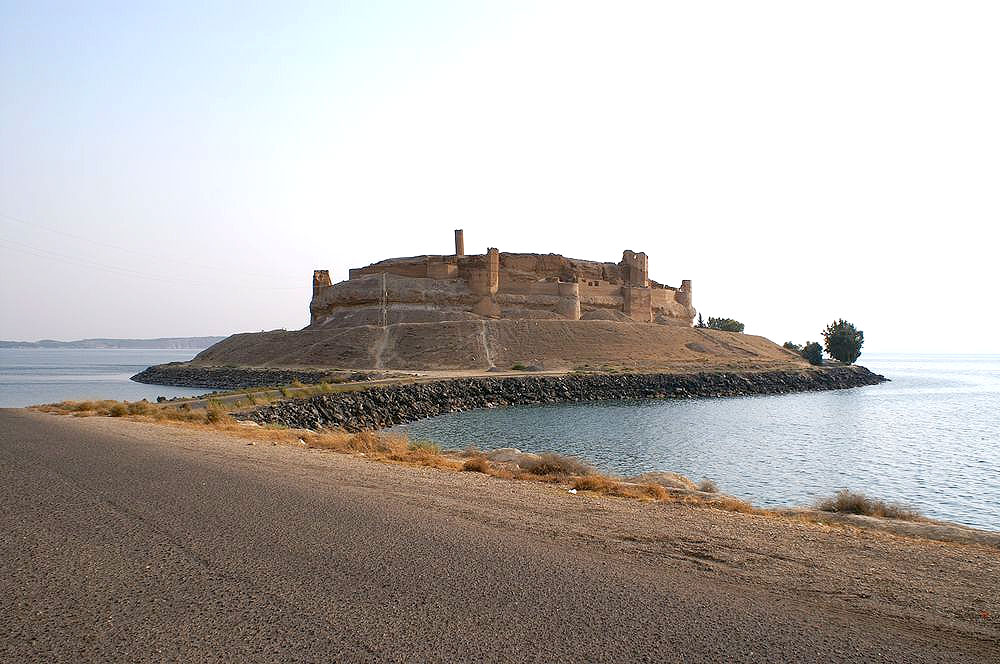
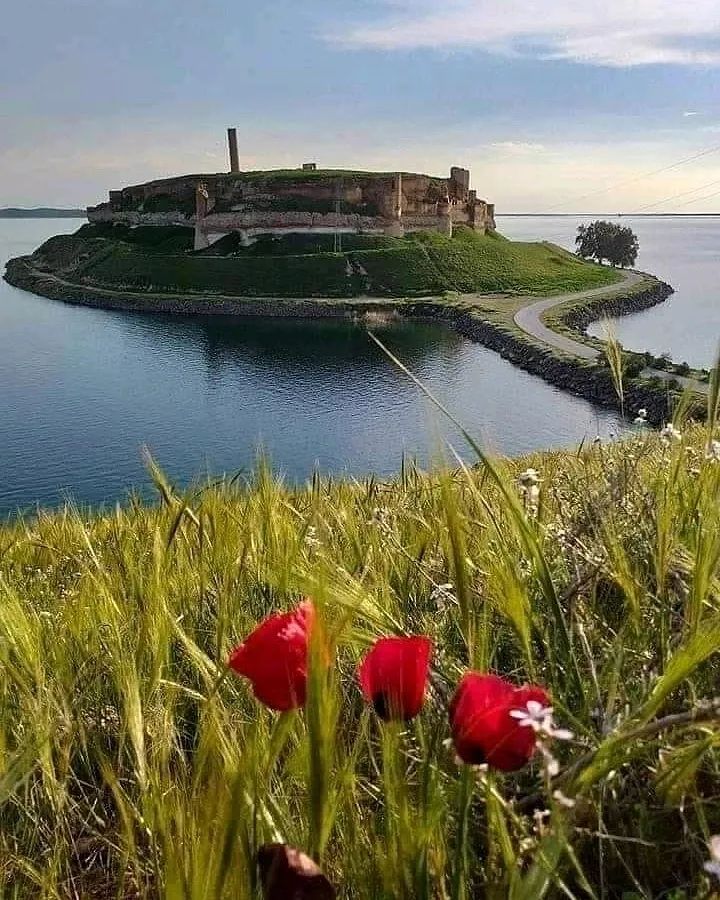
Qal’at Ja’bar occupies a rocky former hilltop on the left bank of the Euphrates. The creation of Lake Assad turned the hill into an island reached by an artificial causeway or raised walkway. The site stands at an elevation of 337 metres. Its fortified area measures approximately 370 by 170 metres and consists of a stone-built enclosing wall with 35 bastions around a rocky core. A dry moat partly surrounds the castle.
Fortifications and approach
Enclosing walls and defensive works
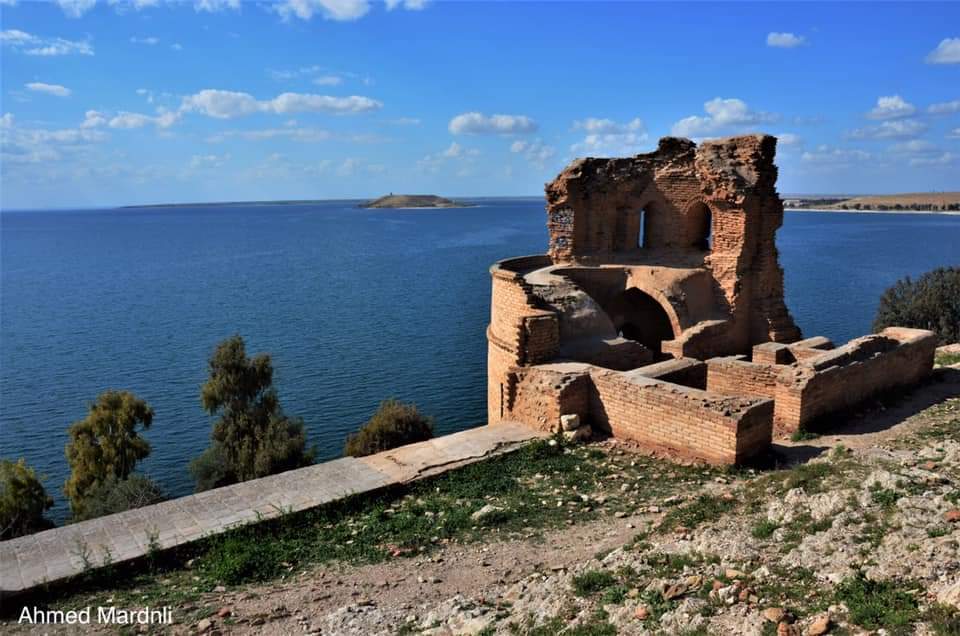
The enclosing wall defines the principal fortified area, while the bastions strengthen its perimeter. The castle’s general arrangement has been compared with the better-preserved Citadel of Aleppo. Upper sections were built in baked brick, although much of the visible brickwork results from extensive modern restoration. During the reservoir works, the castle was partly surrounded by a protective glacis, a sloping defensive embankment or revetment that strengthens an approach and exposes attackers to fire. The eastern walls and towers were restored, as were sections of the western ramparts.
Gatehouse and rock-cut ramp
Entry to the inner castle passes through a gatehouse and a winding ramp cut into the rock. The ramp forms part of the internal approach and leads through the rocky core of the fortress. Stairways cut into the rock were also described as providing access to water from the Euphrates.
Interior structures
Vaulted hall and cylindrical minaret
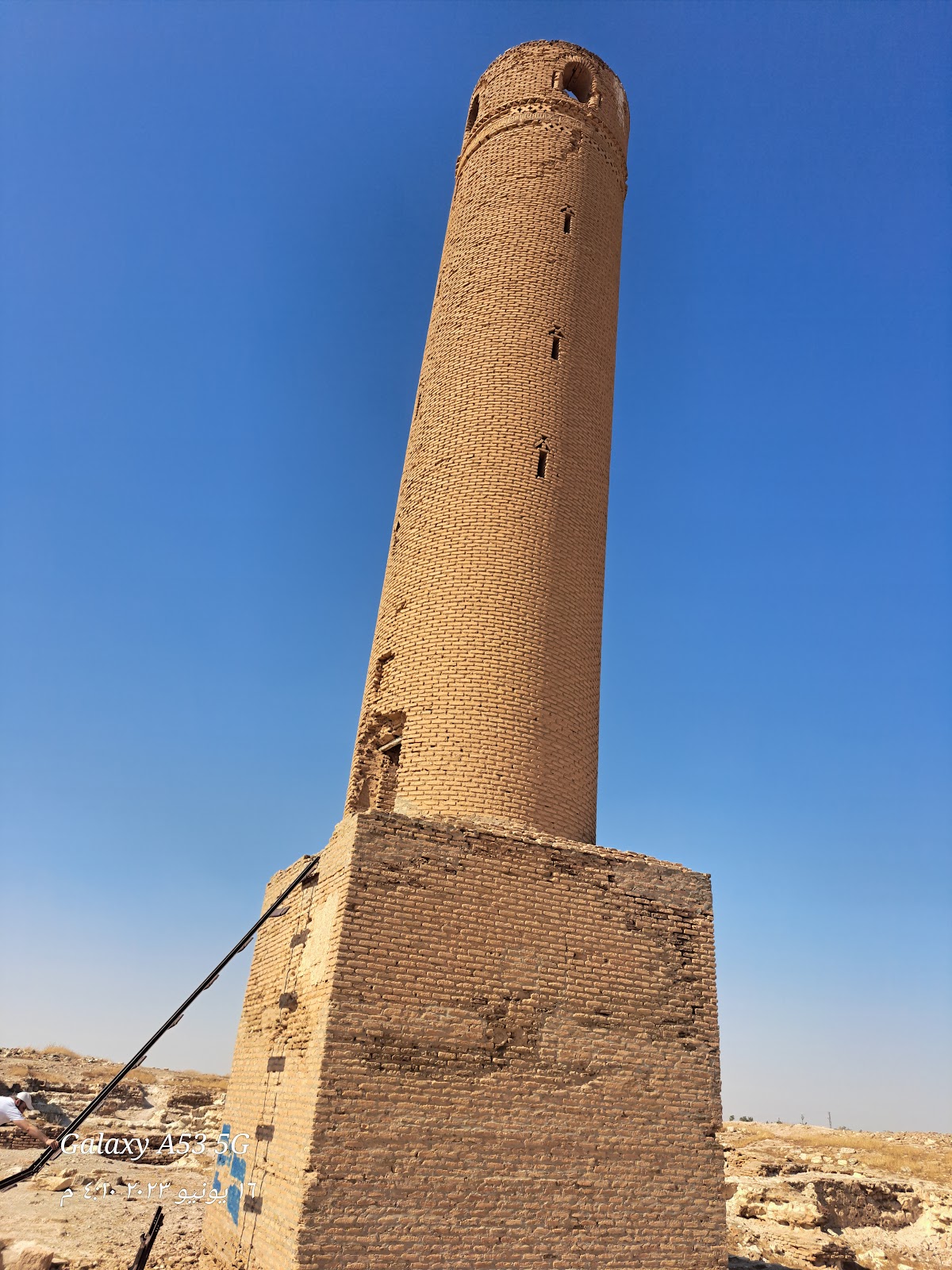
The surviving interior includes a vaulted hall and a cylindrical brick minaret probably built under Nur ad-Din. The minaret is the highest part of the castle and was probably constructed in 1173. By the twentieth century, only its lower portion remained. Its form relates to other twelfth-century cylindrical or polygonal brick minarets in the Raqqa region, including the minaret of the Great Mosque of Raqqa and the minaret near Abu Huraira on the opposite bank of the Euphrates. It has also been discussed alongside the octagonal brick minaret of Balis, built in 1210–11 under al-Adil I, an Ayyubid sultan.
Alia donjon
The Alia donjon was restored for use as a museum for archaeological finds from the castle, but the museum was not established there. The excavated material is instead held at the National Museum of Aleppo and the Raqqa Museum. The donjon remains part of the restored architectural complex.
Seventeenth-century description and restoration
Evliya Çelebi’s description
In 1648, the Ottoman traveller Evliya Çelebi described a high stone fortress standing on red rock. His account included 40 barracks covered with mud plaster, granaries, a small mosque, and rock-cut stairways used for drawing water from the Euphrates.
Reservoir-era conservation
Modern conservation altered and stabilized parts of the surviving structure. The eastern walls and towers, sections of the western defenses, and the Alia donjon were restored during the excavation campaign associated with the Tabqa Dam. A small brickworks was established at the castle to support this work. The site now presents a partially restored combination of stone fortifications, surviving brick construction, rock-cut approaches, and interior remains.