Castel di Pietra: A Medieval Castle in Tuscany


Site at a Glance
- Rating
- 3
- Popularity
- Very Low
- Country
- Italy
- Primary era
- Medieval
- Eras represented
- Medieval
- Civilizations
- Republic of Siena
- Site type
- Military
- Remains
- Castle
On this page11 sections
History
Castel di Pietra, also known as Castello della Pietra, is a ruined medieval castle in Italy, on a hill in the municipality of Gavorrano. Its earliest recorded appearance dates to 1067, when it belonged to Sestinga Abbey, while the surviving fortifications developed from the eleventh through the thirteenth centuries. The hill had already supported a small permanent settlement in prehistoric times, established inside a cave on its eastern slope.
From abbey property to feudal castle
From the beginning of the twelfth century, written records described Castel di Pietra as a castle rather than as a fortified stronghold. During the thirteenth century, the Aldobrandeschi of Sovana controlled it before transferring it as a fief to the Pannocchieschi, a prominent aristocratic family of southern Tuscany. Siena also claimed authority over the site, as shown by an act of submission from 1263, although the castle retained limited practical autonomy into the early fourteenth century.
The castle occupied a position on the communication route between the Massa area and the Grosseto plain. In 1203, its inhabitants were authorized to stop Grosseto salt from passing through unless it had come from Aldobrandeschi or Sienese warehouses. In 1307, the municipality of Massa Marittima appointed a castellan, the official responsible for administering and defending a castle, together with four soldiers to control the route.
Massa Marittima, Siena, and the Pannocchieschi
After Nello Pannocchieschi died in 1328, Massa Marittima acquired the family’s seigneurial rights. The municipality granted citizenship to 52 heads of household and turned Castel di Pietra into a stronghold facing the Ghibelline fortress of Montemassi. The Ghibellines were the medieval faction generally aligned with the imperial cause, and Montemassi was associated with Emperor Louis IV the Bavarian.
Castel di Pietra later entered Siena’s sphere of influence. The Sienese families Tolomei and Malavolti established local lordships, adding the castle to a political landscape shaped by aristocratic rivalries and shifting alliances. After the definitive fall of the Sienese state in the mid-sixteenth century, the site was incorporated into the Grand Duchy of Tuscany, the Tuscan state ruled by the Medici and later by the House of Lorraine until Italian unification.
The Pia de’ Tolomei tradition
During the period of Pannocchieschi control, Castel di Pietra became associated with the alleged disappearance of Pia de’ Tolomei at the cliff known as Salto della Contessa. The tradition derives from Canto V of Dante Alighieri’s Purgatorio, the second part of the Divine Comedy, in which Pia is mentioned only briefly. The identification of the castle’s Pia with a member of the Tolomei family remains historically problematic, since no daughter or granddaughter named Pia is known in that family at the time of Nello Pannocchieschi.
Another tradition links the story to Pia Malavolti, who married Tollo, an Aldobrandeschi vassal and lord of Prata. Three of Tollo’s nephews murdered him in 1285 after he formed an alliance with Siena, and Pia was probably killed in a similar manner. The concealment of the alleged political instigators has been connected with the development of one of the Maremma’s most important legends.
Nello di Inghiramo of the Pannocchieschi della Pietra was an Aldobrandeschi vassal who maintained close political ties with Siena, including through bequests in his will. His marriage to Margherita, an Aldobrandeschi heiress, was presented as an effort to balance competing powers and preserve the county’s independence. Their son, Binduccio or Bindoccio, was murdered at thirteen by agents of the Orsini family. The well associated with his death is located at Massa Marittima.
Decline and archaeological recovery
After its political decline, Castel di Pietra entered a long period of neglect. Excavations and restoration works carried out at the end of the twentieth century brought a substantial part of the ancient settlement back to light. The castle now falls within the area administered by the Grosseto Metalliferous Hills Archaeological and Technological Park.
Remains
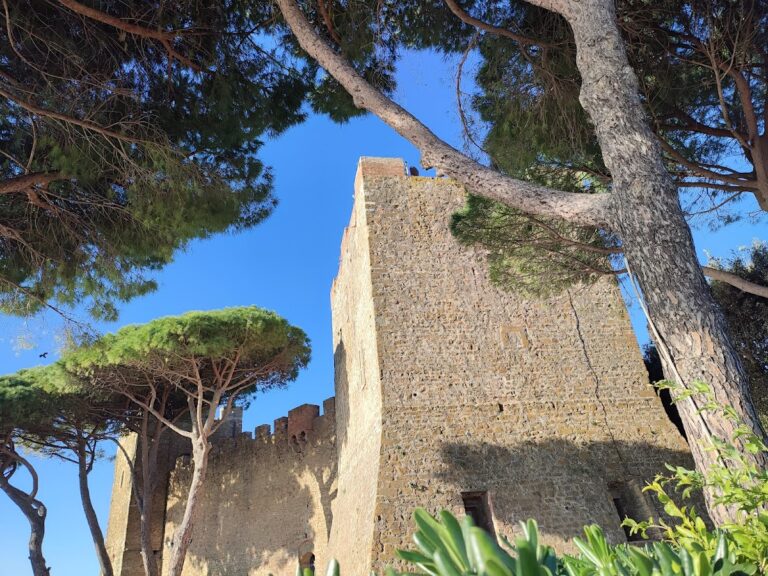
Castel di Pietra stands on the summit of a hill at the northeastern edge of Gavorrano, in the southern part of the Grosseto Metalliferous Hills. The surviving site is a stone-built ruin composed of an original tower, a later fortified keep, and wall remains from additional buildings. The ancient settlement revealed by excavation extends the surviving evidence beyond the principal fortifications.
Fortified core and settlement
Eleventh-century tower
The original tower dates from the eleventh century and forms the earliest surviving element of the medieval castle. Its walls are entirely faced with stone. The tower survives in ruin within the fortified area, where it forms part of the architectural sequence that developed as the site gained greater military and seigneurial importance.
Fortified keep
The keep was built between the twelfth and thirteenth centuries and consists of a seigneurial palace together with a second tower. This enlarged fortified complex combined residential and defensive functions. Its stone-faced walls and surviving fragments belong to the castle’s principal medieval phase.
Additional buildings
Wall remains from further buildings are visible around the castle. Together with the original tower and the fortified keep, these fragments define the surviving ancient settlement, which was partly brought back to light through late-twentieth-century excavation and restoration. The site remains a ruin.
Prehistoric cave and Salto della Contessa
A cave opening on the eastern slope contains traces of the prehistoric permanent settlement that preceded the medieval castle on the hill. The nearby cliff called Salto della Contessa forms the physical setting of the tradition connecting Castel di Pietra with Pia de’ Tolomei.