Castalian Spring: Delphi’s Sacred Ritual Fountain and Water Source
Site at a Glance
- Popularity
- High
- Country
- Greece
- Primary era
- Iron Age
- Eras represented
- Iron Age, Classical
- Civilizations
- Ancient Greek, Roman
- Site type
- Religious
- Remains
- Sanctuary
On this page9 sections
History
Foundation and ritual use
The Castalian Spring is a natural spring and ancient Greek fountain complex at Delphi, Greece. Its archaic fountain house was built in the early sixth century BCE during the First Sacred War, an early conflict over Delphi and its sanctuary. The spring supplied water for ritual purification: pilgrims, priests, and sanctuary staff washed there, as did the Pythia, the priestess who delivered Apollo’s oracles. Contestants in the Pythian Games, athletic contests connected with Apollo’s sanctuary, also washed and drank from the spring.
A nearby temple honored Autonoos, a hero remembered for defending Delphi during the Greco-Persian War in 480 BCE.
Myth and sacred traditions
Greek myth associated the spring with Castalia, a Naiad, or freshwater nymph, and daughter of the river god Achelous. In one tradition, Apollo pursued her and she plunged into the spring and drowned. Other traditions traced the water to Achelous or to the river Cephissus. One identified it as the stream Kassotis, which flowed underground before emerging near Delphi. Castalia was also associated with the nymphs Daphnida and Thyia and counted among the Corycian nymphs of Mount Parnassus. A proposed explanation connected her name with a word meaning “to sew,” referring to the supposed joining of two waters.
One tradition said Apollo washed at the spring after battling Python, the monster associated with Delphi. Another placed his killing of Python at the spring, where the creature guarded the water. The spring was sacred to Apollo, a god associated with prophecy, and to the Muses, deities of poetry and the arts. Its waters were regarded as a source of poetic inspiration by the Hellenistic period, the era of Greek history following Alexander the Great’s conquests. The belief that the spring itself had prophetic power arose later.
Repairs and rediscovery
The fountain was repaired and remodelled over the centuries, including during the Roman period. In the second century CE, the Greek travel writer Pausanias described the spring. The archaic fountain house was uncovered in the 1950s during road-widening work at Delphi. In more recent times, water from the spring was used to supply the Delphi region.
Remains
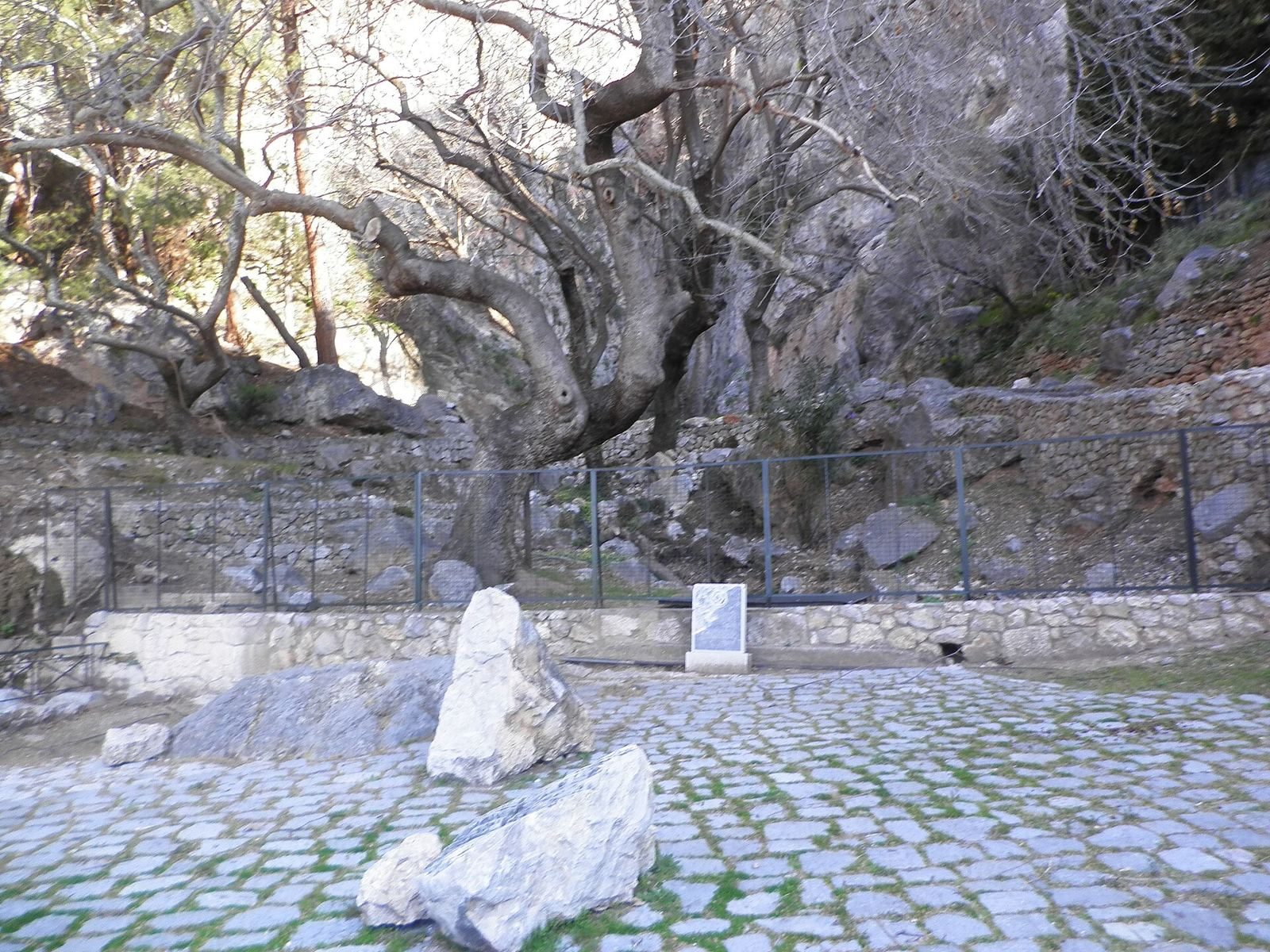
The surviving complex combines a natural hillside spring with archaic and Roman fountains at different elevations. Its waterworks include channels, basins, and a cistern associated with the fountains.
Setting and water supply
The spring lies about 538 m above sea level on Mount Parnassus, below the Phaedriades cliffs and near the rocky height known in antiquity as Hyampeia. It is uphill from the gymnasium. Its water ultimately reaches the Pleistos River, including through the nearby Arkoudorema stream. A circular cistern north of the athletic training ground survives; it supplied a large fountain with eleven smaller basins. A modern fountain stands near the road leading to the archaeological site.
Fountain structures
Archaic fountain house
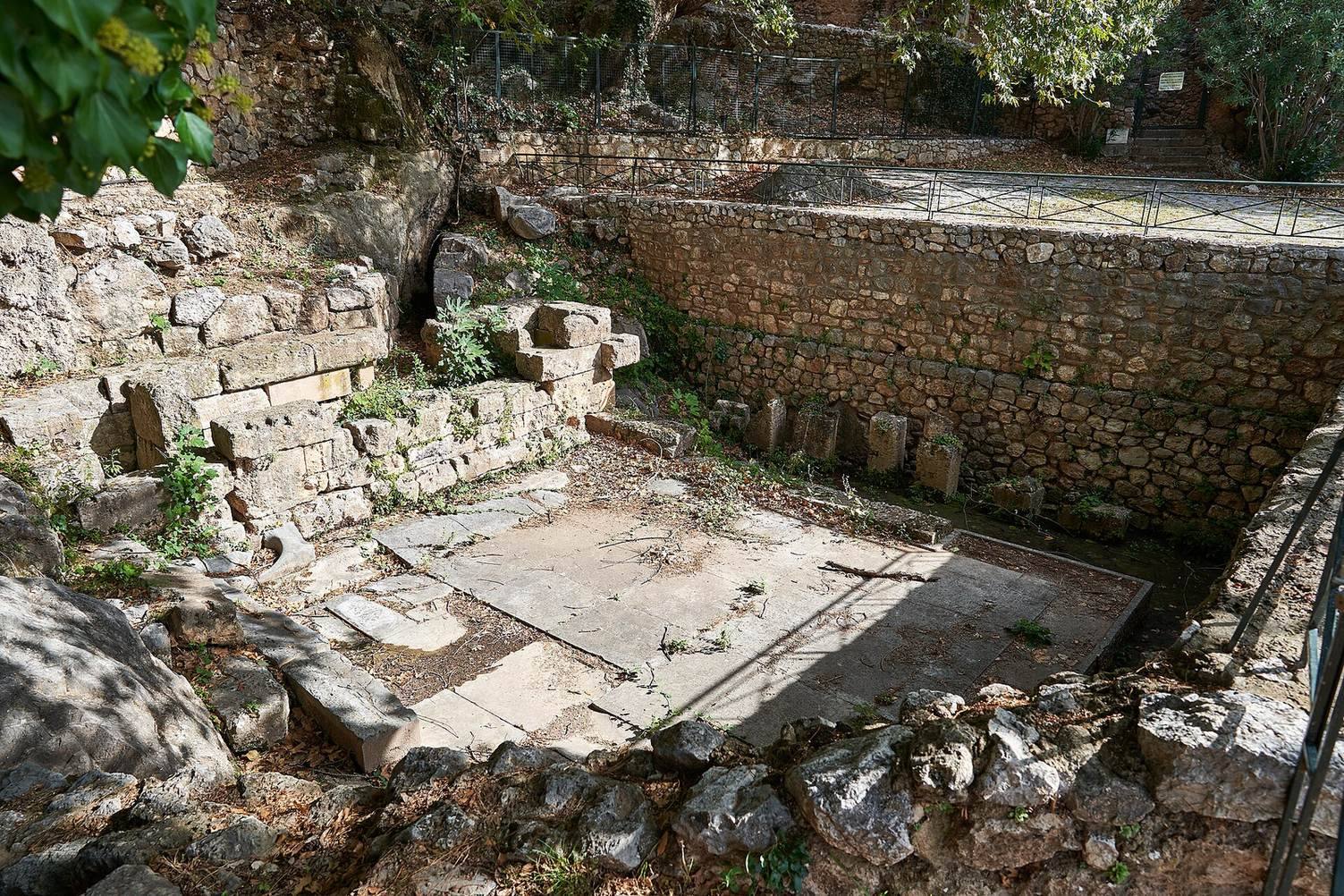
The archaic fountain house stood between Apollo’s sanctuary and the gymnasium. It was an open rectangular structure measuring 8.20 by 6.64 m, with a rectangular basin lined in marble. Conduits fed bronze lion-head spouts on its north side. A short water channel cut into the rock, about 1.60 m high and 1 m wide, carried water from the spring to the fountain. The paved courtyard had stone benches. The archaic fountain survives.
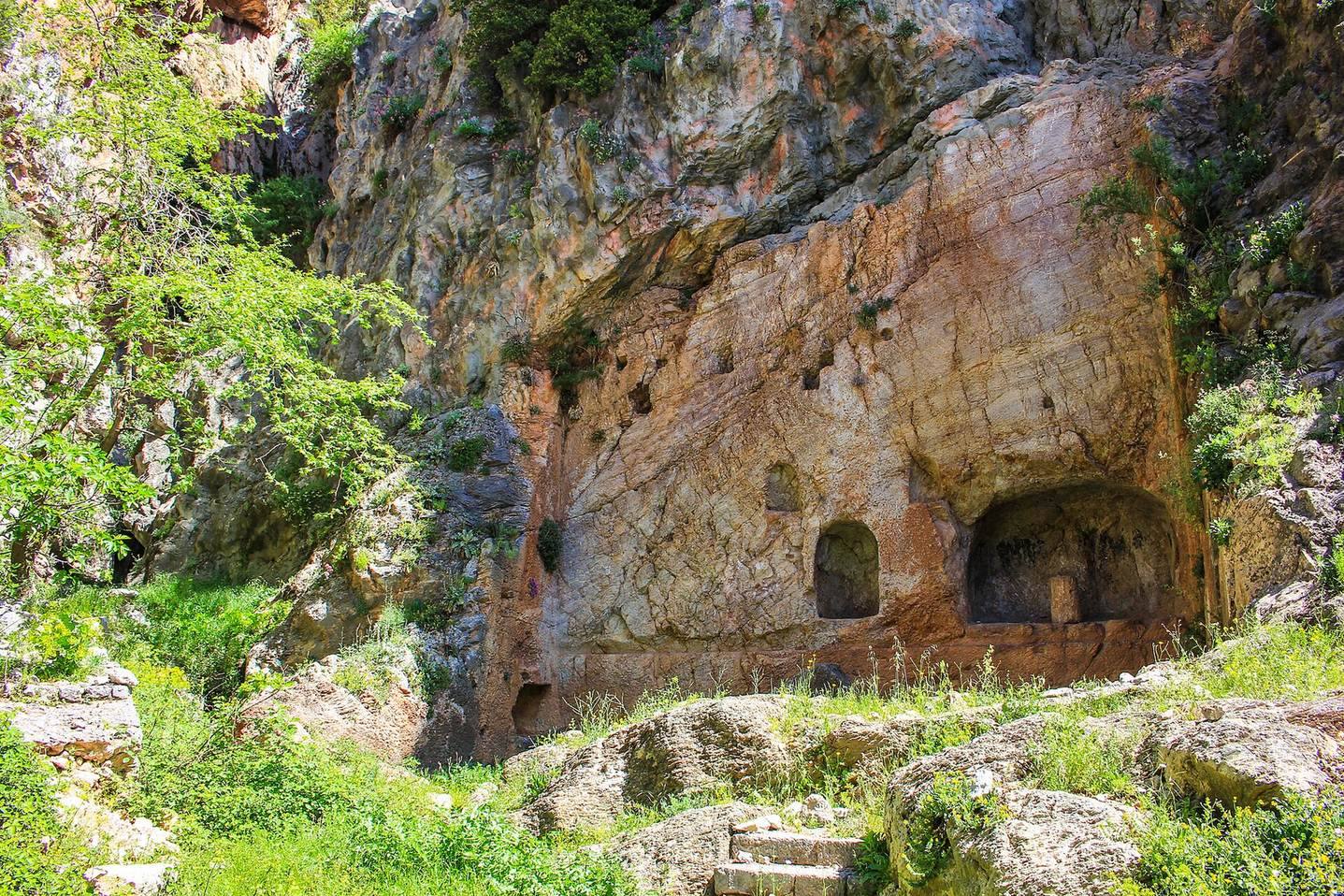
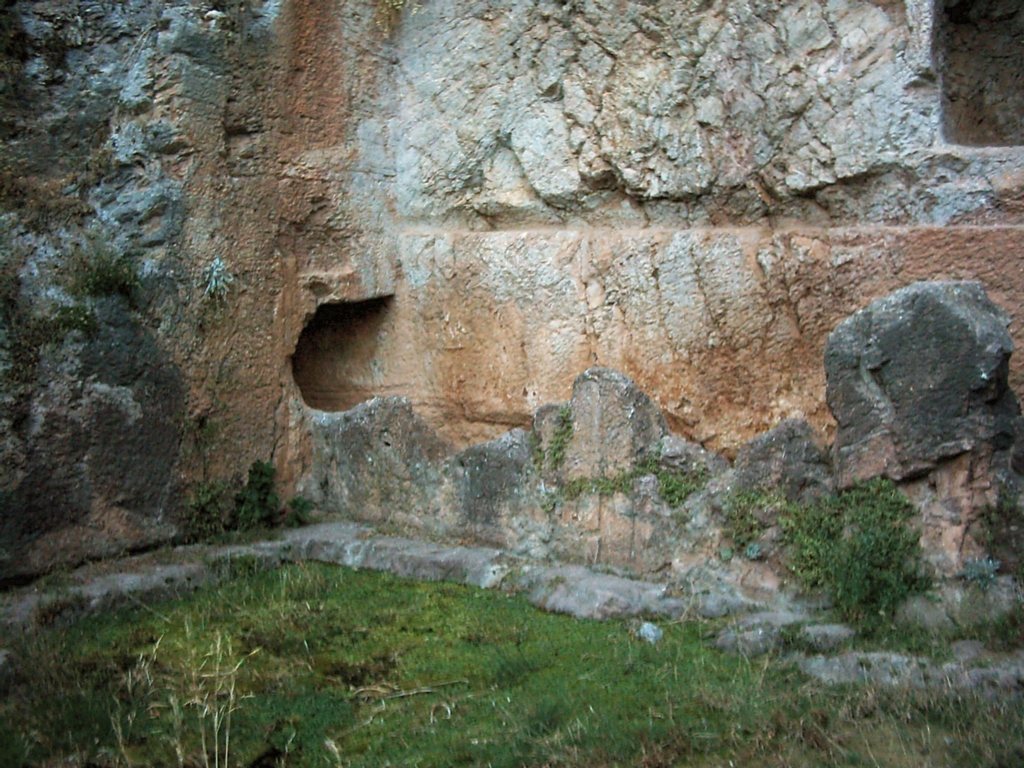
Roman fountain
The Roman fountain, dating to the first century BCE, stands about 50 m above the archaic fountain. Its natural rock face was smoothed and cut with niches for pilgrims’ offerings. One niche was later turned into a chapel dedicated to John the Baptist, the Christian figure known for baptizing Jesus. Below the niches, a covered basin about 10 m long and 0.50 m wide was cut into the rock and supplied through a closed conduit. One end could be opened for cleaning. Seven bronze spouts on the facade were divided by seven pillars carved from the rock. In front, a paved courtyard was reached by eight steps and had stone benches on three sides. The Roman fountain survives.