Casale della Cervelletta: Historic Agricultural Estate in Rome


Site at a Glance
- Rating
- 4.7
- Popularity
- Low
- Country
- Italy
- Primary era
- Early Modern
- External website
- Open
- Eras represented
- Medieval, Early Modern, Modern
- Civilizations
- Italian, Papal States
- Site type
- Domestic
- Remains
- Manor House
On this page13 sections
History
Casale della Cervelletta is a historic agricultural estate in Rome, Italy, in the Tor Cervara area at the eastern edge of the city. In the Middle Ages, it was ecclesiastical property known as Casale sancti loci, and over time it changed from a fortified system into the administrative center of a large farm and then an aristocratic country residence.
Medieval ecclesiastical estate
In 1202, during the pontificate of Pope Innocent III, whose rule lasted from 1198 to 1216, the estate belonged to San Tommaso in Formis, a religious monastery in Rome. It later passed to the Lateran Basilica and then to the Basilica of Saint Lawrence Outside the Walls, linking the rural property to major Roman Christian institutions.
Sforza and Borghese ownership
The Sforza family acquired the estate in the sixteenth century. In 1628, Cardinal Scipione Caffarelli Borghese purchased it and transformed it into an elegant country residence while expanding its agricultural facilities. The Borghese family constructed the principal house in 1630 and added further components to the complex during the sixteenth and seventeenth centuries. Seventeenth-century cadastral maps identify the estate by its present name, Casale della Cervelletta.
Salviati agricultural reforms
In 1835, the estate passed to the Salviati family. The family promoted cultivation and drainage in an area affected by malaria, a mosquito-borne disease, through water-canalization works. By the turn of the nineteenth and twentieth centuries, Cervelletta was regarded as an important agricultural-production center in the Roman countryside.
Malaria research and twentieth-century decline
At the end of the nineteenth century, the estate housed an experimental health station devoted to the prevention and treatment of malaria with quinine. The physician and immunologist Angelo Celli and his wife, Anna Fraentzel Celli, were associated with the station and with campaigns against illiteracy in the Roman countryside. After the Second World War, the estate and casale entered a gradual decline, while the expansion of Rome increasingly threatened the rural landscape with urban development.
Protection and public ownership
In the 1980s, residents of the newly developed Colli Aniene district campaigned to protect the Cervelletta estate and its historic rural buildings from further urbanization and commercialization. Their initiatives contributed to the inclusion of the wetland and the entire estate in the Aniene Valley Nature Reserve in 1997. The deteriorated casale was placed on the Red List of endangered cultural heritage that same year, and the landscape previously drained because of malaria was subsequently restored as wetland.
Rome Municipality acquired the casale and estate in 2001. The property was entrusted to Insieme per l’Aniene ONLUS, a nonprofit association involved in managing the nature reserve on behalf of the regional authority Roma Natura. A temporary custodial-use arrangement granted by Rome Capital to the association La Cervelletta in November 2014 was revoked in November 2015. The complex remains tied to ongoing questions of conservation and future public management.
The origin of the name “Cervelletta” is uncertain. One interpretation derives it from Cervaretto, possibly a reference to deer enclosures in the area. Another connects the name with nearby tuff quarries and the large piles of processing waste, an interpretation also associated with the name Tor Cervara.
Remains
The complex stands on a tuff outcrop overlooking the Cervelletta estate. Its buildings occupy elevated ground within the wetland landscape of the Aniene Valley Nature Reserve, while the Aniene River lies approximately 1.2 kilometres to the north. The principal residence, agricultural buildings, courtyard, medieval tower, and associated religious structures form the surviving physical elements of the estate.
Residential and agricultural buildings
Principal house
The principal house has two stories and a plastered facade framed with rectangular blocks of tuff, a relatively soft volcanic stone widely used in Roman construction. Seven windows open onto the upper level, while the ground floor has a central round-arched entrance portal with three windows on each side. Two parallel tuff cornices run horizontally between the floors. Above the central upper-story window, the Borghese coat of arms formerly occupied the position over the entrance and remained there until 1950.
Courtyard and service buildings
Behind the principal house, a rectangular courtyard is enclosed by agricultural and service buildings, including stables and hay barns. The entrance portal leads into a portico that connects with the residential rooms and, through the internal courtyard, with the service areas. The upper residential level contains a salon with a large fireplace bearing a painted Salviati coat of arms, together with wall paintings. The complex also includes a large covered loggia with two broad arched openings.
Medieval tower and religious buildings
Medieval tower
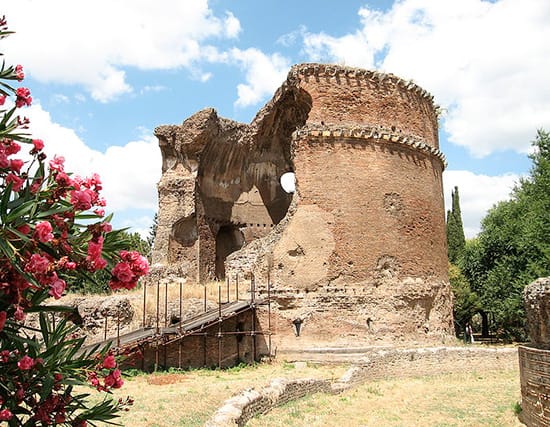
A medieval tower stands on the northeastern side of the courtyard. Approximately 30 metres high, it is crowned with rectangular Guelph-style battlements, crenellations traditionally associated with the papal, or Guelph, side in medieval Italian political symbolism. Traces of loopholes and corbels remain on the tower. The corbels supported galleries or balconies, while the defensive openings and elevated position indicate that the tower originally served jurisdictional and lookout functions.
Church of Santa Maria Immacolata alla Cervelletta
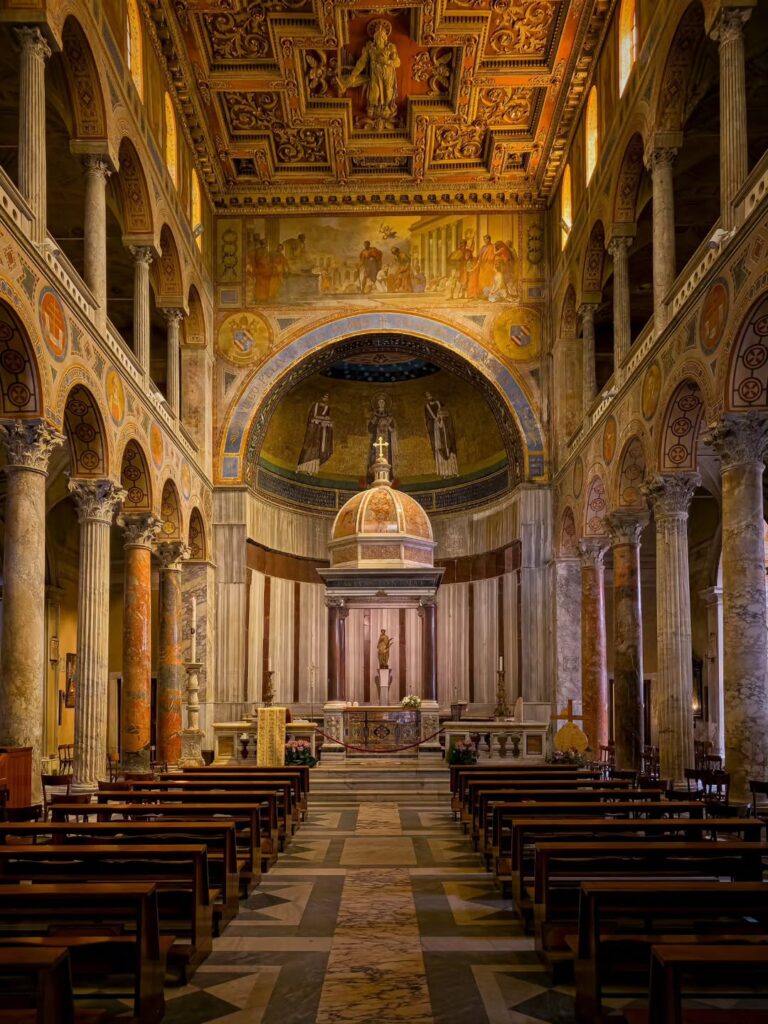
An Assumption chapel formerly stood on the site now occupied by the Church of Santa Maria Immacolata alla Cervelletta. The church was built in 1911 to designs by the architect Carlo Lepri and was consecrated in 1912 by the Catholic prelate Pietro Respighi.
Nearby sites