Casa Marini: A Fifteenth-Century Civilian Building in Guardiagrele
Site at a Glance
- Rating
- 3.7
- Popularity
- Very Low
- Country
- Italy
- Primary era
- Early Modern
- Eras represented
- Medieval, Early Modern
- Civilizations
- Kingdom of Naples
- Site type
- Domestic
- Remains
- Elite Residence
On this page9 sections
History
Casa Marini is a fifteenth-century civilian building in Guardiagrele, Italy, traditionally associated with the town’s medieval mint. The mint was established in 1391, when Guardiagrele briefly joined Sulmona as a centre of coin production during a struggle over the Neapolitan throne.
The mint and its early fortunes
Napoleone II Orsini, an Italian nobleman, established the mint by agreement with King Ladislaus of Durazzo. A diploma issued by Ladislaus in June 1391 granted the privilege. The Durazzo and Angevin factions were rival dynastic parties competing for the Neapolitan throne.
The mint’s early success was short-lived. As the conflict shifted in favour of Louis II of Anjou, a claimant to the Neapolitan throne, Napoleone was imprisoned in 1392. Ladislaus restored him to favour in 1395. In 1400, Napoleone arranged for a chapel dedicated to Saint Leo to be completed in Guardiagrele. An act dated June 28 states that its construction took place on the saint’s feast day, a detail later relevant to debate about the saint shown on the town’s coins.
Political change and later coinage
In 1423, lieutenants of Braccio da Montone, a commander of mercenary troops, arrived in Guardiagrele and demanded allegiance to Giovanna II and Alfonso. The city capitulated on July 29 without being sacked. In 1424, Alfonso V confirmed the Orsini family’s possessions and its privilege to mint bolognini, medieval Italian coins. A further issue of Guardiagrele coins followed under Queen Giovanna II in the 1420s.
Coin imagery and Saint Leo
Guardiagrele’s bolognini carried the mint mark GVAR, understood as the beginning of the name Guardia-Grele, alongside the inscription LADISLAVS R(ex), naming Ladislaus as king. The reverse reads S. LEO PAPA, or Saint Leo the Pope, and shows the saint with a five-petalled rose, the Orsini emblem, on his chest. A rare version places a pair of hooks beside the figure.
On the later issue under Giovanna II, the saint’s image changed slightly: his right hand gives a blessing, while his left holds a cross carried in religious processions. The design echoes images of Pope Celestine V, a thirteenth-century pope, on Durazzo bolognini from L’Aquila. The coin figure’s identity remains disputed. It was long identified as Pope Leo I, known as Leo the Great, a fifth-century pope. A proposal made in 1913 identified him as Leo the Great and was followed by other scholars; a later interpretation instead identifies Leo II, a seventh-century pope. The 1400 act concerning the chapel of Saint Leo supports the latter reading. Another hypothesis is that Napoleone confused the saint’s Sicilian origin with Valle Siciliana in Teramo, a territory associated with the Orsini. The choice of Leo rather than local patrons Saint Donatus or Saints Peter and Paul has also been questioned.
Earthquake and later change
An earthquake severely damaged Guardiagrele in 1706, after which Casa Marini underwent further alterations.
Remains
Layout and exterior
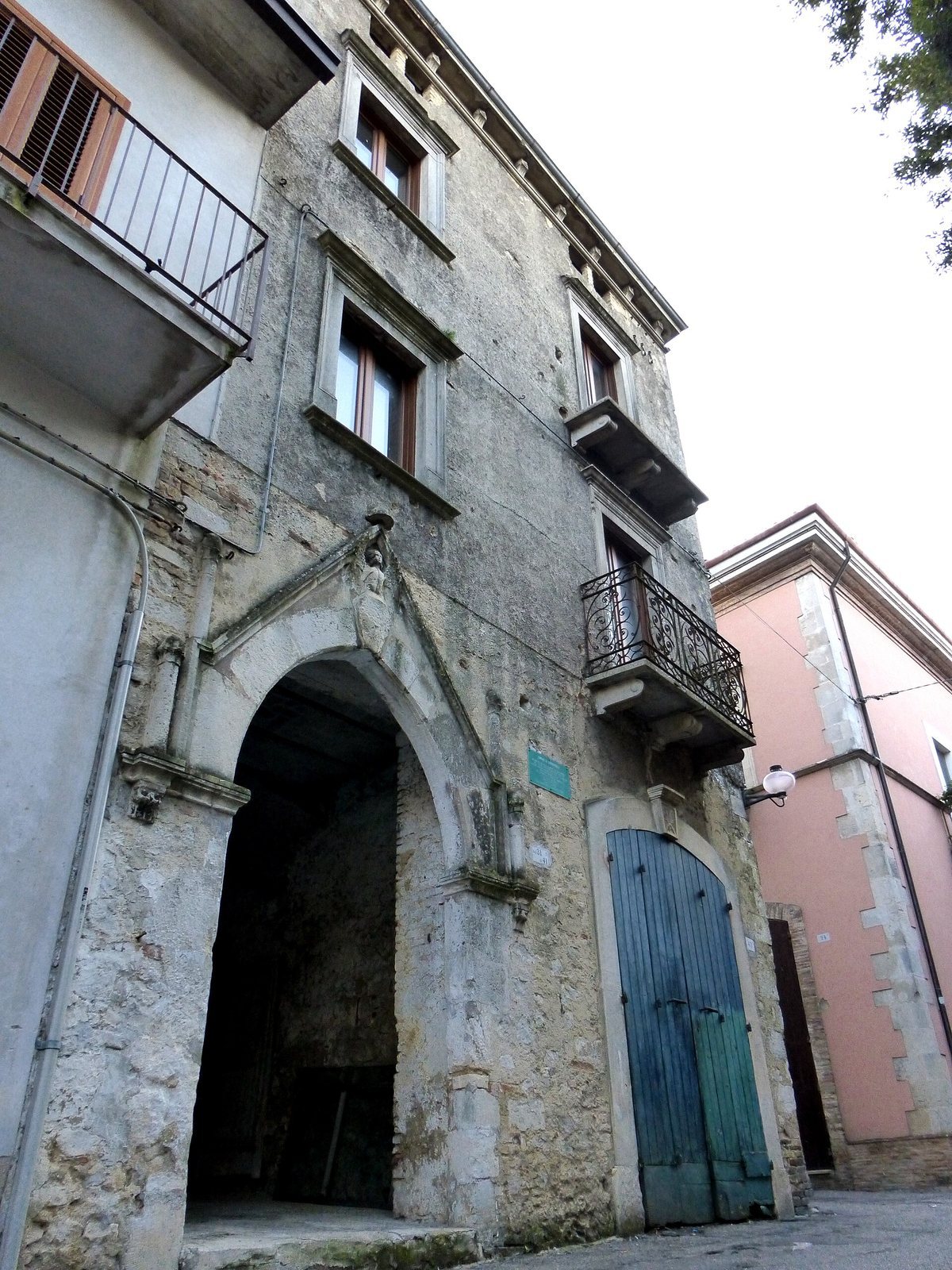
Casa Marini stands where the historic Guardia district, around the Piano area now known as Piazza Garibaldi, meets the Grele district along the Via Roma axis. At the junction of Via Cavalieri and Vicolo I Capocroce, the building’s form makes the two streets bend at a right angle. Alterations, especially in the eighteenth and nineteenth centuries, reshaped the building. It came to resemble a late-eighteenth-century aristocratic townhouse in Neoclassical style, drawing on Greek and Roman forms. Its overall condition is fair.
The late-Gothic portal
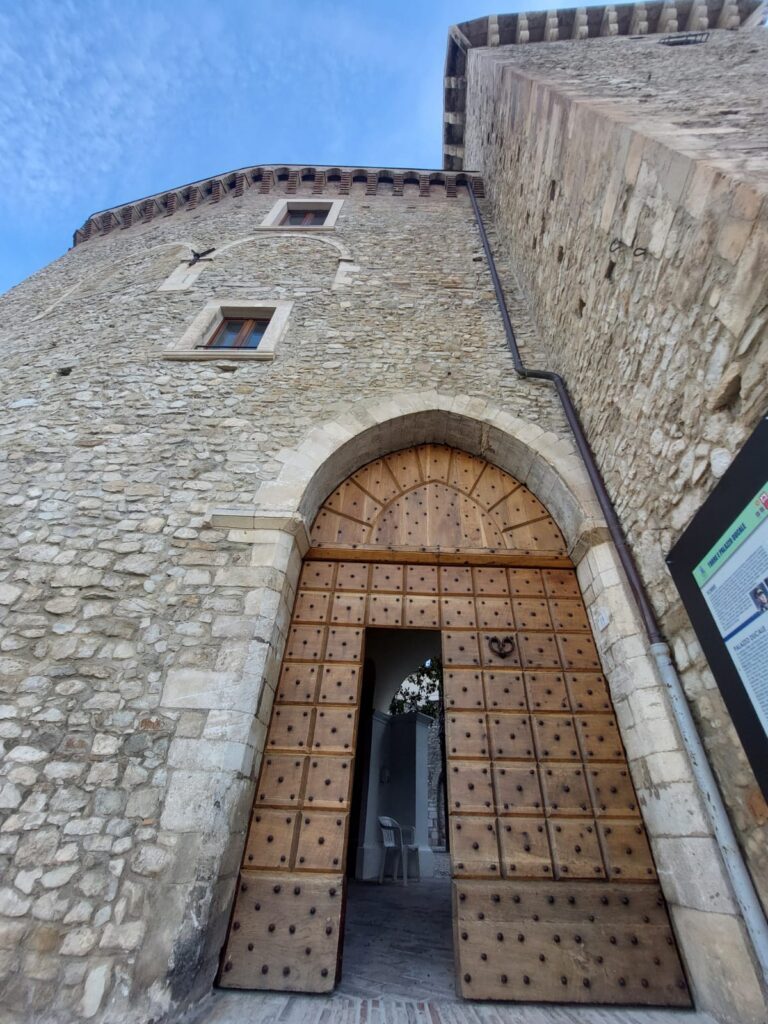
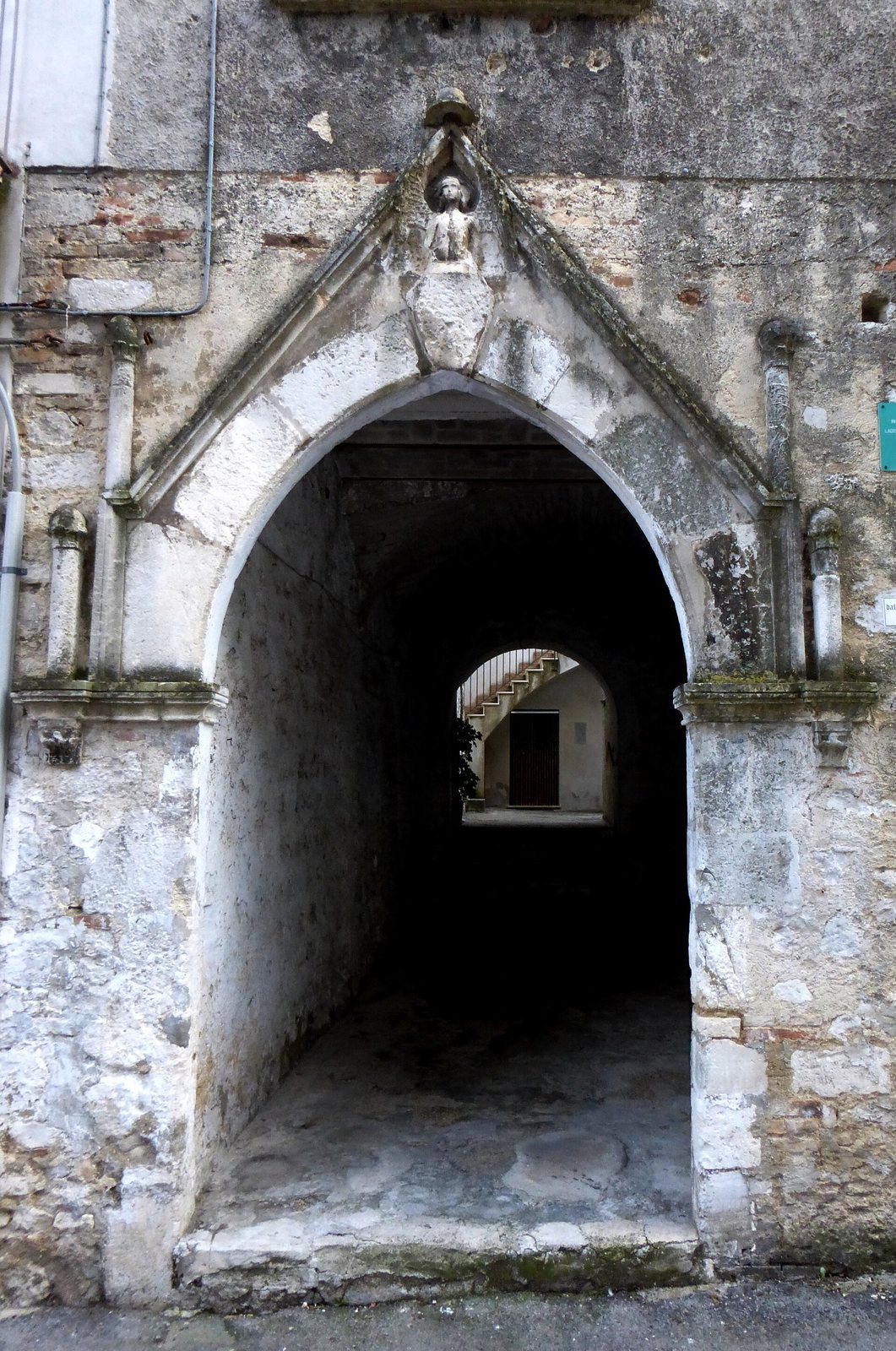
The surviving original feature on the façade is a pointed portal in late Gothic style, known for its pointed arches. A triangular tympanum, the panel above a doorway, tops the entrance. Its ornamental stone gable is framed by small columns with cylindrical shafts, which later alterations have damaged. At the gable’s apex, a framed figure has been interpreted either as an angel or as a man, possibly King Ladislaus of Naples.
Passage and interior
The entrance opens into a passage with a barrel vault, a continuous arched ceiling, leading to a small inner courtyard. A roof of timber and brick rests on pillars above the courtyard. A small stone staircase rises from it to the main entrance, and the courtyard also provides access to the upper floor. Inside, the building is divided into several apartments and includes a large vaulted hall.