Cardinal of Portugal’s Chapel: A Renaissance Memorial in Florence
Site at a Glance
- Popularity
- Medium
- Country
- Italy
- Primary era
- Early Modern
- Eras represented
- Early Modern
- Civilizations
- Republic of Florence
- Site type
- Religious
- Remains
- Chapel
On this page16 sections
History
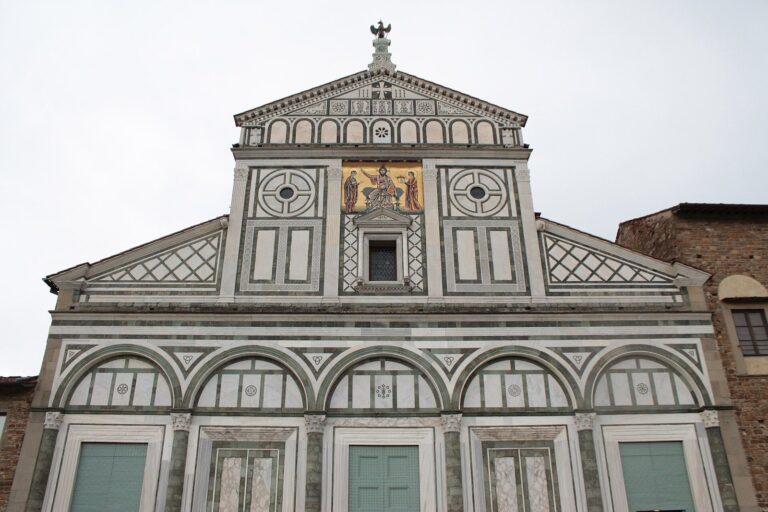
The Cardinal of Portugal’s Chapel is a Renaissance memorial chapel at San Miniato al Monte in Florence, Italy, built for Cardinal Jaime of Portugal. Created in 1465–1466, it was intended as a richly decorated burial place for a young member of Portugal’s royal family and became a notable work of Renaissance Florence.
The memorial commission
Jaime died in Florence on 27 August 1459, aged 25. The Florentine humanist and writer Vespasiano da Bisticci recounts that, while gravely ill, Jaime asked to be buried at San Miniato. His will provided for the chapel, but its bequest covered only part of the cost; his relatives paid the remainder.
The project was carried out as a memorial to Jaime and his family. Its decoration brought together artists working in different materials, an approach promoted by Leon Battista Alberti, a Renaissance architect and humanist who had taught Bernardo Rossellino.
Construction and dedication
Antonio Manetti is traditionally named as the architect, while payment records establish that the workshop of the brothers Antonio and Bernardo Rossellino also took part. The floor was paid for during the construction campaign. Alesso Baldovinetti began the wall paintings in September 1466, and Antonio and Piero Pollaiuolo made the altarpiece in 1466–1467.
Álvaro Afonso, bishop of Silves and, from 1467, archbishop of Évora, supervised the execution of Jaime’s will and consecrated the chapel in 1466. An inscription commemorates both the transfer of Jaime’s body and the consecration. The chapel is Roman Catholic and belongs to the Archdiocese of Florence.
Remains
Plan and architectural framework
Entrance and connection to the church
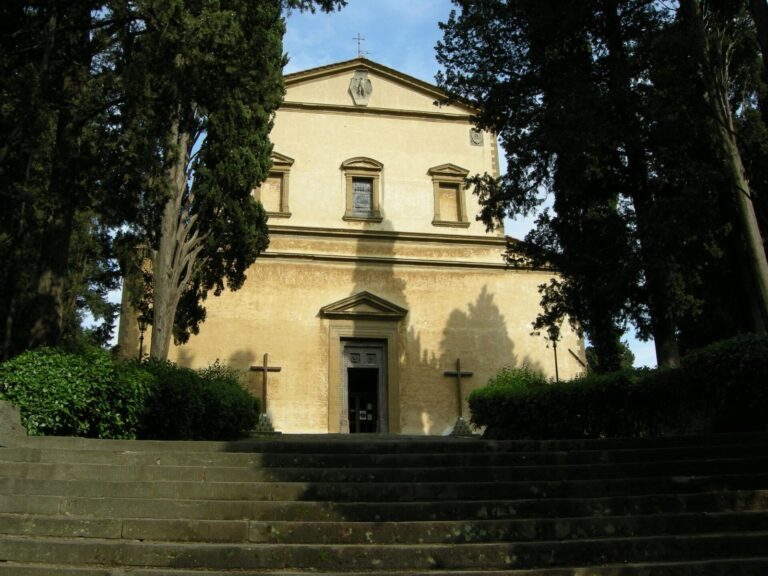
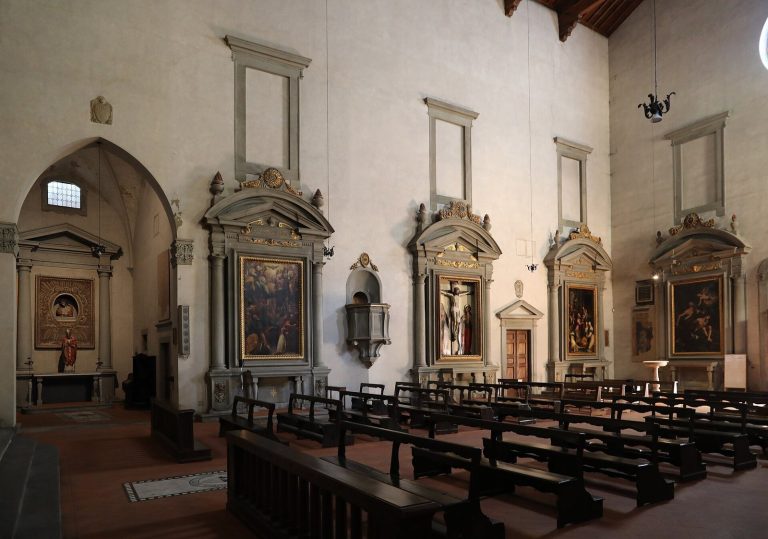
The chapel stands apart from the main body of San Miniato al Monte and has its own roof. A large arch connects it to the church’s left nave. Recessed panels decorate the arch, whose sides are framed by flat, wall-attached columns with Corinthian capitals. Above it, Baldovinetti’s painted prophets flank a semicircular panel bearing Jaime’s arms, including the cardinal’s hat, and an inscription about the chapel’s consecration and the transfer of his body.
Central space and materials
The interior is arranged around a square central space with four shallow arms extending in a cross-shaped plan. A curved vault covers the center, while arches with recessed panels frame the arms. Fluted, wall-attached columns with Corinthian half-capitals mark the corners. Above them, a continuous painted band carries heraldic arms, and four semicircular panels, each with a single-light window, rise above the cornice.
Gray sandstone forms the architectural elements. Marble and patterned surfaces cover the walls, vault, and floor, complemented by porphyry, a hard stone with conspicuous crystals, and green-toned serpentine. The combined materials create a richly colored interior in which the decorative treatment extends across the chapel’s surfaces.
Pavement, ceiling, and paintings
Stone pavement and terracotta ceiling
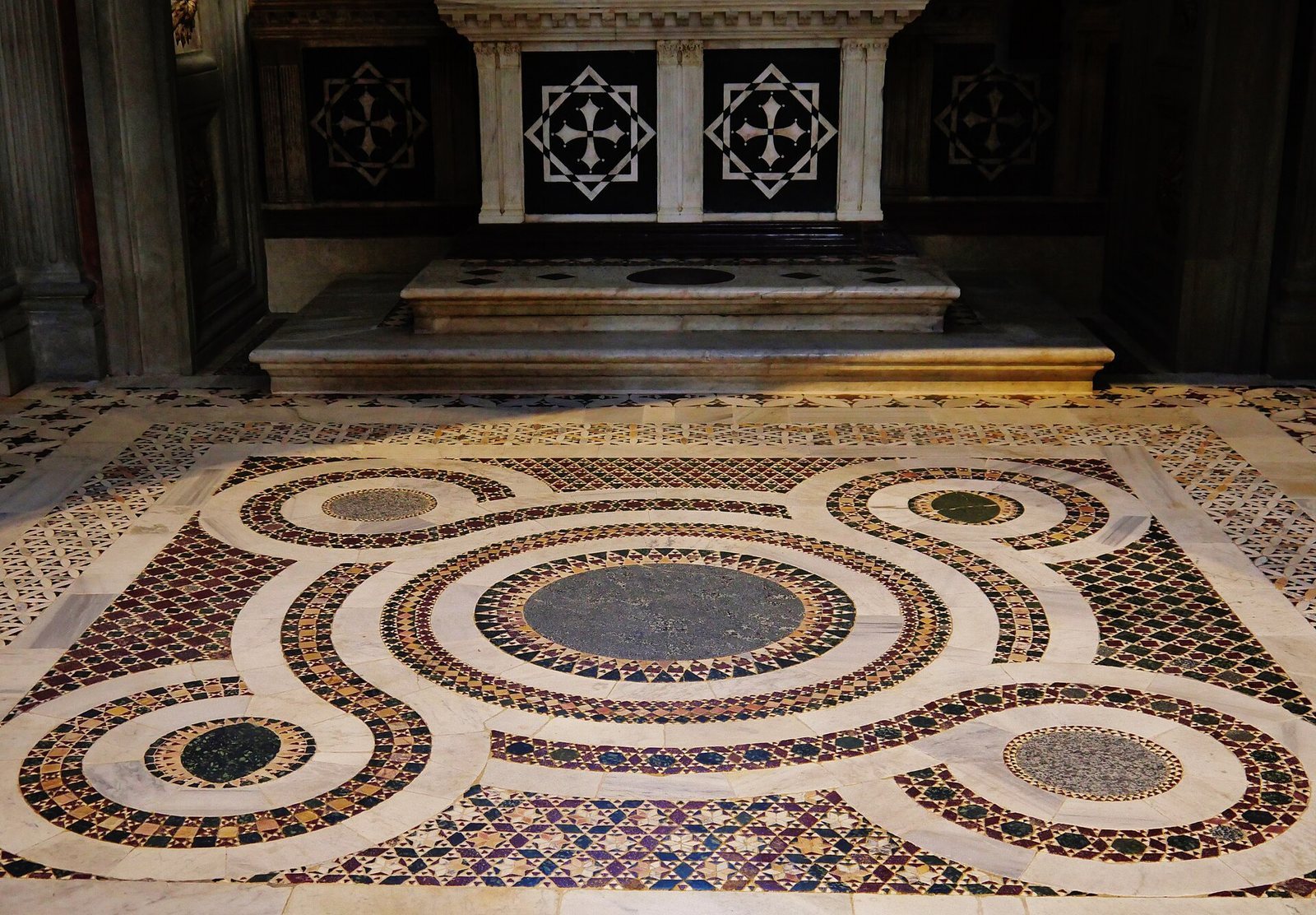
The floor is made from cut pieces of stone fitted together in a patterned pavement, drawing on the medieval Roman and central Italian tradition of decorative stone inlay. Red porphyry brought from Rome forms part of the design and refers to Jaime’s royal ancestry.
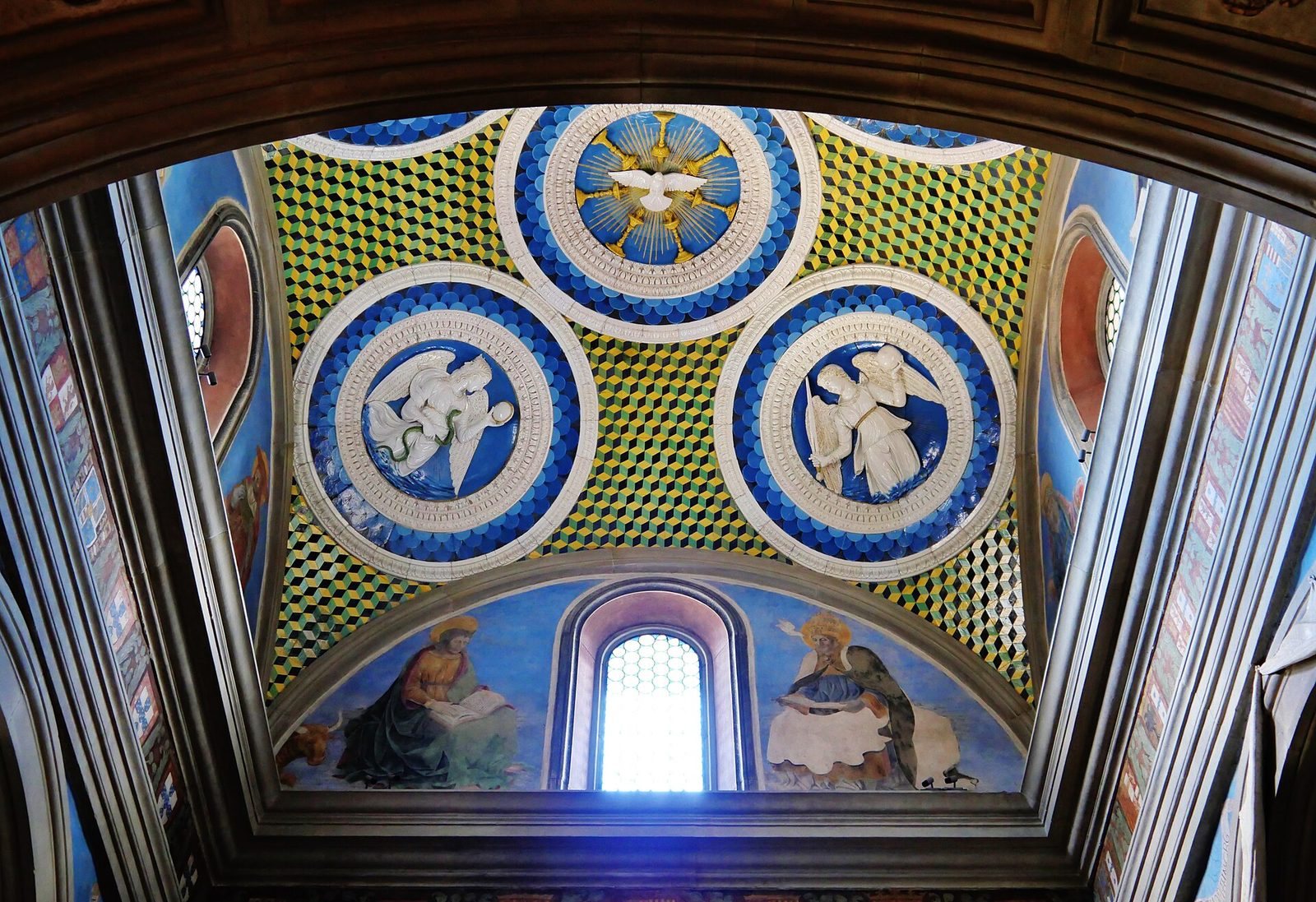
Luca della Robbia made the ceiling from glazed terracotta, echoing the floor’s geometric pattern. A central circular panel is surrounded by four more. Blue, scale-shaped forms vary in intensity, while small cubes use yellow, green, and purple, the heraldic colors of Portugal’s royal house. The outer panels show Temperance, Prudence, Justice, and Fortitude, the four cardinal virtues; a dove representing the Holy Spirit, one of the Christian Trinity, occupies the center.
Painted figures and prophetic scenes
Baldovinetti’s paintings continue across the curved surfaces above the arches and in the four semicircular panels beneath the vault. The latter pair the four Gospel writers with four Church Fathers. Reading counterclockwise from the tomb wall, the pairings are Augustine with John the Evangelist, Gregory the Great with Luke, Jerome with Mark, and Ambrose with Matthew. The last pair is beside a painted false window.
Eight prophets occupy the curved surfaces above the arches, holding scrolls with prophecies concerning Christ and Mary. Their figures include David and Isaiah, Elijah and Nehemiah, Jacob and Aaron, and one figure who may be Boaz. Baldovinetti’s paintings once had added brilliance from enamel-like colors applied after the wall paintings had dried. Those colors have deteriorated, and the Annunciation may also have used them to depict details such as jewels and fabrics.
Cardinal Jaime’s tomb
Monumental composition
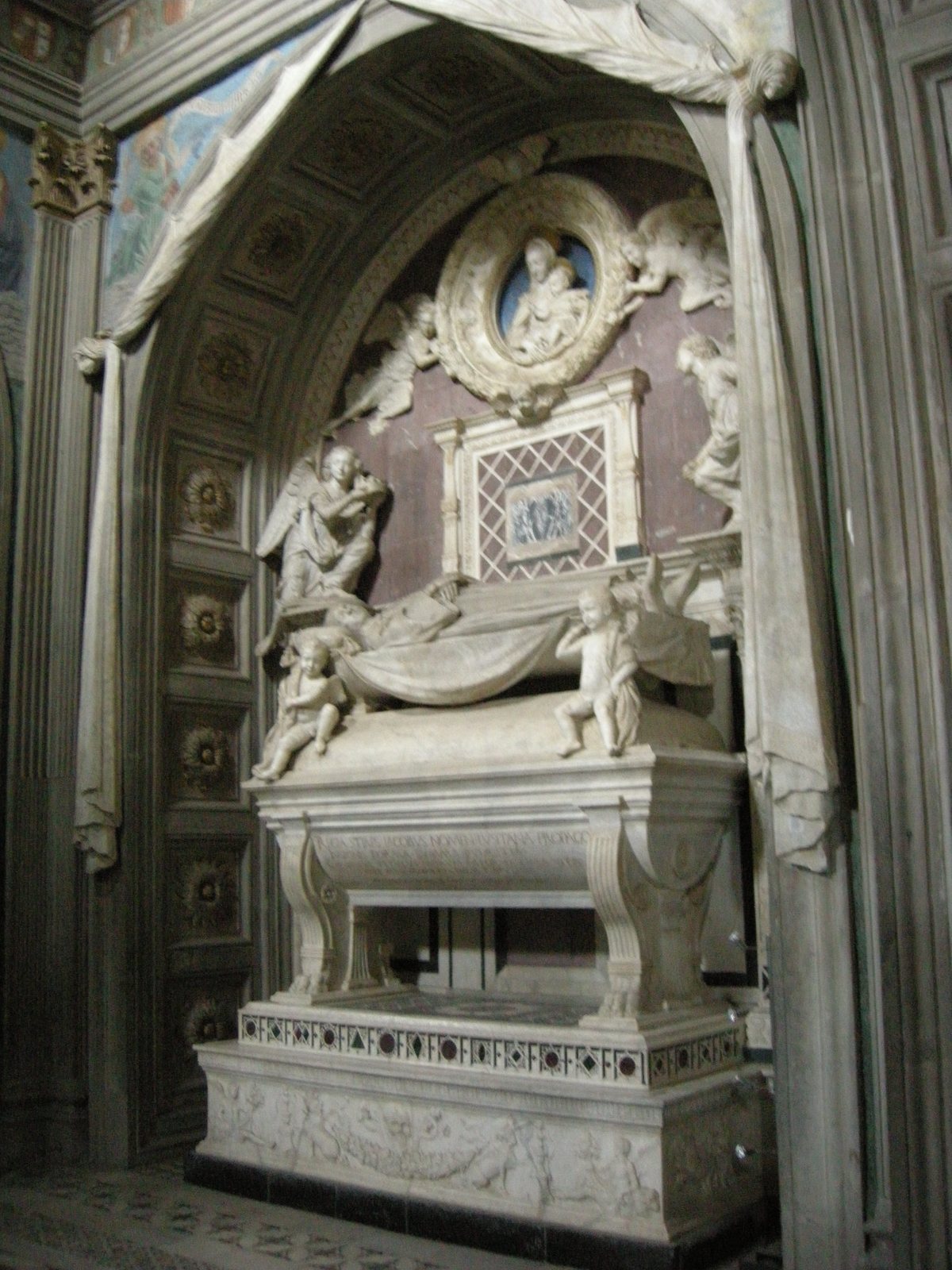
The tomb fills the southeast wall and forms the chapel’s principal sculptural focus. Antonio Rossellino made it with contributions from Bernardo Rossellino and others. Its design adapts a tomb set beneath an arched recess, a form associated with Bernardo’s work at Santa Croce in 1446–1450. The monument is integrated into the chapel’s overall decoration, and its staged composition uses curtain-like framing that appears to have just been drawn aside.
Red Maremma marble forms the background for the white-marble figures and sarcophagus. Above them, a circular panel shows the blessing Madonna and Child among winged heads, stars, and clouds of Paradise. Two airborne angels hold the wreath around the panel.
Effigy, inscriptions, and carved details
The sarcophagus rests on a finely carved base. Its inscription, in Roman-capital lettering, names Jaime, his lineage, and his rank as a cardinal. His effigy lies in religious vestments as if asleep. Child figures hold the drapery at either end of the sarcophagus, while decorated pilasters support two kneeling angels. The sculptural scheme gives the angels a crown and a bronze palm, an emblem of martyrdom.
A smaller framed panel between the bier, angels, and Madonna contains a simulated grille made from white and red marble, Aquitaine marble, yellow onyx, and green marble from Prato. Its position may refer to Jaime’s personal portable altar. The tomb’s base has carved scenes and symbols, including bull combat derived from ancient Mithraism, a mystery religion centered on Mithras, a charioteer, fighting unicorns, and seated spirit figures on lion heads. A skull above the central wreath is flanked by a lily and a palm, associated respectively with purity and the soul’s immortality. Together, the images have been interpreted as references to Jaime’s virtue, self-control, and religious discipline.
Altar and opposite wall
Altar and altarpiece
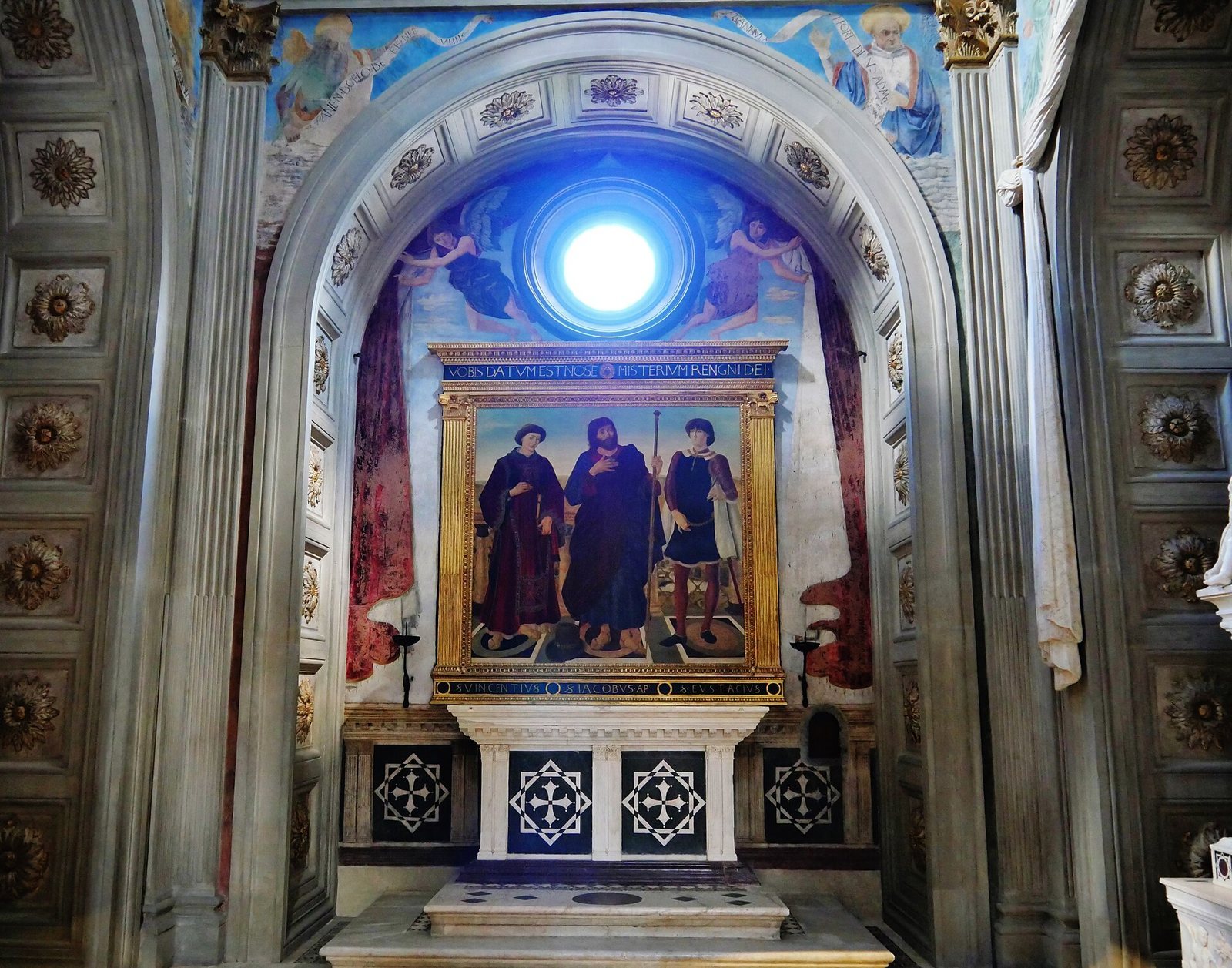
Opposite the entrance arch, a painted red curtain raised by flying angels echoes the drapery around the tomb. The altar has marble inlay and an older frame bearing an inscription and Jaime’s arms. The original altarpiece by Antonio and Piero Pollaiuolo is now in the Uffizi; a copy stands in the chapel. Piero alone is credited with the painted background of the altar wall.
The altarpiece depicts Saints Vincent, James the Greater, and Eustace. Vincent was the patron saint of Lisbon and Portugal, James was Jaime’s namesake, and Eustace refers to the cardinal’s title. A bird’s-eye landscape recalls contemporary Flemish painting. James stands slightly forward, touches his chest, and looks toward the tomb, directing attention to it. His velvet outer garment reveals a fine damask beneath. The two saints at the sides are attributed to Piero and are presented less dramatically, particularly Eustace. The figures stand before a railing with mixed-marble columns and an iron grille; the floor beneath them echoes the chapel pavement. The grille was remade in the early twentieth century.
Annunciation wall and inscriptions
The wall opposite the tomb was the last to receive its decoration. White marble facing and porphyry panels cover its lower section, with a bishop’s official seat at the center, made by Antonio Rossellino in 1466. Above it, Baldovinetti’s Annunciation contributes to the chapel’s themes of salvation and purity. In the tree-filled semicircular panel overhead, a ray representing the Holy Spirit points toward the painted Madonna, while a circular opening admits natural light.
Two inscriptions on this wall refer to religious benefits granted by Pope Paul II and to 29 noble coats of arms painted on the chapel’s inner frieze in celebration of Jaime’s lineage.