Cappella di San Brizio: The Last Judgment Chapel in Orvieto Cathedral
Site at a Glance
- Popularity
- Very High
- Country
- Italy
- Primary era
- Medieval
- Eras represented
- Medieval, Early Modern
- Civilizations
- Papal States
- Site type
- Religious
- Remains
- Chapel
On this page21 sections
History
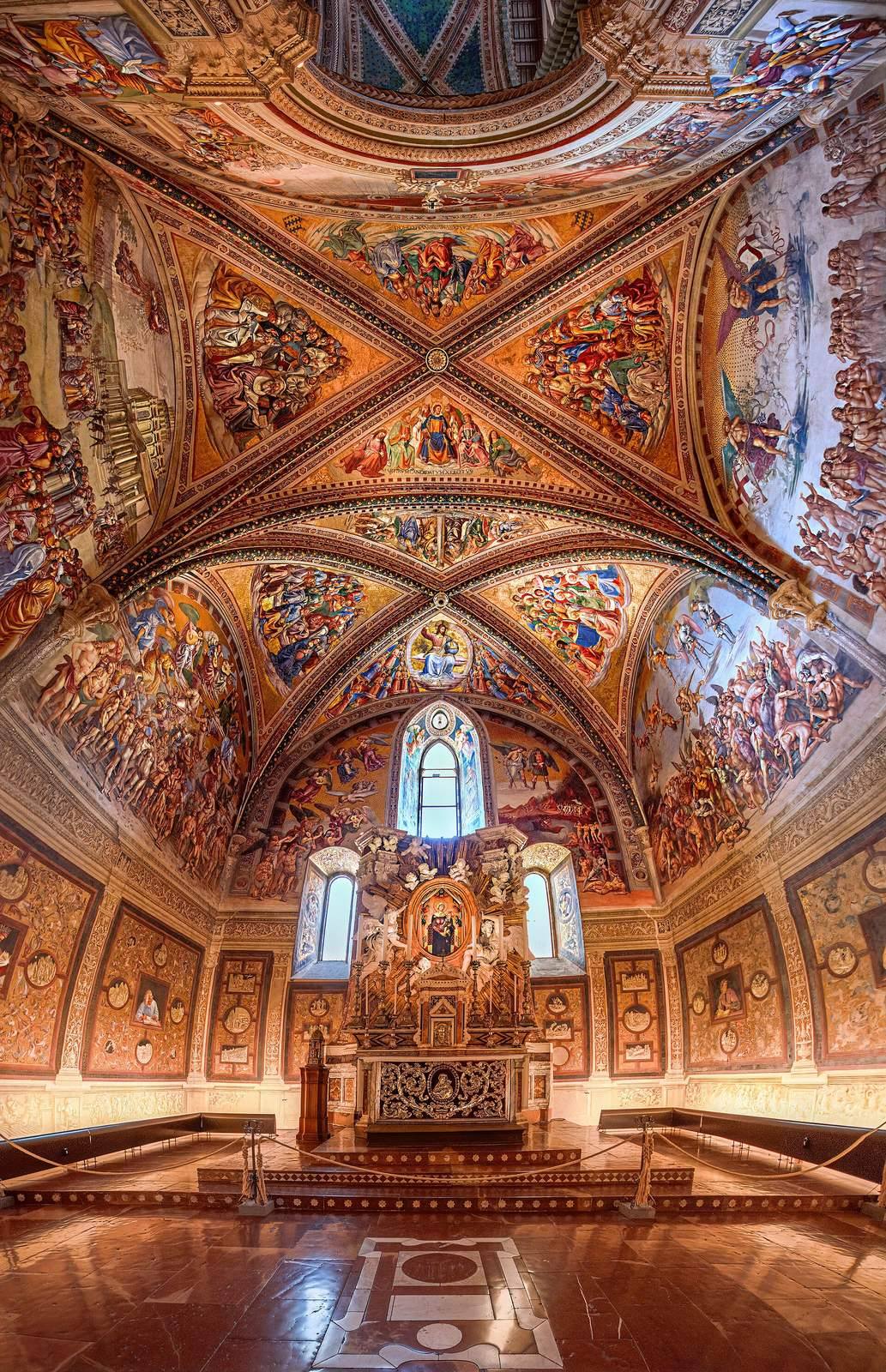
The Cappella di San Brizio is a Roman Catholic chapel in Orvieto Cathedral in Orvieto, Italy. Construction began in 1396, funded by a bequest from the Orvieto benefactor Tommaso di Micheluccio, and enlarged the cathedral built in the thirteenth century under Lorenzo Maitani. Initially intended for the Crowned Virgin, the chapel became known for its decoration devoted to the Last Judgment, the Christian belief that Christ will judge the dead and assign them to salvation or punishment.
Construction and the first paintings
Cristoforo di Francesco of Siena is named as master builder in 1408, and the enlargement was finished in 1425. In 1447, the Opera del Duomo, the institution responsible for works at the cathedral, commissioned the Florentine Dominican friar and painter Fra Angelico to begin the frescoes. Angelico was then serving Pope Nicholas V in Rome. He travelled to Orvieto in June with assistants that included Benozzo Gozzoli, Giovanni Antonio da Firenze, and Giacomo de Poli; the local painter Pietro di Nicola Baroni also joined the team.
Angelico worked at the chapel for fifteen weeks, painting the vault above the altar and the adjoining section. The images included Christ as judge, angels, and prophets. He and his assistants left in September, and the project did not resume. Gozzoli tried unsuccessfully to restart it in 1449. In 1455, workers raised the roof to better protect the painted vaults from water.
Signorelli’s Last Judgment cycle
After the decorative project remained incomplete for at least four decades, the painter Antonio del Massaro, known as Pastura, tried to arrange its continuation. Negotiations with the Umbrian painter Perugino continued for nearly ten years. On 5 April 1499, the commission was given to Luca Signorelli of Cortona, whose comparatively low price and reputation for working efficiently helped secure the decision. The Last Judgment subject was retained amid political and social unrest in Italy and fears of an approaching catastrophe. The cathedral’s archdeacon, Antonio Alberi, advised on the theology and had a library built beside the chapel, with 300 books on theology, philosophy, history, and law.
The cycle drew on the Gospels, the Book of Revelation, the Golden Legend, writings by the fourteenth-century mystic Saint Bridget of Sweden, and Dante. Signorelli may also have consulted German prints, possibly Albrecht Dürer’s Apocalypse, published in 1498, or illustrations from Hartmann Schedel’s Nuremberg Chronicle of 1493. The vaults were complete by 23 April 1500, when Signorelli received a further commission for the remaining decoration. The cycle was finished in 1502, though payments continued until at least 1504.
Names, devotional images, and later work
The chapel was called Cappella Nova, or New Chapel, because it was the last one completed after the Chapel of the Corporal. A marble Pietà by Scalza was installed in 1579 and removed in 1622, when a revered painting of the Madonna della Tavola was brought into the chapel. The image was believed to have been painted by Saint Luke, but dates to the late thirteenth or early fourteenth century. An image of Saint Brizio had been placed beside the Virgin in 1464 and was later removed. The Madonna nonetheless came to be called the Madonna of San Brizio, giving the chapel its present name.
The chapel’s furnishings and adjoining spaces changed during the eighteenth century. Bernardino Cametti made the Altar of Glory, replacing an earlier tabernacle of the Assumption; the tomb of Cardinal Ferdinando Nuzzi was also placed in the chapel and later removed. The Chapel of the Magdalene was renovated. Restoration work began in the first half of the nineteenth century, and paintings covered with lime in the eighteenth century were later uncovered. Work in 1996 was followed by further study of the painted figures, while a later lighting system illuminated the decoration from below. In 1947, a silver-and-enamel votive lamp by engraver Maurizio Ravelli was consecrated in gratitude for the chapel’s narrow escape from bombing during the Second World War.
Remains
The chapel combines a two-bay interior with a large, interrelated programme of paintings on its vaults and walls. Its construction extended the cathedral while retaining most of the earlier fabric and the substantial thickness of its walls. The arrangement brings architectural decoration, biblical scenes, portraits, and narratives drawn from classical writing together around the theme of judgment and the fate of the soul.
Architecture and spatial arrangement
Plan and vaults
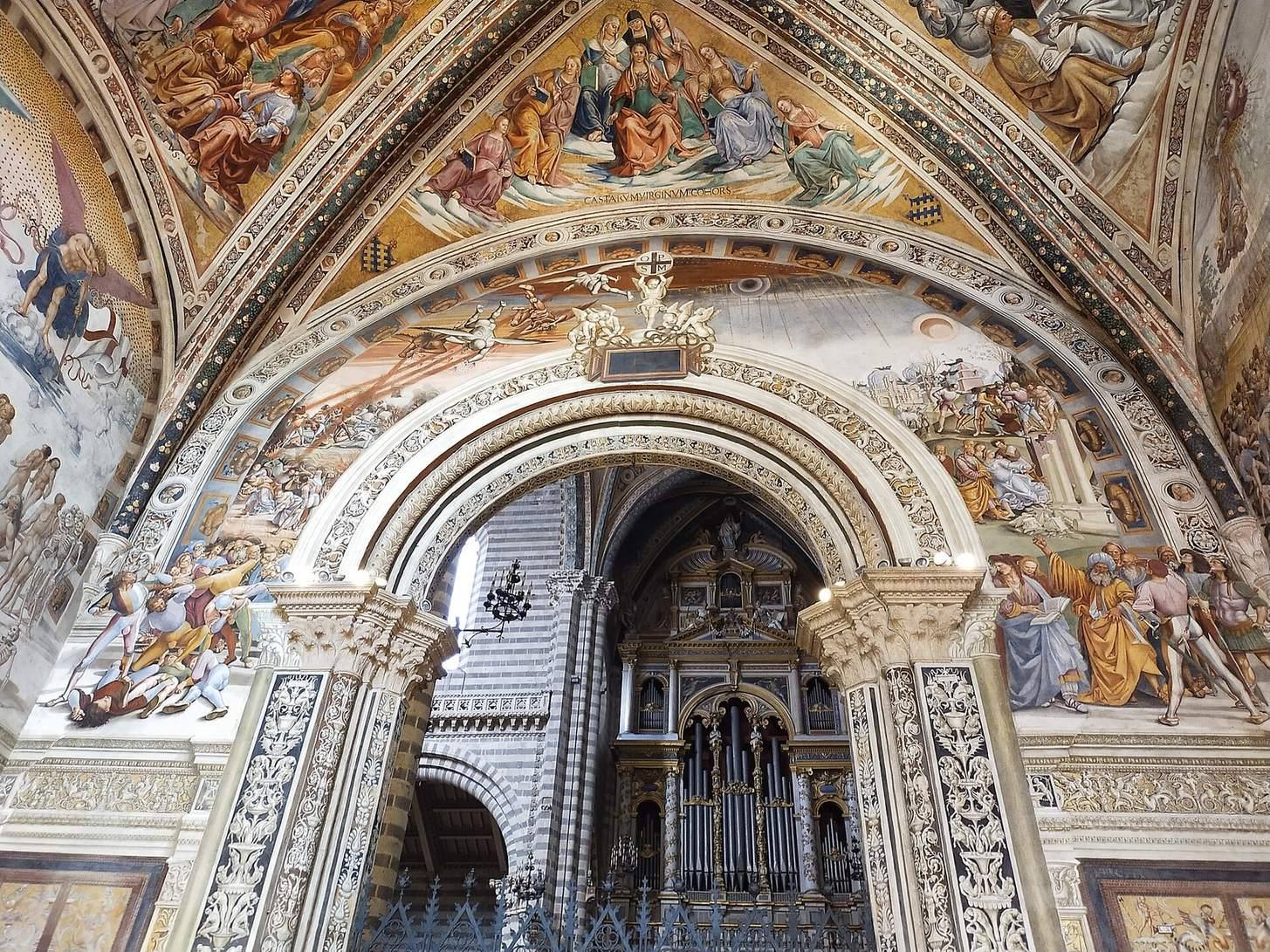
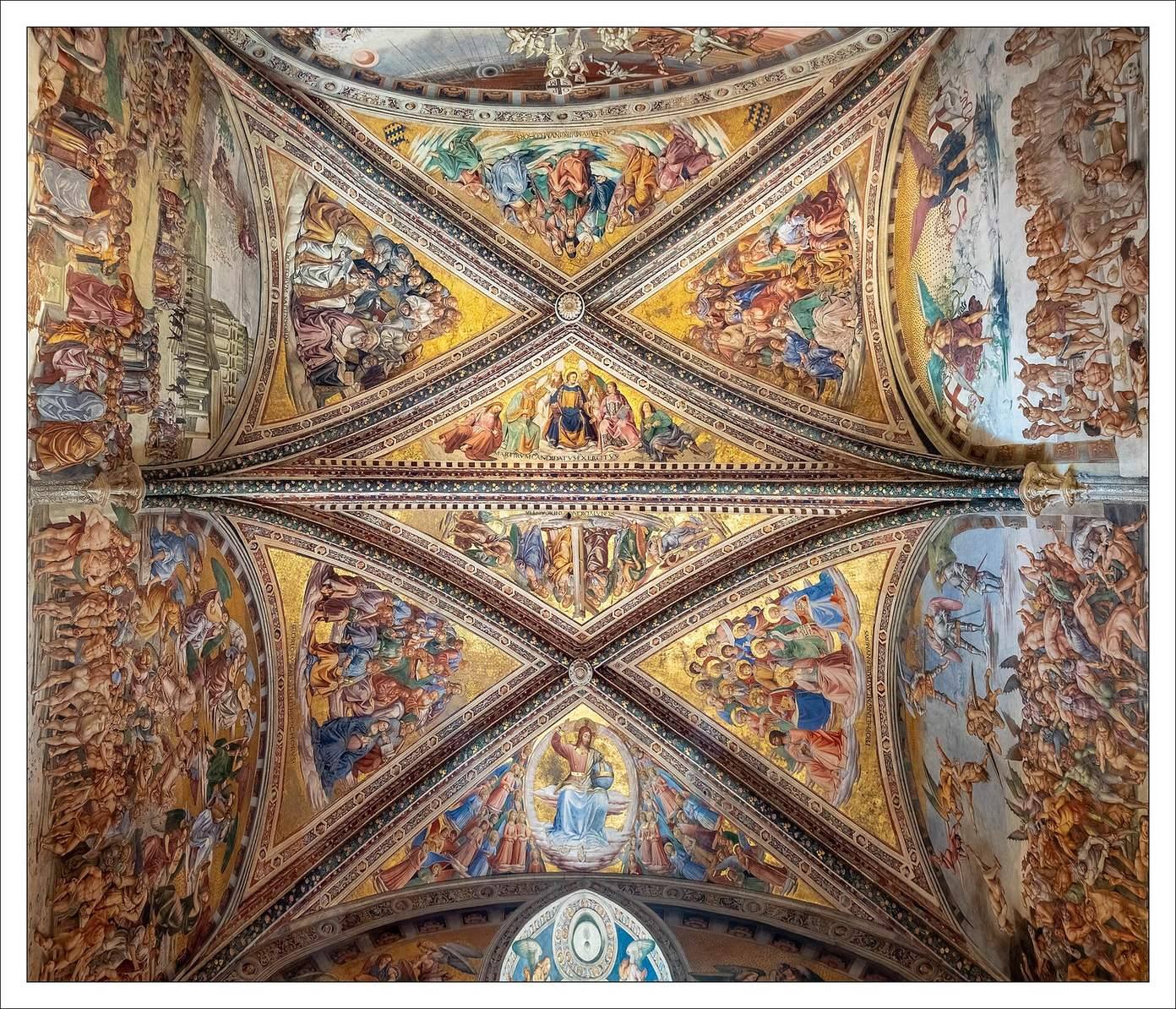
The chapel occupies the site of the former sacristy and a small rounded chapel belonging to the Monaldeschi family. Its two large bays are covered by ribbed vaults, ceilings in which projecting ribs divide the curved surfaces into sections. Together they form six crescent-shaped wall or vault surfaces, called lunettes. The one opposite the entrance is divided into two half-lunettes by a Gothic window above the altar; the entrance occupies part of another. The eight sections of the vault carry paintings.
Entrance and adjoining chapels
A low semicircular arch inside the chapel conceals a supporting flying buttress, an arched brace that transfers structural pressure, and divides off two small chapels. The Chapel of the Holy Bodies of Saints Faustino and Pietro Parenzo opens on the right, while the Chapel of the Magdalene, later called the Gualterio Chapel, lies on the left. Above the entrance arch are a large Gothic double rose window and a crescent-shaped painted field with pairs of angels attributed to Antonio del Massaro. Marble statues of Adam and Eve by Fabrio Toti stand to either side, beneath niches of white and red marble made by Simone Mosca. A wrought-iron screen, made by Gismondo di Graziano in 1516, closes the chapel and imitates the screen of the Chapel of the Corporal.
Vaults and upper-wall paintings
The painted vault
The vault sections have gold backgrounds and are separated by ribs decorated with plant forms. Red bands with small-scale ornament and hexagonal panels containing heads embellish the Gothic-style frames. Above the altar, Angelico’s section shows Christ the Judge among angels; the adjacent section contains sixteen prophets. Angelico’s hand is associated with the damaged figure of Christ, angels to his left, and some seated prophets. Gozzoli is credited with border decorations containing small heads, including a blond youth, a boy wearing a turban, and a self-portrait. The attribution of additional figures to Gozzoli remains disputed. Angelico and his assistants also painted decorative bands on the ribs and sections of the other bay.
Signorelli’s vault paintings include the Apostles, Martyrs, Patriarchs, Doctors of the Church, and Virgins, as well as symbols of Christ’s Passion and angels announcing the Judgment. The groupings occupy distinct sections of the two bays. Angelico’s paintings have a finer, more detailed finish, while Signorelli’s figures are directed more openly toward the viewer.
Antichrist and the end of the world
The first wall scene to the left of the entrance shows the Antichrist, the figure believed to oppose Christ before the end of the world. Standing on a pedestal and resembling Jesus, he is guided by the Devil, who whispers in his ear and appears to direct his gestures. A crowd gathers gifts around him; elsewhere in the scene are a killing and a young woman receiving payment from an elderly merchant. In the distance, the Antichrist orders the deaths of Enoch and Elijah, raises a dead person, and faces religious figures consulting scripture. At the left, the archangel Michael strikes him down and sends fiery rays at his followers.
A deep landscape behind the figures includes a monumental classical building shown with distorted perspective. It may represent the Temple of Solomon in Jerusalem and, by extension, the Church. Its design is arranged around a central space, with four projecting porches in the form of a Greek cross and a double lantern; a dome may continue beyond the painted area. Small black figures of soldiers were added at its base after the fresco was painted. Two black-clad figures at the far left are traditionally identified as Signorelli and, behind him, Fra Angelico. The Antichrist scene has also been interpreted in relation to the Dominican preacher Savonarola, but that reading is not a literal identification of the painted figure. Giorgio Vasari identified several people in contemporary dress as portraits, including Cesare Borgia and the painter Pinturicchio.
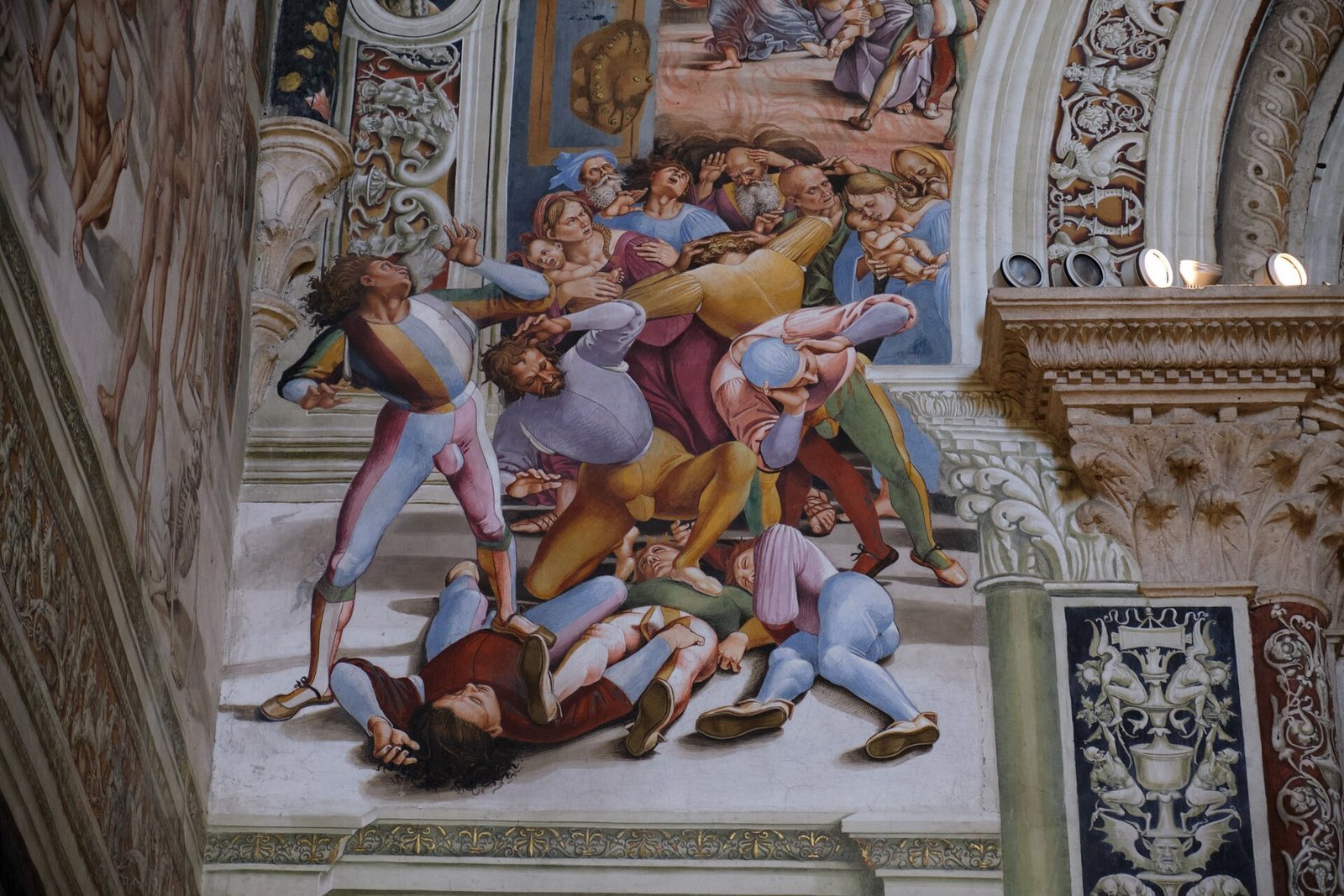
The narrow wall above the entrance carries a scene of the world’s end, divided into two groups by a childlike figure bearing the emblem of the Opera del Duomo. On the right, the Erythraean Sibyl, a prophetic woman of classical tradition, reads her book beside David. An earthquake destroys a temple, robbers strip three youths, and a flood drives ships toward the city as the sun and moon darken. On the left, distant wars and killings accompany winged demons raining fire upon a terrified crowd that appears to spill beyond the painted arch. Seven young people lie dead or dying in the foreground, followed by mothers with children and other figures.
Resurrection of the dead
On the wall to the right of the entrance, two angels with trumpets and banners bearing crosses announce the Resurrection of the Flesh. Against a smooth white ground, the dead appear to rise as if from ice rather than from tombs. Skeletons regain skin and muscle and become vigorous adults; one figure at the far right is shown partway through the change. A nude figure seen from behind addresses the rising dead, while some of them dance. Added painted veils once covered some figures’ private parts and remain faintly visible. The golden sky above is made from individual wax discs covered with gold leaf, with the maker’s fingerprints preserved in the wax. Scratched outlines of preliminary figures can also be seen.
The blessed and the damned
In the altar lunette, which is divided by the window, the damned and the blessed are directed toward punishment or reward beneath Christ the Judge. On the right, Dante’s vestibule of Hell, the region before Hell, includes the morally indifferent pursuing a demon with a white banner. Charon, the ferryman of the dead, prepares to carry the damned, while Minos judges them by winding his tail around each person to assign a punishment. In the foreground, a blue-skinned devil lifts a condemned figure by the hair; Michelangelo copied this figure. On the left, angels lead the saved upward, accompanied by angel musicians.
The second lunette on the right wall shows the damned in Hell as a dense mass of nude bodies among brightly coloured demons. Its grotesque, erotic, and comic details include a flying demon carrying a woman on its shoulders, another biting a woman’s ear, and a blue demon lifting a woman with a horn. Signorelli’s cross-hatching, fine intersecting strokes, gives the bodies a sculptural quality. The blue demon has been interpreted as a self-portrait referring to a private relationship with a blonde woman, who may have been unfaithful. The same woman has been identified among the damned and as the paid companion in the Antichrist scene.
The lunette on the left shows the blessed in a calm setting, represented as mature adults. Nine angels play music above them, while two others scatter roses and camellias. The flowers, applied with a dry painting technique, are now faintly visible.
Lower-wall decoration
Painted architecture and portraits
A painted row of pilasters, shallow rectangular supports attached to a wall, divides the lower-wall decoration. Above them, an entablature, a horizontal ornamental band, carries a richly decorated frieze on a gold ground. Below it, painted panels imitate Roman sarcophagus reliefs and alternate with the pilaster bases. The ornamental designs combine people, animals, and plants, including human-shaped candleholders, tritons, and sea nymphs. Panels contain windows with portraits of famous men, poets, and writers. In some, foreshortened books seem to project over the painted window sills. Beside certain portraits, grisaille medallions, paintings in shades of grey, comment on the writers’ works or illustrate Dante.
The portraits and narrative panels form a programme concerned with poets and the afterlife. The identities of some figures remain uncertain. A nineteenth-century interpretation, favoured until the 1996 restoration, identified Virgil, Homer, Horace, Ovid, and Lucan by comparison with Dante’s account of Limbo. Later study connected the portraits more broadly with poets who wrote about the otherworld. The programme may have been inspired by Federico da Montefeltro’s private study at Urbino. Much of the decorative work was carried out by the workshop.
Dante and the Purgatorio
On the left wall, one panel shows the Roman writer Sallust. Nearby medallions may depict Catiline addressing conspirators, the people’s alarm, and Catiline’s death. Above the entablature, two satyrs harvest and press grapes. A neighbouring panel shows Dante reading and is surrounded by scenes from the first four cantos of the Purgatorio, the second part of his Divine Comedy, which follows souls being purified. The scenes include Dante and Virgil meeting Cato, the arrival of an angel at Purgatory, souls surprised to see a living man, and the poet Casella approaching Dante. Others show Dante and Virgil meeting Manfred, climbing the mountain, discussing the sun’s position, encountering the indolent, and speaking with Belacqua.
A third panel may represent the poet Statius. Its surrounding scenes continue Dante’s journey: Virgil reproaches Dante for lingering with a soul who recognizes him; the violent dead sing the Miserere before noticing Dante’s shadow; and souls ask the poets to pray for them. Other medallions show the meeting with Sordello, indolent souls watched over by angels driving off a serpent, and encounters with Nino Visconti and Corrado Malaspina. Four more depict the labours of Hercules, including his struggles with the Nemean lion and the Lernaean Hydra.
Dante scenes continue across the rear wall. The upper register includes his dream of an eagle, Virgil and Saint Lucy arranging for the sleeping poet to be taken to Purgatory’s entrance, and Dante asking a sword-bearing angel to let him through its gate. Other images show Dante and Virgil travelling along a narrow road, David’s order to move the Ark, the Roman emperor Trajan with a widow, and Dante looking toward souls Virgil suggests as possible guides. The lower panel shows Dante meeting three of the proud.
Classical stories and the altar wall
Beside the altar, a panel combines two roundels with a rectangular image. One roundel shows a standing woman nursing a child while a reclining woman bites her hands. The rectangle contains two scenes from the first book of Virgil’s Aeneid. In another section, paintings in shades of grey draw on Virgil, Ovid, and Claudian. They include Hercules with Pholus, an episode that may involve Deiphobus, damned people pursued by demons, Perseus rescuing Andromeda, and a disturbance at the palace of Cepheus. Scenes from Claudian’s account of Proserpina’s abduction show Pluto and his chariot on the giant Enceladus, Proserpina on Mount Etna with Venus, Minerva, and Diana, and Ceres searching for her daughter.
A further panel shows a crowned poet, possibly Ovid, among episodes from the Metamorphoses. These include the Sibyl pointing toward the underworld with a golden bough, Aeneas with the soul of a dead person who may be Anchises, and Orpheus seeking Eurydice. Other scenes show demons driving Orpheus away while Eurydice remains in Hell, and Hercules capturing Cerberus. A neighbouring panel may portray Tibullus, wearing an oak-leaf crown and holding a letter. Its roundels contrast the horrors of war in Jupiter’s age with peace and prosperity in Saturn’s. Above, two tritons summon the Phoenix from a fire, an allusion to Christ’s resurrection.
Painted roundels on the entrance wall show men. One, now almost illegible, faces toward the altar and salvation. Another portrays a man reacting to the Last Days; it was once identified as the ancient Greek philosopher Empedocles, without supporting evidence. Near the altar, some paintings that had been covered with lime were later partly uncovered. Their exposed images include a man being killed, a triton striking a prone figure, two upright demons, and a man lying in flames and biting his left hand, possibly Cain.
Side chapels and furnishings
Chapel of the Holy Bodies
Cut into the thickness of the right wall, the Chapel of the Holy Bodies contains a marble sarcophagus holding the bodies of Saints Faustino and Pietro Parenzo, objects of strong local devotion. Beneath the shelves supporting the sarcophagus, Signorelli painted the dead Christ mourned between the two saints. The work may be a replica made by Signorelli himself of his Lamentation in the Diocesan Museum of Cortona. Vasari wrote that Christ’s body was modelled on Signorelli’s son Antonio, who died of plague at Cortona in 1502. Scenes of the saints’ martyrdom appear on the chapel’s side walls.
Gualterio Chapel
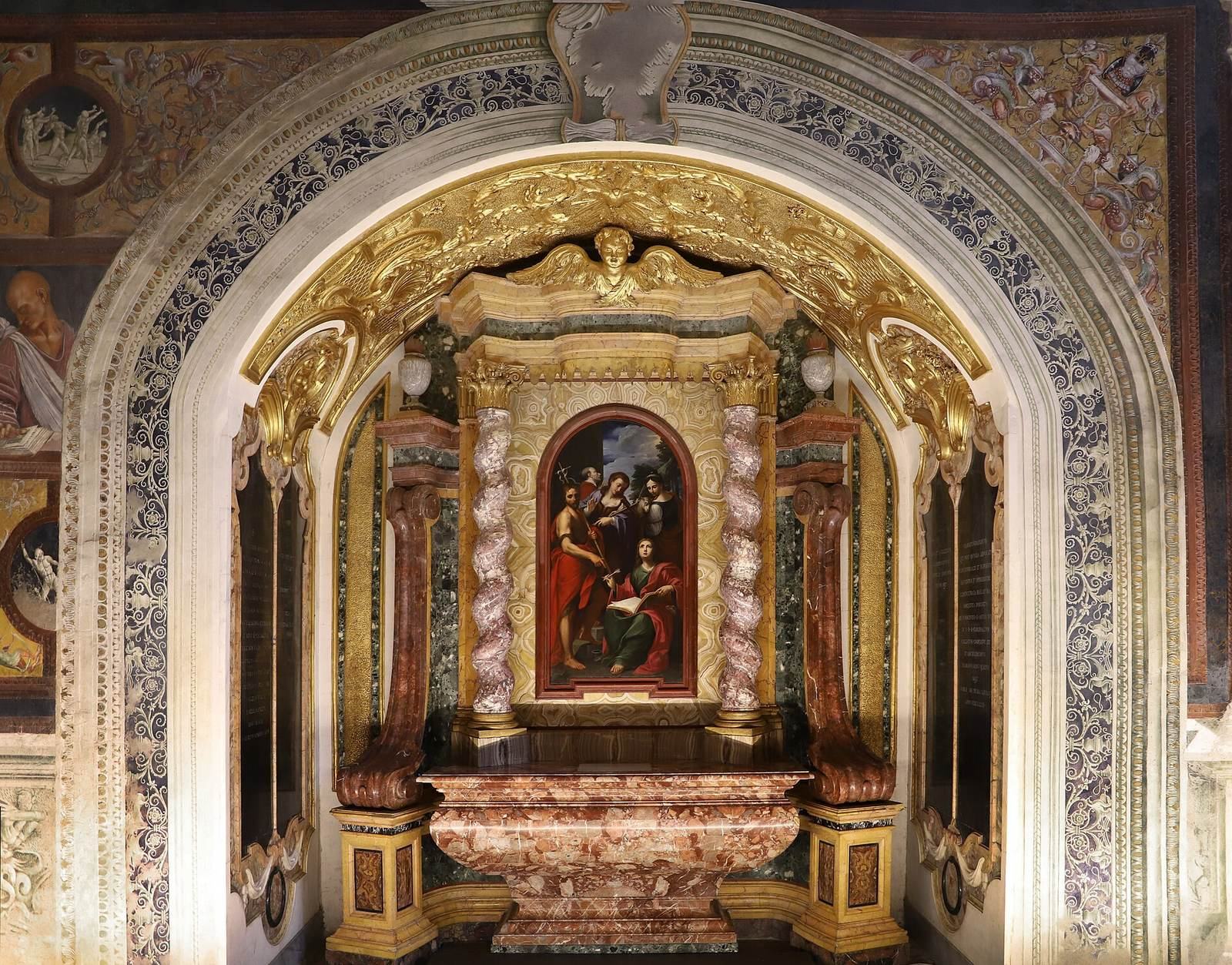
The small Gualterio Chapel opens from the left wall. Its decoration was completed in 1736. Its altar, finished by 1724 and faced with coloured marble, holds a small painting dated to that year. The image shows Saints Charles, John the Baptist, John the Evangelist, Mary Magdalene, and Agnes.
Altar and metalwork
The Altar of Glory is made of marble, fitted pieces of cut stone, and alabaster. Its crimson velvet and silver altar frontal, the decorated facing on the front of the altar, was made by Angelo Cervosi. Michele Borgianni produced six silver candlesticks, followed by four more. These furnishings accompany the chapel’s extensive painted decoration.