Cambrai Cathedral: From Benedictine Abbey to Archbishop’s Seat
Site at a Glance
- Popularity
- Medium
- Country
- France
- Primary era
- Early Modern
- Eras represented
- Medieval, Early Modern, Modern
- Civilizations
- French, Holy Roman Empire
- Site type
- Religious
- Remains
- Cathedral
On this page18 sections
History
Cambrai Cathedral, in Cambrai, France, is a Roman Catholic church and the seat of the Archdiocese of Cambrai. Rebuilt between 1695 and 1703 as a Benedictine abbey church, it combines Baroque and classical forms associated with the reign of Louis XIV. Dedicated to the Virgin Mary, it is also known as Notre-Dame-de-Grâce.
The Benedictine foundation
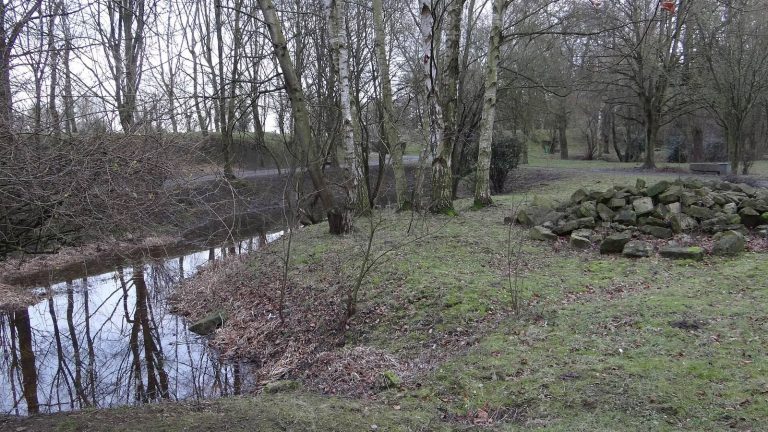
A chapel of the Holy Sepulchre was built here in 1047 by Bishop Gérard of Cambrai, on the site of a mass grave. In 1054, Bishop Liébert of Arras and Cambrai, unable to make a pilgrimage to Jerusalem, set out to recreate its holy places in Cambrai. The hill of Mont-des-Bœufs, with an orchard belonging to Saint-Géry Abbey and a stream between it and the city, seemed to recall Gethsemane and the Kidron Valley.
Liébert established a Benedictine monastery, where the monks followed the Rule of Saint Benedict. Its church was consecrated on 28 October 1064 and was intended to evoke Jerusalem’s Church of the Holy Sepulchre. Liébert endowed the foundation with relics and extensive lands, and extended Cambrai’s walls to protect the abbey, which had stood outside them.
Rebuilding and the present church
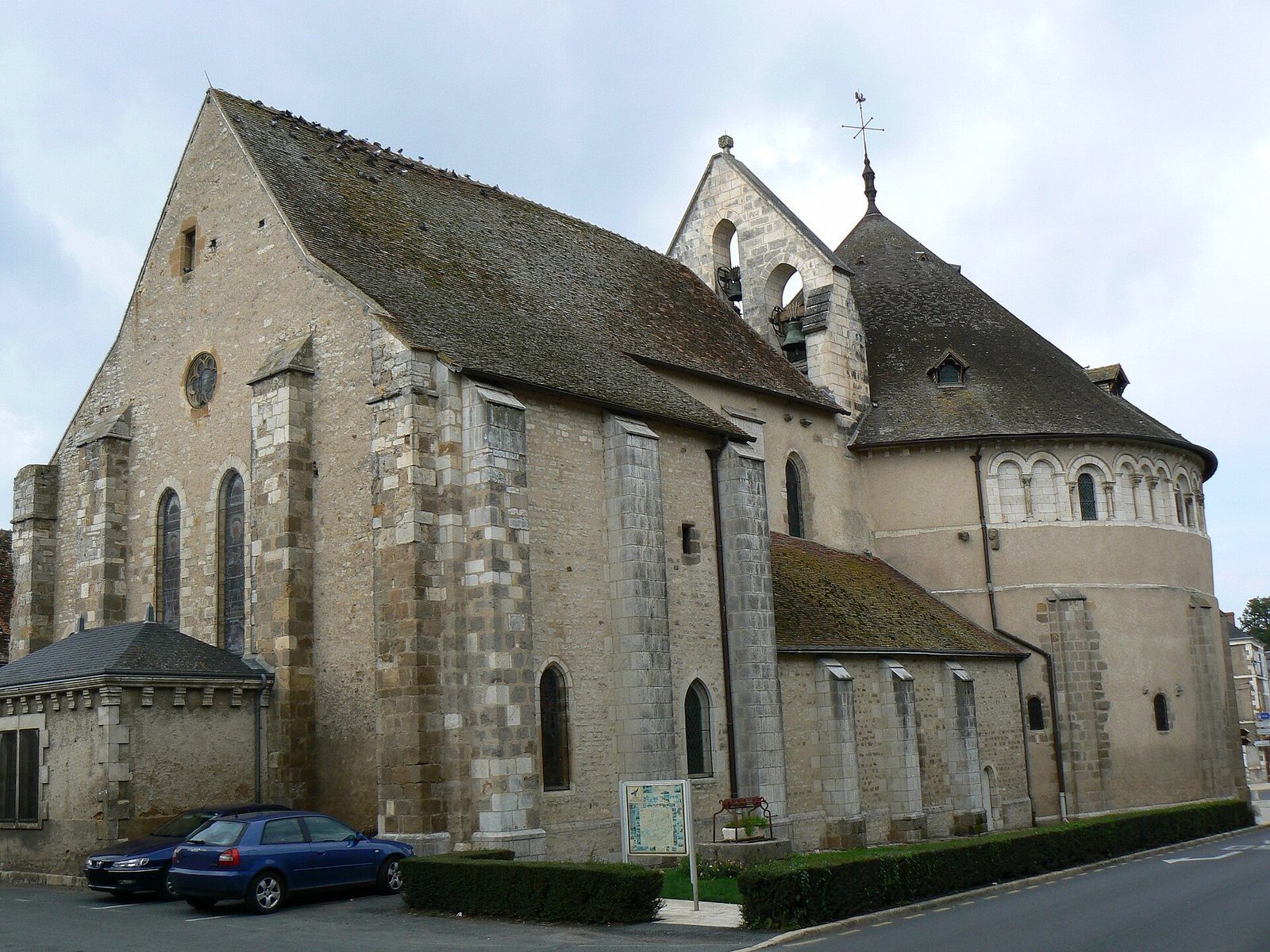
The abbey church was repaired after a fire in 1145. In the thirteenth century, an abbot replaced Liébert’s church with a building on a cross-shaped plan, and in 1498 Abbot Guillaume Courtois ordered a further rebuilding and enlargement. In 1553, troops of King Henry II of France burned the abbey and chapel. Reconstruction included a detached bell tower and was completed in 1602, when Archbishop Guillaume de Berghes consecrated the church again.
Cambrai came under French rule in 1678, following the Treaty of Nijmegen. French architectural influence grew in the region, while the abbey’s wealth supported extensive construction. The Church held about 40 percent of the land in Cambrésis, and rebuilding was also used as a means of avoiding taxation. A church tower dating from 1542 was retained during later rebuilding.
In 1695, the year François Fénelon became archbishop of Cambrai, Abbot Louis de Marbaix began a new choir. The project grew to include the nave, and the rebuilt church was completed in 1703, with only the earlier tower retained. The work reflected Louis XIV-era taste through its combination of Baroque and classical elements. Abbot Joseph Dambrinne continued the abbey’s building programme, extending it to its associated quarters and communal buildings.
Fénelon died in 1715 and was first buried in the former cathedral. His body was moved to the bishops’ burial vault in 1720, and a mausoleum was erected a few years later. After the former cathedral was destroyed, his remains were transferred to the abbey church. A new monument was commissioned in 1823, with a marble block donated by King Louis XVIII. Sculptor David d’Angers completed it, and it was unveiled in January 1826; Fénelon’s remains were placed in it that month.
Revolution and the new cathedral
During the French Revolution, the abbey church survived while Cambrai’s former Gothic cathedral was demolished. In April 1789, representatives of the region’s three estates, the clergy, nobility, and Third Estate, met in the church. A 1790 decree concerning religious orders led to the monks being released from their vows and the abbey’s property being confiscated. The church closed in November. Archbishop Ferdinand-Mériadec de Rohan was deposed after refusing the required oath, and Claude Primat was elected in his place. The church reopened as a parish in 1791 under Pierre Renaud, a priest who had accepted the oath imposed on clergy.
The church’s cracked tower was demolished in 1792. From January 1794, the former abbey served as a hospital for people with scabies. Around this time, its choir grilles were removed and used to enclose the Tree of Liberty, a symbol of revolutionary freedom, in the main square. Joseph Le Bon, sent to Cambrai by the Committee of Public Safety in May 1794, later addressed the people from the pulpit when the church was being used as a Temple of Reason, a center for revolutionary civic and secular worship. The building had also been used as a barn.
The church was sold as national property to the merchant Blanquart of Saint-Quentin. In 1800, the municipal administration prohibited its demolition, saving the building. The former cathedral, also sold to Blanquart, was dismantled; its remaining tower collapsed in a storm in 1809. After the 1801 Concordat, Bishop Louis Belmas reopened the former abbey church as Saint-Géry. He bought the former abbot’s residence in 1804 to house the bishopric and made the church a cathedral. Cambrai became a diocese rather than an archdiocese in 1802, then was re-established as an archbishopric in 1841.
The image of the Virgin that gave the church its Notre-Dame-de-Grâce name was transferred there from the former cathedral in 1797, following a petition by parishioners. It had drawn pilgrims for centuries: a confraternity was founded to care for and venerate it in 1453, and it was carried in procession through Cambrai for the Feast of the Assumption in 1455. The image had arrived in Cambrai in 1440 and was left to the cathedral by Fursy de Bruille, a canon, at his death in 1450; the donation is dated 14 August 1451.
Fire, restoration, and war
A major fire during the night of 9–10 September 1859 destroyed the roof and furnishings and badly damaged the vaults. Although the municipality and Archbishop René-François Régnier first considered building a new church, the architect Eugène Viollet-le-Duc argued for restoring the existing one as an important example of Louis XIV-era architecture. The restoration was directed by Henri de Baralle, and the cathedral was consecrated again on 12 May 1894. Pope Leo XIII granted it the honorary title of minor basilica in 1896. It has been listed as a French historic monument since 1906.
Shellfire severely damaged the cathedral in the final months of the First World War. A shell tore a large hole in the bell tower, but it remained standing. Cambrai residents opposed its demolition, and the building was repaired. The cathedral also sustained less severe damage during the Second World War. Its roofs were restored between 2000 and 2007, and work on the interior and stained glass began in 2022.
Remains
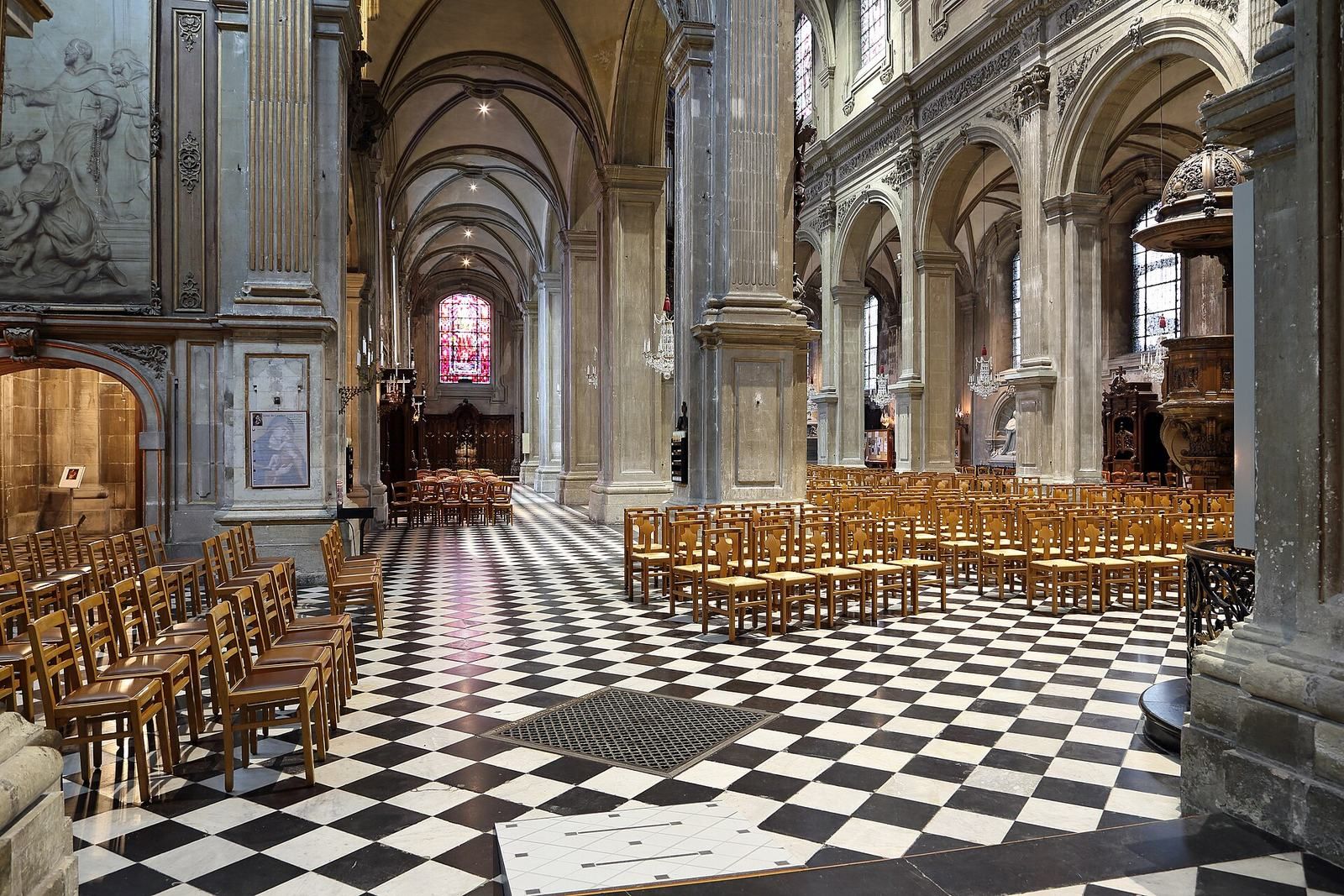
The cathedral has three aisles arranged on a cross-shaped plan, a long choir, and a prominent western façade. Its Baroque and classical character reflects the rebuilding completed in 1703, while later restoration altered and enriched parts of the building. The surviving abbey fabric also includes a sandstone pillar from the earliest church and the former guest quarter.
The church and abbey fabric
Plan, façade, and tower
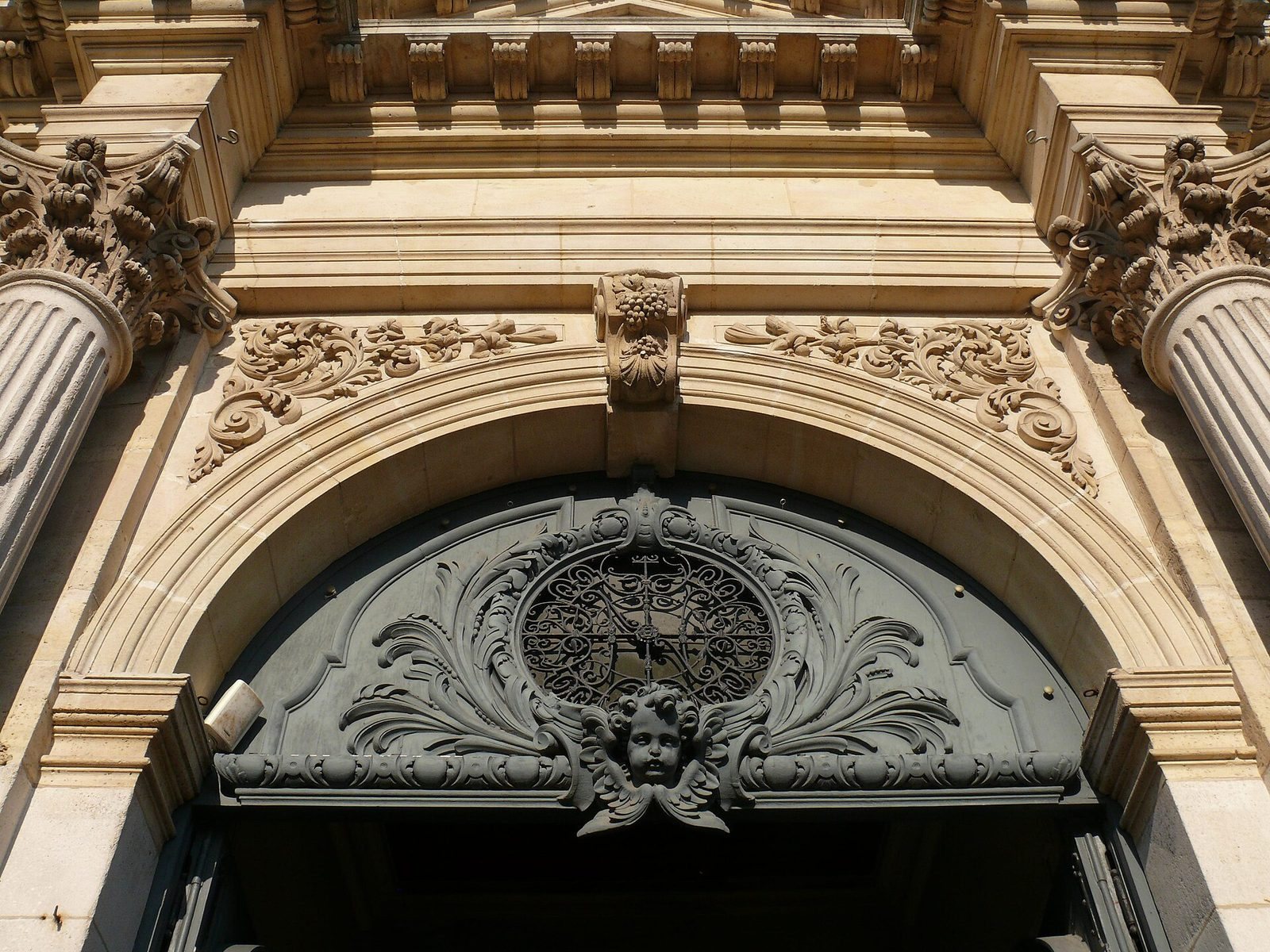
The nineteenth-century restoration added five chapels around the ambulatory, a passage running around the choir, and a Chapel of Saint Michael beside the Chapel of Notre-Dame-de-Grâce. The western façade received statues of saints and ornamental details. The restoration also introduced new fittings in a neo-Baroque style and a distinctive crown topped by a gilded statue of the Virgin. The bell tower, completed in 1876, rises 65 metres.
Remnant of the earliest church
The first abbey church had a rectangular nave for the monks adjoining a circular structure intended for pilgrims. Its only surviving remnant is a sandstone pillar inside the present cathedral, with the pulpit attached to it. The pillar probably supported the earlier bell tower.
Former guest quarter
The abbey’s guest quarter survives as a separate building and is now occupied by the Hôtel de La Poste. It formed part of the wider abbey complex, which also had quarters associated with the abbot, a refectory, and a library.
Images, paintings, and memorials
Notre-Dame-de-Grâce icon
The icon in a side chapel measures 35.7 by 25.7 centimetres. Made around 1340, it is an Italo-Byzantine image of the Virgin and Child in a tender, intimate pose, a type known as Eleousa. Cardinal Jean Allarmet de Brogny acquired it; tradition says that a patriarch of the Greek Church gave it to him at the Council of Constance. The cardinal passed it to his secretary, Fursy de Bruille, who brought it to Cambrai. A longstanding legend says the image was secretly venerated in Jerusalem during the early persecutions of Christians, given to Pulcheria in 430, and kept in a church she founded at Constantinople. Tradition also attributes it to Saint Luke.
Paintings in the chapels and sacristy
Nine large grisaille paintings, works executed mainly in shades of grey, are preserved in the cathedral. Painted by Martin-Joseph Geeraerts of Antwerp, they form two cycles: one on the life of the Virgin and another on the Passion. They are located in the chapels of Notre-Dame-de-Grâce and Saint Joseph and in the sacristy. The scenes include the Presentation of the Virgin in the Temple, the Annunciation, and the Descent from the Cross. Painted effects give some details an illusion of three-dimensional form.
Fénelon’s monument
David d’Angers’s marble monument to Fénelon includes a statue and low-relief carvings. The marble was donated by Louis XVIII, and the monument contains Fénelon’s remains. An earlier mausoleum had included a bust by Lemoyne, now held at the Cambrai Museum.
Crypt and Belloc memorial
The crypt, a burial chamber beneath the church, holds the remains of Cambrai’s bishops and archbishops, recovered from beneath the former cathedral. A separate memorial erected by Hilaire Belloc commemorates his son, who was killed nearby in the final days of the First World War.
Organs and later artwork
Organs
The main organ was built in 1897 by Pierre Schyven’s workshop in Ixelles. It originally had 38 stops, each controlling a set of pipes, and 2,408 pipes in total. After First World War damage, Auguste Convers substantially restored and enlarged it. The resulting instrument has 49 stops and 3,670 pipes, with three keyboards played by the hands and a pedalboard played by the feet. It was inaugurated by Joseph Bonnet on 9 June 1936. Its case is an eighteenth-century work by Aimé-Joseph Carlier, assembled by the Lille cabinetmaker Buisine to designs by diocesan architect Guidasci. Convers also built a new choir organ in 1936.
Assumption at the crossing
A circular painting titled Assumption, by French painter Augustin Frison-Roche, is positioned at the crossing, where the church’s crosswise section meets the nave and choir, 21 metres above the floor. Measuring 3.78 metres in diameter, it depicts the Virgin Mary being taken bodily into heaven, with her arms open in welcome. Its stars represent the sky on 15 August 2025. The work was publicly presented in March 2025 before installation. An eighteenth-century canvas of the same subject had previously occupied the crossing and was lost in the 1859 fire.