Almodí de València: A Medieval Municipal Grain Store
Site at a Glance
- Popularity
- Medium
- Country
- Spain
- Primary era
- Medieval
- Eras represented
- Medieval, Early Modern, Modern
- Civilizations
- Crown of Aragon, Spanish
- Site type
- Economic
- Remains
- Warehouse
On this page9 sections
History
Origins and medieval expansion
The Almodí de València is a former municipal grain store in València, Spain, with an original structure broadly dated to the 14th century and Valencian Gothic design incorporating Renaissance elements. Its origins probably lie in the period after the Christian reconquest. Built over part of the former Islamic alcázar, a fortified palace or citadel, and beside one of the city’s Roman entrances, it stored and sold wheat to supply València. It formed part of a wider provisioning system: a separate grain store from the Islamic period stood near the mosque, and the port’s shipyards also stored grain.
Building work began in 1417, when master builders associated with Valencia’s Royal Palace constructed the street-facing front and the first arches. Around 1455, a further campaign enlarged and completed the structure, adding the remaining arches and a portico on Almodí Street. The building grew during the 15th and 16th centuries and was then royal property.
City management and later changes
By the late 15th century, responsibility for the Almodí had passed to the city council. The council oversaw the wheat supply under strict rules, using public officials to manage distribution and trade.
Work around 1571 changed the building’s earlier appearance. During the 17th century, a roof covered its open central courtyard, and mural painting began in 1609 and continued through that century. In the 19th century, the portico facing Almodí Street was removed and the portico facing Plaça de Sant Lluís Bertran was blocked. The wooden roofs were altered, the original eaves were removed, and new windows with grilles were opened.
Modern civic use
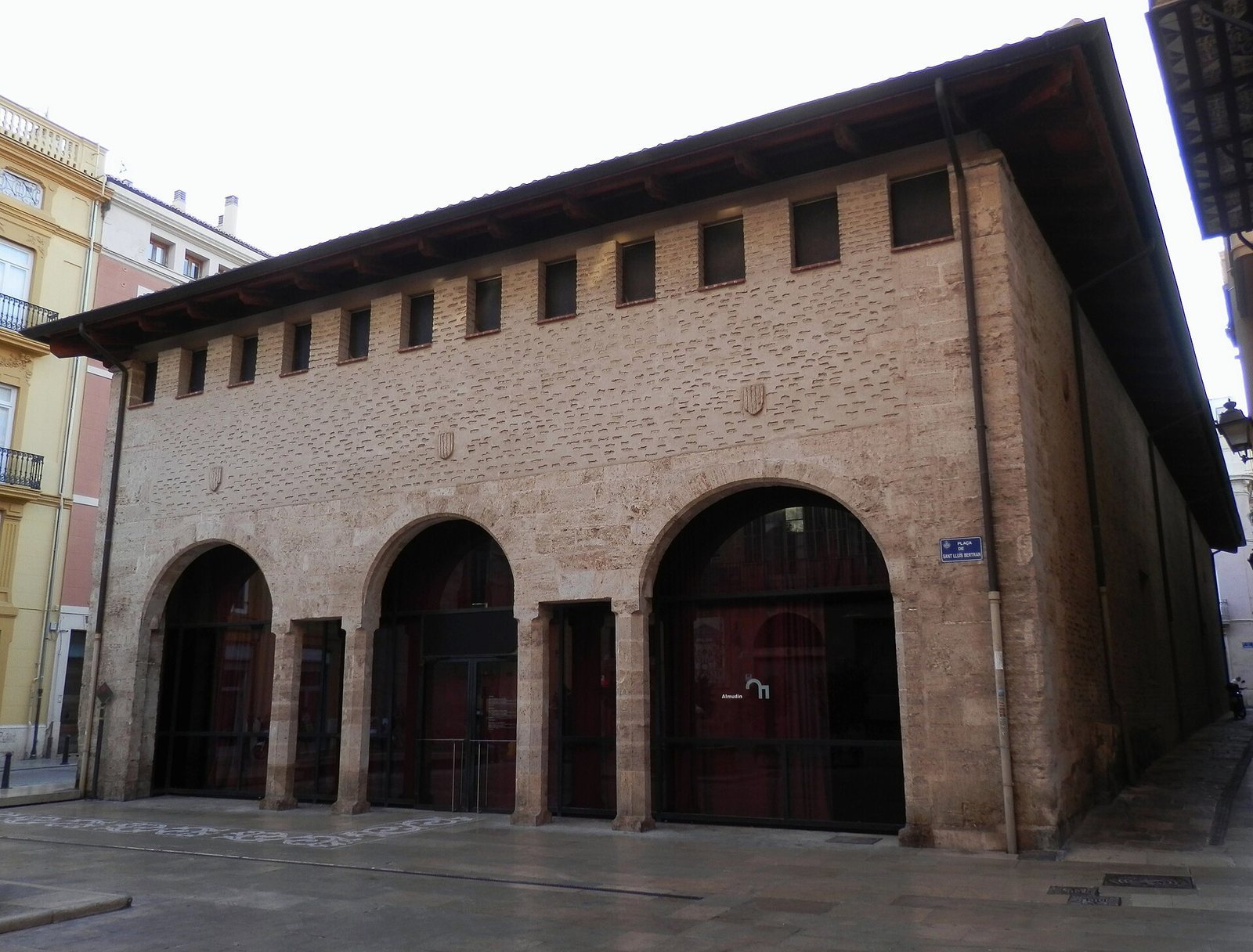
The Almodí stopped serving as a wheat store in 1906. Valencia’s Paleontological Museum occupied the building from 1908 to 1991. A restoration carried out between 1993 and 1996 brought the three-arched portico facing Plaça de Sant Lluís Bertran back into view. Since 1996, the building has served as a municipal exhibition space. It was declared a Historic-Artistic Monument in 1969 and is classified as a Cultural Interest Property in the monument category.
Remains
Plan and construction
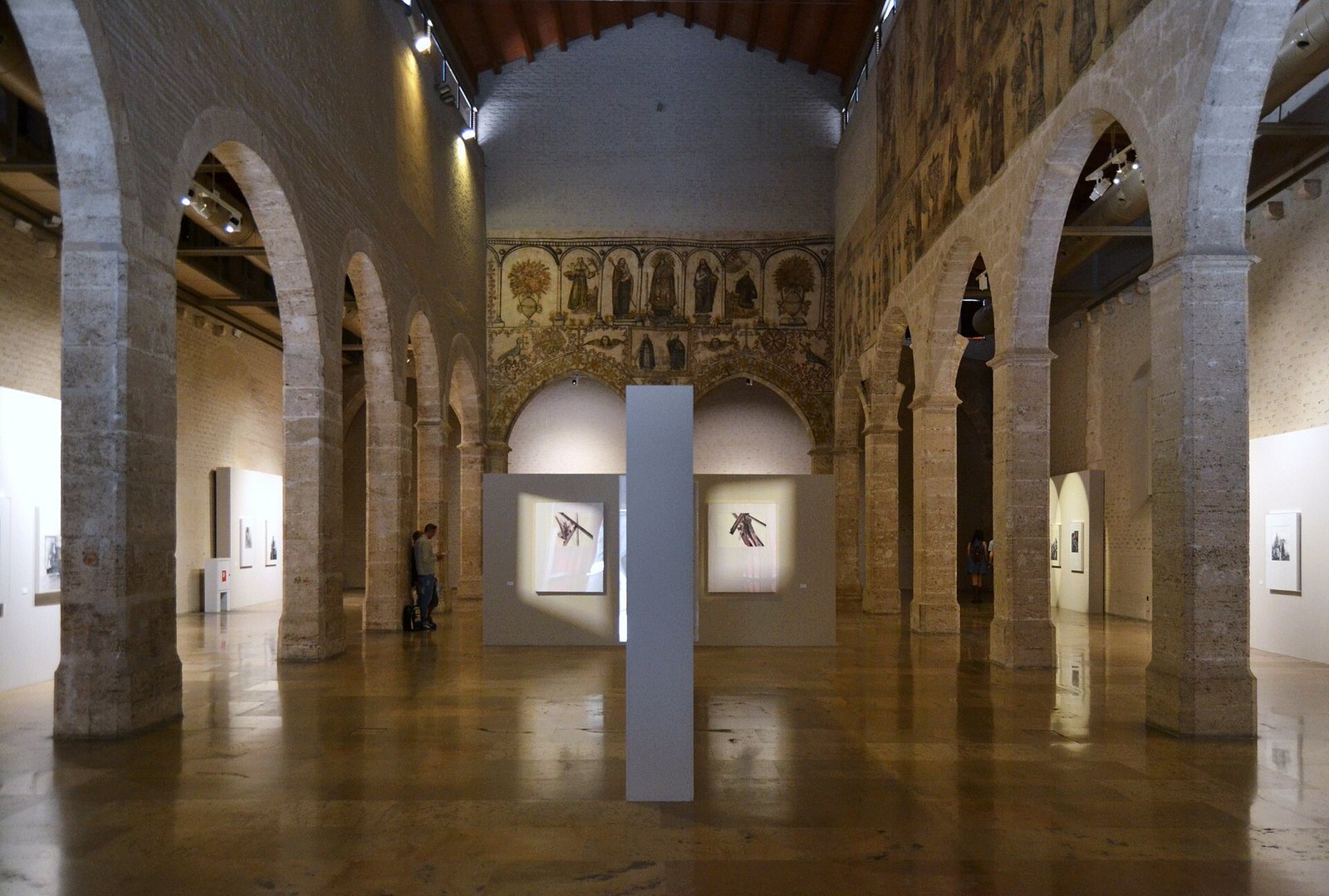
The freestanding building has a rectangular plan. A broad, raised central hall is divided from two side aisles by rows of arches. The central hall has a timber gabled roof, while the side aisles have sloping roofs. The resulting layout reflects the roofed-over courtyard described in the building’s history. Its walls use rammed-earth construction, with ashlar stone blocks at the corners. Carved white-limestone arches appear inside and at the entrances, and timber forms the roof structure.
Entrances and stonework
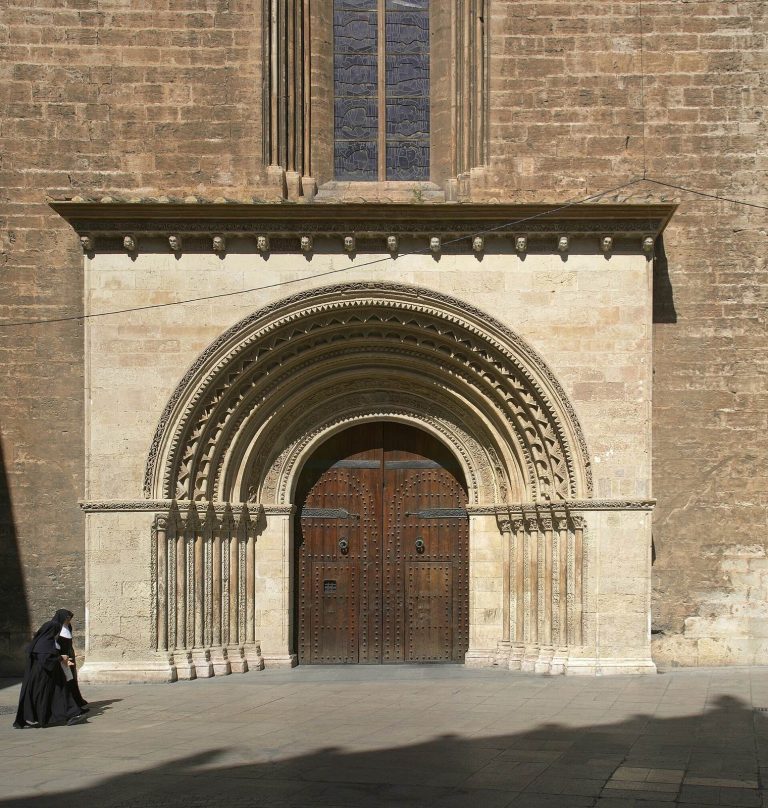
The Almodí Street entrance retains a semicircular arch. On the Plaça de Sant Lluís Bertran side, a portico has three stone arches in a composition with a central arch flanked by straight-topped openings. Two pairs of polygonal piers support the arches, with straight sections between them. Shields above each arch display the bars of the Crown of Aragon, a composite monarchy whose territories included the kingdom of Aragon and other lands around the western Mediterranean. The design combines Renaissance-derived forms with Gothic elements. Other stonework includes diagonal arches and arches at the rear corner; arches near the portico carry geometric and plant-like mouldings.
Interior features and decoration
Murals cover three interior walls and the upper parts of the central hall. Their popular-style scenes concern the arrival of wheat in València, the patron saints of guilds, or trade associations, involved in the grain business, and aspects of social and religious life. The paintings use glue tempera. A floor laid around 1571 bears the city’s coat of arms. The interior also has a timber-beam ceiling that was entirely remodelled during the recent restoration.
Surrounding complex
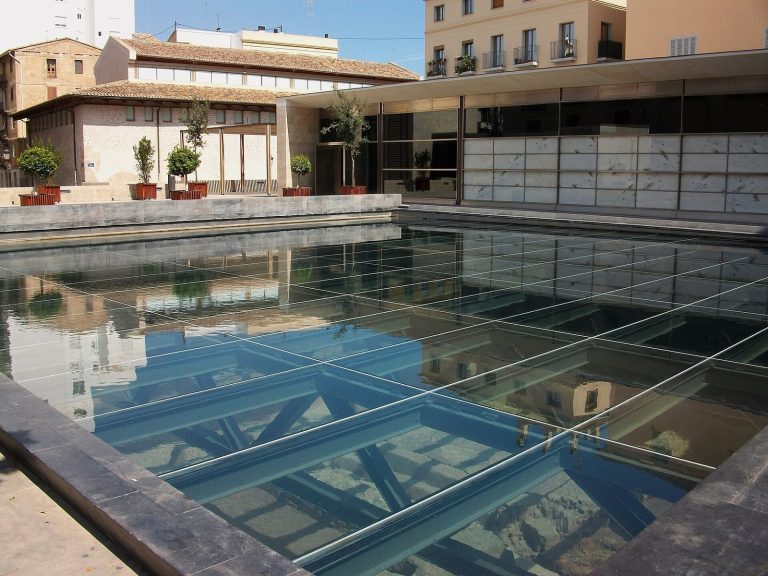
The Almodí forms an ensemble with Escrivà Palace and the birthplace of Saint Louis Bertrand, a Spanish Dominican friar and Catholic saint. The Almodí museum complex also includes a porticoed courtyard adjoining the former flour-weighing building.