The Buried Pyramid: An Unfinished Royal Funerary Complex at Saqqara, Egypt
Site at a Glance
- Popularity
- Very High
- Country
- Egypt
- Primary era
- Bronze Age
- Eras represented
- Bronze Age
- Civilizations
- Egyptian
- Site type
- Burial
- Remains
- Pyramid
On this page15 sections
History
The Buried Pyramid is an unfinished royal funerary complex at Saqqara, Egypt, generally attributed to Sekhemkhet, a ruler of Egypt’s Third Dynasty. Ancient Egyptian builders began it in the 27th century BCE, during the early Old Kingdom, when royal pyramid complexes were developing. Sekhemkhet succeeded Djoser and ruled for about six years; his early death is thought to have brought most construction to a halt.
Construction and royal attribution
Sekhemkhet remains the usual candidate for the pyramid’s owner, although the evidence has prompted other interpretations. Seals bearing his Horus name, a royal name linked to the god Horus, came from the descending gallery. An ivory label from the burial apartments carries the name Djeseret-Ânkh-Nebty. This may have been Sekhemkhet’s Nebty name, one of a pharaoh’s formal names invoking the Two Ladies, Nekhbet and Wadjet, or it may have named a queen. Another proposal assigns the pyramid to Sanakht, a ruler whose place in the succession is debated, and treats Sekhemkhet’s seals as a later deposit. That interpretation remains uncertain.
A construction inscription on the enclosure wall also names Imhotep, the official and architect traditionally associated with Djoser’s Step Pyramid. His titles do not survive in the inscription, so it does not establish that he designed Sekhemkhet’s complex.
Some installations for cult rituals appear to have been completed after work on the pyramid was curtailed. A mortuary temple, a building used for rites connected with a deceased ruler’s cult, may have been planned to the north. Other ceremonial buildings have also been proposed, but their intended form and construction remain uncertain.
Discovery and investigation
Egyptian Egyptologist Zakaria Goneim noticed a rectangular outline in 1951 while excavating near the complex of Unas, a Fifth Dynasty pharaoh. Goneim began investigating the enclosure and, in 1952, uncovered remains of the pyramid and the northern entrance to its underground passages.
On 31 May 1954, excavators broke through the sealed wall before the burial chamber. The alabaster sarcophagus inside was opened on 26 June and found empty. Its sealed condition prompted speculation that Sekhemkhet’s body had not been available for burial, but no historical or archaeological evidence confirms that explanation or suggestions that he died in an accident or was assassinated. The timing of any disturbance to the tomb is also unclear. Plundering during the First Intermediate Period, a time of political division between the Old and Middle Kingdoms, has been proposed, as has an earlier date; Demotic papyri, written in a later form of Egyptian used in the first millennium BCE, point to disturbance during the Late Period.
The discovery and the empty sarcophagus drew criticism of Goneim. He was later accused in connection with a valuable vessel missing from Djoser’s complex. Jean-Philippe Lauer found the vessel miscatalogued in the Egyptian Museum in Cairo on 12 January 1959, the day Goneim died. Goneim’s death is generally described as suicide, although murder has also been suggested.
Lauer resumed work at the complex in 1963 and discovered the South Tomb in 1967. He excavated there intermittently until 1973, but the investigation remained incomplete.
Remains
Enclosure and site plan
Overall plan
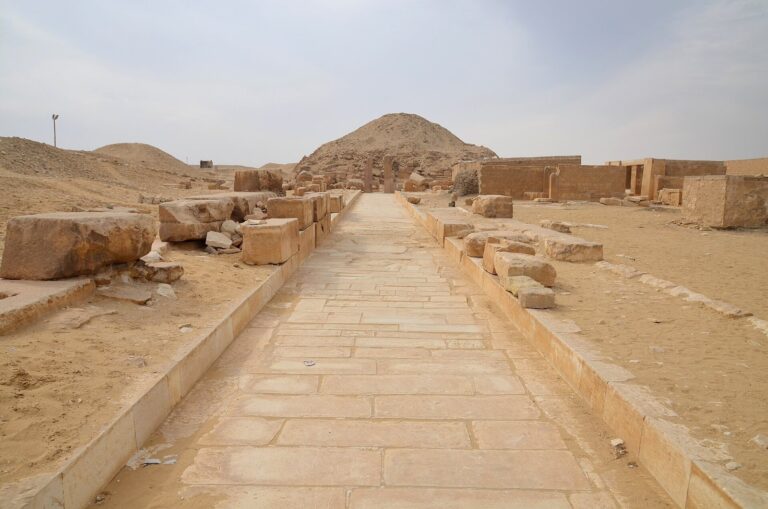
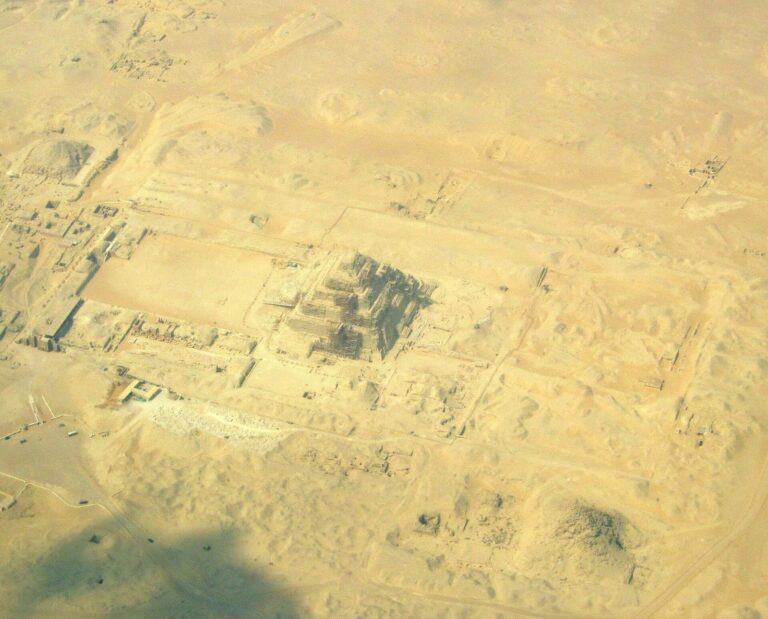
The complex is laid out on a roughly north–south axis, angled about 11 degrees west, within an enclosure measuring approximately 546 by 185 metres. The pyramid stands off-centre within the larger enclosed area. Two enclosure lines have been identified, but their sequence is unresolved. One proposed plan begins with an area about 262 by 185 metres that was extended mainly northward, with a smaller extension to the south. Another interpretation suggests that a larger original plan was reduced.
Enclosure walls
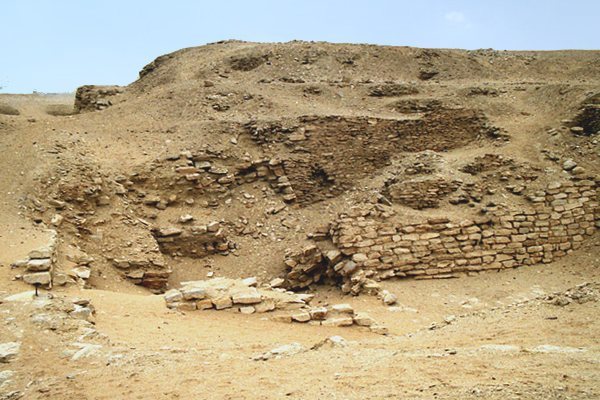
The walls had niches and false gates, symbolic doorways rather than usable entrances. The northern wall of the earlier enclosure was built in regular limestone courses and faced with Tura limestone, a fine stone quarried near Memphis. Its outer stone facing survived where the wall was buried by a later extension. The later walls may have been left unfinished, or their facing may have been removed. The walls were about 10 metres high; one exposed section measures 5.2 metres high and 18 metres thick.
White Wall
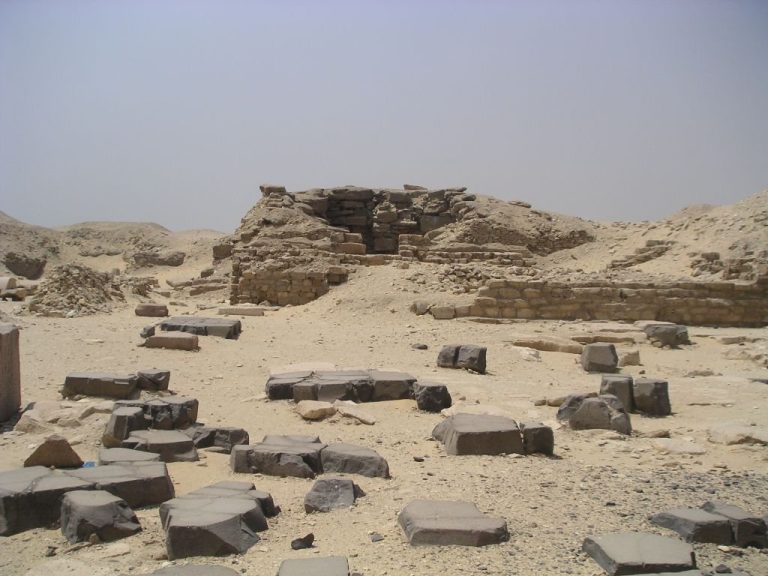
The inner wall, also called the White Wall, was made of limestone. Blocks from its northern section bear red construction lines, graffiti, and cursive hieroglyphic writing in red ink.
The pyramid
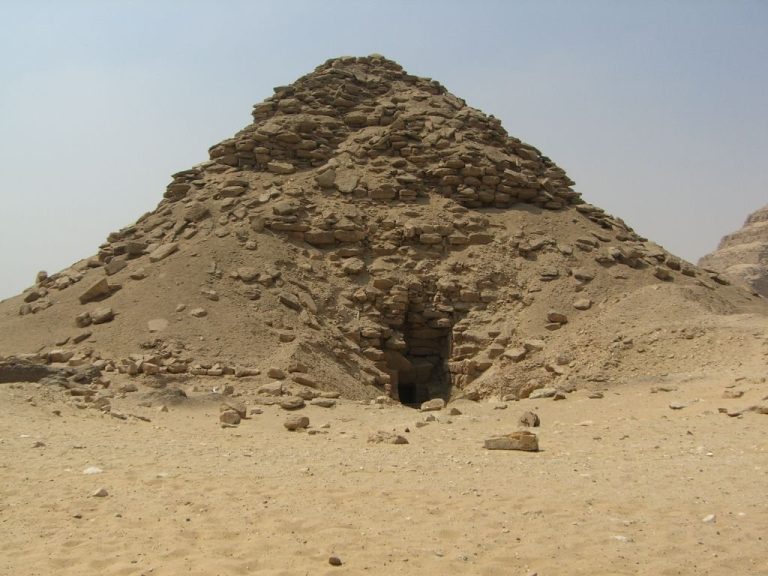
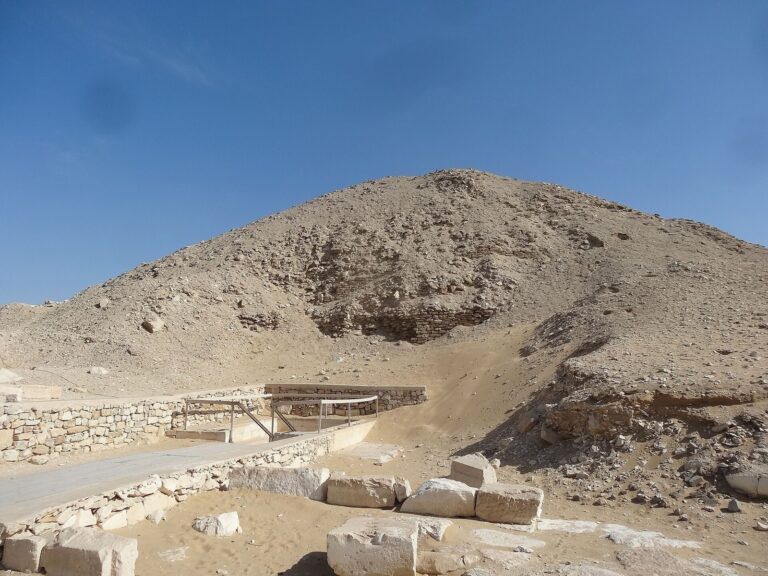
The pyramid was planned as a square, stepped structure with a base about 120 metres on each side. If completed, it would have stood about 70 metres high, probably in seven steps, though six steps have also been proposed. Construction reached only the first step, and the surviving ruin is about 8 metres high. The name Buried Pyramid reflects its unfinished state and its discovery beneath the sand.
The pyramid was built on uneven bedrock. Stone terraces, some reaching 10 metres in height, levelled the ground. The core consists of local limestone laid in courses that slope inward at about 10 to 15 degrees; fourteen courses formed the core of the first step. A fine-limestone outer facing was planned but never applied. A construction ramp made from rubble mixed with clayey earth survives to about 2 metres above the pyramid remains.
Underground passages and burial chamber
Passages and storage galleries
The underground entrance lies north of the pyramid. A passage cut into the bedrock descends about 30 metres over a route roughly 80 metres long toward the burial apartments. A vertical shaft intersects it and rises through the pyramid, apparently to help remove excavated material and ventilate the work area. The shaft may later have been closed with a blocking stone.
Near the shaft, a small doorway in the west wall opens into a low side passage about 5.3 metres long. The passage turns north and leads to a U-shaped gallery around the pyramid, containing 136 known magazine chambers, or storage rooms. Two more U-shaped galleries lie near the burial chamber. Their chamber count is lower than in Djoser’s pyramid, and the galleries are undecorated.
Finds from the underground galleries include animal bones, Demotic papyri, and Third Dynasty stone vessels. About 700 vessels came from the excavated magazine area. A decayed wooden casket contained gold bracelets, cosmetic boxes, beads, and jars inscribed with Sekhemkhet’s name. Other finds included diorite and alabaster vessels and a gold container shaped like a two-part shell, with a removable lid.
Burial chamber
The burial chamber lies about 32 metres below the pyramid and measures approximately 8.9 by 5.2 metres, with a height of 4.5 metres. Its rough-hewn interior was unfinished. A corridor from its south wall ends within the rock, and the chamber belongs to a network of passages and side rooms arranged in a south-pointing, three-pronged plan. A blocking wall about 3 metres thick sealed the approach.
The chamber’s alabaster sarcophagus was carved from a single block. Its unusual lid slid vertically into place at the narrow end and was sealed with mortar. Residue on top was first thought to be floral material, but was later identified as decomposed wood and bark, possibly from a wooden lever. An ivory label bearing the name Djeseret-Ânkh-Nebty was attached to part of a male royal garment and lay on the floor of the burial apartments beyond the sealed wall.
South Tomb
Superstructure and position
The South Tomb stands south of the pyramid, slightly west of its centre, and closer to the pyramid than the corresponding tomb in Djoser’s complex. Its east–west superstructure was mastaba-like, resembling a flat-roofed, rectangular tomb, and measured about 32 by 16 metres. The surviving remains include the foundation and parts of the superstructure, as well as the underground structure.
Underground chamber
A corridor from the west, interrupted by a vertical shaft, leads to an unfinished chamber. Excavators found a wooden coffin containing the remains of an unidentified child about two years old. Other finds included animal bones, Third Dynasty stone vessels, gold jewellery, fragments of gold leaf, and traces of tomb robbery. The South Tomb’s precise ritual purpose remains uncertain.