Burg Sonnenberg: A Medieval Spur Castle in Wiesbaden, Germany


Site at a Glance
- Rating
- 4
- Popularity
- Low
- Country
- Germany
- Primary era
- Medieval
- Eras represented
- Medieval
- Civilizations
- Holy Roman Empire
- Site type
- Military
- Remains
- Castle
On this page9 sections
History
Foundation and Nassau-Eppstein Rivalry
Burg Sonnenberg is a ruined medieval spur castle in Wiesbaden, Germany, founded around 1200 by the Nassau counts Heinrich II and Ruprecht to protect Wiesbaden and guard against the neighboring lords of Eppstein. It occupied a rocky spur on the slopes of the Vordertaunus, using the surrounding slopes as part of its defenses. The dispute reflected a complicated division of authority. The Nassau family held the royal estate of Wiesbaden, while the judicial center of the surrounding administrative district lay in territory controlled by the Eppsteins. The royal estate had first been recorded in 829 as the administrative center of the Königssondergau, a district controlled directly by the monarchy under Charlemagne.
The land on which construction began belonged to the cathedral chapter of Mainz rather than to Nassau. In 1221 Heinrich II and Ruprecht acknowledged that they had taken the Castrum Sunneberc unlawfully and by force. They then bought the land from the cathedral chapter and held the castle as a feudal grant from the archbishopric of Mainz. This arrangement created a political disadvantage because four archbishops of Mainz during the thirteenth century came from the Eppstein family. Ruprecht later entered the Teutonic Order, a religious-military order founded during the Crusades, and Heinrich II ruled alone from 1230. Sonnenberg was then one of nine castles displaying the Nassau banner.
Destruction and Reconstruction
The first division of Nassau possessions in 1255 separated the dynasty into its Ottonian and Walramian branches. Sonnenberg and Wiesbaden passed to the Walramian line. Adolf of Nassau, who later became German king, rebuilt and enlarged the castle after it suffered heavy damage during the Nassau-Eppstein feud in 1283. Sonnenberg became one of Adolf’s residences, alongside Idstein.
After Adolf’s death, Eppstein forces and Gerhard II, the Eppstein archbishop of Mainz, captured the castle in 1298 and almost completely destroyed it. Adolf’s young son Gerlach was rescued. After later reconciling with his former enemies, Gerlach greatly enlarged Sonnenberg, beginning the castle’s most important period. Emperor Louis the Bavarian visited in 1338, when the complex offered a substantial and secure residence.
Town Rights and the Nassau-Sonnenberg Lordship
Gerlach’s second wife, Irmengard of Hohenlohe-Weikersheim, received Sonnenberg as her widow’s residence in 1337 and worked to secure new privileges for the settlement. In 1351 King Charles IV granted Sonnenberg town rights and its own jurisdiction. The settlement below the castle was incorporated into the fortified complex, the valley was enclosed by defenses, and the community gained a more clearly defined legal position. In 1355 Sonnenberg became part of the newly established lordship of Nassau-Sonnenberg, ruled by members of Gerlach’s family.
Gerlach died at Sonnenberg in 1361. His son Ruprecht later became count of Nassau-Sonnenberg and acquired a reputation as a “last wandering knight” because of his many feuds over the inheritance of his wife, Anna of Nassau-Hadamar. He assigned Sonnenberg to Anna as her widow’s residence in 1365. In 1384, when the Catherine altar was founded in the chapel within the wall tower, Ruprecht ceremonially laid down his sword permanently. Despite his feuds, he avoided damaging his residence.
Ruprecht died without children in 1390. Through Anna’s marriage in 1391, Count Diether VIII of Katzenelnbogen became a co-owner of the castle. After Anna’s death in 1405, Nassau-Sonnenberg and the castle passed to the counts of Nassau-Wiesbaden-Idstein and Nassau-Weilburg, who thereafter shared ownership.
Decline, Ruin, and Preservation
The castle declined gradually for about two centuries, although it experienced a final period of prosperity between 1558 and 1566 under Count Philipp of Nassau-Idstein, who used it as his residence. After Philipp died without children, Sonnenberg was uninhabited by the end of the sixteenth century. Military bands occupied it during the Thirty Years’ War, the seventeenth-century conflict that involved much of central Europe. After the war, its masonry was quarried for houses rebuilt in the valley, and the castle became a ruin.
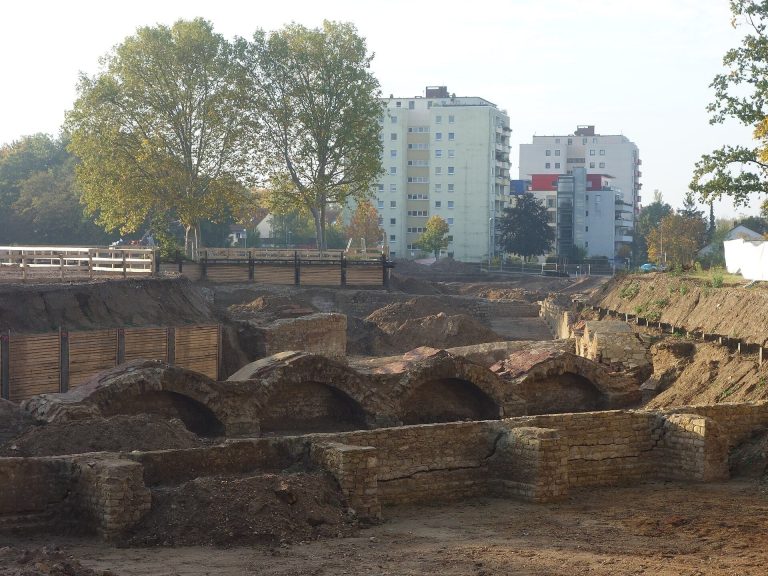
During the nineteenth century, the ruin became a popular destination for visitors to the neighboring spa town of Wiesbaden, whose spa park was extended toward Sonnenberg. The city of Wiesbaden acquired the site in 1875, before Sonnenberg had been incorporated into the city. The keep was restored after the Second World War. Further restoration, accompanied by archaeological investigations, took place from 2005 to 2015, making the ruin accessible again, although additional restoration was still required in 2019. The keep now contains a museum, and the complex continues to support cultural use through the annual Wiesbaden-Sonnenberg Cultural Days in July.
Remains
Fortress Layout and Entrances
Burg Sonnenberg survives as a largely preserved but ruined hilltop fortress built on a rocky spur in Wiesbaden-Sonnenberg, Hesse. Its upper and lower sections occupy the projecting ridge, while later defenses extended around the settlement and into the valley. The castle has three present entrances: the main gate on the east side and two approaches from the valley through the former town gates. After 1351, a protective wall brought the houses below the original castle within the fortified complex. The valley was also fortified, and the town gates formed part of this broader defensive arrangement.
Keep and Upper Castle
The keep, or donjon, is the principal fortified tower of a medieval castle, serving as a place of defense, residence, and refuge. At Sonnenberg it was completed in 1208 and now contains the castle museum. Its covered viewing platform overlooks the castle complex and Sonnenberg. The upper part of the fortress was expanded between 1221 and 1242, then rebuilt and enlarged in successive phases after the destruction of 1283 and 1298. Part of the upper castle is now occupied by a hospitality establishment.
Lower Castle and Chapel Tower
The lower castle formed part of the later enlargement of the complex and includes the wall tower that contained a chapel built in 1384. The Catherine altar was founded there in the same year. Cultural events take place in the lower castle near this chapel tower, which remains a distinct feature of the fortified complex.