Burg Schöneck: A High-Medieval Hilltop Castle in Germany


Site at a Glance
- Rating
- 4.5
- Popularity
- Very Low
- Country
- Germany
- Primary era
- Medieval
- Eras represented
- Medieval
- Civilizations
- Holy Roman Empire
- Site type
- Military
- Remains
- Castle
On this page10 sections
History
Burg Schöneck is a high-medieval hilltop castle in Schöneck, Germany, built by lesser nobility around 1180 on the elevated Alter Söll. Its first known owner was Albertus de Schoenegge, who appears in 1225. The castle later became the center of a lordship whose changing allegiance linked Schöneck with the Bohemian Crown and the Saxon territories.
From Noble Castle to Bohemian Fief
In 1327, Heinrich the Elder of Plauen submitted his lordship, including Schöneck, to King John of Bohemia as a fief. The castle and town thereby entered the political sphere of the Bohemian Crown, the territories governed by the kings of Bohemia. In 1370, Emperor Charles IV, a fourteenth-century Holy Roman Emperor and King of Bohemia, raised Schöneck to town status and granted it the same rights as Elbogen in Bohemia.
The Schöneck Thosse family held the castle lordship in 1370. One of its five sons received Schilbach and established the Schilbach manor there. In 1397, King Wenceslaus IV appointed Count Günter of Schwarzburg as administrator of the castles and settlements of Schöneck, Mylau, Stollberg, and Schönbach.
Transfer to the Wettins and the Schlick Family
From 1422, King Sigismund pledged Schöneck, together with Mylau, Stollberg, Gattendorf, Sparnberg, and their appurtenances, to the Wettins for 90,000 gulden. The Wettins were a major German ruling dynasty whose Saxon branches controlled extensive territories in central Germany. Schöneck and its territory thus passed from Bohemia to Saxony, while its liberties and rights continued to be confirmed.
In 1430, Elector Frederick and Duke Sigismund of Saxony pledged the castle, administrative district, and vogtship of Schöneck and Schönbach to the brothers von Wolffersdorff for 1,500 gulden. Seven years later, Kaspar Schlick received Schöneck and its appurtenances after paying Emperor Sigismund 3,000 gulden on behalf of the Wettins. The grant began as a pledge and later became hereditary property and a fief. In 1466, Schlick’s successors received the castle and its appurtenances as a collective fief from the Saxon electors.
Wenzel Schlick, mentioned again in 1487, sold Burg Schöneck with its appurtenances to Hans von Scheuben of Eger in 1499. The sale caused a dispute because Schlick had sold the castle to two interested parties. In 1534, the guardians of Adam von Scheuben probably sold the lordship, including the castle, estate, and town, to Johann of Saxony. The purchaser’s exact dynastic affiliation remains uncertain, since the transaction is also associated with the Ernestine line, although Elector Johann of that line had died in 1532.
War, Ruin, and Demolition
Imperial troops captured and ravaged Schöneck and its castle in 1546 during the Schmalkaldic War, the conflict between Emperor Charles V and the Protestant Schmalkaldic League. In 1549, King Ferdinand of Bohemia rewarded his chancellor Heinrich von Plauen for wartime service by transferring, among other possessions, Burg Schöneck and the town to him.
Heinrich von Plauen pledged the administrative districts of Plauen, Voigtsberg, and Pausa, which included Schöneck, to Elector Augustus of Saxony in 1559 for 60,000 gulden. The pledge was extended in 1563 to the Albertine line and was never redeemed, so Schöneck again became part of Saxony. Repeated pledges and changes of lordship contributed to the castle’s ruin. Parts of the lower castle were dismantled in 1580, and a Saxon electoral hunting lodge was established in their place.
In 1632, during the Thirty Years’ War, the major Central European conflict of 1618–1648, troops commanded by General Heinrich von Holk plundered Schöneck, destroyed the castle complex, and burned the town. Austrian troops were quartered in Schöneck in 1761 during the Seven Years’ War, the wider European conflict of 1756–1763. A fire caused by the soldiers’ negligence destroyed much of the town and affected the remaining castle ruins. In 1765, the last castle remains, including the old keep, were demolished, and their stones were reused in rebuilding the town.
Archaeology and Conservation
The castle area was registered as the archaeological monument Alter Söll on 3 December 1970. Archaeologists from the Municipal Museum of Zwickau excavated the site in 1985 and 1986, exposing building foundations on the castle hill and recovering pottery fragments from the thirteenth and fourteenth centuries. The finds are displayed in Schöneck’s local-history museum. Work on the castle rock also exposed and conserved walls belonging to the former castle, while the museum presents the town’s history together with archaeological finds from the site.
Remains
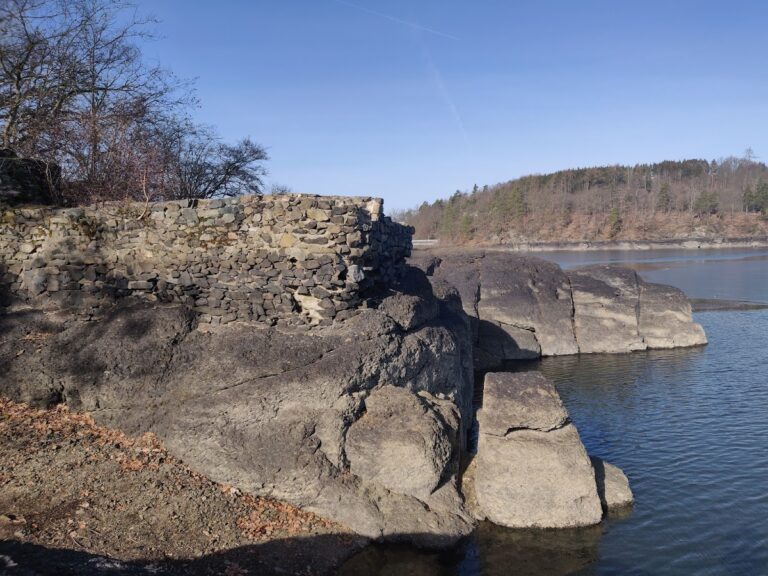
Burg Schöneck survives as a Burgstall, an archaeological castle site with limited standing remains, on the 734-metre-high Alter Söll. The rocky spur is formed of graywacke quartzite, and parts of the former complex extended onto the adjoining mountain ridge. The castle was arranged in two connected sections, an upper castle on the summit spur and a lower castle on the ridge. The former castle rock is now the natural monument Alter Söll, with exposed and conserved wall remains marking part of the site.
Castle Layout
Upper Castle
The upper castle occupied the summit of the rocky spur. Archaeological excavation revealed foundations of a building on the castle hill, along with pottery fragments dating from the thirteenth and fourteenth centuries. The surviving foundations provide the principal physical evidence for the building area within the upper section of the fortification.
Lower Castle and Defenses
The lower castle extended along the adjoining ridge. A 1628 drawing by chief master builder Wilhelm Dilich shows a large keep, the principal fortified tower, positioned at the center of the complex. The drawing also depicts a defensive tower in the castle wall toward the Old Town Hall and Saint George’s Church, with a main building between them. The lower castle was partly dismantled in 1580, and the remaining walls were later affected by the destruction and fire of the seventeenth and eighteenth centuries.
Landscape Setting
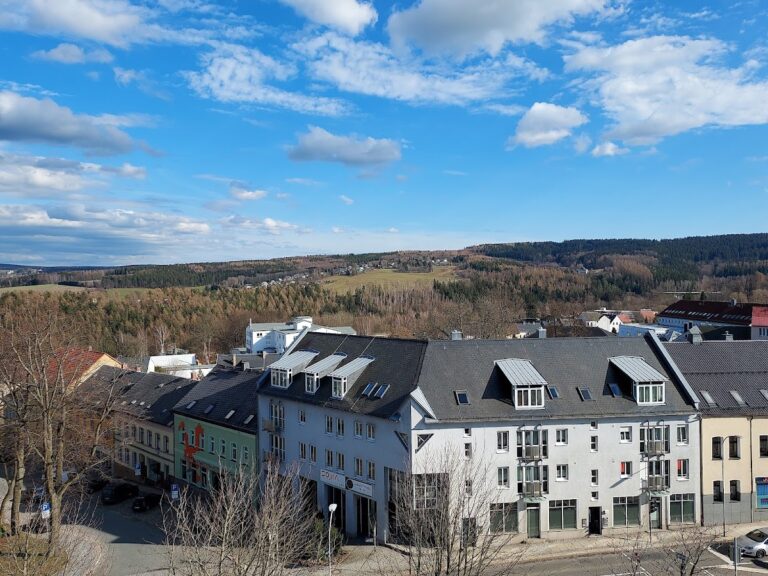
The elevated rocky spur provides wide views across the Vogtland and toward the Ore Mountains. In suitable conditions, the Elster Mountains, Fichtel Mountains, and Thuringian Forest are visible from the site. The stated viewing area covers approximately 2,000 square kilometres, placing the former castle within a broad mountain landscape that also shaped its elevated position.
Nearby sites