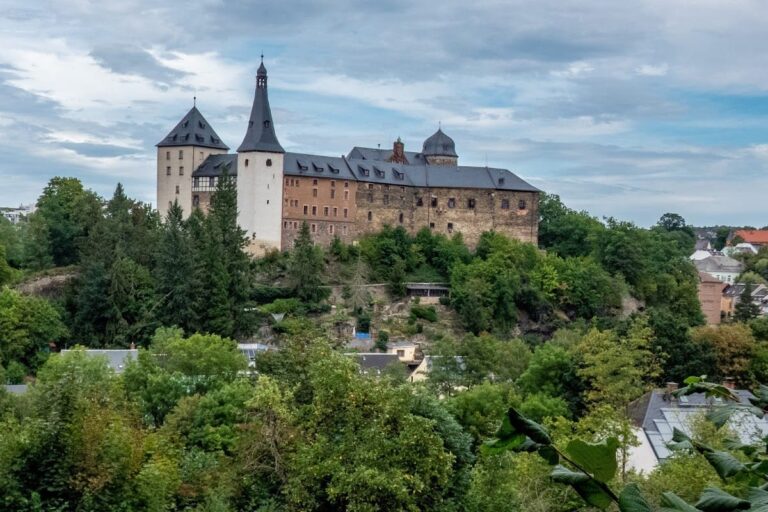
Burg Falkenstein: A Medieval Hilltop Fortress in Germany


Site at a Glance
- Rating
- 4.5
- Popularity
- Low
- Country
- Germany
- Primary era
- Medieval
- External website
- Open
- Eras represented
- Medieval
- Civilizations
- Holy Roman Empire
- Site type
- Military
- Remains
- Castle
On this page7 sections
History
Burg Falkenstein is a medieval hilltop fortress in Germany, built around 1200 by the Vogts of Weida and Plauen. The Vogts were territorial lords whose title came from the office of advocate or governor, and they ruled much of the region later known as the Vogtland. The castle occupied a rocky summit above the Church of the Holy Cross in the present-day town of Falkenstein, forming part of a defensive system that secured the cleared settlement area of the Lordship of Plauen.
A Fortress of the Vogts
Burg Falkenstein belonged to a chain of fortifications that included Treuen and Auerbach to the northwest and north, with Schöneck to the south. Together, these strongholds helped protect the territory east of Plauen. The castle of the territorial rulers was granted as a fief to the Falkenstein noble family. Johannes of Falkenstein, named as Johannes de Valkinstein in 1267, followed Heinrich I of Plauen.
From Bohemian Access to Wettin Rule
The balance of power changed during the Vogtland War, a late-fourteenth-century conflict in which Emperor Charles IV and the Wettins took much of the Vogts’ territory. As a consequence, the Falkenstein family was required to grant Charles IV, who was also King of Bohemia, the right to enter the castle. By the end of the fourteenth century, Burg Falkenstein had become a possession of the Wettins, a powerful German dynasty that acquired territories in Saxony and neighboring regions. The Falkenstein family had probably died out by this time.
The Trützschlers and the Castle’s Decline
During the first half of the fifteenth century, the Wettins enfeoffed the noble family of Trützschler with the castle. The Trützschlers also developed the settlement of Falkenstein, which had emerged in the thirteenth century, into a town. They commissioned a palace at the foot of the fortress, replacing the earlier economic courtyard. By around 1528, the castle was already decaying. In 1618, Georg Abraham Trützschler had most of the remaining structure demolished.
Remains
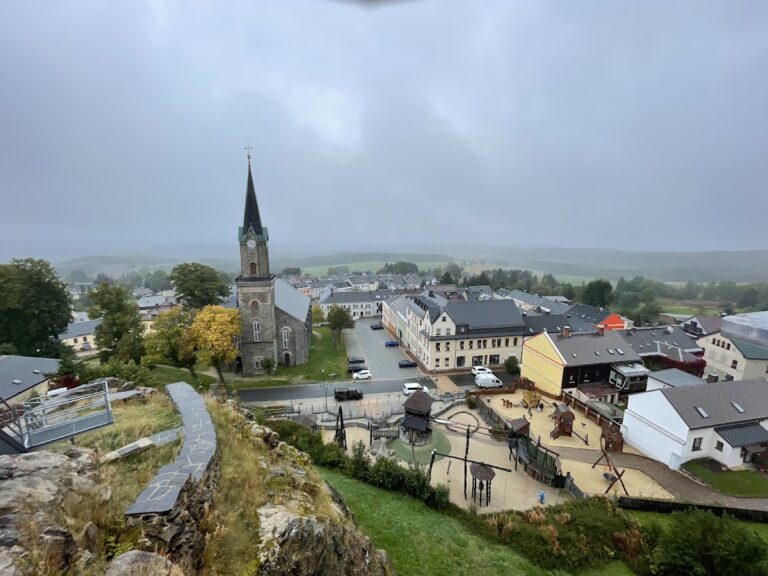
The surviving remains occupy the summit of a rocky outcrop in the center of Falkenstein. Retaining walls shaped the summit into a roughly trapezoidal area, while the rock itself restricted the space available for additional buildings. The present structure consists chiefly of the remnant of the former fortress tower and masonry reused in a later wall adjoining the palace.
Rocky Summit and Tower
The surviving tower is a square stump measuring 8 by 8 meters. Built as part of the hilltop fortress, it now has a railing and serves as a viewing platform. Its position on the rock preserves the defensive character of the original site, whose summit was shaped and supported by retaining walls.
Reused Romanesque Masonry
A wall beside the palace was apparently built in the eighteenth or nineteenth century from material taken from the demolished castle. It contains massive granite bossage blocks, large masonry blocks with deliberately projecting, roughly worked faces. These stones belong to the Staufen period, the era of the medieval Hohenstaufen dynasty, and are attributed to the castle’s former Romanesque palas, its principal residential and representative hall. They probably date from the twelfth century, and this surviving use of the blocks is described as unique in the Vogtland district.
Nearby sites