Geroldstein Castle (Burg Geroldstein): A Medieval Ruin in Germany


Site at a Glance
- Rating
- 4.5
- Popularity
- Very Low
- Country
- Germany
- Primary era
- Medieval
- External website
- Open
- Eras represented
- Medieval
- Civilizations
- Holy Roman Empire
- Site type
- Military
- Remains
- Castle
On this page7 sections
History
Geroldstein Castle, known locally as Burg Geroldstein, is a medieval castle ruin in Germany, within the settlement of Geroldstein in Heidenrod. Built at the end of the twelfth century, it became the seat of the Geroldstein family, who held it as vassals of the Counts of Katzenelnbogen and formed a small lordship around the castle.
Origins and the Geroldstein lordship
The castle’s early history is poorly known. Its name probably comes from a nobleman named Gerhart, and the site first appears in written records around 1215 under the name Gerhartstein. Other names used for the castle include Gerolstein, Junkerburg, and, less frequently, Schwarzenberg. The Geroldstein family maintained the castle as its ancestral seat while serving the Counts of Katzenelnbogen, a ruling family whose county lay in the central Rhine region.
The castle faced a military challenge in 1353, when troops of the Elector of Trier unsuccessfully besieged it. The Elector of Trier was both the archbishop and territorial ruler of Trier, as well as one of the German princes entitled to participate in the election of the Holy Roman Emperor. In 1479, the County of Katzenelnbogen passed by inheritance to the Landgraviate of Hesse, a principality ruled by landgraves, and Geroldstein consequently came under Hessian authority.
Decline and changing ownership
A branch of the Geroldstein family still occupied the ancestral castle in 1551. When the male line ended in 1569, the castle reverted to Hesse as a fief, meaning a castle, estate, or income source granted by a superior lord in return for service. The neglected complex was already described as a ruin by 1585.
In 1718, Franz Moyses Brenner received the castle and an associated mill as an hereditary fief. This arrangement allowed the property to remain with the Brenner family until its male line ended. Brenner was ennobled in the same year and received permission to use the name “von Brenner zu Geroldstein.” When the family line died out in 1863, the fief returned to the Duchy of Nassau, the German principality that existed from 1806 until its annexation by Prussia in 1866.
Names and modern identification
The name Junkerburg is recorded from around 1840, while Schwarzenberg came into use later and much less often. The two castles associated with Geroldstein caused further confusion. Some maps continued to identify the older castle as Burg Haneck, although newer maps corrected the error from 2010 onward.
Remains
Castle setting and surviving structures
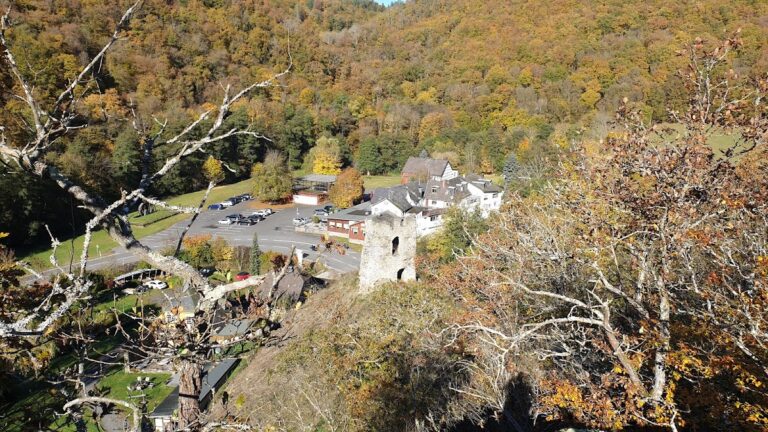
Geroldstein Castle is a lowland castle, a fortification built in relatively low or level terrain rather than on a high mountain summit. The ruin stands at approximately 223 metres above sea level on a rocky outcrop that was originally enclosed on three sides by the Wisper River, whose course formed a river loop around the site. Burg Haneck lies higher to the east. In 1589, the low saddle north of the castle was cut through to shorten the river’s course and increase its fall for use as an energy source by an ironworks. This intervention changed the earlier topographical relationship between the castle rock and the river.
Round tower and gate complex
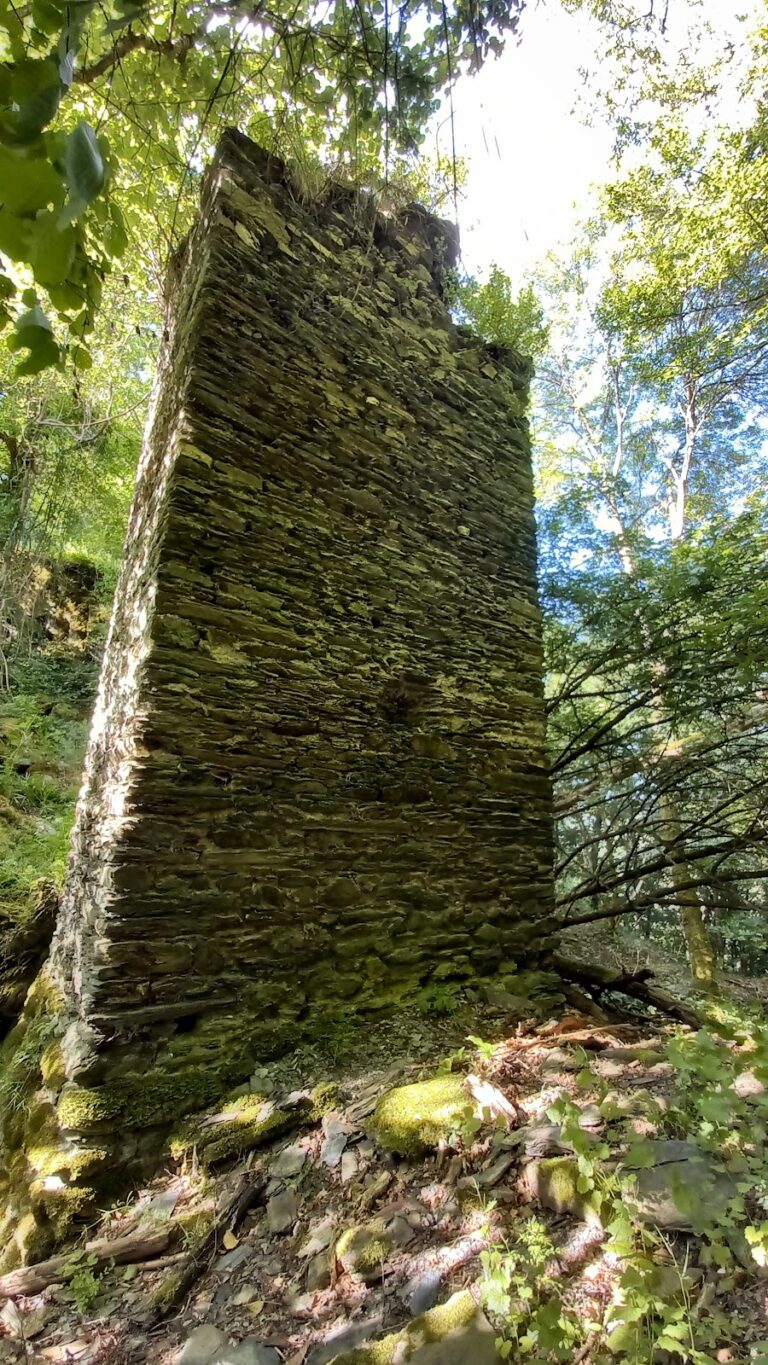
The surviving fabric consists of a round tower, parts of a gate complex, and several sections of wall. These fragmentary remains represent the principal visible elements of the former castle complex and preserve its fortified character within the settlement of Geroldstein.