Burg Falkenstein: A Medieval Hilltop Castle in Bavaria


Site at a Glance
- Rating
- 4.7
- Popularity
- Low
- Country
- Germany
- Primary era
- Medieval
- Eras represented
- Medieval, Early Modern
- Civilizations
- Holy Roman Empire
- Site type
- Military
- Remains
- Castle
On this page13 sections
History
Burg Falkenstein is a hilltop castle in Germany, probably built in the eleventh century during the medieval development of the region around Falkenstein. Its emergence was linked to the bishops of Regensburg, including Wolfgang and Tuto, who sought to secure their possessions in the Upper Palatinate during the mid-tenth century. The castle later became an important seat of regional authority and remains a record of changing noble, dynastic, and territorial control.
Regensburg bishops and the Counts of Bogen
The Regensburg bishops entrusted local protection to cathedral reeves, secular officials responsible for defending and administering a bishopric’s temporal interests. Their personal power allowed them to protect the territory more effectively. The Counts of Bogen held the cathedral reeveship during the castle’s construction, while a loyal retainer named Falko directed the building work and became the founder of the Falkenstein noble family.
The castle was probably erected in the eleventh century, although its oldest surviving enclosing walls are more likely to belong to the thirteenth century. The first secure documentary reference dates to 1129, when Rudolph of Valchenstein witnessed an agreement between the bishops of Regensburg and Bamberg. In the same period, Falkenstein became involved in the conflict between Duke Henry X the Proud and Cathedral Reeve Frederick II. Contemporary records called it a “very strong castle.” Duke Henry besieged it in 1129 and captured it in 1130, but it was not destroyed. A garrison was installed, and mediation by Count Palatine Otto IV of Wittelsbach led to the territory’s return to Bishop Henry I and Frederick II in 1132.
Frederick I, Count of Bogen, probably held Falkenstein from 1075 to 1101. Frederick II followed him from 1101 to 1136, with his tenure securely associated with the castle from 1129. His son Frederick III held the reeveship from 1136 to 1149 and died while accompanying King Conrad III on a crusade against the French. Count Berthold of Bogen then held the inheritance until 1168, followed by Count Albert III until his death in 1196 and his son Albert IV until 1242.
Hohenfels and the Wittelsbachs
When Albert IV of Bogen died without heirs in 1242, the County of Bogen, including its white-and-blue diamond arms, passed to his half-brother, Duke Otto II of Bavaria. Falkenstein thereafter remained connected with the Wittelsbach dynasty, although the Regensburg bishops continued as its formal owners and cathedral reeves represented them.
The date when Falkenstein passed to the Hohenfels family is unknown. In 1232, Cathedral Reeve Conrad II of Hohenfels returned the castle to Bishop Siegfried of Regensburg during a dispute with the neighboring lords of Brennberg. The Hohenfels family later received the lordship again. In 1250, Conrad II attempted to assassinate King Conrad IV on the bishop’s behalf. The attempt failed, and Conrad fled. After the king’s death in 1256, he reappeared under the name Conrad II of Ehrenfels. His son Conrad III succeeded him from 1267 to 1290.
Conrad III’s sons Conrad and Henry became involved in repeated disputes with neighboring lords. After an imperial ban was imposed, Henry of Hohenfels-Falkenstein had to sell the castle to King Louis IV in 1323. Louis could not pay the purchase price and borrowed the money from Landgrave Ulrich I of Leuchtenberg. When the loan could not be repaid, Falkenstein and its lordship passed to Ulrich in 1327. Ulrich sold them to Duke Henry XV of Bavaria in 1332. The castle thereby entered Lower Bavaria, but after that Wittelsbach line died out in 1340, it returned to King Louis IV.
Louis’s continuing financial difficulties led him to pawn Falkenstein in 1347 to Count Wolfahrt Satzenhofer, his court master to the margrave. Satzenhofer thoroughly renewed the castle that year. After his childless death in 1360, his brother Dietrich, mayor of Regensburg, inherited it. Dietrich’s sons Dietrich and Hans succeeded him in 1374, but Duke Albert I of Lower Bavaria-Straubing redeemed Falkenstein in 1379. The dukes William II and John III followed him until the Lower Bavarian-Straubing line ended in 1425.
Late medieval and early-modern ownership
After a territorial reform, Falkenstein came under Bavaria-Munich in 1429 and was ruled by Duke Ernest. His son Albert III became sole ruler in 1467 and remained so until his death in 1508. From 1514, Duke William IV entrusted the castle and lordship to his court master, the knight Hieronymus von Stauff. Stauff was executed for high treason in 1516, but Falkenstein remained with his son Hans Ruprecht. Hans Ruprecht’s extravagant lifestyle eventually led to the sale of the castle to Duke Louis X of Bavaria in 1526.
Louis X granted Falkenstein to his court marshal Ludwig von Pienzenau. Count Michael von Preysing acquired the lordship through his marriage to Pienzenau’s daughter and held it until his death in 1544. Their elder daughter Melusina married Hieronymus von Seiboldsdorf in 1565, making him lord of Falkenstein. After his death in 1574 and the division of the inheritance in 1590, the castle passed to the younger daughter, Anna, and then to Bernhard Nothaft of Wernberg.
Bernhard Nothaft’s daughter married Baron Ferdinand Khuen von Belasy. After Ferdinand’s death in 1620, his widow married Baron Wolf Dietrich von Maxlrain and then, in 1629, Baron Johann Heinrich von Haslang zu Haslangskreuth. Haslang served as a court war councillor and field colonel and was captured during the Swedish War, the conflict in which Swedish forces intervened in the wider Thirty Years’ War.
While Haslang was imprisoned, Swedish forces captured and burned Burg Falkenstein in 1634. The castle withstood a second Swedish invasion in 1641, and the attackers did not approach it during the third invasion. After Maria Euphemia Haslang died in 1662, her two daughters from her marriage to Wolf Dietrich von Maxlrain inherited jointly. An inheritance dispute between the Haslang and Törring families ended with Falkenstein passing to Count Maximilian von Törring zu Jettenbach in 1664.
After Maximilian’s death around 1666, his underage sons Franz Josef and Leonhard Simpert von Törring-Jettenbach jointly ruled once they reached adulthood in 1678. Leonhard Simpert later shared authority with Field Marshal General Count Josef Ignaz Felix von Törring from 1715, and Josef Ignaz Felix ruled with Count Maximilian Joseph I von Törring from 1734. The inheritance was divided in 1763 between Max Emanuel von Toerring-Jettenbach and Count Norbert Johann. Norbert Johann transferred his share to Max Emanuel in 1769. After Max Emanuel died in 1773, his brother August von Toerring-Seefeld succeeded him, followed by Count Joseph August von Toerring, who held the estate until 1826.
Decline, restoration, and present status
Maximilian Joseph, Joseph August’s successor, sold the entire Falkenstein estate to the princely House of Thurn und Taxis in Regensburg on 22 October 1829. Maximilian Joseph von Thurn und Taxis owned it until 1872, followed by Maximilian Maria von Thurn und Taxis until 1888, then Albert von Thurn und Taxis and Johannes von Thurn und Taxis.
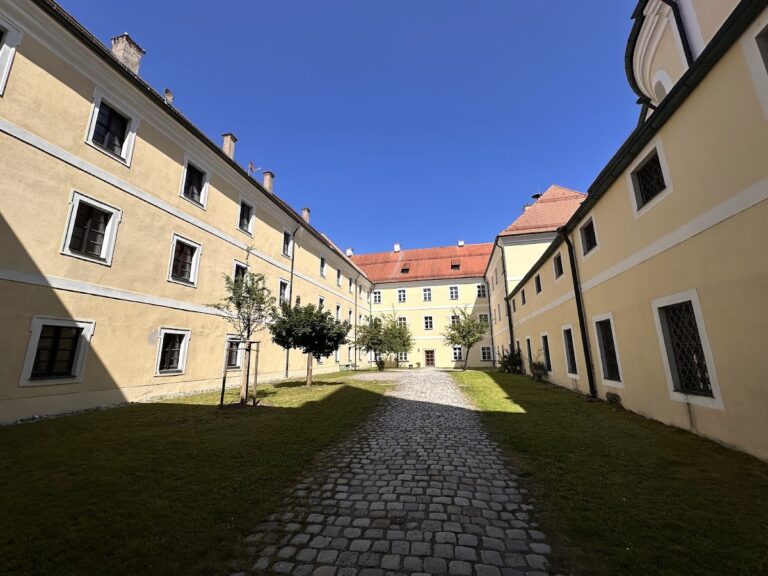
Limited use caused the castle to deteriorate severely during the nineteenth and twentieth centuries. In 1967, the market town of Falkenstein acquired it for the symbolic price of one mark to prevent its final decay. Renovation was completed in 1978. The restored complex later became a guest center with a restaurant and the Hunting and Wildlife Museum, whose collection is based on the hunting trophies of Hamburg notary Hans-Werner Schacht (1907–1981). The courtyard also hosts annual castle-courtyard performances.
Burg Falkenstein is protected as a listed architectural monument and as an archaeological monument encompassing medieval and early-modern remains in the castle area. The surrounding Schlosspark Falkenstein is designated as a nature reserve.
Remains
Castle layout and defenses
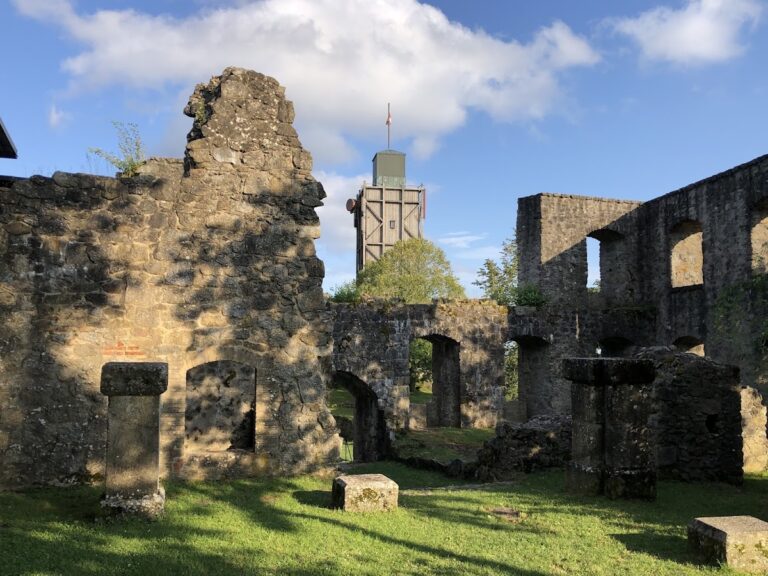
Burg Falkenstein stands on a granite outcrop 626 meters above sea level, about 60 meters above the Perlbach valley. The castle consists of an outer and main castle occupying approximately 40 by 40 meters. The main castle is divided into an upper and a lower castle, while the surrounding defenses adapt to the steep rock and the elevated position.
Outer castle and gate
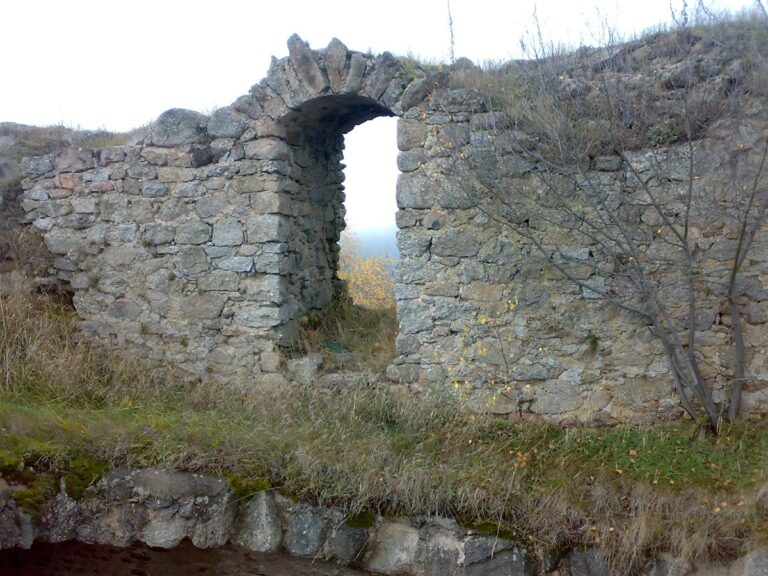
The outer castle’s rubble-masonry curtain wall survives largely as a retaining wall and joins the feature known as the Weiberwehr on the northwest. Within it lies a narrow, elongated courtyard shaped as an irregular pentagon, approximately 45 by 29 meters. Access is provided by a strategically angled gate passage with a vaulted ceiling. An alliance coat of arms belonging to the Belasy and Nothafft families is set above the entrance.
The Weiberwehr is associated with the castle’s defensive system. According to historical tradition, Hussite forces threatened Falkenstein around 1430, and courageous women defended the outer defensive enclosure, or zwinger. The defensive walkway around it subsequently became known as the Weiberwehr.
Lower castle and keep
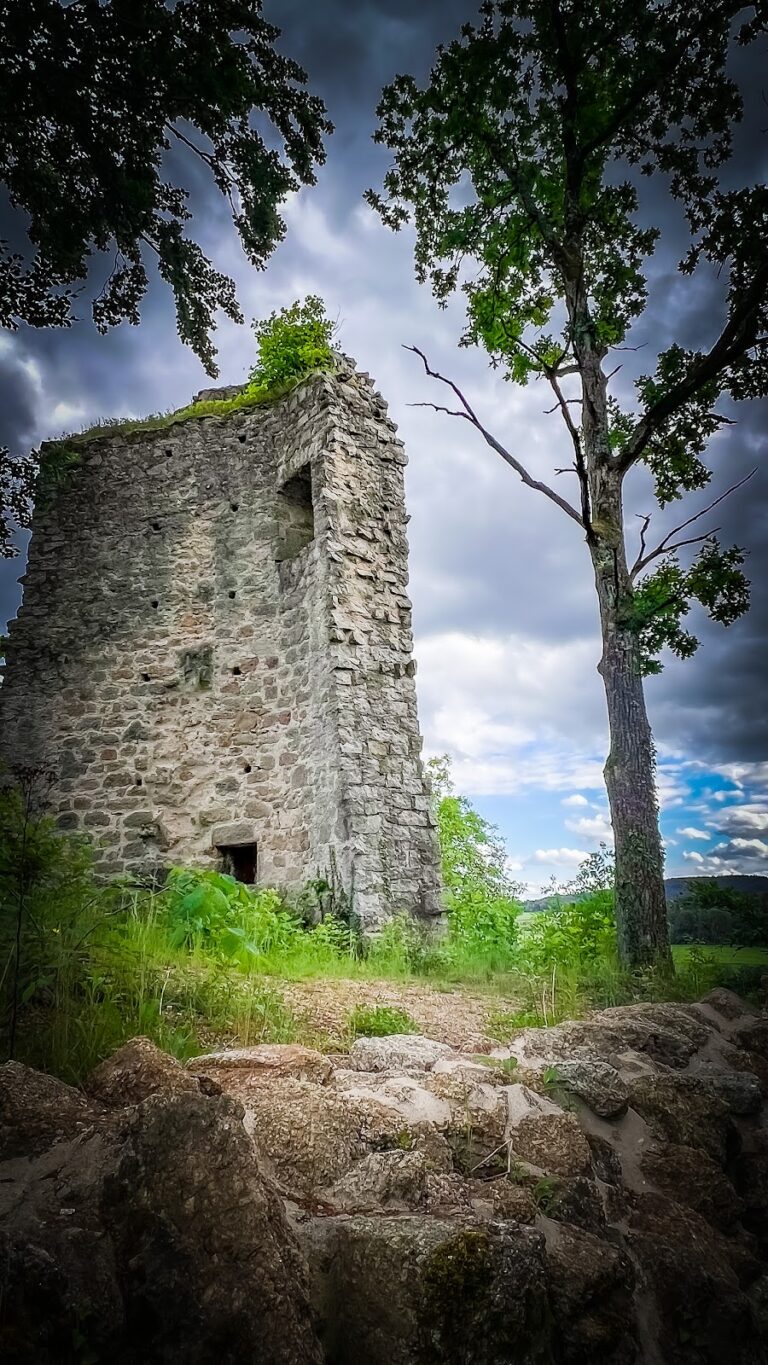
The lower castle’s outer walls reach 1.50 meters in thickness and form part of the oldest surviving building fabric, probably dating from the thirteenth century. At the western side, a square five-story keep rises from the steep rock. It measures 8.5 by 8.5 meters and now serves as a lookout tower. From its upper level, visibility can extend to the Großer Arber to the east in clear conditions.
Chapel and later architectural changes
Castle chapel
The castle chapel is a hall building covered by a groin vault, a ceiling formed where two barrel vaults intersect. The vault rests on consoles and carries post-Gothic decorative ribs, retaining Gothic forms from a later period. A small square tower rises at the western end, changing to an octagonal upper section and ending in an onion dome. The chancel is rounded at the bottom and closed on three sides above.
Late Renaissance galleries
Seventeenth-century alterations gave the castle late Renaissance features, including arcaded galleries on the ground and upper floors. The attached chapel dates from the period of Count Törring’s ownership, which began in 1664. These additions form part of the restored architectural character of the complex.
Surrounding park
The surrounding park covers 13.748 hectares and is described as Bavaria’s second-largest nature and rock park. It contains the rare light-reflecting luminous moss and individual rocks designated as geotopes, naturally significant geological features valued for scientific, educational, or cultural reasons. Features along the park’s walking routes include the Klause, Froschmaul, Steinernes Gässchen, Hohler Stein, and Himmelsleiter.
Nearby sites