Bílá Voda Palace: A Historicist Residence and Psychiatric Hospital in Czechia
Site at a Glance
- Popularity
- Medium
- Country
- Czechia
- Primary era
- Modern
- Eras represented
- Early Modern, Modern
- Civilizations
- Austria-Hungary, Austrian Empire, Habsburg, Habsburg Austria, Holy Roman Empire, Kingdom of Bohemia
- Site type
- Domestic
- Remains
- Manor House
On this page12 sections
History
Foundation and early owners
Bílá Voda Palace is a late-seventeenth-century manor in Czechia, built for Franz Karl von Liechtenstein-Kastelkorn shortly after he inherited the Hertwigswaldau estate in 1684. It had acquired a historicist appearance by the mid-nineteenth century, an architectural approach drawing on earlier styles. First recorded in 1691 as a knight’s residence, the manor may originally have served as a hunting lodge. Hunting took place in nearby forests in the late seventeenth century.
Franz Karl’s son Jakob Ernst owned the palace from 1709. On 20 October 1742, a protocol setting a new boundary between Prussia and Austria was signed at the manor. With minor later changes, the modern Polish-Czech border follows that line. Ownership passed to Karl Otto, Count of Salm and Neuburg, in 1747, then to Karl von Salm and Neuburg from 1766. Karl’s three daughters inherited the property in 1784.
Estate disputes and sale
In 1794, the daughters separated the Bílá Voda estate from the Prussian lordship of Hertwigswaldau and sold it to Anton von Schlegenberg. He transferred it to his son-in-law Otto von Haugwitz in 1802 for 130,000 gold talers. The estate passed to Wenzel and Anton von Haugwitz in 1809, but mortgage debts eventually reached 70,000 gold talers. At auction in 1818, retired cavalry captain Count Ludwig d’Ambly bought the property for 70,000 florins.
After d’Ambly died in the late 1830s, his widow Bettina became embroiled in a prolonged dispute with local peasants. In June 1848, peasants entered the manor by force and made her sign an agreement. One hundred soldiers were then quartered with people considered to have instigated the action. A commission ultimately blamed Bettina. After her death in 1851, her heirs put the estate up for sale in 1853.
Marianna and her heirs
Princess Marianna of Orange-Nassau bought the estate in 1854 for 175,000 Prussian talers and owned it until 1883. Her divorce from a member of a royal family made her unwelcome in Prussia, where she could not stay for more than 24 hours. Her other estates, at Kamieniec Ząbkowicki and Stronie, lay in Prussia; Bílá Voda, just across the border, gave her a place from which to manage them. She often stayed at the palace with family and acquaintances from Berlin, and established a stud farm nearby.
Between 1860 and 1883, Marianna enlarged the estate, including through land purchases at Kamienica, Błotnica, and Złoty Stok. The acquisitions included buildings and a lime kiln at Kamienica, and another lime kiln at Złoty Stok. After Marianna’s death in 1883, her daughter Princess Alexandrine inherited the property and continued its expansion. In 1906, Alexandrine’s daughter Charlotte inherited it and made it an estate whose inheritance rules were intended to keep it within the family. It covered 800 hectares, including 700 hectares of forest.
Twentieth-century changes of use
The estate was sold to Josef and Frieda Kutz in 1917. They sold the palace in 1934 to Max Weiss, a wealthy Jewish merchant from Wrocław who had moved to Czechoslovakia as fascism and antisemitism grew in Germany. After Germany occupied the Sudetenland in October 1938, Weiss was forced to sell the property to the German state. He and his wife fled to Prague and soon died by suicide. The property subsequently passed to Johannes von Welczeck Jr.
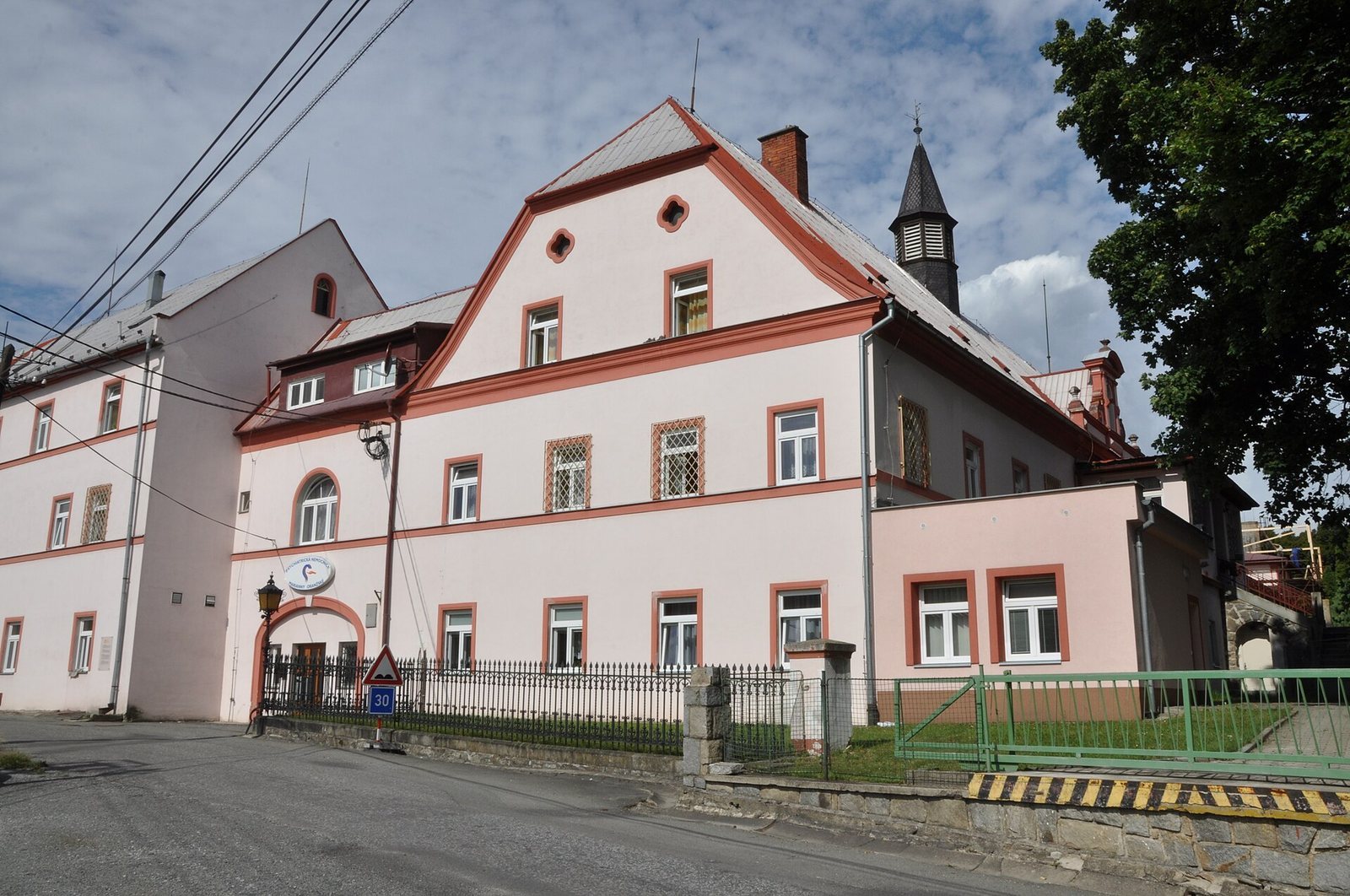
During the Second World War, the palace served as a hospital. The Czechoslovak state took over the estate in 1945, and the palace then housed a border-guard post and, from 1950 to 1952, a children’s sanatorium. It also accommodated Greek children from families associated with the Democratic Army of Greece, a communist-led force that fought the Greek government during the Greek Civil War. In the 1952–53 school year, the sanatorium became a holiday centre for university staff. It later became a psychiatric institution, initially focused mainly on treating alcoholism, and housed the district public-health authority in the 1980s. The palace continues to operate as the Marianna of Orange Psychiatric Hospital.
Remains
Setting and grounds
The palace stands about 370 metres above sea level, on a flattened section of slope at one of the summits of Pasieka in the Golden Mountains. The hill rises above the Paczków Foothills and overlooks the Otmuchów Depression and part of the Golden Mountains. The palace is near the deep valley of the Bílá Voda river, called Kamienica in Poland.
An old park surrounds the palace, with its main section enclosed by a wall. West of the farm buildings, the park gives way to woodland containing a small pond.
The palace and its grounds
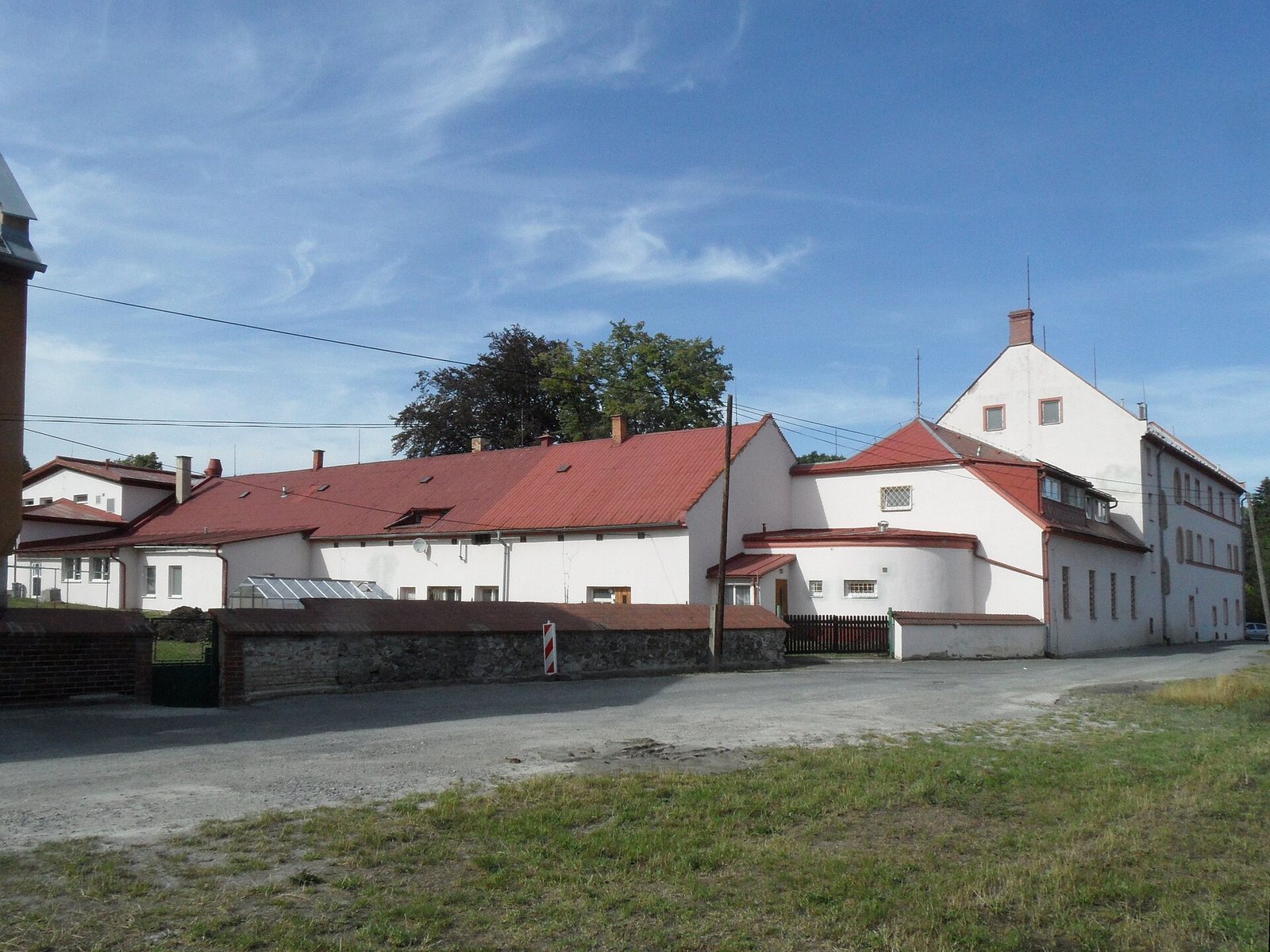
The original manor was modest in appearance. Its main hall and entrance vestibule had decorated wooden ceilings, and the entrance faced the garden. In the mid-nineteenth century, the wings were raised by a storey and a small tower was added to the main building. The palace interiors were renovated and its roof coverings replaced. The grounds included a bachelor’s cottage, a gardener’s house, an orangery, a building for cultivating citrus plants, and a shooting range. The garden was laid out in the English style. Alexandrine later altered the park, and its oldest surviving sections probably date from her period.
Park monuments
Saints Florian and Wendelin
Two sandstone sculptures were erected in the park in the 1760s. They depict St Florian, an early Christian martyr associated with protection from fire, and St Wendelin, a saint venerated as a patron of rural life and livestock.
Joseph II memorial column
A column at the northwestern edge of the park commemorates Joseph II, a Habsburg ruler and Holy Roman Emperor. Its inscription survives.
Hospital memorial cross
A cross in the park commemorates the palace’s use as a hospital during the Second World War.