Bayenturm: Medieval Defensive Tower and Women’s Archive in Cologne
Site at a Glance
- Popularity
- High
- Country
- Germany
- Primary era
- Medieval
- Eras represented
- Medieval, Modern
- Civilizations
- German, Holy Roman Empire, Kingdom of Prussia
- Site type
- Military
- Remains
- Tower
On this page11 sections
History
Construction and civic struggle
Bayenturm is a medieval defensive tower on the Rhine in Cologne, Germany, probably built around 1220 as one of the final two towers completing the city’s medieval wall. The circuit extended for about eight kilometres and enclosed Cologne for roughly 700 years. The tower was first recorded in 1250.
On 8 June 1262, Cologne’s citizens seized Bayenturm during their struggle against Archbishop Engelbert II. As archbishop, Engelbert was both a church leader and a figure with political authority in the city. The capture broke his dominance and advanced Cologne’s effort to free itself from his control. Bayenturm later became associated with the battle cry “Kölle alaaf” and the saying, “Whoever has the tower has the power.” After Cologne gained independence in 1288 and the archbishop’s residence moved to Bonn, the city’s arms were added to the tower in recognition of its part in the struggle.
Defences, harbour works, and rebuilding
Bayenturm guarded against attacks from both land and river. Its riverside defences also allowed surveillance of the towpath, where horses hauled boats upstream. In 1620, during the Thirty Years’ War, a major European conflict fought from 1618 to 1648, the tower was substantially strengthened.
A fire badly damaged the tower in 1697. Harbour construction in 1850–51 brought further changes: the medieval riverside wall was demolished and replaced with new fortifications connected to Bayenturm. In 1881, Prussia, a German kingdom, altered the area occupied by the medieval wall and later bastions. Most of the wall and its gates were demolished, but Bayenturm was spared because it did not impede the city’s expansion, and was sold to Cologne. The fire damage was repaired through rebuilding between 1895 and 1898.
Museum and wartime damage
Bayenturm was prepared as a home for Cologne’s Museum of Prehistory and Early History, which opened there in 1907 under archaeologist and museum director Carl Rademacher. Air raids in July 1943 destroyed much of the museum’s exhibitions and research holdings. The surviving material was moved to Severinstorburg and remained there until a successor institution was established in October 1946. Together with the Roman and Germanic departments of the Wallraf-Richartz Museum, it formed the basis of today’s Roman-Germanic Museum.
The tower itself suffered severe damage during the Second World War and stood as a ruin for decades. By the time it was rebuilt in 1987, it was almost entirely destroyed. The reconstruction followed plans prepared for the 1895 works and was carried out under city conservator Hiltrud Kier.
FrauenMediaTurm
Since August 1994, Bayenturm has housed the nonprofit FrauenMediaTurm foundation, initiated by feminist journalist and publisher Alice Schwarzer in 1984. The centre includes an archive and documentation centre on the history of the women’s movement. Schwarzer also has an office in the tower, and the editorial office of Emma has been based there since 2003.
The archive covers the historical women’s movement from the mid-nineteenth century to 1933, the New Women’s Movement, a renewed wave of feminist activism that developed from the late 1960s into the 1970s, and prominent women in politics, culture, science, and sport. Its holdings include about 15,000 books, 60,000 documents such as leaflets and posters, and 33,500 articles, including the complete Emma magazine collection from 1977 onward. Its online database contains around 42,000 entries on women-related and feminist subjects, including periodical articles. FrauenMediaTurm is also part of i.d.a., an umbrella association of German-language women’s and lesbian archives, libraries, and documentation centres, and contributes to META, a shared catalogue that makes records from multiple collections searchable together.
Remains
Tower and defensive system
The tower
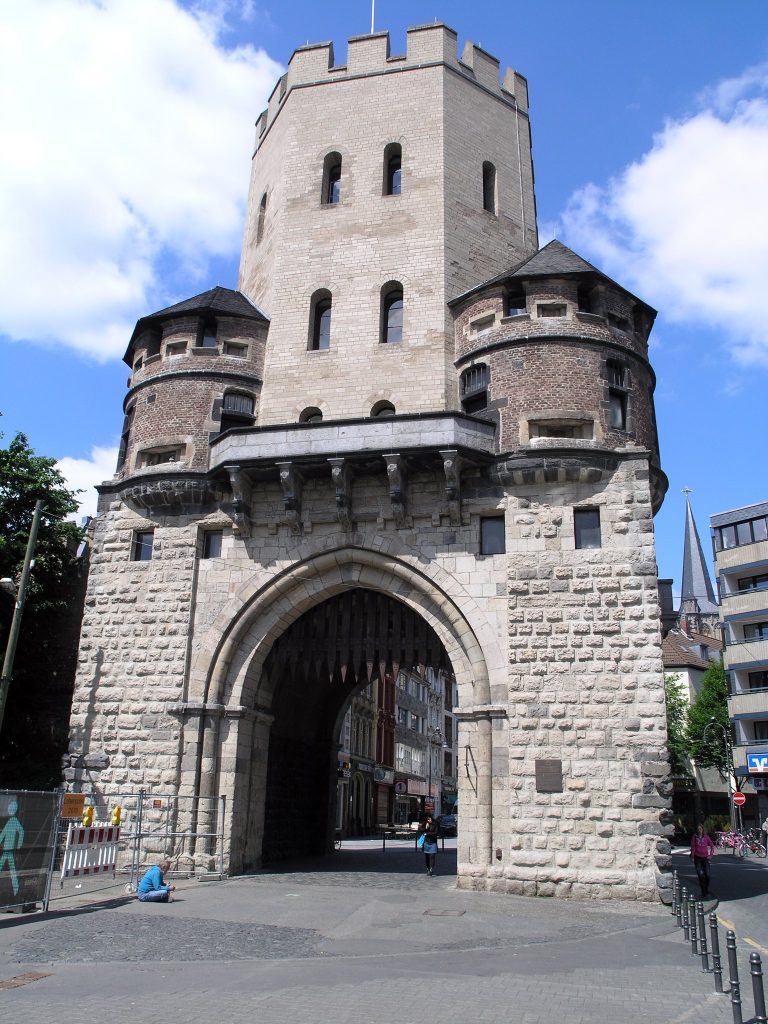
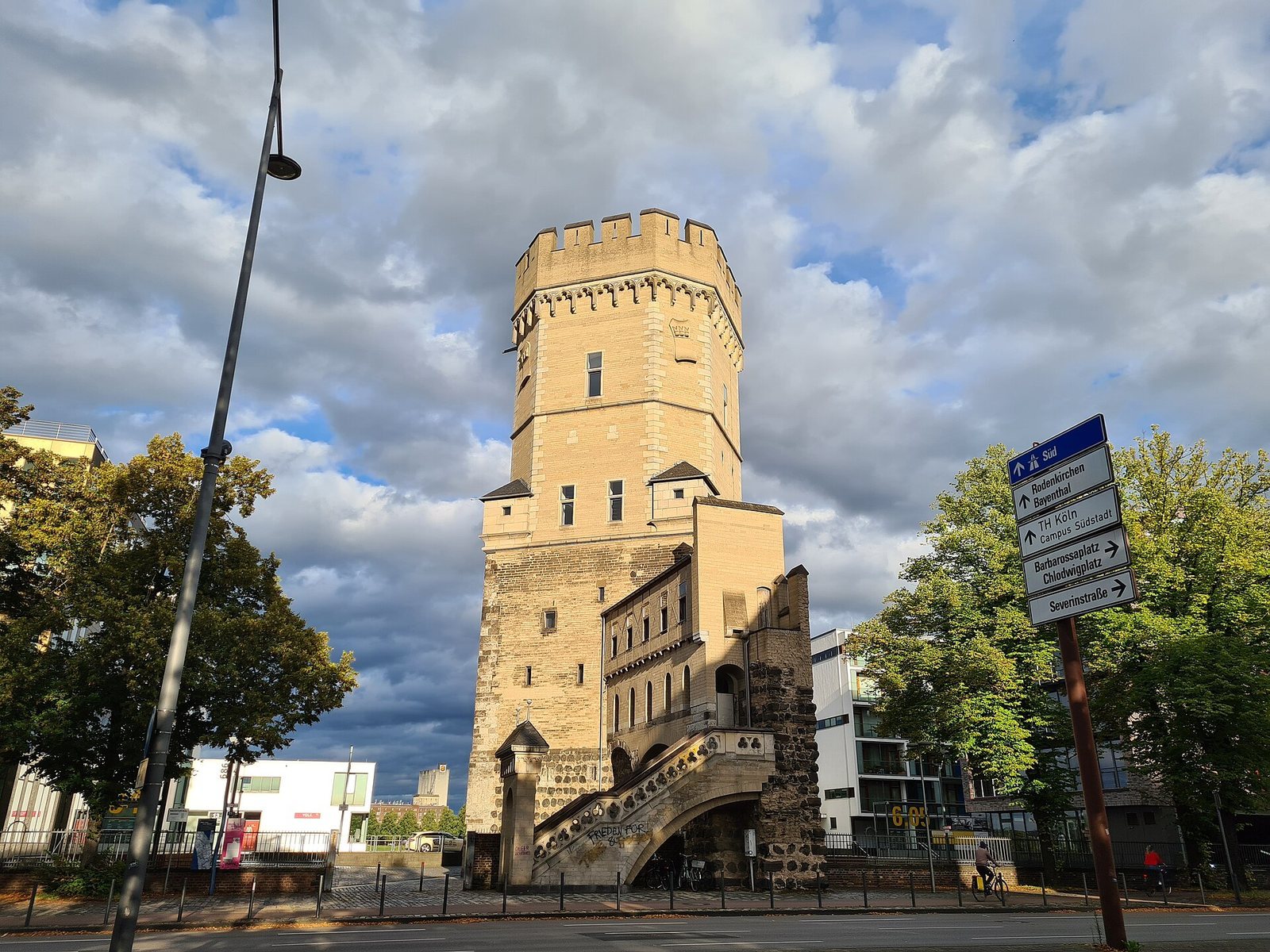
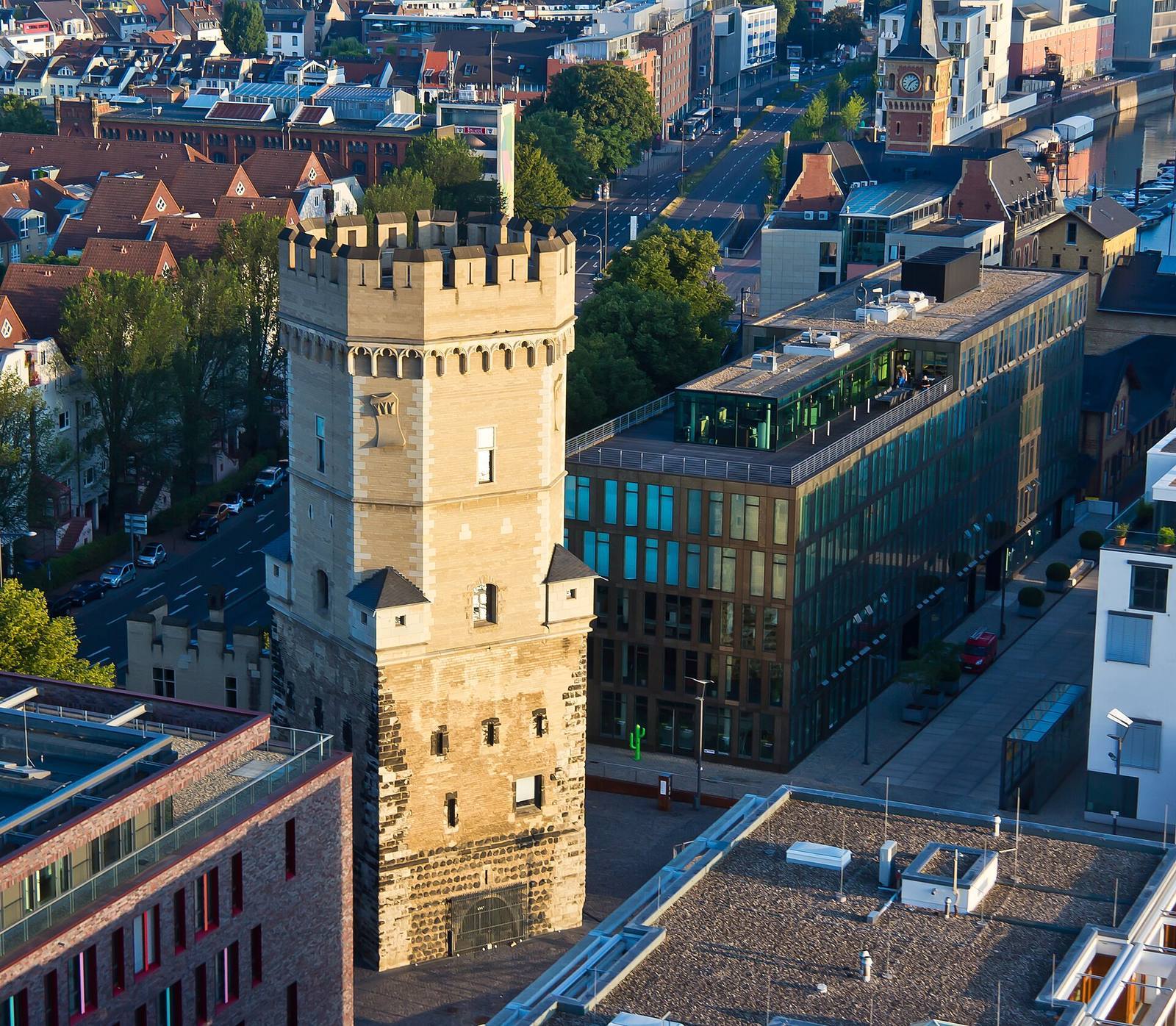
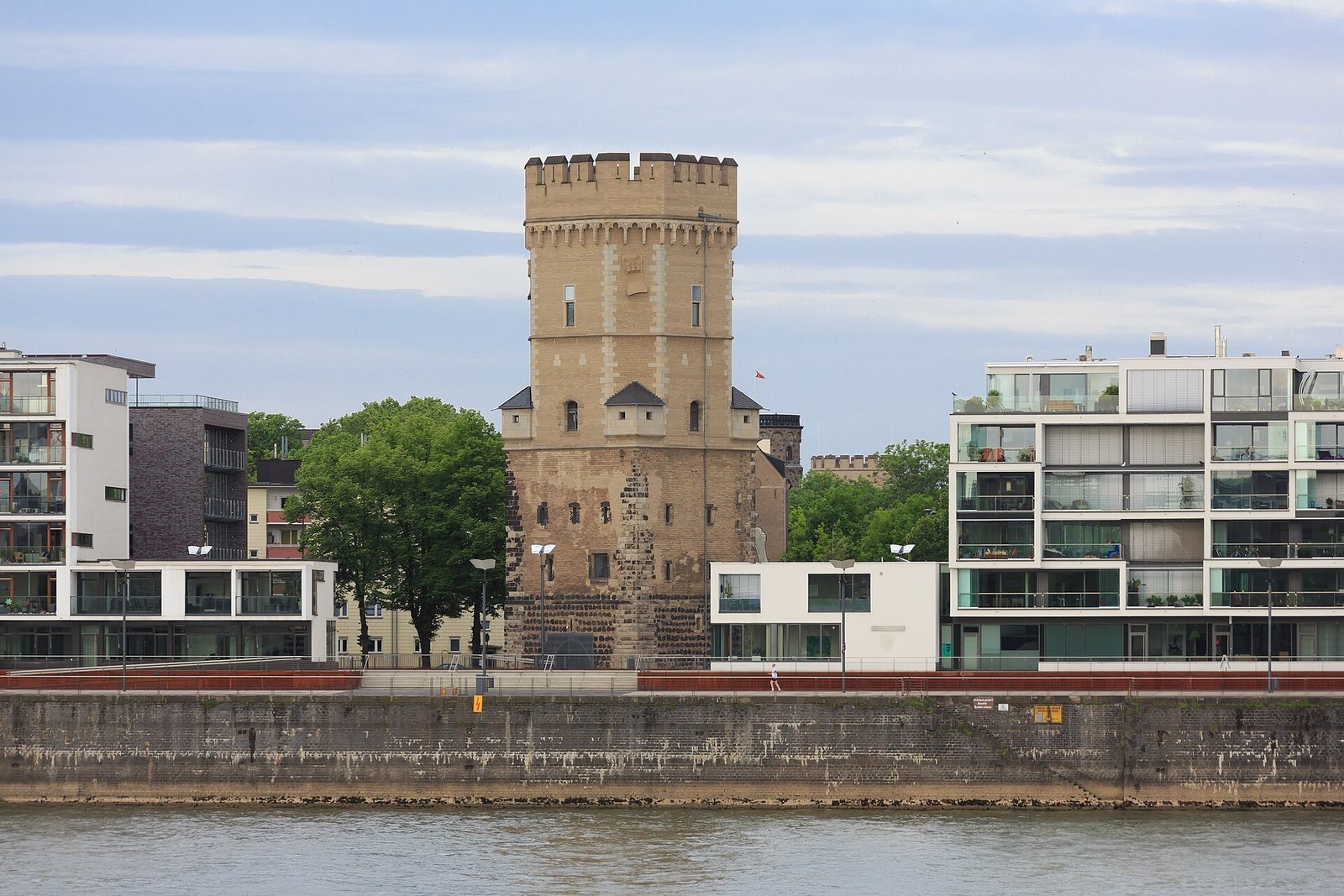
Bayenturm stands in the southern part of Cologne’s old town, between Bayenstrasse and Agrippinawerft, near the Rheinauhafen waterfront. It is about 35 metres high including its battlements, with a ground floor and four upper storeys. Its lower section is a square, three-storey base with walls up to 2.5 metres thick. Two octagonal storeys, added around 1325, rise above it. A band of round arches with three-lobed outlines and projecting battlements crowns the upper structure. The tower is one of the few surviving parts of Cologne’s medieval fortifications.
Riverside defences
The tower marked the southern corner of the riverside city wall, with fortifications continuing south and west from it. On the Rhine side, a wall, defensive walkway, and hipped-roof building marked the end of the riverside road, where a gate provided access. Another wooden gate in the Rhine wall led into the city; 21 further gates stood farther north along the wall. The walkway and watch buildings also crossed an arch over the Rhine to a pier anchored in the river. The crossing had fallen into disrepair and was dismantled in 1585, leaving the point where the arch rose from its support. Ice destroyed the sections within the river in 1784.
Landward and harbour defences
A sluice south of the tower channelled water into the moat outside the landward city wall. The harbour works of 1850–51 replaced the medieval riverside wall with a crenellated wall on the newly formed Rheinau peninsula. An open half-tower, or caponier, projected into the defended area so its flank could be covered, and a new outer defensive enclosure completed the arrangement. About ten metres of a three-storey building section belonging to the landward fortifications survives toward the riverside road. The present quay lies about 50 metres from the reconstructed tower.
Interior
The interior was refitted in 1992. A feature known as the “sky eye” brings light into the tower, where narrow slit windows provide the other stated source of illumination.