Bauernkirche: Iserlohn’s Evangelical St. Pancratius Church


Site at a Glance
- Rating
- 4.7
- Popularity
- Very Low
- Country
- Germany
- Primary era
- Medieval
- External website
- Open
- Eras represented
- Medieval, Early Modern, Modern
- Civilizations
- Holy Roman Empire
- Site type
- Religious
- Remains
- Church
On this page11 sections
History
Bauernkirche, formally the Evangelical St. Pancratius Church, is the oldest surviving building in Iserlohn, Germany. The church probably dates from around 985, although a Carolingian origin has also been proposed, and its earliest form belonged to the Romanesque period. Originally a daughter church of St. Vincent’s parish church in Menden, it stood at the origin of the settlement that later became Iserlohn and helped advance the Christianization of the surrounding region.
Medieval parish and ecclesiastical authority
During the Middle Ages, the Andreasstift in Cologne, a collegiate foundation dedicated to St. Andrew, held the right to appoint the church’s clergy. Bauernkirche was the seat of its own deanery in the thirteenth century. A deanery was an ecclesiastical district led by a dean. The district was later united with Attendorn, while the church’s bailiwick, meaning its jurisdiction or protective authority, initially belonged to the Counts of Arnsberg.
Before the Reformation, the parish was served by a dean, four canons, and seven vicars. Each vicar served one of the parish’s seven vicarages. The church also had altar dependents who were liable for dues in other parishes, reflecting the wide institutional and financial connections of the medieval foundation.
From the Reformation to the modern period
The settlement of Iserlohn was later relocated, but Bauernkirche continued as the parish church until the Reformation, the sixteenth-century religious movement that led to the establishment of Protestant churches across much of Europe. The Oberste Stadtkirche, or Upper City Church, was built around 1330 but remained subordinate to Bauernkirche. After the Reformation, it became an additional parish church.
Johann Abraham Strauß was pastor from 1782 to 1832, followed by the publisher and writer Ludwig Josephson, who held the office from 1832 to 1851. After the Second World War, the church served as a garrison church for British occupation forces until 1957. Since 2006, a support association has owned the building and pursued the restoration of its earlier condition. The Reconciliation Parish uses it for sermons, while the association also uses the church as an events venue.
Remains
Bauernkirche is a two-aisled Romanesque basilica built of rubble stone, with a transept and a western tower. A basilica is a church arranged around a longitudinal nave with aisles, while a transept forms the cross-arm of a cruciform plan. The oldest surviving parts belong to a cross-shaped pillar basilica dating approximately from the eleventh century. Repeated alterations changed the medieval building over time, including a later annex on the south side of the nave and a chapel on the north side.
Medieval structure and later additions
Western tower
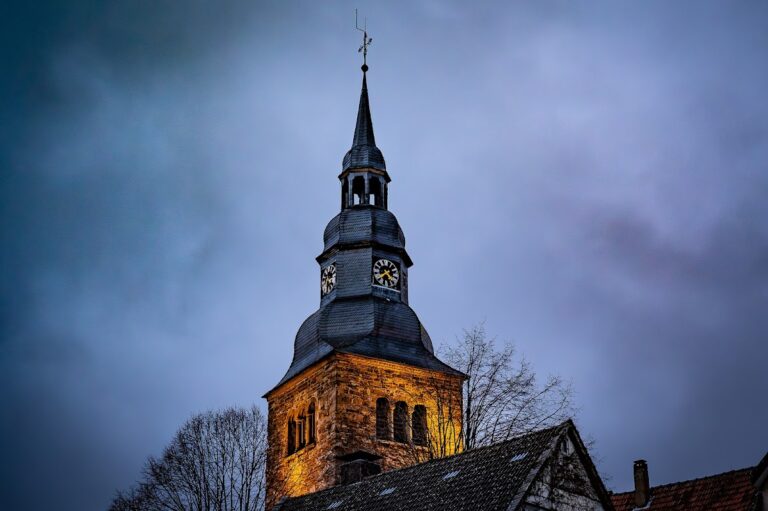
The western tower was designed as a defensive tower and rises approximately 60 metres. Its position at the west end forms the principal vertical element of the Romanesque church and preserves the building’s connection between religious and defensive architecture.
Choir and windows
The choir is one bay deep and ends in a 3/8 closure, a polygonal eastern termination formed from three sides of an implied eight-sided figure. Both the choir and its windows are late Gothic. The eastern window has a pointed arch, two sections, and tracery, the ornamental stone framework that divides and decorates a Gothic opening. The southern and northern transept windows each have three sections, while the windows of the northern aisle are round-arched. A sacristy stands on the south side of the choir.
Interior furnishings
The interior contains a Gothic sacrament house, an architectural receptacle for the consecrated Eucharistic sacrament, together with a late Gothic altarpiece and an eighteenth-century Baroque pulpit. The historic wooden barrel vault was demolished during the 1960s and replaced by a flat ceiling. The galleries were also removed during that period, altering the interior volume and appearance.
Organ and bells
2019 organ
The present organ was built in 2019 by the Grenzing organ-building firm. Designed in the French symphonic style, it has 33 speaking stops and 2,272 pipes, along with 31 extended stops and transmissions distributed across four manuals and a pedal. An organ stop is a selectable rank or group of pipes with a particular tonal character. Transmissions and extensions allow a stop or pipe set to serve more than one manual or pitch arrangement, enabling this instrument to provide a large symphonic disposition within the church’s limited space.
In the second manual, the stops are arranged as separate sections that can be coupled individually. The Orgue de l’Autel, meaning altar organ, is positioned behind the altar and functions as a distant division, an organ division located away from the main instrument. It can be played from the fourth manual.
Bell installations
A new bronze peal was installed in 1884 after the earlier bells had been melted down. Cast by the Rincker Bell and Art Foundry in Westhofen, the three bells sounded D, G, and B. They were themselves melted down for wartime purposes in 1918 and replaced in 1925 by four cast-iron bells made by the Schilling and Lattermann foundry. Those bells sounded C-sharp, E, F-sharp, and G-sharp and hung from deeply cranked steel yokes.
Serious damage to the bell installation in 2007 led to the acquisition of replacement bells from the closed Trinity Parish community center in Gütersloh. Cast by Rincker in Sinn in 1967, they were installed in a new two-storey wooden bell frame inside the tower and first rung at Bauernkirche on Easter Sunday 2009.
The church is also associated with an old Pancratius bell, probably cast in the fourteenth century. Its strike note is F-sharp, and the bell is now kept at the House of Heimat.