Basilica of Santa Maria delle Grazie: Gothic Church and Minor Basilica in Cortemaggiore


Site at a Glance
- Rating
- 4.5
- Popularity
- Low
- Country
- Italy
- Primary era
- Medieval
- Eras represented
- Medieval, Early Modern, Modern
- Civilizations
- Holy Roman Empire
- Site type
- Religious
- Remains
- Basilica
On this page14 sections
History
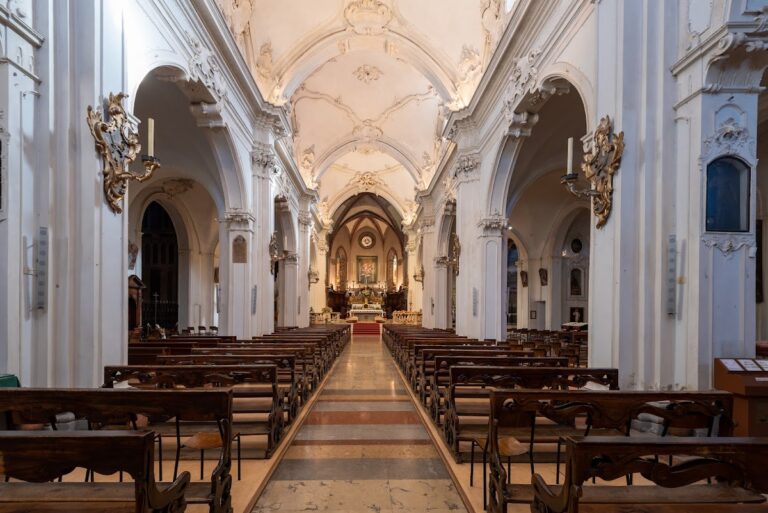
The Basilica of Santa Maria delle Grazie and San Lorenzo is a Roman Catholic church in Cortemaggiore, Italy, built by the Pallavicino rulers in a Gothic architectural tradition beginning in 1480. It replaced the older Church of San Lorenzo as the parish church and later became both a collegiate church, served by a chapter of clergy, and a minor basilica, an honorific Catholic status recognizing particular religious or historical importance.
Foundation and consecration
In 1481, Gian Lodovico I Pallavicino, the first marquis of Cortemaggiore, and his son Rolando II Pallavicino commissioned the architect Gilberto Manzi to design the new church. By 1495, the sanctuary, choir, apse, transept, and first bay of each of the three naves were complete. That year the building became the parish church, and Monsignor Fabrizio Milani consecrated it in 1499.
Construction then stopped because the Pallavicino family could not meet the considerable cost of building this church alongside the other churches of Cortemaggiore. The church was nevertheless elevated to collegiate status in 1513. Work later resumed with support from the collegiate chapter, the church-building committee, and the local population. This second phase ended in 1567 to 1569 and departed in some respects from Manzi’s original design.
Seventeenth- and eighteenth-century changes
The Gothic building underwent extensive alteration during the seventeenth century. The floors of the choir and sanctuary were raised in 1606, and the church was completely whitewashed in 1630, immediately after the plague epidemic. At the request of Canon Paolo Ziotti, the campanile was raised in 1653. The side chapels were enlarged and given Baroque stucco decoration in 1660.
The added height of the campanile placed excessive weight on the structure below, so the bells were installed on one side only to limit the load. A crypt was excavated beneath the church in 1761, adding a further devotional and architectural space to the complex.
Restoration, relics, and later status
In 1812, after Napoleon’s suppression of the Convent of the Annunciation, the remains of Gian Lodovico I Pallavicino and his wife Anastasia Torelli were transferred to the collegiate church with their Renaissance marble mausoleum. The couple had initially been buried in the Church of the Annunciation at Cortemaggiore.
Professor Gaetano Guglielmetti directed a major renovation of the facade and interior in 1880 and 1881. The work introduced new flooring, slimmer columns, and reconstructed capitals. The church’s polyptych was dismantled during this campaign, separating its painted panels from their frame. Much of the altarpiece was reassembled in 2003.
In 1964, the sculptor Paolo Perotti adapted the church to contemporary liturgical requirements, working on the high altar, tabernacle, and altar of Our Lady of Fatima. On 3 May 2008, the former collegiate church was raised to the rank of minor basilica in a ceremony officiated by Cardinal Angelo Sodano.
The location of the founders’ remains within their mausoleum was clarified in 2020, when deterioration in a wall separating the monument from a service room revealed a wooden box bearing their names. The church also preserves a relic of the Holy Thorn, a thorn traditionally associated with the Crown of Thorns of Christ. King Francis I of France presented it in 1521 to Gian Lodovico II Pallavicino as moral compensation for the killing of the Pallavicino marquises Cristoforo and Manfredo during the French occupation of the Duchy of Milan.
Remains
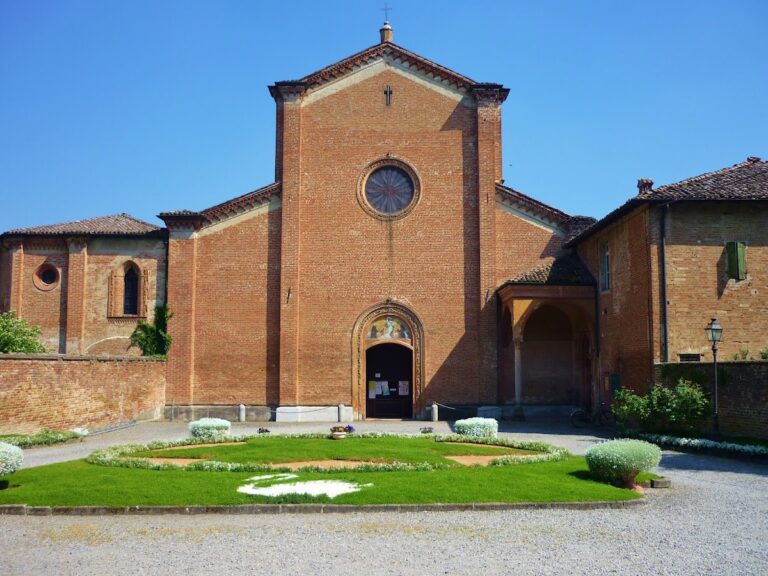
The basilica stands in central Cortemaggiore on Piazza dei Patrioti. Its basilical layout takes the form of a Latin cross, with a long central axis crossed by a shorter transept, and contains three naves divided into five bays. A small forecourt paved with rectangular stone slabs precedes the building. Three flights of polygonal granite steps, each with four steps, lead up to it.
Facade and bell tower
Neo-Gothic facade
The exposed-brick facade was executed in a Neo-Gothic style and divided into three sections. Full-height pilasters end in terracotta pinnacles, while pointed-arch single windows in the upper parts of the pilasters contain mosaics of saints. The central stone portal has a lunette, the semicircular space above the doorway, with a mosaic of the Blessed Virgin. Above it, a niche contains a stone statue of Saint Lawrence, followed by a rose window and a two-light window set within a round arch.
Two side portals flank the main entrance. Their niches contain Saint Joseph on the right and Moses on the left. The square bell tower is attached to the presbytery, the area around the main altar reserved for the clergy, on the right side of the church. It has three orders, or principal vertical levels, and its bells occupy one side because of the weight of the upper structure.
Altarpieces and chapels
Polyptych and founders’ mausoleum
The church contains a twelve-panel polyptych, an altarpiece made from multiple painted panels, painted in 1499 by Filippo Mazzola, the father of Parmigianino, in connection with the consecration. The work was dismantled in 1880, and much of it was brought back together in 2003.
The Chapel of Saint Lawrence in the left nave contains the white-marble mausoleum of Cortemaggiore’s founders. Rolando II Pallavicino commissioned it in 1499 for his father, Gian Lodovico I Pallavicino, and Anastasia Torelli. Its artistic attribution remains debated, with associations to Andrea Bregno, Leonardo da Vinci, and the school of Giovanni Antonio Amadeo.
Chapel of the Blessed Sacrament
The Chapel of the Blessed Sacrament contains The Virgin of the Angels, painted by Francesco Scaramuzza in 1847, and The Resurrection of Christ, painted by Lorenzo Toncini in 1850. Onorato Buzzi made the altar. Two monochrome wooden statues imitating alabaster represent Faith on the left and Hope on the right; they were made by the Flemish sculptor Jan Geernaert.
The chapel also preserves the Holy Thorn relic. A tradition connects it with Giuseppe Verdi, the nineteenth-century Italian opera composer. According to that tradition, Verdi prayed before Scaramuzza’s Virgin of the Angels while composing the similarly titled aria in his opera La forza del destino.
Chapel of the Rosary
The Chapel of the Rosary contains a canvas of the Madonna, Child, and Saint Louis Gonzaga by Pompeo Batoni, together with a restored Pietà attributed to Il Pordenone.
Crypt and organ
Crypt fresco
A fresco in the crypt depicts Christ emerging from the Tomb. It is dated 1522 and attributed to Antonietto de’ Renzi.
Historic pipe organ
A mechanical pipe organ made by Adeodato Bossi-Urbani in 1860 stands on a seventeenth-century choir loft on the Gospel side of the presbytery. It has two manuals of 61 keys, extending from C1 to C6, and a straight pedalboard with 24 pedals and 12 notes beginning at C13.
The Grand Organ and Pedal stops have a 16-foot basis and are operated by extractable wooden Lombard-style stop knobs arranged in three columns to the right of the window console. The Swell Organ, fitted with shutters, occupies a separate room beneath the choir loft, with non-extractable controls to the left of the keyboards.
Prospero Galloni of Piacenza and Father Davide of Bergamo, whose secular name was Felice Moretti, inaugurated the instrument. Moretti advised on additions during its construction, and both men later served on the jury that selected the titular organist. The Fratelli Piccinelli workshop of Ponteranica restored the organ in 1967, and Alessandro Esposito performed at the inauguration of the restored instrument.