The Boris Stone of Polotsk: A Medieval Commemorative Boulder
Site at a Glance
- Popularity
- Medium
- Country
- Belarus
- Primary era
- Medieval
- Eras represented
- Medieval
- Civilizations
- Unclassified
- Site type
- Civic
- Remains
- Monument
On this page7 sections
History
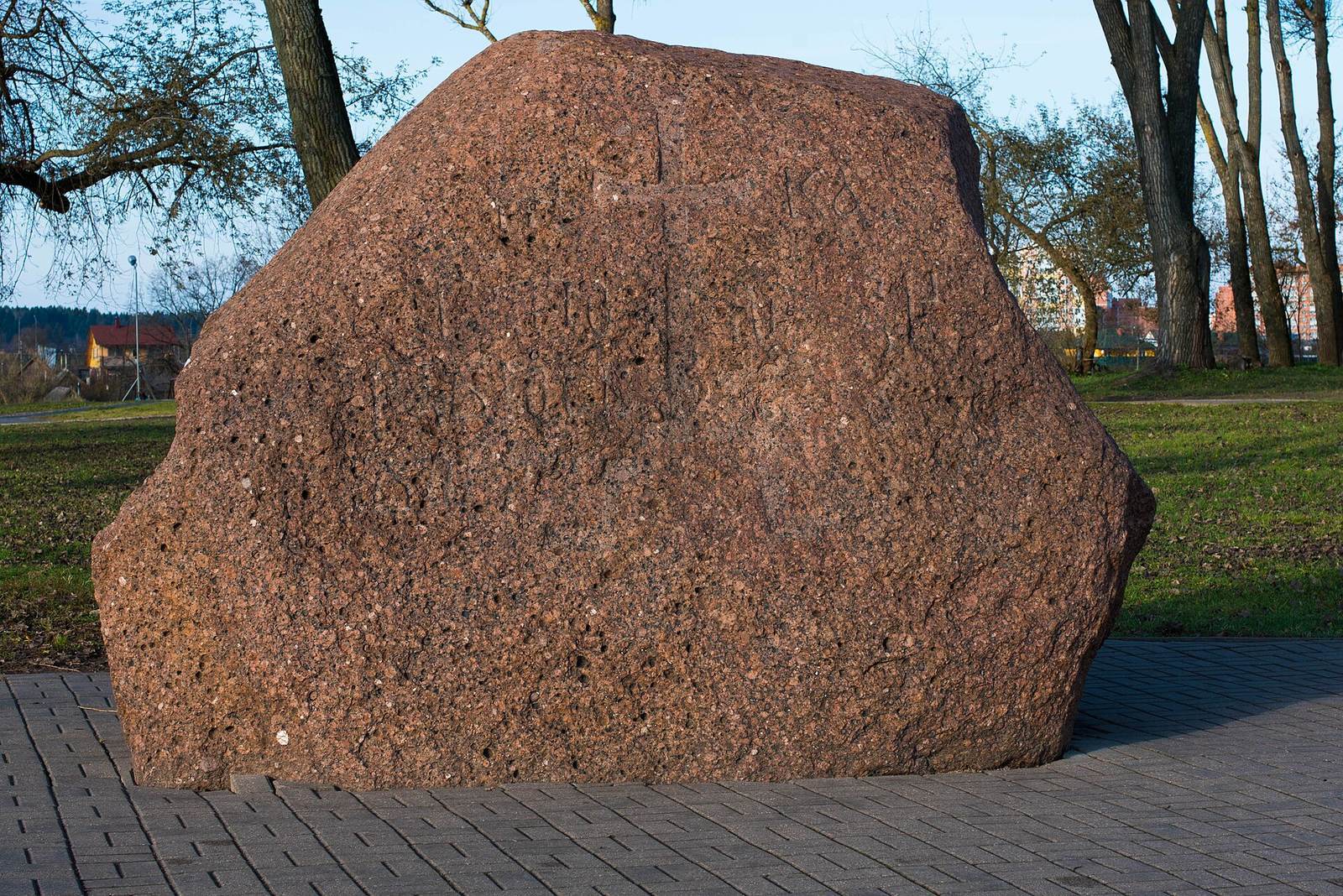
The Boris Stone of Polotsk is a medieval boulder bearing a carved cross and inscriptions, now in Polotsk, Belarus. It belongs to a group of similar monuments associated with the Western Dvina region. The cross and text were carved in the first third of the twelfth century on the order of Prince Boris Vseslavich, also known as Rogvolod. The monument was associated with a revival of pagan beliefs and was intended to commemorate the prince’s name.
Nineteenth-century study and local traditions
In the late nineteenth century, historian and local historian A. M. Sementovsky studied the stone. A. P. Sapunov described and illustrated it in his 1890 monograph on the Dvina, or Boris, stones. In 1896, philologist and historian of Old Russian art I. A. Shlyapkin examined and photographed it during an expedition. The Polotsk stone was long regarded as the only surviving Boris Stone in Belarus, although more than ten boulders with similar carvings had once stood in the Western Dvina basin.
Sementovsky connected the stone’s local bread-related name with the time it became fully visible above the water, around July 24. The date was the feast of Saints Boris and Gleb, princes of early Rus’ later revered as Christian saints, and coincided with the beginning of the grain harvest. A local saying also linked the feast to harvesting. Sementovsky recorded a different explanation that grain-bearing barges had struck the boulder, but rejected it because the navigable channel ran near the opposite bank. Sapunov proposed that the bread-related name arose from a softened Belarusian pronunciation of Gleb, in which the initial sound resembled an “h.”
From the river to Polotsk
Before its removal in 1981, the stone lay in the Western Dvina about five kilometres downstream from Polotsk, near the left bank and opposite Podkosteltsy, a village later incorporated into Novopolotsk. The river current had worn away ground beneath one side, tipping the boulder so that the top of its cross leaned toward the water. An effort to haul it ashore in 1889 failed. Polotsk’s district police chief assembled about a hundred people; after a prayer service and decorating the stone with a flag, they tried to pull it up the steep bank.
The boulder was lifted from the Dvina and moved to Polotsk in 1981. It is listed as a Historical and Cultural Value of Belarus, an official national heritage designation.
Remains
The carved monument
Boulder and setting
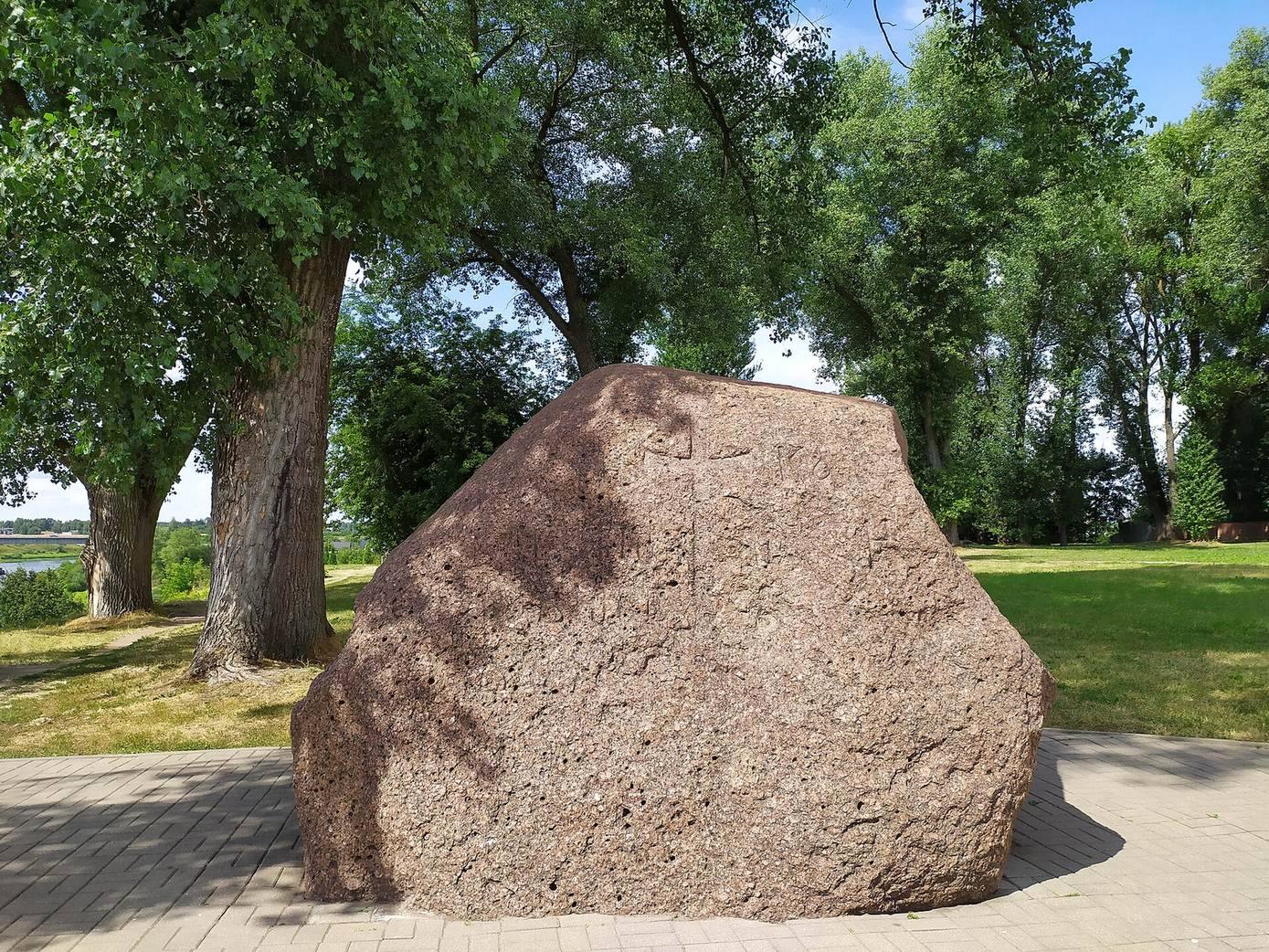
The irregular, reddish boulder is rapakivi granite, a type marked by distinctive feldspar crystals. Feldspar and quartz are among its principal minerals. It measures about three metres across and eight metres around. The stone now stands opposite St Sophia Cathedral in Polotsk.
Cross and inscriptions
A four-ended cross is carved into a stepped base more than 1.5 metres long. The base represents Golgotha, the place associated with Jesus’s crucifixion. Other Boris Stones bear crosses with two horizontal bars and six ends, unlike the four-ended cross here. The inscriptions include “Lord, help your servant Boris” and a formula above and beside the cross meaning “Jesus Christ conquers.” Natural weathering of the feldspar has left the surface rough and grainy, making the carved words difficult to read.