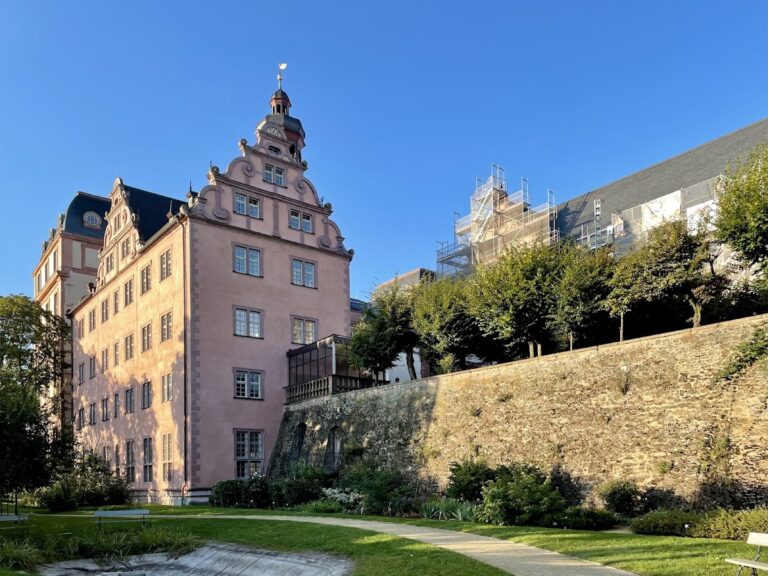
Schloss Dornberg: A Medieval Castle Complex in Groß-Gerau, Germany


Site at a Glance
- Rating
- 4.3
- Popularity
- Very Low
- Country
- Germany
- Primary era
- Medieval
- External website
- Open
- Eras represented
- Medieval
- Civilizations
- Holy Roman Empire
- Site type
- Military
- Remains
- Castle
On this page8 sections
History
Schloss Dornberg is the surviving remnant of a medieval castle complex in Groß-Gerau, Germany, built by the Lords of Dornberg on the site of an earlier water castle. The castle stood at Dornberg, now a district of Groß-Gerau, and became the administrative center of the Katzenelnbogen Upper County before that role moved to Darmstadt in 1375.
Medieval Origins and Katzenelnbogen Rule
Eberhardus de Dornburg is first documented around 1160. The castle, named castrum Dorenburg in records from 1236 to 1245, was probably constructed by the Lords of Dornberg as a fief of the Counts of Henneberg. A fief was an estate granted by a superior lord to a subordinate in return for service and loyalty. After Conrad von Dornberg died without children in 1257, Diether V von Katzenelnbogen acquired the fief through his maternal connection with the Henneberg family.
During the thirteenth and fourteenth centuries, the complex grew through the construction of an outer bailey, an enclosed area adjoining the main stronghold, and further expansion of the castle. The Counts of Katzenelnbogen used Dornberg as the center of their Upper County until the administrative center was transferred to Darmstadt in 1375. Expansion continued during the fifteenth century. A round residential tower at the heart of the original castle was demolished and replaced by a new castle building.
Hessian Landgravial Possession
When the Counts of Katzenelnbogen became extinct in 1479, the castle passed to Heinrich III of Hesse. It remained a Henneberg fief, however, and was pledged on several occasions. Henneberg feudal overlordship ended during the War of the Landshut Succession, a late-fifteenth-century conflict over the inheritance of the Duchy of Bavaria-Landshut, when Wilhelm of Henneberg renounced his rights. The Hessian landgraves, high-ranking territorial rulers in the Holy Roman Empire, thereafter used Dornberg mainly for occasional hunting stays.
Destruction, Reuse, and Later Institutions
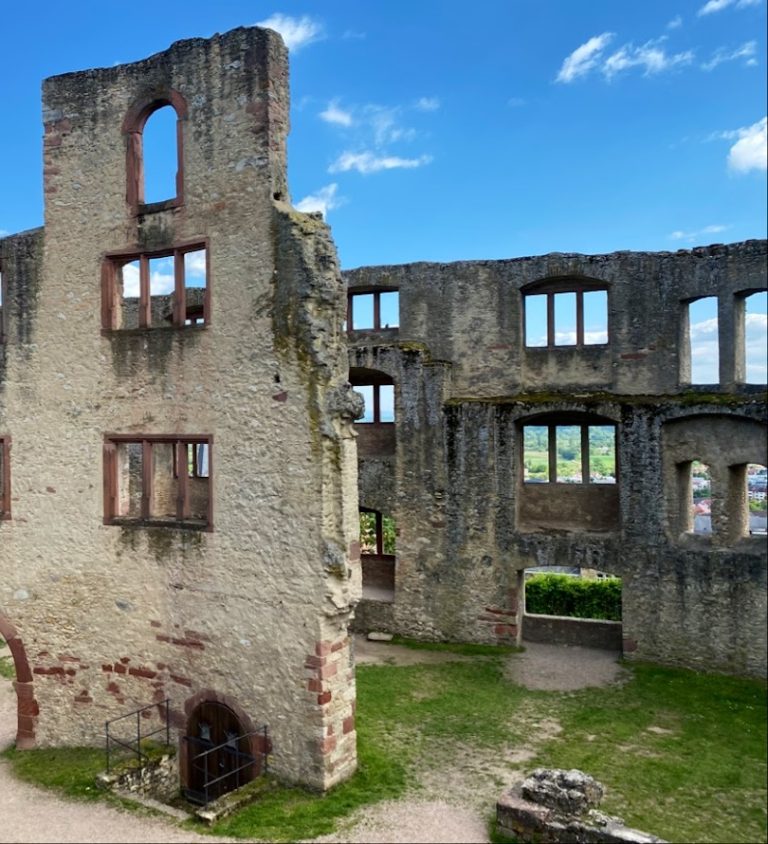
French troops burned Schloss Dornberg on 14 February 1689 during the War of the Palatine Succession, a European conflict fought from 1688 to 1697 that brought military destruction to parts of the German territories. Between 1722 and 1726, stones from the burned castle were reused in the nearby Fasanerie wall. Only limited parts of the former complex survived, and some of the remains were converted into a hunting lodge. The remaining building was demolished during the nineteenth century, although the surviving complex housed the district administration from 1832 to 1837.
From 1953, the gatehouse and several later additions were used as a youth hostel. From 1960 or 1963, the site served as the district youth center. Extensive renovation later adapted the surviving castle remains for the adult education center of the Groß-Gerau district.
Remains
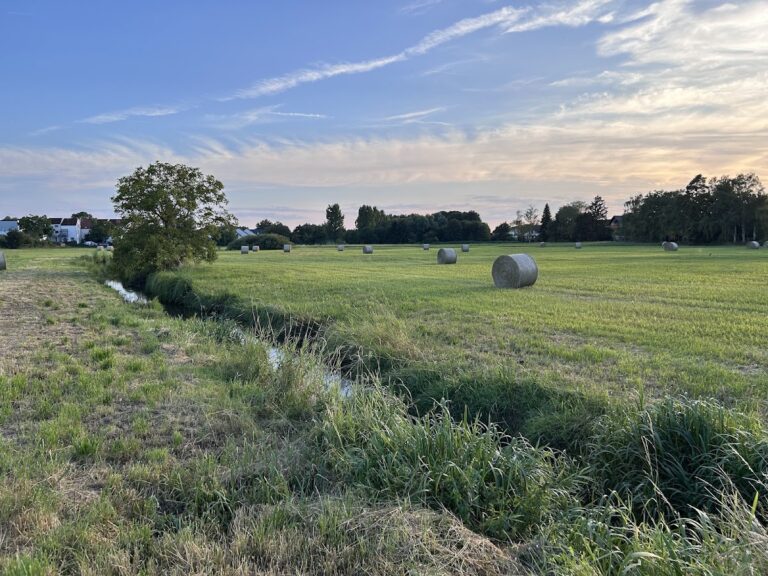
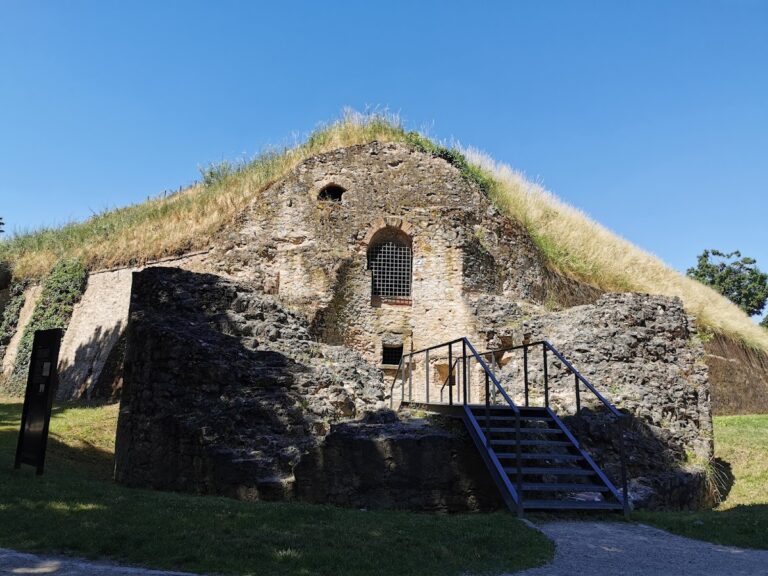
The surviving complex occupies a sand dune northwest of the edge of a former channel of the Neckar. The Landgraben now forms a broad loop around the dune. The former core castle stood on a clearly visible artificial mound, or motte, a raised defensive earthwork that commonly carried a tower or stronghold. The mound remains largely unbuilt, its masonry remains are crossed by vegetation, and much of it is heavily overgrown. Marshy ground with reeds now surrounds much of the former core castle.
Former Core Castle
The core castle had a polygonal plan measuring approximately 50 to 55 meters in diameter. Parts of its gatehouse survive in restored form. The visible mound and the surviving masonry convey the position of the former stronghold within the wider water-protected complex, while the surrounding marshy ground reflects the defensive landscape associated with the medieval water castle.
Outer Bailey and Later Buildings
More of the outer bailey survives than of the core castle. A second restored gate building remains, together with sections of the enclosing wall on the eastern side facing the Landgraben. A nineteenth-century historicist building in the western part of the outer bailey is used as a forestry office. On the side facing Dornberg, a newer adult education center building was constructed against the former wall, and its form reflects the earlier arrangement of the outer bailey.
Roman Archaeological Setting
A sand dune southwest of Schloss Dornberg previously held the Roman fort of Groß-Gerau and its associated settlement, or vicus. A vicus was a civilian settlement connected with a Roman military fort and could provide commercial and service functions. The fort and settlement stood at a road junction. Southeast of the castle, reed-covered terrain was probably as difficult to cross in the past as it is today.