Balamand Monastery: From Cistercian Abbey to Antiochian Orthodox Monastery
Site at a Glance
- Popularity
- Medium
- Country
- Lebanon
- Primary era
- Early Modern
- Eras represented
- Medieval, Early Modern
- Civilizations
- County of Tripoli, Crusader, Ottoman
- Site type
- Religious
- Remains
- Monastery
On this page8 sections
History
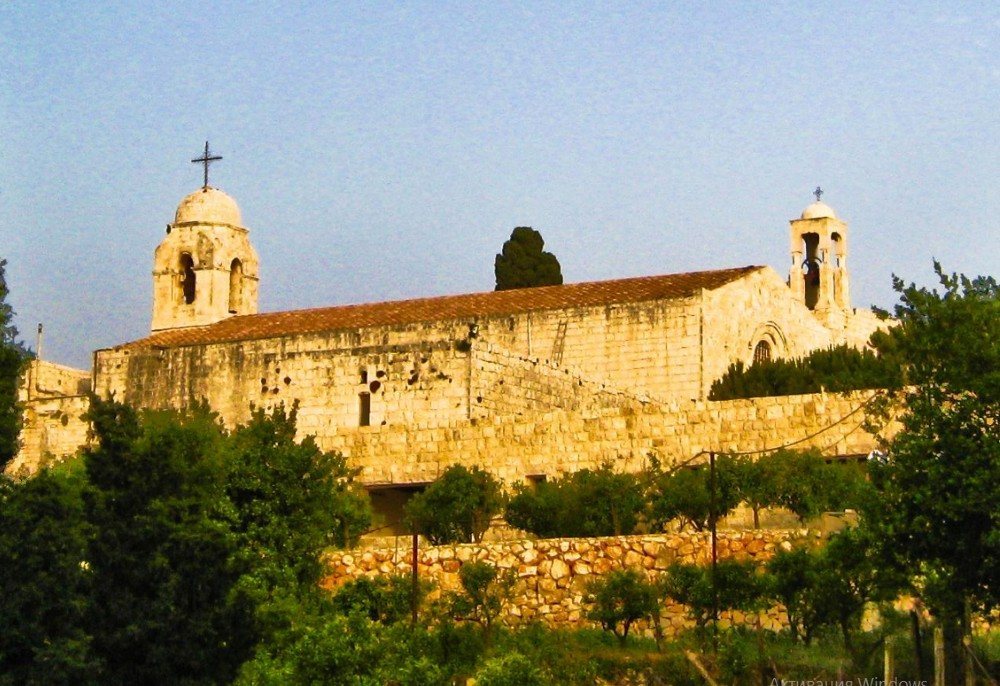
Balamand Monastery is an Antiochian Orthodox monastery on a plateau in Lebanon’s Koura District, about 10–15 kilometres southwest of Tripoli. It began as the Cistercian abbey of Belmont, founded in 1157 by thirteen monks sent from Morimond, its mother abbey. The Cistercians were a monastic order that developed from the abbey of Citeaux. Built between 1157 and 1169 in Cistercian style with elements of Provençal Gothic, a regional form of Gothic architecture, Belmont was the first Cistercian abbey outside Europe and became the order’s leading house in the eastern lands. The name Belmont means beautiful mountain.
Cistercian foundation and expansion
The foundation followed earlier attempts to establish Cistercian communities in the Holy Land. In 1124, Arnold of Morimond tried to found a house with German monks, but Bernard of Clairvaux criticized the project. Arnold returned in 1125 without success. In 1129–30, Baldwin II, king of Jerusalem, and William of Messines, appointed patriarch of Jerusalem in 1130, sought Bernard’s support for another foundation. He refused, and resistance to the project appears to have eased only after his death in 1153.
Belmont expanded through affiliated monasteries, known as daughter houses. Salvatio was founded around 1161, followed by St John in Nemore in 1169 and SS Trinitas de Refech in 1187. The locations of the latter two houses are uncertain, though both are thought to have been in the County of Tripoli, a Latin Christian polity established during the Crusades in what is now northern Lebanon. Beaulieu, a daughter house in Cyprus, followed in 1235, and Santa Maria di Rifesi is also listed among Belmont’s foundations. Two nunneries dedicated to Mary Magdalene, in Tripoli and Acre, may also have received support from the abbey.
End of Cistercian occupation
The last recorded Cistercian abbot, Peter the German, was appointed on 26 February 1282. A Cistercian monk’s unusual public Mass in Tripoli was recorded in 1287. Cistercian occupation ended around the Mamluk conquest of Tripoli in 1289. The Mamluks were the Muslim ruling dynasty that took the city, and Muslim forces had destroyed the monastery by 1291. Its ruins remained largely abandoned for about three centuries, although Syriac-Arabic manuscripts from around 1492 indicate that hermits sometimes lived there.
The transition from Cistercian to Orthodox control has two historical traditions. The Antiochian Orthodox tradition holds that the withdrawing Cistercians handed the estate over as they left for Cyprus, a view supported by Mamluk-era documents. The Cistercian tradition maintains that monks returned after the conquest and, after their final departure, invited Aramaean monks described as non-Chaldean to live at the monastery; Western historians have supported this interpretation on the basis of manuscripts. The transfer is no longer disputed between the Cistercians and the present monastery.
Orthodox revival
Youwakim (Joaquim), metropolitan of Tripoli, re-established the monastery as a Greek Orthodox house in 1603 with support from local Muslim officials. A metropolitan is a senior bishop responsible for a major church region. In 1610 the monastery received a waqf, a religious endowment, and twelve monks took up residence. By the middle of the seventeenth century it had become one of the Antiochian Orthodox Church’s most important monasteries. It flourished under Ottoman rule, sustaining religious life and a reputation for hospitality. In 1697, about forty monks lived there.
Balamand became a center for Orthodox theology and the copying of religious manuscripts for other monasteries. Its library holds manuscripts spanning five centuries. The monastery also offered refuge to local people during political conflicts, epidemics, and natural disasters.
Theological education and modern history
In the early 1830s, Archimandrite Athanasius (Kasir), a senior monastic cleric, established a clergy-training school at Balamand. Its teaching included Arabic and Greek, church music, dogmatic theology, and pastoral theology. Ottoman authorities closed it in 1840. Most students were Arab, while Greek hierarchs then dominant in the Antiochian Church opposed the growth of Arab influence. The school reopened in 1900, after an Arab was elected patriarch in 1899. Its curriculum followed Russian theological schools, and some graduates continued their studies in Russia.
The school closed at the start of the First World War in 1914, briefly resumed in 1921, and operated intermittently during the interwar years. Continuous teaching returned in 1960. In 1962, Patriarch Theodosius VI appointed Bishop Ignatius (Hazim) to direct the school. Student numbers doubled and graduates began receiving bachelor’s degrees. Ignatius, who later became Patriarch Ignatius IV of Antioch, had also served as the monastery’s abbot until 1966. The theological seminary was re-established that year and took the name St John of Damascus in 1970.
Because of the Lebanese Civil War, the theological institute was evacuated to Thessaloniki in 1975 and returned in 1979. A synodal commission was established to supervise it in 1978, and the monastery sheltered many refugees during the war. In 1988, Patriarch Ignatius IV founded the University of Balamand on and around the historic monastery lands. The university is secular and institutionally distinct from the monastery, though the seminary’s history is also connected with its development.
From 17 to 24 June 1993, the monastery hosted the seventh plenary session of the Joint International Commission for Theological Dialogue between the Catholic and Orthodox Churches. On 23 June, the meeting adopted the Balamand declaration. It rejected uniatism, a proposed model for church unity based on the historical union of some Eastern Christian communities with Rome while retaining Eastern rites, as a method of pursuing unity. It also opposed proselytism, or efforts to draw members from another church, and Catholic expansion at the Orthodox Church’s expense. At the same time, it recognized the Eastern Catholic Churches’ right to exist and serve their members’ spiritual needs.
Balamand is a male monastery dedicated to the Dormition of the Virgin Mary, the Christian observance of her death and passage from earthly life. It is stavropegial, meaning directly subject to the Antiochian patriarch rather than a local bishop. The monastery also houses a museum devoted to its architectural history and sacred art.
Remains
The monastery occupies a plateau about 275 metres above sea level. Its buildings reflect the original Cistercian foundation and later Orthodox rebuilding, which incorporated elements of the earlier architecture.
Plateau setting
The ground drops steeply on three sides of the plateau, while higher mountains border it to the southwest. To the north, the site faces the Mediterranean and the coastal road between Tripoli and Chekka. This naturally defensible position may have influenced the choice of location. Cistercian communities generally preferred secluded valleys beside running water, so the setting was unusual; the reason for choosing it is uncertain. One possibility is that unused buildings already stood on the plateau and made the foundation easier.
Church and monastic architecture
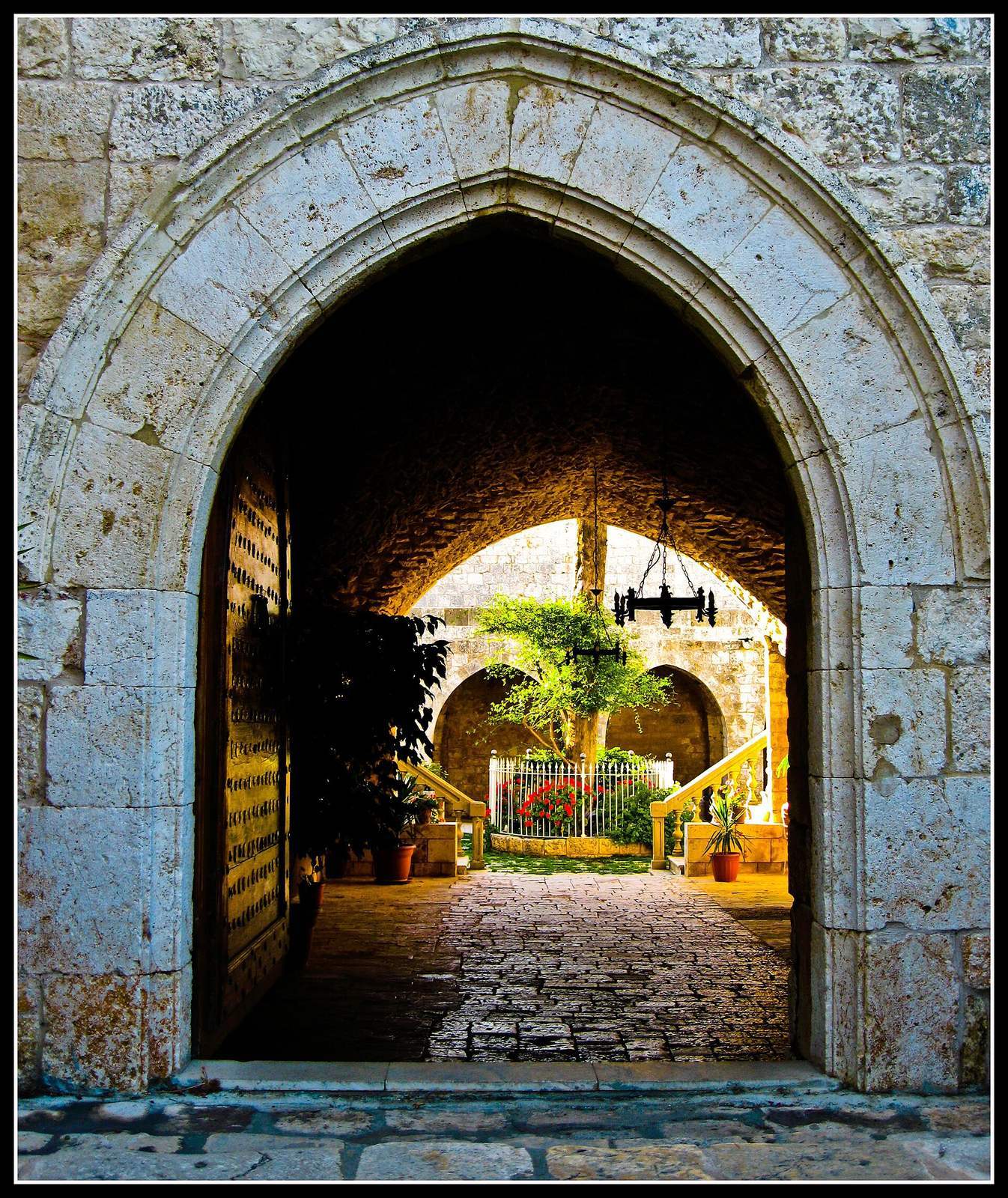
The church faces east-northeast, 22 degrees north of due east, an unusual orientation for a Cistercian building. Its design has led to suggestions that it may have begun as a Byzantine church or that its construction involved the Order of Grandmont, a medieval monastic order. Both ideas assume that existing, unused buildings helped make the foundation possible, but neither is established. A 1921 photograph shows the church nave and bell tower, as well as an interior monastic garden with part of the cloister.