Bajrakli Mosque in Peja: A Fifteenth-Century Ottoman Mosque
Site at a Glance
- Popularity
- Medium
- Country
- Kosovo
- Primary era
- Medieval
- Eras represented
- Medieval
- Civilizations
- Ottoman
- Site type
- Religious
- Remains
- Mosque
On this page15 sections
History
Ottoman foundation and urban role
Bajrakli Mosque is an Ottoman mosque in Peja, Kosovo, built in the second half of the fifteenth century during the Ottoman Empire’s expansion into southeastern Europe. Its exact construction year is uncertain. Sultan Mehmed II commissioned and endowed the mosque, which helped establish Islamic architectural traditions in Kosovo while incorporating local building practices.
Also known as the Bazaar Mosque or Çarshi Mosque, it stood in Peja’s old bazaar and became a focus of the city’s Ottoman-era development. Markets and civic buildings were organized around it, and it served as Peja’s main mosque. Bajrakli means ‘with a flag’ in Turkish: raising a flag on the minaret signaled prayer time to the city’s other mosques.
Destruction and protection
Italian forces burned the mosque in 1943, when the entire Peja bazaar was also burned. Serbian forces burned it again during the 1999 Kosovo War, and restoration followed. The mosque is protected as a cultural monument of exceptional importance under permanent cultural-heritage protection.
Remains
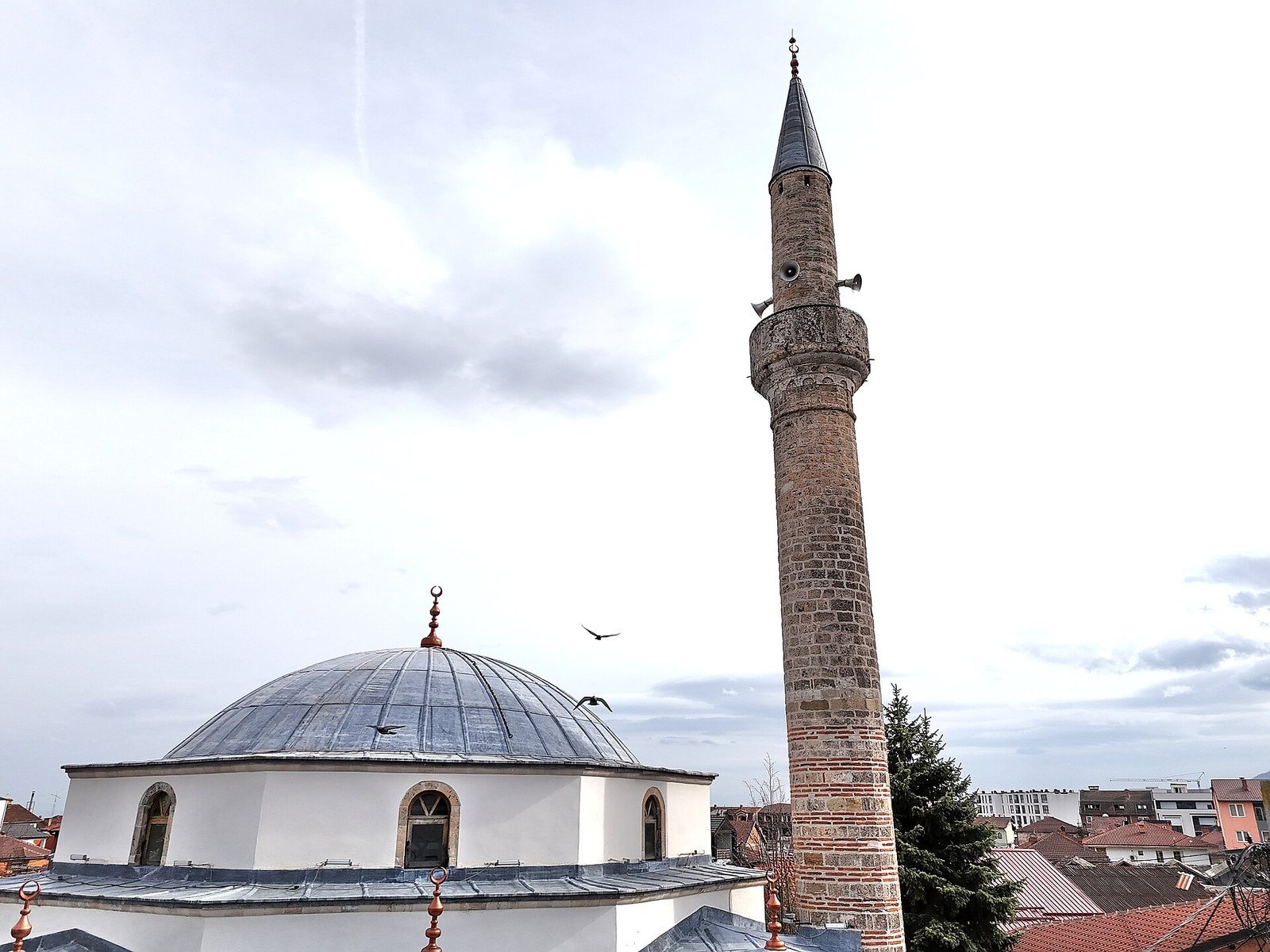
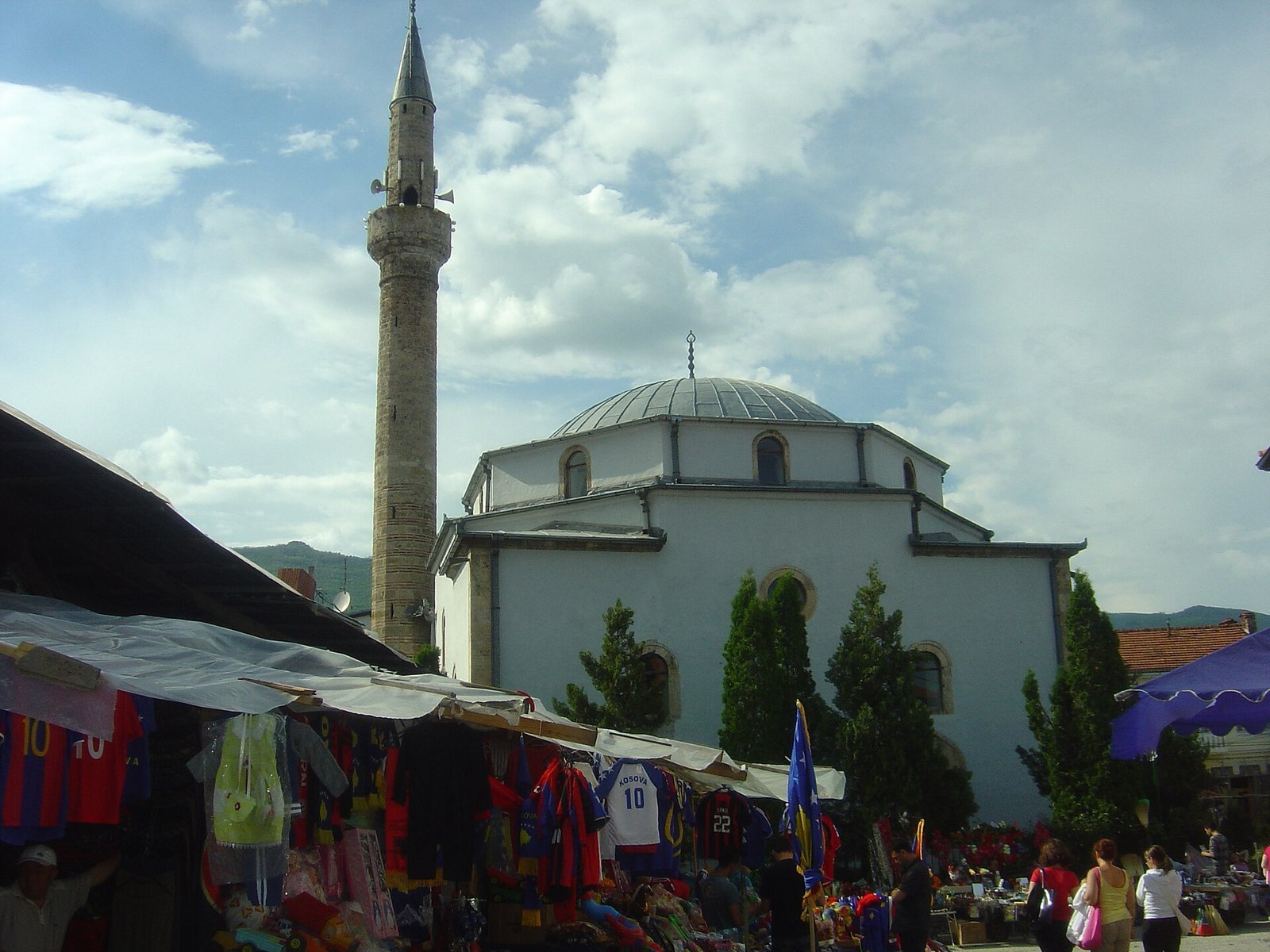
The Ottoman-style building has a rectangular plan measuring 18.87 by 13.95 metres and a total area of 263.24 square metres. Its principal parts are a central prayer hall, an open entrance portico, and a single minaret. It is Peja’s largest mosque, and its dome is the city’s oldest and highest.
Building and condition
Prayer hall and dome
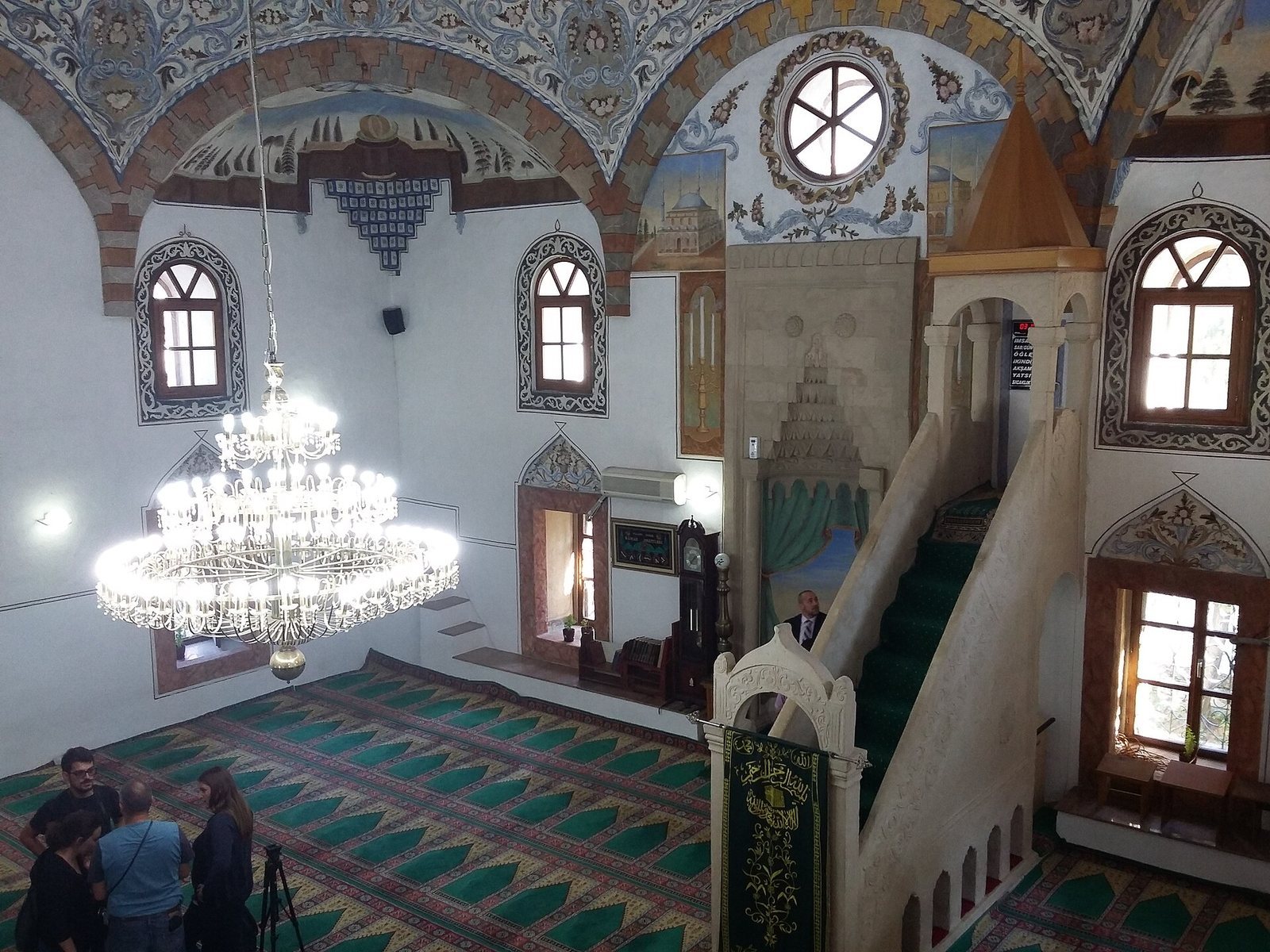
The central prayer hall is covered by an octagonal dome measuring 11.65 metres across, with its crown 13.5 metres above the floor. Pendentives, curved supports that transition from a square space to a dome, carry the dome. Three rows of windows light the interior: the lowest has square openings, while the two upper rows have arched openings. A circular opening, or oculus, sits at the top of the mihrab wall.
Portico and minaret
The open entrance portico has three smaller domes, supported by the side walls and four pillars linked by arches. The tall, slender, polygonal minaret is attached to the right side of the main building. Its parts include a footing, a transition section, a shaft, a balcony, an upper shaft, and a spire.
Construction and exterior
The mosque is built of brick and stone, with a plastered exterior façade. Above the entrance, a gallery runs the full length of the wall and is supported by ten stone pillars with capitals. Carved designs ornament its railing, while floral motifs are painted on the supporting arches. A carved fence with painted floral decoration encloses the mosque.
Structural condition
Structural assessments found concentrations of force in the small portico domes, pendentives, arches, and around openings in the main dome. Inspections identified cracks in domes, pendentives, arches, load-bearing walls, and supporting elements, often near openings. Under simulated earthquake conditions, estimated maximum movement was 7.1 to 8.0 millimetres. Some areas, particularly in the roof system, exceeded acceptable limits for pulling and squeezing forces, prompting continuing conservation concern.
Decoration and furnishings
Gallery and painted ornament
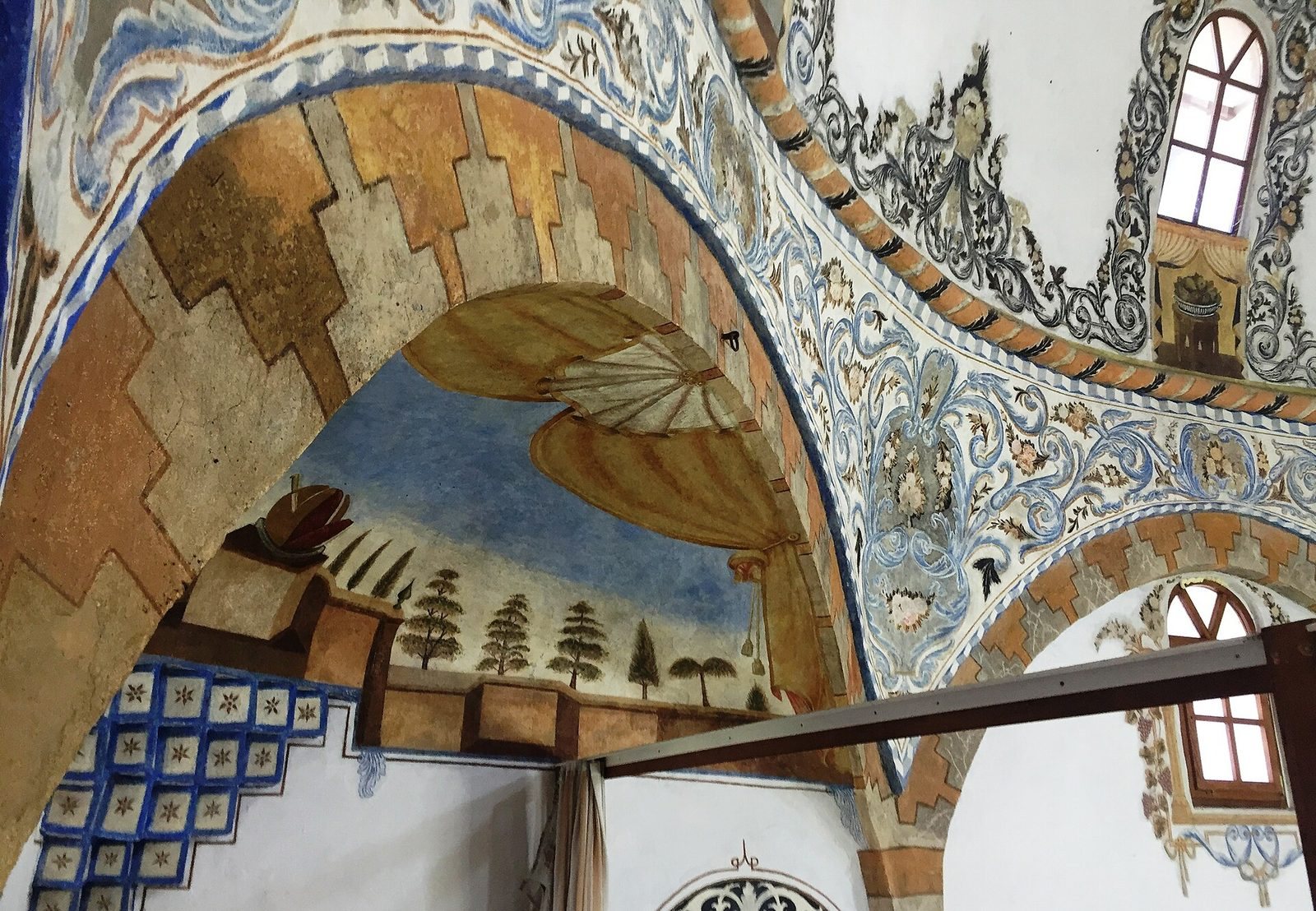
The richly coloured interior has painted arabesques, intricate interlacing patterns, alongside geometric designs, medallions, and floral, architectural, and naturalistic motifs. Blue, green, yellow, and red stand out against a white background. Carved stars, rosettes, and geometric designs decorate the dome supports and the pedestals and capitals of columns in the portico and gallery.
Mihrab and minbar
The mihrab, a niche indicating the direction of prayer, is shallow and elaborately painted with a depiction of paradise. It also has muqarnas, three-dimensional, niche-like ornament, and two rosettes in low relief. The monumental minbar, or pulpit, stands in the mosque’s southeast section. Made of marble, it has carved and painted decoration. Carved stars, rosettes, and geometric designs also adorn both features.
Fountain and cemetery
Fountain
A fountain near the mosque bears a carved floral medallion, representations of the moon and stars, and plaques with Arabic inscriptions.
Cemetery
The associated cemetery contains carved grave markers and a sarcophagus belonging to Hajri-beg Miralaj. Its decoration includes a raised heraldic emblem, an identifying symbol, as well as floral ornament, weapons, and other emblematic objects.