Baggio Old Church: A Medieval Catholic Church in Milan


Site at a Glance
- Rating
- 4.4
- Popularity
- Very Low
- Country
- Italy
- Primary era
- Modern
- External website
- Open
- Eras represented
- Medieval, Modern
- Civilizations
- Holy Roman Empire, Italian
- Site type
- Religious
- Remains
- Church
On this page15 sections
History
Baggio Old Church, dedicated to Saint Apollinaris, is a medieval Catholic church in Milan, Italy. It originated probably between the tenth and eleventh centuries under the patronage of the da Baggio family and belongs to the Ambrosian rite, the distinctive Catholic liturgical tradition of the Archdiocese of Milan.
Medieval origins and family patronage
The church may have occupied the site of an earlier pagan temple. A seventeenth-century tradition, also repeated by the historian Giorgio Giulini, attributed its foundation to Pope Alexander II, but historians regard that claim as false. The church is first mentioned in 1161, when the provost of Cesano was negotiating an unsuccessful land purchase on its behalf.
By 1398, the church was listed among the wealthiest churches in the Pieve of Cesano Boscone because of its benefices. Its revenues and administration were closely connected with the da Baggio family. This arrangement was an example of ecclesiastical patronage, a legally recognized right that could allow a lay family to exercise authority over a church, including the nomination of its priest, without necessarily owning the building.
Reform and the creation of the parish
In 1568, Baggio Old Church was open to the public but had not yet become a parish. Baptisms and funerals remained the responsibility of the parish church of Saint John the Baptist in Cesano, which was difficult for Baggio residents to reach because of the poor roads. The same inspection described the church as severely neglected after Anselmo Baggio had dismissed those responsible for cleaning it.
Archbishop Carlo Borromeo ordered Paolo Baggio, Anselmo’s son, to turn the church into a parish and devote part of the family’s patronage revenues to its maintenance. Paolo refused because parish status would have removed his authorization over the church and reduced his income. Borromeo therefore investigated the legal basis of the patronage, which was confirmed by a document dated 8 January 1324.
Borromeo also required an altar for the newly established Confraternity of the Blessed Sacrament. A confraternity was a voluntary religious association organized around shared devotional, charitable, or liturgical duties. This group purchased vestments and other ornaments, including a candle intended to burn continually near the tabernacle. It also helped finance a chaplain with the archdiocese. He heard confessions and celebrated Masses commemorating the dead.
An inspection in 1598, during the episcopate of Federico Borromeo, confirmed the validity of the da Baggio patronage. Eucharistic celebrations required the patrons’ permission, while the chaplain had to celebrate on obligatory feast days. During Federico Borromeo’s pastoral visit in 1604, the church was described as ancient and consecrated. The main altar met current regulations, but the wooden tabernacle, topped by a wooden-and-silver crucifix, did not. There was no sacristy, and the priest prepared for Mass inside the altar rail. A confessional stood in the nave, and Jesuit priests often preached from the pulpit.
At that time, entry was through a side door from the rectory courtyard, which Borromeo regarded as a source of gossip. The church’s later creation as a parish took place during the social and economic crisis that preceded the plague traditionally associated with Alessandro Manzoni’s account. The da Baggio patrons sometimes kept the building closed, forcing residents to travel to Cesano and leading them to protest to the archbishop.
The parish of Saint Apollinaris
On 26 April 1628, Anselmo IV Baggio, the patron and titleholder, authorized the establishment of a parish on his property. He granted use of the site rather than ownership, required the people of Baggio to pay for maintenance, and requested a residence for himself and his heirs in the rectory garden. He also reserved the right to nominate the first parish priest.
The need for a local parish became especially clear when a woman died on the road to Cesano the following day without receiving confession. On 13 August, the provost of Cesano formally consented to Baggio’s separation from his parish in the presence of representatives of the metropolitan curia and a notary. On 8 September, 55 household heads, the consul of Baggio, Anselmo IV Baggio, and an archdiocesan notary accepted the proposed agreement.
Anselmo promised to enlarge the church and build a baptismal font. In return, he was to receive annual payments of 60 lire until his death, while a further 220 lire was assigned to the parish priest for maintaining the parish and supplying its liturgical furnishings. On 9 September 1628, the archbishop’s representatives presented the case to Federico Borromeo, who formally established the parish and granted it the privileges of a parish church, including a cemetery cross and baptismal font. He accepted Anselmo’s right to nominate the first parish priest, Sebastiano Capechio.
The new parish also had obligations toward Cesano. On Saint John the Baptist’s day, the people of Baggio had to process to the provost’s church and offer the provost a candle. Parish income came from annual alms of 220 lire, a vineyard of about three hectares on the site now occupied by the Church of Saint Anselm of Baggio, testamentary bequests, and a smaller vineyard donated by Giovanni Battista Bosisio.
Pope Urban VIII formally approved the Confraternity of the Blessed Sacrament in 1635, after its informal establishment in 1567. The Confraternity of Our Lady of Mount Carmel followed in 1640. The Humiliati, a religious movement active in northern Italy, and the Jesuits, members of the Society of Jesus, donated relics to the new parish.
Parish life and changing patronage
In 1717, parish priest Giovanni Battista Redaelli founded a manual chaplaincy for the primary education of young people in Baggio. Its chaplain had to be over 23, economically disadvantaged, and resident in Baggio. Redaelli financed the position personally and arranged for its succession first to his nephew and later to the prior of the Jesuit college of Brera.
The Teresian Cadastre of 1722, a land and property survey introduced under Empress Maria Theresa’s administration, listed 63 pertiche belonging to the parish and 283 belonging to the patronage, then designated the Abbey of Saint Apollinaris. A pertica was a traditional northern Italian unit of land measurement. Donations and hereditary bequests later increased the church’s resources, although the suppressions carried out first under Joseph II and later under Napoleon Bonaparte restricted them.
Giuseppe Pozzobonelli made the last pastoral visit for a long period on 8 and 9 March 1747. His report was the first to record the tradition that Pope Alexander II had founded the church. The da Baggio patronage continued until 1809, when the male line ended and the title passed to Gerolamo d’Adda, son of Francesca Baggio. After Gerolamo’s death in 1825, the patronage passed to all his children, regardless of sex, ending the earlier practice of male primogeniture.
Nineteenth-century crisis and rebuilding
Structural problems were reported in 1845, when parish priest Carlo Valsecchi warned the municipality that the church was unstable and declined responsibility in the event of a collapse. Valsecchi and the local community sought to use 17,645 Austrian lire held during a dispute over the patronage for reconstruction. The holder of the benefit refused, citing an older agreement that assigned repairs to the parish priest and the Baggio community.
Temporary bracing supported the building while the dispute between Valsecchi and the d’Adda family continued. In 1853, the d’Adda family offered the municipality of Baggio 8,000 Austrian lire for restoration on condition that it would bear no further responsibility. Provincial imperial authorities commissioned the Brera Academy professors Schmidtt, Brocca, and Bisi to inspect the church. They considered its historical importance sufficient to recommend restoration and produced the last detailed description of the medieval building.
After Italian unification, the municipal council acted on the Brera report in 1869. The architect Rosa demolished the old apse and constructed a larger transept, the crosswise part of a church that intersects the main axis of the nave. A new high altar was consecrated in July 1870. The church then deteriorated rapidly, possibly as a result of the renovation work, and the municipal council ordered it fenced off and demolished in 1873.
Demolition was ordered on 18 September, and reconstruction was authorized on 8 February of the following year at a cost of 16,600 lire, again to Rosa’s design. A municipal commission meeting at the Brera Palace confirmed the building’s dangerous condition. The demolition recovered two shafts, two Corinthian capitals, and a base, which are now preserved in Milan’s Civic Archaeological Museum. The rebuilt church retained the Romanesque bell tower and the transept and apse constructed shortly before the demolition. It was blessed by coadjutor priest Andrea Reina on 21 October 1875.
Twentieth-century changes and present use
Andrea Carlo Ferrari made pastoral visits in 1900, 1904, 1912, and 1917, continuing a program inspired by Carlo Borromeo. Cardinal Alfredo Ildefonso Schuster visited in 1932, 1938, 1942, and 1949. During Andrea Reina’s tenure, the church was considered too small for Baggio’s growing population. His successor, Carlo Chiesa, laid the foundation stone of a new parish church several hundred metres away, and that building was completed in 1942.
Baggio Old Church remains consecrated but is no longer the parish church. It is used for occasional Masses and rosaries and hosts concerts organized by the Primavera di Baggio association. The bell tower underwent complete restoration in 2009.
The church also gave rise to the Milanese expression andare a Baggio a suonare l’organo, meaning “to go to Baggio to play the organ.” One popular explanation claimed that the church had no organ and that an instrument was painted on its wall. Historical analysis presented in the church has instead proposed two possible origins. One connects the saying with the organ maker Gaetano Medaglia, who was mocked by toll collectors while repeatedly passing their gates on parish business. The other links it to the absence of an organ after the nineteenth-century reconstruction.
A second local legend tells of a donkey that climbed the bell tower in search of grass. The story inspired the donkey race that formed part of the Baggio festival for many years.
Remains
The present church combines a Neo-Romanesque single-nave building with surviving and reconstructed elements of the earlier complex. Its Romanesque bell tower belongs to the medieval phase, while the transept and apse were built shortly before the nineteenth-century demolition and retained in the rebuilt church.
Medieval fabric and surviving tower
The medieval church
The medieval church was arranged like an early Christian basilica, with three aisles divided by marble columns. Marble served both structural and decorative purposes, while the roof was later than the principal body of the building. During Carlo Borromeo’s visit, the church measured 17.4 metres long, 9.5 metres wide, and 13.6 metres high. Its facade contained a portal 3.7 metres wide and a rose window 1.3 metres in diameter.
Descriptions from the Borromeo visit mention six marble columns, while the inspection under Federico Borromeo counted twelve. A cemetery surrounded the church along several sides, and two tombs were located within the medieval building. The former complex also included a rectory south of the church, with a kitchen, cellar, three rooms, and a portico.
The Romanesque bell tower
The bell tower is Romanesque and is dated variously to the tenth or eleventh century. Its surviving upper levels have paired openings divided by a central support, with the openings increasing in size toward the top. The design has been described as inspired by the bell tower of Santa Maria presso San Satiro. Complete restoration was carried out in 2009.
The surrounding medieval complex
The church stood beside the building known as the Palazzietto, which may have been the historic residence of the da Baggio family. The complex was also near Moronasc square and Cascina Monastero. The medieval church and its cemetery therefore formed part of a wider group of ecclesiastical and family buildings associated with the historic settlement of Baggio.
Nineteenth-century reconstruction and interior
The present church
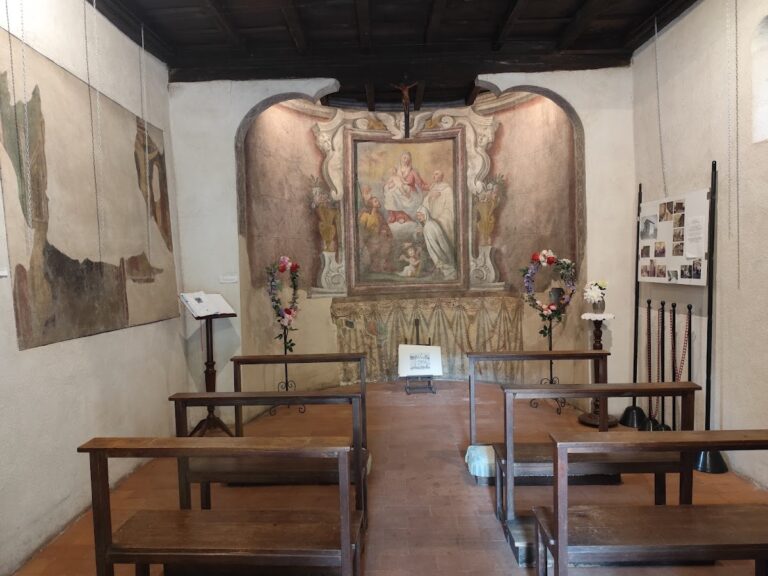
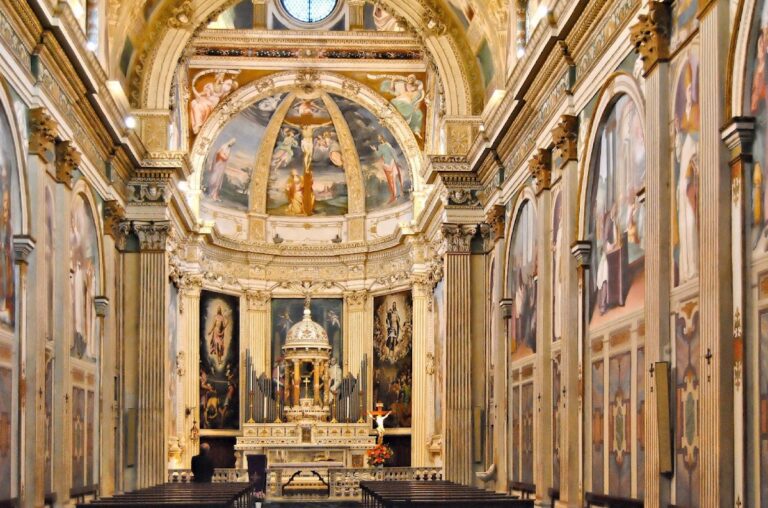
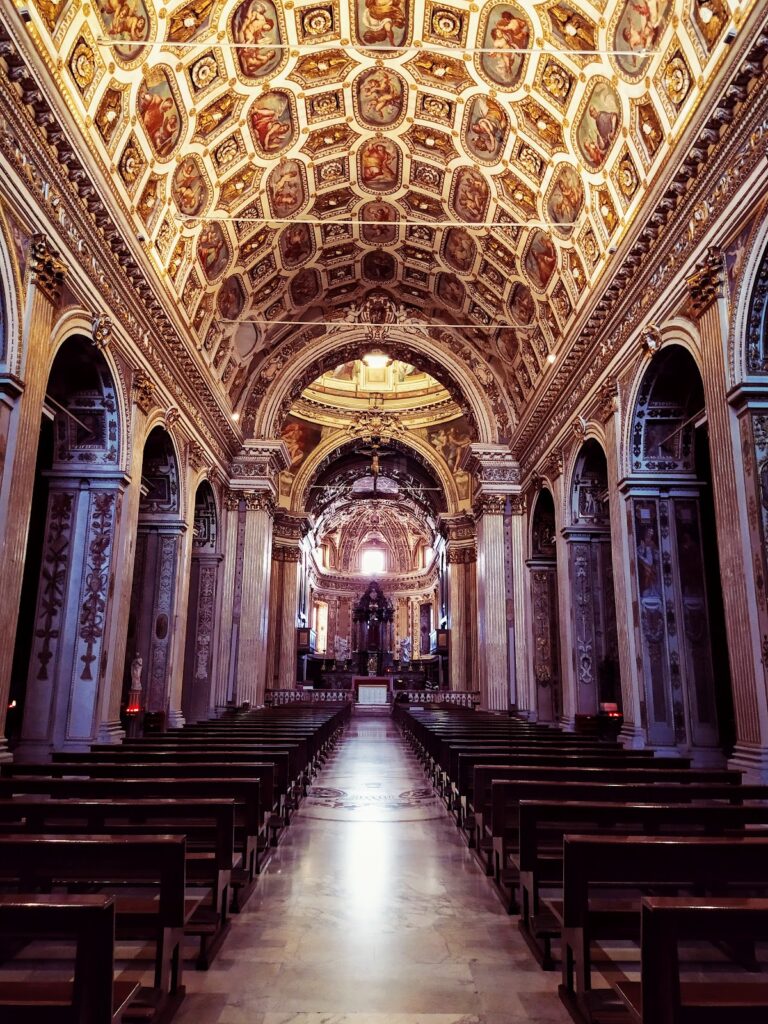
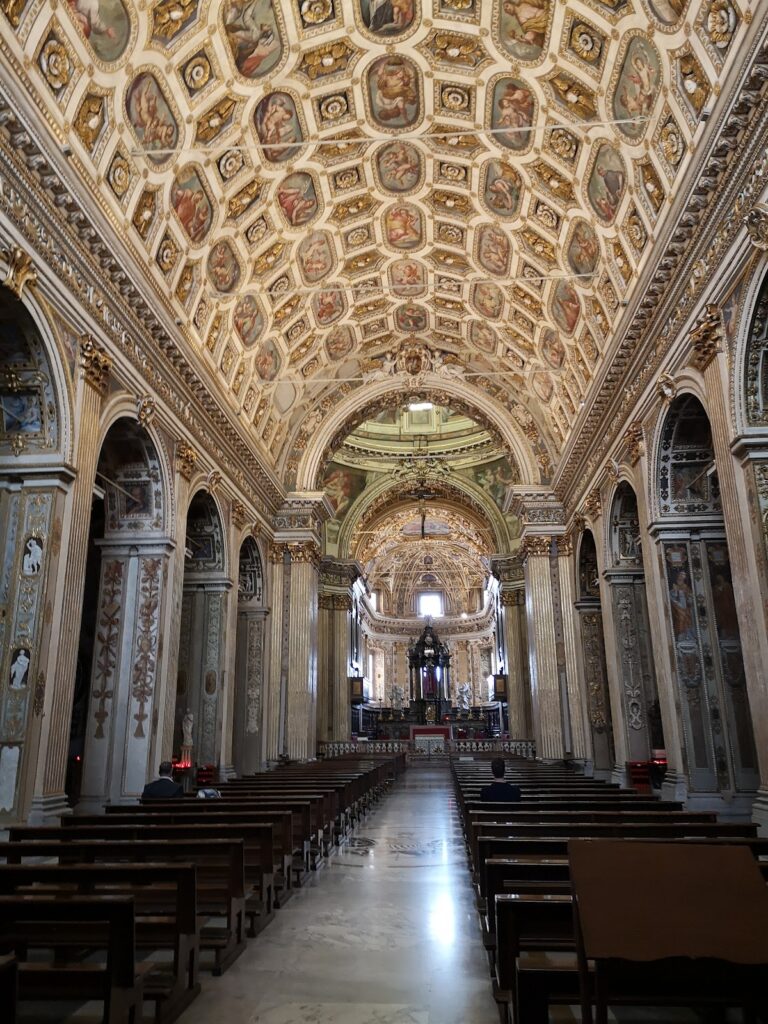
The present building is Neo-Romanesque and has a single nave. Its marble high altar is accompanied by a secondary altar adapted to the liturgical provisions of the Second Vatican Council, the Catholic council held from 1962 to 1965 whose reforms affected altar arrangement and other aspects of worship space. Three minor altars are dedicated to Our Lady of Mount Carmel, Saint Joseph, and Saint Anselm of Baggio.
Liturgical adaptation removed the altar rails and the metal frontal and moved the Eucharistic table forward. A vestment relic of Saint Anselm of Baggio is preserved in the church. The rebuilt structure also incorporates the transept and apse created during the work of 1869-1870.
The organ
An organ was present in the church from 1717. It was removed between 1873 and 1888 during the reconstruction of the parish church, when a new Marelli organ was installed after being designed and tested by Professor Polibio Fumagalli.
The present organ has been in the church since 1926. Built by the Rossi firm, it retains the exterior of its older predecessor, including 25 non-speaking facade pipes. These conceal the mechanism of 833 speaking pipes. The instrument is deteriorated and requires repair.