Azov Fortress: An Ottoman and Russian Stronghold in Azov


Site at a Glance
- Rating
- 4.6
- Popularity
- Low
- Country
- Russia
- Primary era
- Medieval
- External website
- Open
- Eras represented
- Medieval, Early Modern, Modern
- Civilizations
- Ottoman, Russian
- Site type
- Military
- Remains
- Fort
On this page10 sections
History
Azov Fortress is an Ottoman fortification in Azov, Russia, built as Azak in 1475 on the site of the former Genoese and Venetian trading settlement of Tana. Standing near the mouth of the Azovka River, it guarded access to the Sea of Azov and the northern approaches of the Ottoman Empire.
From Tana to Ottoman Azak
Before the second half of the fifteenth century, Tana served as an important trading settlement between Western and Eastern markets. The Ottoman Empire, a major Islamic state based in Anatolia that controlled territories around the Black Sea, the Balkans, the Middle East, and North Africa, conquered Tana in 1471. Four years later, it established the fortress of Azak on the site, turning the settlement into an Ottoman northern port and military outpost.
The Cossack capture and siege of 1641
In June 1637, Don and Zaporizhian Cossacks stormed and captured Azak. A mounted force of about 400 Cossacks remained to defend the fortress from the steppe. In 1641, an Ottoman army commanded by Husein Pasha besieged Azov and its suburbs. Ottoman troops launched two assaults but suffered heavy losses, while the Cossacks strengthened their defense with trenches and mines.
Continuous artillery fire badly damaged the fortress, yet the Ottoman army abandoned the siege on 26 September after three months. Supply and provisioning difficulties contributed to the withdrawal, while Ottoman losses have been estimated at roughly 20,000 to 70,000 men. Afterward, the Cossacks offered Azov to Tsar Michael I of Russia, asking Russia to restore the fortress and maintain a garrison there. The Zemsky Sobor, a representative Russian assembly that advised on major political and military decisions, rejected the proposal because it could provoke another war with the Ottoman Empire. Without sufficient provisions and other resources, the Cossacks abandoned the damaged fortress in summer 1642.
Peter the Great’s campaigns
Peter I, later known as Peter the Great, led Russian campaigns against Azov in 1695 and 1696. The expedition advanced by land and along the Voronezh, Volga, and Don rivers. On 5 August 1695, the first assault, commanded by Franz Lefort, captured only some watchtowers, and Russian forces suffered about 1,500 killed and wounded. A second assault on 25 September, led by Fyodor Apraksin with the Preobrazhensky and Semyonovsky regiments, seized part of the fortifications and entered the town. The Ottoman defenders regrouped, however, and the siege was lifted on 2 October.
Preparatory siege works for the next campaign were completed on 16 July 1696. The following day, about 1,500 Don and Zaporizhian Cossacks entered the fortress without authorization and occupied two bastions, projecting fortified positions that allowed artillery and firearms to be directed against attackers. After a prolonged bombardment, the Ottoman garrison surrendered on 19 July. The Treaty of Constantinople, concluded in 1700 and signed on 13 July, recognized Russian sovereignty over Azov and the surrounding area.
Russian administration and the return to Ottoman rule
In 1698, Peter I sent the military engineer Baron Ernst von Borgsdorf to supervise construction work at the Azov and Taganrog fortresses. Five residential soldier regiments formed from streltsy and transferred soldiers were assigned to permanent service in Azov that year. They were commanded by Vladimir Zhavoronkov, Alexander Bludov, Stepan Verkhovsky, Venedikt Yangrek, and Ivan Starkov. These regiments helped suppress the Bulavin Rebellion in 1708 and operated against the Ottomans in 1711. After the Azov garrison was disbanded in 1712, their personnel joined the Pavlovsky, Belokolodsky, and Korotoyaksky garrison regiments.
Russia returned Azov to the Ottoman Empire under the Treaty of Pruth in 1711. Russia accepted the treaty after its army was trapped near the Pruth River by a larger Ottoman force supported by Crimean Tatar cavalry during the Russo-Ottoman War of 1710 to 1711.
The siege of 1736 and later military use
During the Russo-Ottoman War of 1735 to 1739, a Don Army of about 28,000 men under Field Marshal Peter Lacy besieged the fortress in 1736. Ottoman forces launched a major sortie on 27 May and further sorties on 15 June. On 28 May, 100 Tatars managed to enter the fortress from the steppe. Russian artillery began continuous fire on 11 June.
On 19 June, an artillery shell struck a powder magazine, destroying five mosques and 100 houses and killing about 300 people. Lacy ordered an assault for the night of 28 to 29 June. Ottoman defenders resisted and detonated two mines, but they were eventually forced to withdraw. Russian losses were seven killed, 38 enlisted men wounded, and two missing. The Ottoman governor, Mustafa Aga, then offered to surrender the town. The Treaty of Belgrade in 1739 returned Azov permanently to Russia.
After the war, the fortress was destroyed, leaving the Alekseevsky Gates and surviving sections of the earthworks as its principal defensive remains. During the Crimean War in the mid-nineteenth century, when the old fortress was already largely ruined, Azov was again used for military purposes. Food and uniform stores were installed, artillery batteries were established, and additional fortification work was carried out. The surviving remains were archaeologically investigated in 1935 by the Rostov regional monument-preservation bureau, whose work included excavation and restoration. Azov Fortress is recognized in Russia as a cultural-heritage site of federal significance.
Remains
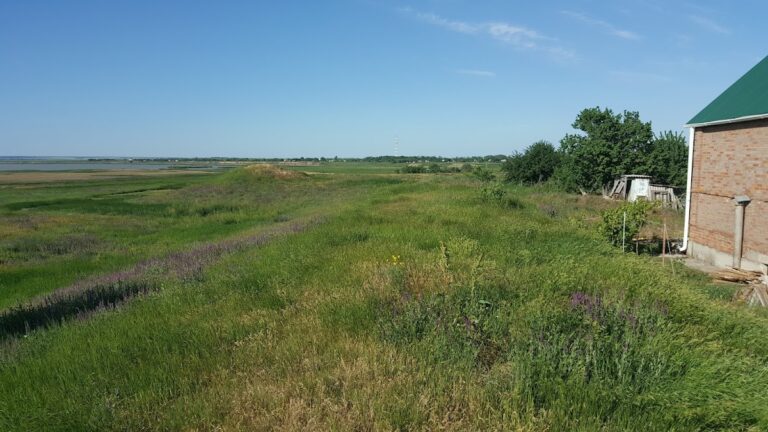
The surviving defenses occupy a hill overlooking the Don River and the Port of Azov to the north. The Ottoman fortress consisted of a high stone wall with 11 towers, while ditches and earth ramparts protected the suburbs. Its defenses also included gates and bastions. Today, earthworks extend for hundreds of meters through the modern city, with streets crossing them in places.
Gates and defensive earthworks
Alekseevsky Gates
The Alekseevsky Gates stand at the end of an earth rampart as two parallel stone walls forming gate pylons. They are more than 3 meters apart, and each wall measures up to 13.5 meters in length. Dressed stone faces the walls, while forged iron spikes driven into a single block of stone also survive. The gates were among the defensive structures that remained after the fortress was destroyed, and they were examined during the archaeological work of 1935.
Ramparts and ditch
The surviving earth ramparts generally measure 4 to 15 meters high and 10 to 30 meters wide at the base. Their crests range from 5 to 15 meters across. A fragment adjoining the Alekseevsky Gates reaches up to 30 meters in width and 15 meters in height. Along a parallel axis, a sixteenth-century fortress ditch survives for up to 100 meters. It reaches 12 meters in depth, while the adjoining rampart rises as much as 30 meters and has steep slopes.