Fort Rodd Hill National Historic Site: A Coastal Defence Fort in Canada
Site at a Glance
- Rating
- 4.7
- Popularity
- Medium
- Country
- Canada
- Primary era
- Modern
- External website
- Open
- Eras represented
- Modern
- Civilizations
- British
- Site type
- Military
- Remains
- Fort
On this page12 sections
History
Fort Rodd Hill National Historic Site is a nineteenth-century coastal artillery fort in Canada, built to defend Esquimalt Harbour in Colwood, British Columbia. Its permanent works were constructed between 1894 and 1897 as part of the British and Canadian defence of the Royal Navy’s Pacific base, and the fort remained in military use until 1956.
Esquimalt Harbour and early defences
The Royal Navy began using Esquimalt Harbour during the 1840s for anchorage, watering, and obtaining lumber. Three hospital huts built during the Crimean War, fought from 1854 to 1856, marked the beginning of the harbour’s continuing military role. The Royal Navy’s Pacific Squadron moved from Valparaíso, Chile, to Esquimalt in 1862, leading to the expansion of shore-based storehouses and workshops.
Several events increased concern about the harbour’s security. The Fraser River Gold Rush of 1858 brought increased activity to the region, while the San Juan Islands Pig War of 1859 was a dispute between Britain and the United States. Tensions between the two countries continued until 1871. Guns were installed on Rodd Hill in 1864 to protect the harbour, and the first fixed defences followed after Vancouver Island joined the mainland colony in 1866 and British Columbia entered Canada in 1870.
The Great Eastern Crisis of 1877–1878, when Britain faced heightened tensions with Russia, drew attention to Esquimalt’s vulnerability. It was Britain’s only naval station on the western coasts of North and South America. Five gun batteries were built rapidly, mainly with 64-pounder naval rifled muzzle-loaders, guns loaded through the front of the barrel and given greater accuracy by spiral rifling. The guns stood behind timber-revetted earthworks. Three 7-inch guns were placed at Macaulay Point, while an 8-inch gun was installed on Brothers Island.
Admiral de Horsey judged these defences inadequate. The local artillery militia did not have enough trained gunners, and he considered that its members might choose to defend Victoria rather than the naval base. He recommended a permanent garrison, modern guns, and a submarine minefield.
Permanent fortifications
Britain and Canada reached a permanent defence agreement in 1893. Britain supplied the guns, equipment, stores, submarine-mining buildings, half the estimated costs of the defence works and their maintenance, and a garrison of 75 Royal Marine Artillerymen. The Royal Marine Artillery was a British corps specializing in artillery service with the Royal Marines. Canada provided the land and most buildings, contributed the remaining halves of the construction and maintenance costs, paid £10,000 toward the garrison’s upkeep, and maintained and expanded the local militia.
Construction began in February 1894 and ended in October 1897. A separate fort was built at Macaulay Point on earlier earthworks, while Fort Rodd Hill was established as an entirely new position. The Royal Marine Artillery arrived in 1894 with Royal Engineers who supervised the work. An original proposal to use Chinese labour met opposition in local newspapers, and more expensive European day labourers were employed instead.
The hill was named for John Rashleigh Rodd, first lieutenant of HMS Fisgard under Captain John A. Duntze. Rodd later became rear admiral in 1877, vice admiral in 1884, and admiral in 1888. He died in 1892.
Military use and modernization
In 1899 the Royal Marine Artillery garrison was replaced by a larger Royal Garrison Artillery garrison. The Royal Garrison Artillery was the British coastal-artillery branch that succeeded the Royal Marine Artillery at the fort. Royal Engineers, including specialists in submarine mining, accompanied the new garrison.
Canadian artillery militia continued training at Fort Rodd Hill and became highly proficient. Imperial and Canadian troops held annual exercises, including a full-scale night assault on the fort and the Esquimalt naval base in 1902. British troops initially occupied the position, but command passed to Canadian forces in 1906. Canadian personnel continued to man, expand, and modernize the fort until its military use ended in 1956.
The original guns were considered obsolete by the Second World War. In 1944, a twin-mounted QF 6-pounder 10 cwt gun was installed. Quick-firing guns were designed for a faster loading and firing cycle than older heavy artillery pieces. Fort Rodd Hill’s medium guns were intended to engage as many as six enemy light cruisers, while its smaller quick-firing guns addressed the threat from fast, unarmoured torpedo boats.
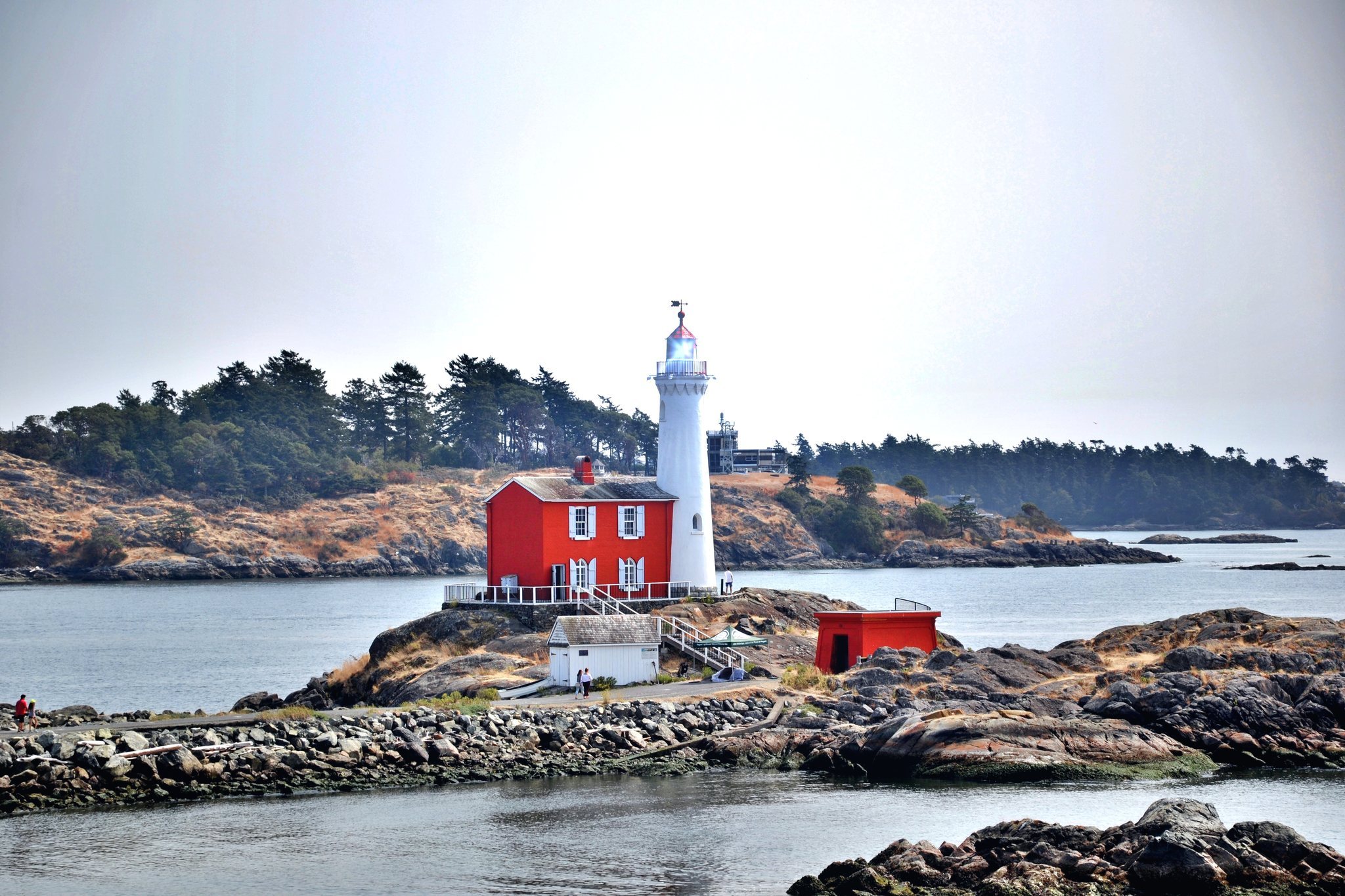
Fort Rodd Hill became a National Historic Site of Canada on 3 November 1958 under the Historic Sites and Monuments Act. Parks Canada manages and presents the fort, together with the adjacent Fisgard Lighthouse National Historic Site. Fisgard Lighthouse was the first lighthouse on Canada’s west coast and formed part of the harbour’s defensive and navigational setting.
Remains
Fort Rodd Hill occupies a rocky bluff and hillside overlooking the western side of the narrow entrance to Esquimalt Harbour. Its principal elements are the Upper Battery, Lower Battery, Belmont Battery, an underground fort, and a later searchlight installation. The batteries and underground works are enclosed by separate walls, while the physical arrangement reflects construction and modernization from the 1890s through about 1940.
Gun batteries
Upper and Lower Batteries
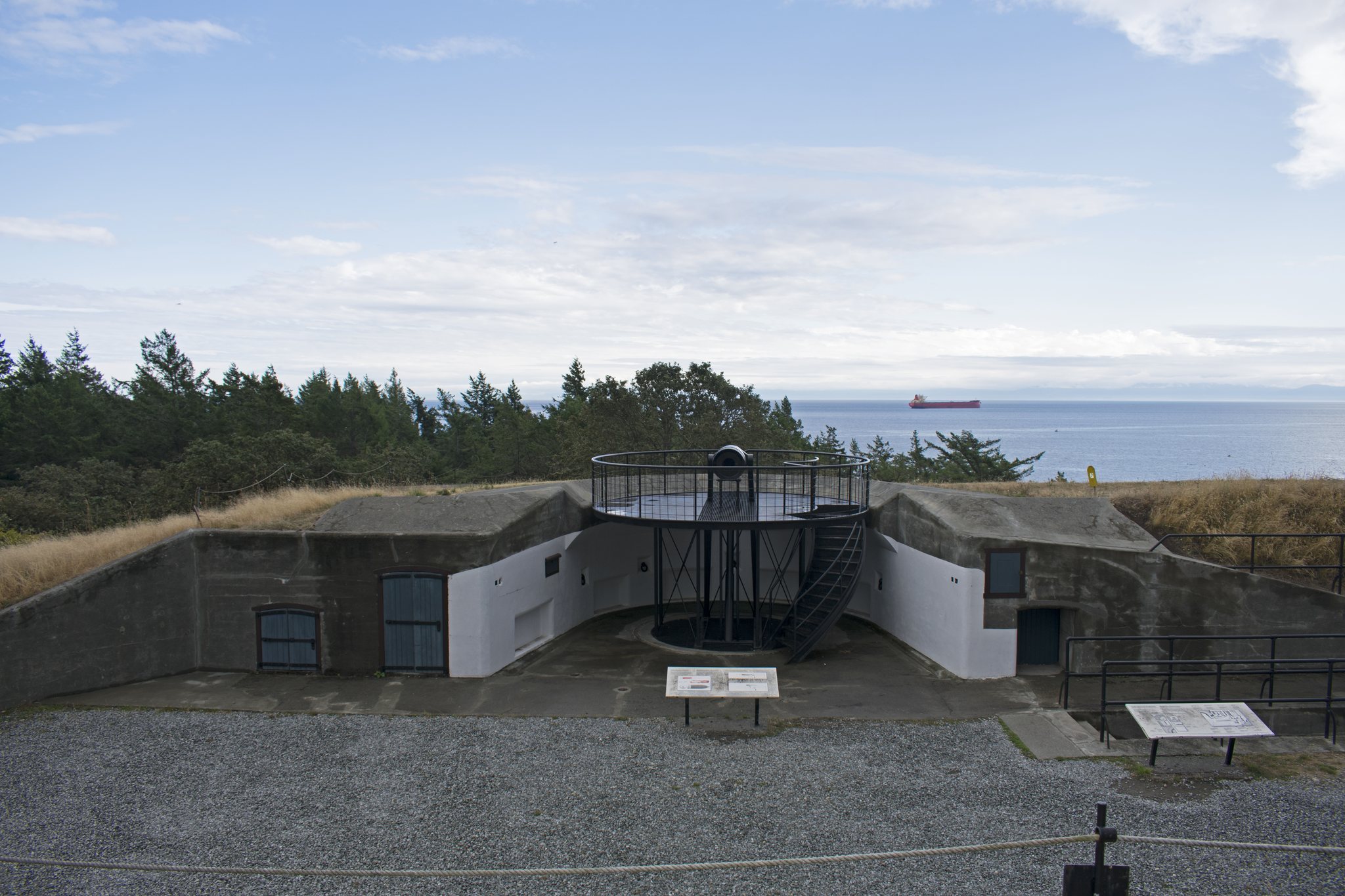
The Upper Battery and Lower Battery date from the main construction period of the 1890s. Together they held three 6-inch disappearing guns, each fitted with a Mk VI barrel on a Mk IV mounting. A disappearing gun lowered its barrel behind protective cover for loading and raised it above the parapet only for firing. At Fort Rodd Hill, hydraulic pressure and compressed air powered the mechanism.
Two guns stood in the Lower Battery and shared a magazine. The third was positioned approximately 200 metres away in the Upper Battery, which had its own battery, underground magazine, loopholed wall, water supply, and guardhouse. The guns were set in concrete emplacements about 10 feet, or 3.0 metres, thick. These structures were sunk into the hillside and protected further by the surrounding rock and a sloping rock glacis, a protective bank or slope.
When not firing, the barrels remained lowered in the loading position beneath the concrete emplacement and an overhead metal shield. A central observation post and remote electric dial system transmitted target information while the guns were down. Immediately before firing, a hydro-pneumatic mechanism raised each 5-tonne barrel above the parapet. The arrangement reduced the time the barrel was exposed to enemy fire, although its complicated mechanism could leak and allowed perhaps one shot every two minutes.
Belmont Battery
Belmont Battery was built around 1900 and contained two quick-firing 12-pounder guns. Two sets of defence electric lights supported the battery. Diesel engines and generators powered the lights from an engine room built into the landward side of a hill, concealing the machinery within the fort’s defensive landscape.
Underground fort and ammunition systems
Casemates and functional rooms
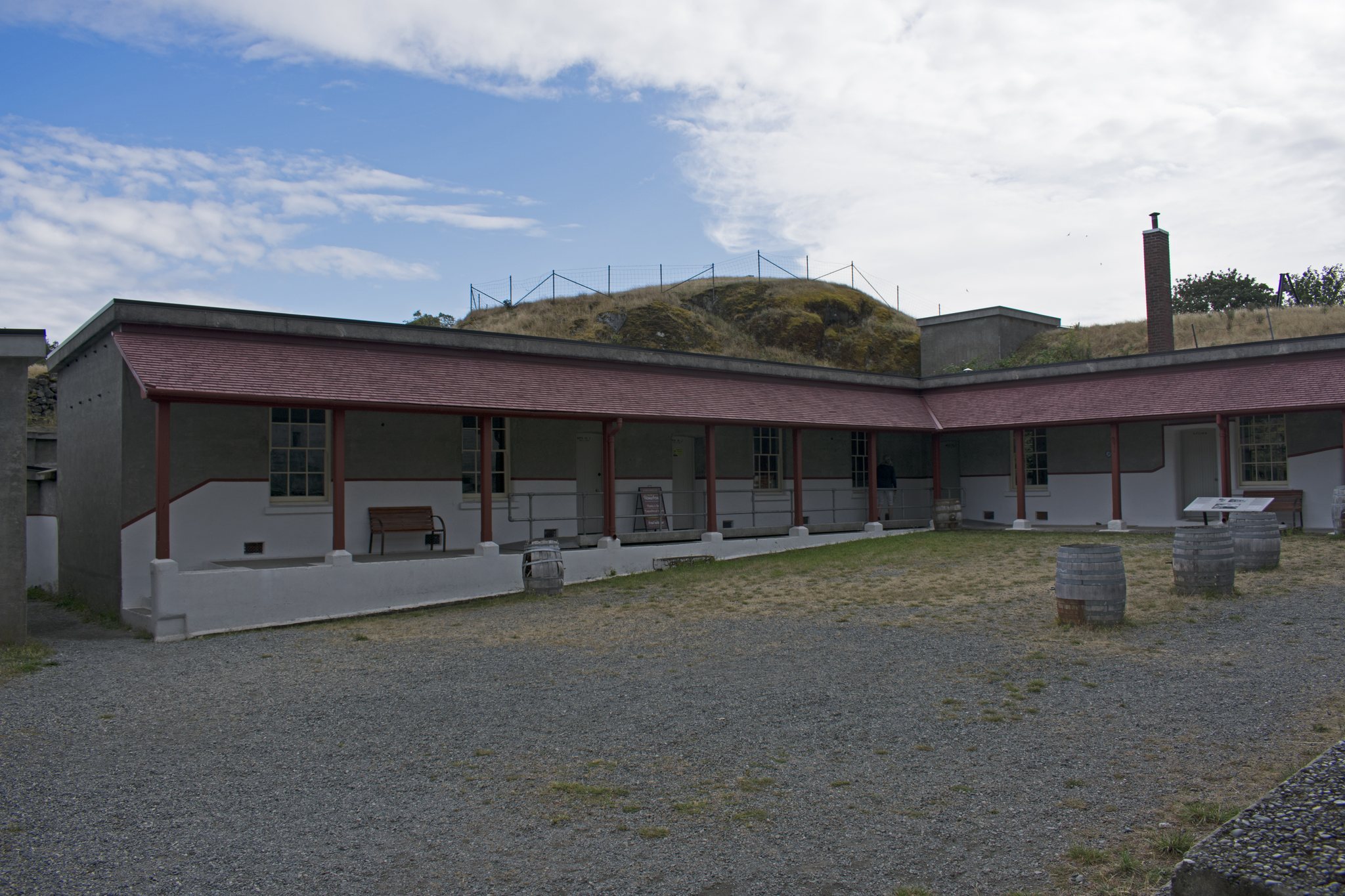
The underground fort contains casemates, enclosed rooms for military use, together with magazines, command spaces, and other functional rooms. Its underground arrangement supported the batteries by placing ammunition, control areas, and working spaces within the protected hillside.
Six-inch ammunition
The 6-inch guns used separate-loading ammunition, with the propellant cartridge stored and loaded independently from the shell or shot. The cartridges were made from raw silk and kept in wooden crates in a high-security section of the underground magazine. The 1897 inventory included high-explosive Lyddite, armour-piercing shells, common pointed shells for non-armoured maritime targets, shrapnel, and solid steel shot. Each type weighed 94 pounds, or 43 kilograms, and measured 6 inches, or 150 millimetres, in diameter, although the lengths differed.
Searchlight installation
The later searchlight installation was among the works built around 1940. It was disguised as a fishing hut, while its diesel engines and generators were concealed in the hill’s engine room. The installation formed part of the fort’s later system for detecting and illuminating vessels approaching Esquimalt Harbour.