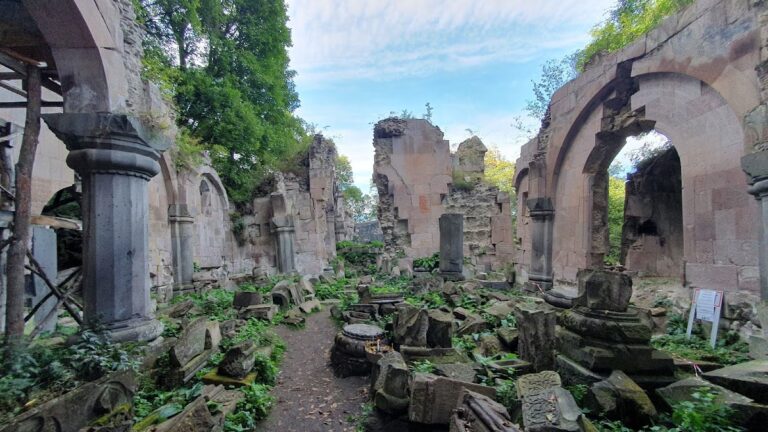
Ardvi Monastery: An Armenian Apostolic Monastic Complex in Armenia


Site at a Glance
- Rating
- 5
- Popularity
- Very Low
- Country
- Armenia
- Primary era
- Medieval
- Eras represented
- Medieval, Early Modern
- Civilizations
- Armenian
- Site type
- Religious
- Remains
- Monastery
On this page11 sections
History
Ardvi Monastery is an Armenian Apostolic monastery in Armenia, near the northwestern side of Ardvi village in Lori Province. Founded in the eighth century, possibly in 726, it is associated with Hovhan III Odzneci, the 34th Catholicos, or senior ecclesiastical leader, of the Armenian Church. The monastery is also known as Srbanes Monastery, Saint John Monastery, and the Monastery of Hovhan Odzneci.
Foundation and ecclesiastical association
Hovhan III Odzneci held the office of Catholicos from 717 to 728. He was a theologian, jurist, thinker, and reformer, and later became known as Saint Hovhannes Imastaser, meaning “the Wise.” He was buried at Ardvi, and his tomb remains inside the church. The monastery therefore preserves a direct connection with one of the Armenian Church’s senior medieval leaders.
The complex took shape through several building phases between the eighth and seventeenth centuries. The northern church is older than the other principal structures. Most of the later complex, including the bell tower, belongs to the seventeenth century, when the northern church was probably rebuilt or restored as well.
Later rebuilding and religious continuity
Ste||||panos Tarinyan reconstructed or repaired the monastery during the nineteenth century. Further restoration took place in 1902 under Melikset Kalantaryan, followed by another renovation in 2018. The monastery belongs to the Armenian Apostolic Church and is associated with the Gugark Diocese, the church’s regional administrative jurisdiction. It is recognized as a cultural monument of Armenia, while parts of the complex survive in ruined form.
In 1969, Armenian film director Sergei Parajanov filmed parts of The Color of Pomegranates at Srbanes Monastery. The site is also connected with the natural feature called Snake’s Navel and with local traditions about Hovhan Odzneci. One tradition says that, during or after the celebration of the liturgy, he turned two threatening dragons into stone.
A related legend tells of a holy hermit and teacher whose seven pupils were devoured by a dragon. The hermit struck the creature with his staff, causing a spring to emerge from its heart. These traditions are linked to two long, vein-like rock formations on the mountainside. One spring, known as Snake’s Navel, is mineral water and is regarded locally as medicinal. Both springs provide water, and the medicinal spring continues to be used by local people.
In 1939, villagers dismantled a nearby rock formation traditionally understood as a woman carrying a vessel. Its stones were reused in the construction of cowsheds, linking a change in the surrounding landscape with local practical needs.
Remains
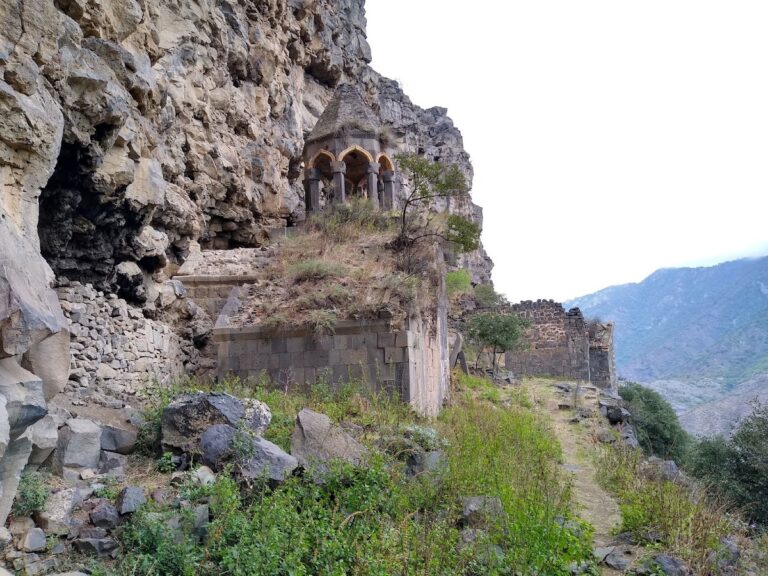
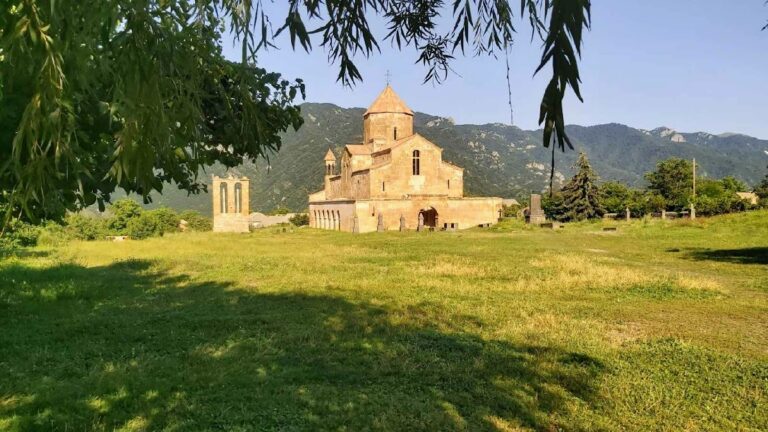
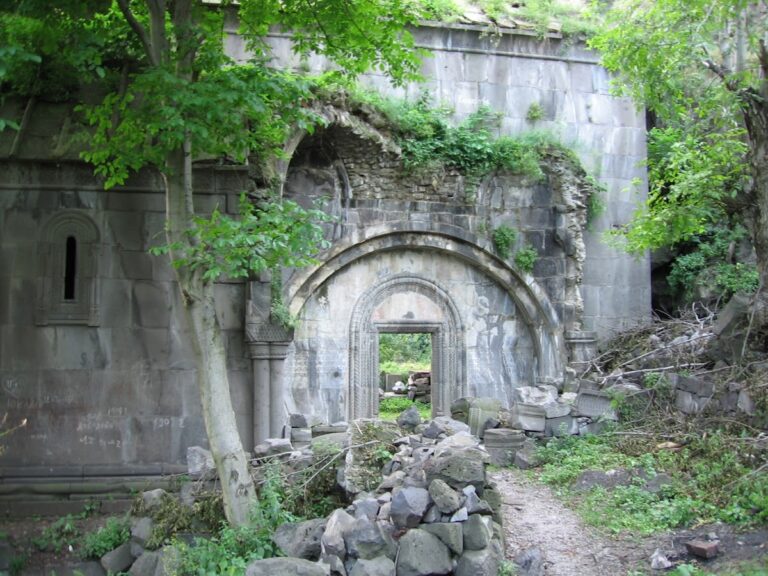
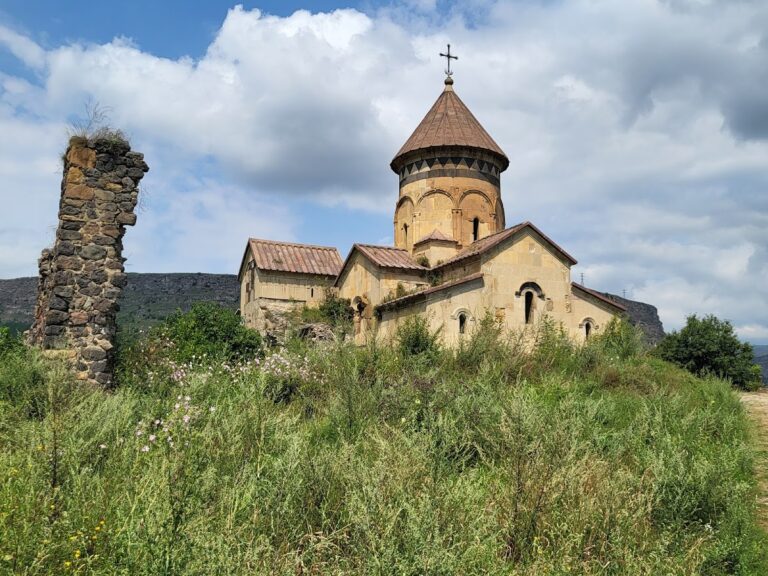
Ardvi Monastery is an enclosed complex of two adjoining churches, a separate bell tower, monastic, residential, and economic buildings, a quadrangular monument, a cemetery, and the natural feature of Snake’s Navel. A low, irregular enclosing wall surrounds the grounds. Ruins of monastic cells and service buildings remain within the enclosure, together with tombstones and khachkars, carved Armenian stone monuments centered on a cross and often decorated with geometric or plant motifs.
The adjoining churches
Northern church
The two churches are single-nave halls with barrel vaults, continuous curved ceilings extending along the length of each space. They share a longitudinal wall, which contains an entrance opening. The smaller northern church has a square prayer hall and a horseshoe-shaped apse, the recessed area at the eastern liturgical end. Its former western entrance is now closed.
A small vaulted entrance hall was added to the western side of the northern church in the thirteenth century. The large tombstone of Hovhan Odzneci stands in front of the sanctuary, while his grave is located inside the church. This burial gives the northern building particular importance within the complex.
Southern church
The southern church is larger than the northern one and shares its longitudinal wall. Tombstones cover its floor, making burials a visible part of the building’s surviving interior. Both churches were built mainly from small, irregular pieces of split andesite, a volcanic building stone. The lowest three courses of the eastern wall instead use large, finely dressed blocks.
Bell tower and enclosed grounds
Seventeenth-century bell tower
The bell tower stands separately in the southern part of the complex and dates from the seventeenth century. Its lower level is cube-shaped, while the upper structure forms a rotunda, a circular form supported here by six columns. The tower belongs to the period when much of the later monastery was developed.
Cemetery and secondary buildings
A medieval cemetery lies west of the monastery. It contains numerous tombstones and elaborately carved khachkars. The monastery grounds and nearby area also contain the quadrangular monument and the remains of residential and economic structures, placing the churches within a wider monastic setting rather than as isolated buildings.
Snake’s Navel
Snake’s Navel is a natural monument associated with the monastery. Two rock veins resembling dragons emerge from the mountainside, and two springs issue from the larger formation. The western, thinner spring is mineral water traditionally regarded as medicinal. Together, the formations and springs provide the physical setting for the local stories about dragons, Hovhan Odzneci, the hermit, and the origin of the water.
Nearby sites