Archaeological Area of Zonzamas: A Majo Settlement on Lanzarote
Site at a Glance
- Rating
- 3.5
- Popularity
- Very Low
- Country
- Spain
- Primary era
- Medieval
- Eras represented
- Classical, Medieval
- Civilizations
- Amazigh
- Site type
- Settlement
On this page8 sections
History
Settlement and royal residence
The Archaeological Area of Zonzamas is a pre-Hispanic settlement on Lanzarote, Spain, built by the Majos in the fifth century. The Majos were Lanzarote’s Indigenous people, and their culture had connections to the wider Berber world of North Africa. Zonzamas served as both a settlement and a royal residence.
The settlement remained occupied until the eighth century, when it was abandoned. It was reoccupied in the twelfth century, and new buildings were constructed over earlier remains buried by sediment. A separate tradition credits the Palace of Zonzamas to Zonzamas, a Majo king of Lanzarote, whose story is associated with the visit of Ruiz de Avendaño, a man from Biscay in northern Spain, around 1377. Le Canarien, a medieval chronicle about the Canary Islands, identifies the cave or palace as Zonzamas’s royal residence. Guadarfía, described as the island’s last king, was also said to have lived there.
Eruption, abandonment, and archaeology
Some buildings that escaped burial remained in use at least into the eighteenth century. The settlement’s final abandonment is thought to have occurred in 1731, following Lanzarote’s 1730–1736 eruption in the Timanfaya volcanic area. Testimony also places habitation at the site well into the twentieth century.
Excavations began in 1973, with Inés Dug Godoy identified as the site’s archaeologist. At the start of the work, only the Palace of Zonzamas was visible; sediment and ash from the 1730 eruption covered the other buildings. The site was designated a national historic-artistic and archaeological monument on 27 April 1979. On 7 September 2000, it received Spain’s Asset of Cultural Interest status, a legal designation for protected cultural property.
Remains
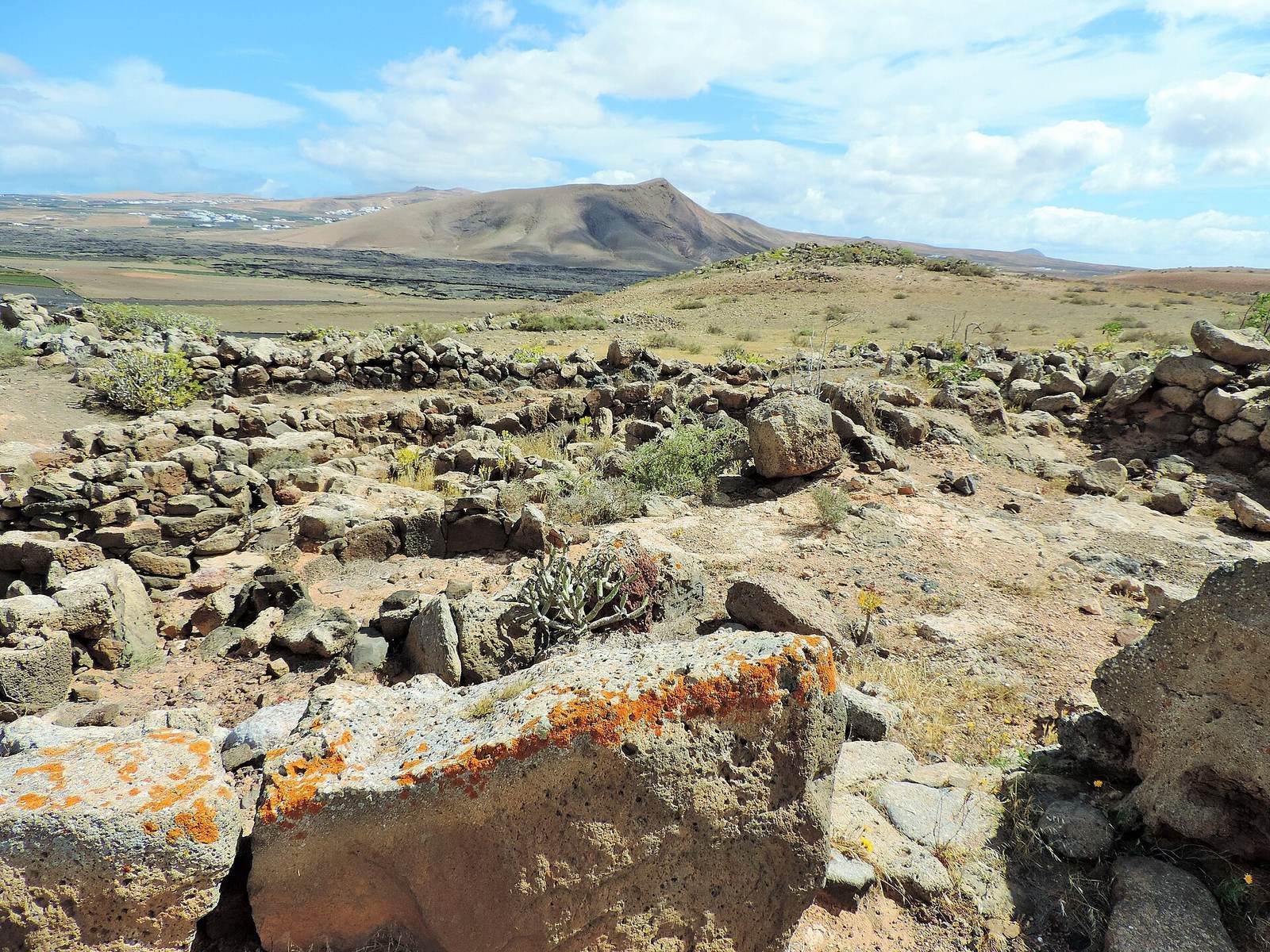
The archaeological area lies between the Caldera de Zonzamas and Montaña de Maneje, within the municipalities of Teguise, Arrecife, and San Bartolomé. Its remains include mostly semisubterranean dwellings, a natural cave associated with the palace and its surrounding stone wall, and carved basalt installations.
Dwellings and excavated finds
Most of the buildings are semisubterranean homes. Excavations have yielded large quantities of handmade pottery, goat bones, and limpet shells.
Palace and cave
The Palace of Zonzamas is associated with a natural cave enclosed by a massive stone wall. Some stones in the wall weigh between 1,300 and 1,800 kilograms.
Carved basalt channels
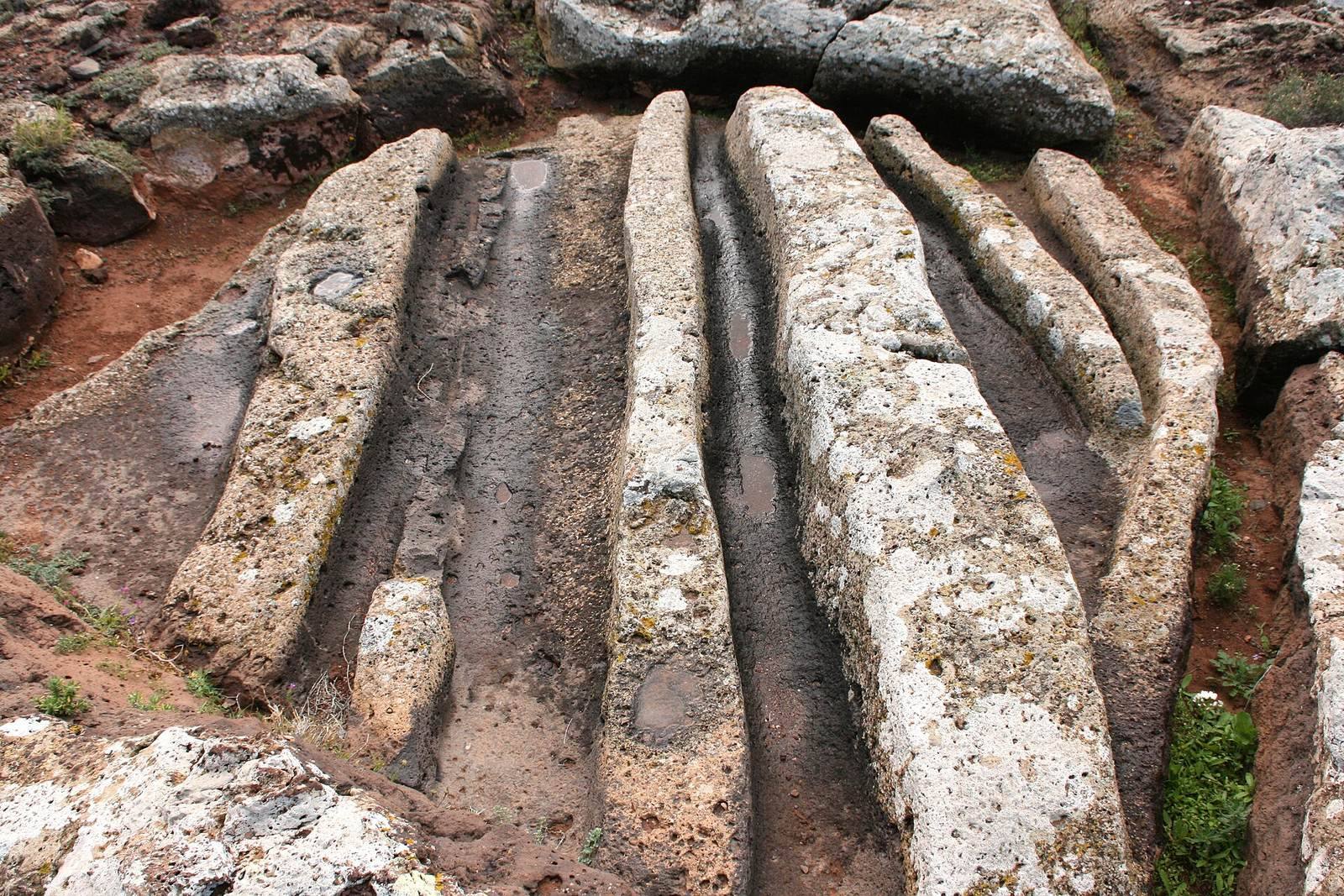
One installation consists of parallel, lengthwise channels cut into a large basalt block. It measures 3.90 metres across and has five channels oriented northwest, an extension one metre long on its eastern side, and channels closed at both ends. Proposed uses for such installations include ritual activity, everyday tasks such as grinding, and collecting or storing water. The Zonzamas example is probably the best-preserved of its kind on Lanzarote.
Zonzamas idol
The Zonzamas idol is a seated human-shaped figure. Some interpretations describe it as an object brought by Phoenician sailors, an ancient seafaring people of the eastern Mediterranean, and identify it as a representation of Taweret, an ancient Egyptian goddess.