Arates Monastery: A Medieval Armenian Apostolic Monastery in Armenia


Site at a Glance
- Rating
- 4.9
- Popularity
- Very Low
- Country
- Armenia
- Primary era
- Medieval
- Eras represented
- Medieval
- Civilizations
- Armenian
- Site type
- Religious
- Remains
- Monastery
On this page13 sections
History
Arates monastery is a ruined Armenian Apostolic monastery in Armenia, founded as a monastic complex generally associated with the thirteenth century, although its churches and inscriptions indicate a much longer history. The Armenian Apostolic Church is an ancient Armenian Christian tradition belonging to the Oriental Orthodox family. The monastery stands in Arates village and was associated with the Diocese of Vayots Dzor, the regional ecclesiastical jurisdiction of that church.
Early history and inscriptions
The oldest inscription at Arates dates to 907, while the latest dates to 1713. In 1073, a man named Artavazd gave the monastery a vineyard and estates in Yeghegis. Another inscription, made in 1220 by Prince Vasak Khaghbakyan, records the liberation of the fortresses of Vayots Dzor. The name Arates is also linked by tradition to words meaning “come” and “see,” although this is a legendary explanation rather than a historical derivation.
Orbelian period
In the late thirteenth century, Stepanos Orbelian transferred Arates monastery and its estates to Noravank, a major medieval Armenian monastery in Vayots Dzor. Arates then served as Noravank’s summer residence. In 1301, Stepanos Orbelian donated eight villages in Gegharkunik Province to the monastery.
The complex also had a role in Armenian intellectual life. In 1303, the scribe Khachatur Yerznkatsi copied Gregory of Nyssa’s Commentary on Ecclesiastes at Arates on Stepanos Orbelian’s commission. Gregory of Nyssa was a fourth-century Christian theologian and bishop whose writings influenced Armenian and other Christian traditions.
Later changes and survival
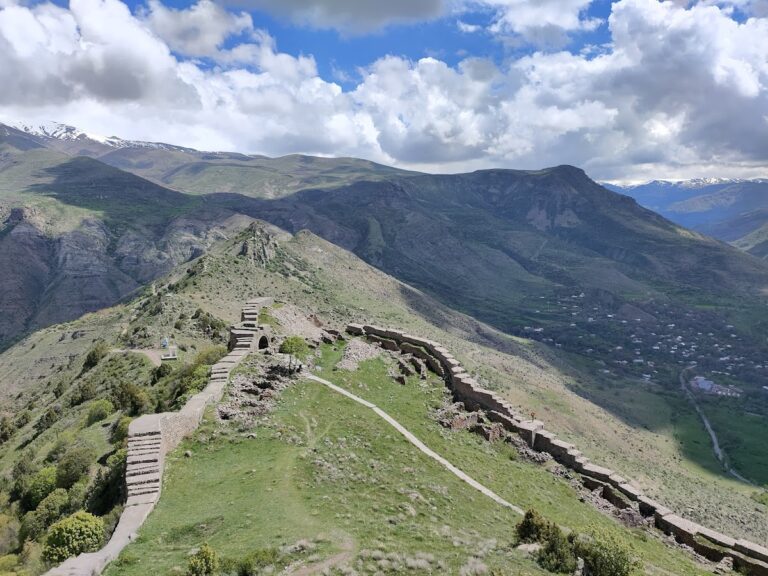
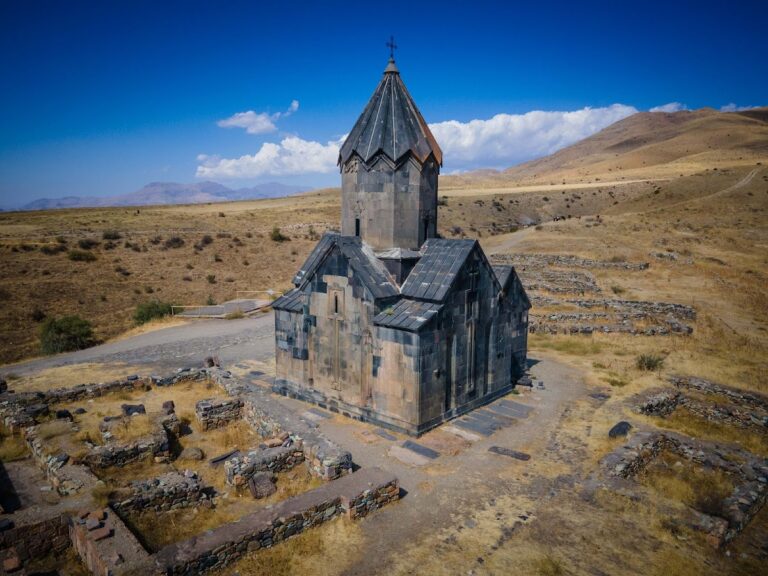
The monastery was originally surrounded by an enclosing wall, but the wall was destroyed in the seventeenth century. Arates is now a ruin, while its surviving churches, inscriptions, stone monuments, and graves preserve evidence of its long religious and architectural development. The complex is protected as a cultural monument of Armenia.
Remains
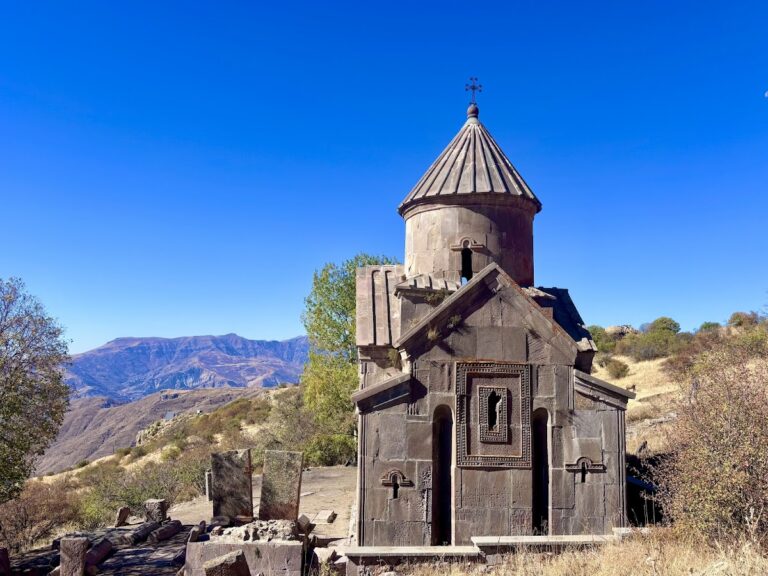
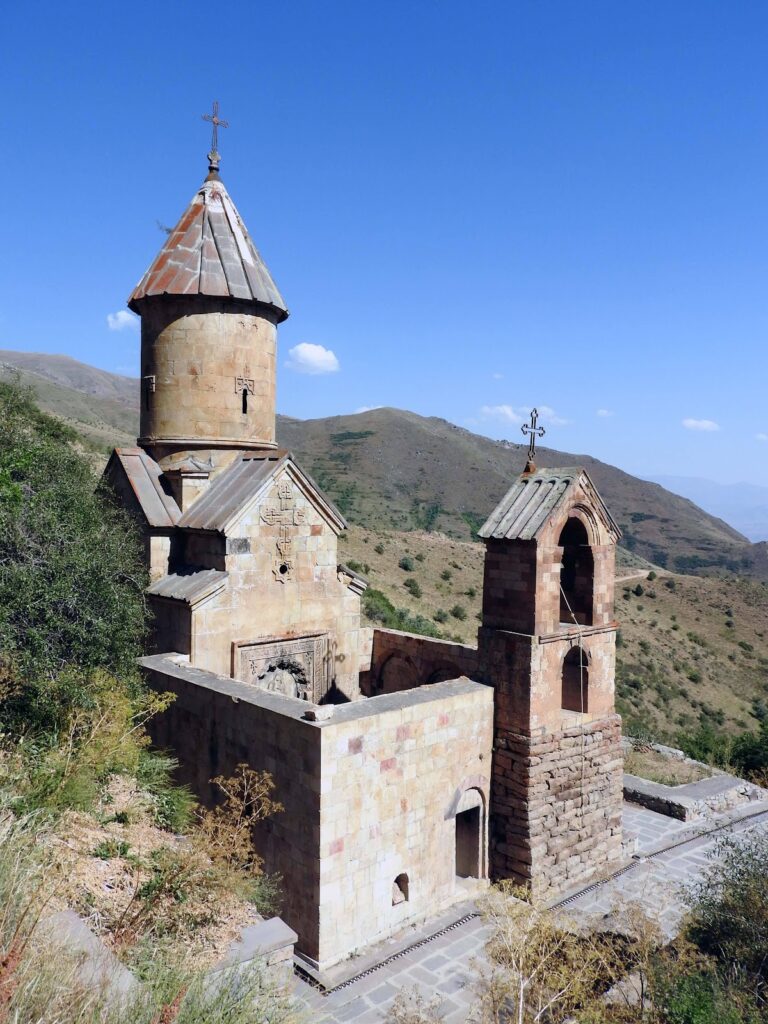
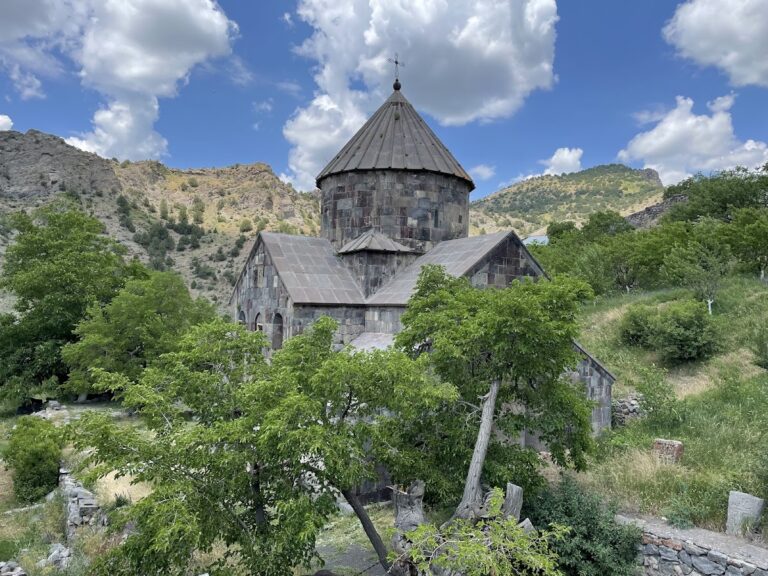
Arates monastery occupies a hilltop in Arates village beside a tributary of the Yeghegis River. Its three churches are arranged along a north-south axis, with the principal buildings and monastic annexes forming the surviving core of the complex. The structures represent several periods of Armenian ecclesiastical architecture and are accompanied by inscriptions and later stone memorials.
Churches
Surb Zion
Surb Zion is the northern church. It is a single-nave building covered by a barrel vault, with three side chambers. Two chambers stand beside the sanctuary, while another adjoins the northern wall. Its origins are attributed to the seventh century, although it is also identified as a tenth-century church, a chronology reflected in the complex’s early inscriptions and architectural history.
Surb Astvatsatsin
Surb Astvatsatsin is the southern church. It has a domed hall with a pair of wall piers and is also described as a cross-domed church. Its construction date remains uncertain, and it is elsewhere identified as an eleventh-century building. An inscription inside the church bears the date 1073, but that inscription does not by itself establish when the building was constructed.
Surb Karapet
A square-plan church identified as Surb Karapet, the Church of Saint John the Baptist, stands between Surb Zion and Surb Astvatsatsin. Its date of construction is uncertain, although an inscription gives the year 1251.
Gavits
Central gavit
A thirteenth-century gavit stood between Surb Zion and Surb Astvatsatsin. A gavit is an Armenian monastic annex or entrance hall that could serve for gatherings, funerary purposes, or receiving pilgrims. This building had a square plan and two chambers on its eastern side.
Western gavit
In 1270, the monastery’s rector, Hairapet, commissioned a second gavit against the western facade of Surb Astvatsatsin. The architects were Siranes and Grigoris, and the work was undertaken under the patronage of Smbat Orbelian, a nobleman of the Orbelian house. Its roof was formed by intersecting arches, and its central dome contained a skylight framed by stalactite-like stone treatment. The dome was destroyed during the 1970s.
Stone monuments and graves
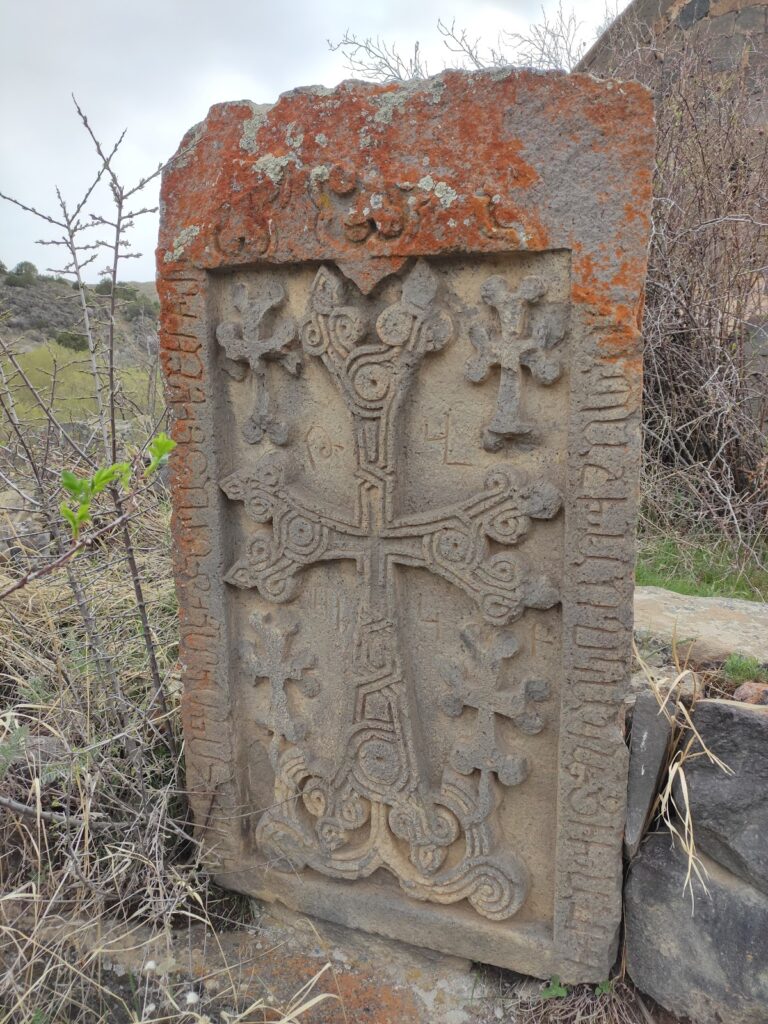
Khachkars and gravestones remain within the former monastery grounds. A khachkar is a carved Armenian stone monument centered on a cross and often enriched with vegetal or geometric ornament. The surviving examples date from the tenth to the seventeenth centuries and extend the physical record of Arates beyond its churches and gavits.