Santa María Magdalena Church, Seville: A Former Dominican Convent Church
Site at a Glance
- Rating
- 4.7
- Popularity
- High
- Country
- Spain
- Primary era
- Early Modern
- External website
- Open
- Eras represented
- Medieval, Early Modern
- Civilizations
- Crown of Castile, Spanish
- Site type
- Religious
- Remains
- Church
On this page25 sections
History
Santa María Magdalena Church is a Baroque Catholic church in Seville, Spain, built between 1694 and 1709 for the Dominican convent of San Pablo. The Dominicans, formally the Order of Preachers, combined communal religious life with preaching, study, and missionary work. The convent became a major religious and educational center, and its church later took over the parish of Santa María Magdalena.
Dominican foundation and medieval history
After Ferdinand III conquered Seville in 1248, he gave houses in the city to the Dominicans, who established the convent of San Pablo. Friars were assigned there around 1250, and Alfonso X confirmed the donation in 1255. In 1324, Prince Felipe gave alms to the convent, where he venerated the Virgin of the Fevers. The image was believed to have helped cure King Pedro I in 1351. In gratitude, Pedro gave the convent a silver statue of himself, later destroyed when a building collapsed in 1691.
A fire damaged the convent around 1353, and Pedro I contributed to repairs in 1361. In 1421, Seville’s municipal council provided 3,000 maravedís, a form of currency, for a Dominican general meeting held there, as well as making other donations for religious observances. The convent continued to attract support from prominent local families, some of whose members were buried in its church.
Study, missions, and religious life
A higher-learning institution known as the Estudio General was established at San Pablo in 1504. Pope Julius III granted it university status in 1552. That same year, the convent received help from the Catholic Monarchs, Ferdinand II of Aragon and Isabella I of Castile, toward repairs to the church roof, which a severe storm had brought down.
Dominican friars from San Pablo took part in missions to the Americas and the Philippines. Bartolomé de las Casas organized some of these efforts, and in 1544 he was appointed bishop of Chiapas at the convent. San Pablo was the largest Dominican house in Andalusia. It had 200 friars in the early seventeenth century; plague killed 85 of them in 1649, and the community numbered 190 in 1757.
Reconstruction and parish transition
Flooding from the Guadalquivir in 1691 and 1692 damaged the medieval convent complex. It was eventually demolished and rebuilt, including the present church, designed by Leonardo de Figueroa and constructed from 1694 to 1709. During the French invasion of Seville, troops looted the convent and used it as a barracks. The convent church then became the Church of Santa María Magdalena, taking the dedication from the old parish church. That earlier church stood on the site now occupied by Plaza de la Magdalena and was demolished in 1811.
The Dominicans later returned and began repairing the convent church. They also started rebuilding the demolished parish church on its former site. After the convent was confiscated in 1835 and assigned to civil offices, work on the parish church reconstruction was abandoned in 1842. The former convent church then became the permanent parish church of Santa María Magdalena. The convent buildings were adapted for civil use, and the entrance court and portal were demolished in 1889. A fire destroyed the former convent building in 1906; twentieth-century urban works removed its two cloisters and other structures. The church, sacristy, and Chapel of Montserrat survive from the complex.
Brotherhoods and later history
The church is the seat of several brotherhoods, lay religious associations organized around particular devotions and, in Seville, often public processions. The Sacramental Brotherhood of the Magdalena was founded in 1575 and continues an annual Eucharistic procession through the neighborhood for Corpus Christi. The Brotherhood of Our Lady of Amparo traces its origins to a sixteenth-century association founded by Archbishop Fernando Valdés to care for foundlings. The present brotherhood, established in the early eighteenth century, continues under the same dedication.
The Brotherhood of the Quinta Angustia began in 1575 as the Brotherhood of the Sweet Name of Jesus at the Church of San Vicente. It moved to San Pablo in 1587 and remained dependent on the convent prior until 1764. In 1851 it united with a brotherhood founded in 1540 to honor the Descent of Christ and the Virgin’s Fifth Anguish. It makes its penitential procession on Maundy Thursday.
A Brotherhood of Calvary was founded in 1571 at the Hospital of Our Lady of Bethlehem, later moved to the Church of San Ildefonso, and disappeared in the late eighteenth century. Refounded at San Ildefonso in 1886, the present brotherhood moved to Magdalena in 1916 and processes in the early hours of Good Friday. The Brotherhood of Montserrat, founded in the late sixteenth century, moved to San Pablo in the mid-seventeenth century. After a period of decline and the sale of its belongings in the early nineteenth century, it was refounded in 1849 and occupied its chapel again in 1938. It processes on Good Friday.
The Chapel of Montserrat had previously housed the Brotherhood of Our Lady of Antigua from 1546. That association merged with the Brotherhood of the Seven Sorrows in 1596; the combined brotherhood ended in the early nineteenth century, after which the chapel was abandoned until Montserrat’s return. The church also preserves a connection with the painter Bartolomé Esteban Murillo: he was baptized at the former parish church on 1 January 1618, and his family’s parish records span more than sixty years, including his parents’ marriage, his own baptism and marriage, and the baptisms of his first two children.
The church was declared an Asset of Cultural Interest in the Monument category in 1970. Its high altarpiece was restored in 2012.
Remains
The church has a cross-shaped plan, with three long aisles intersected by a cross arm. Its taller, wider central aisle is divided into five bays; a choir stands above the main entrance, and the sanctuary is at the far end. The building’s Baroque interior combines sculpted and gilded stucco, attributed to Pedro Roldán, with paintings and richly framed altarpieces.
Entrances and exterior
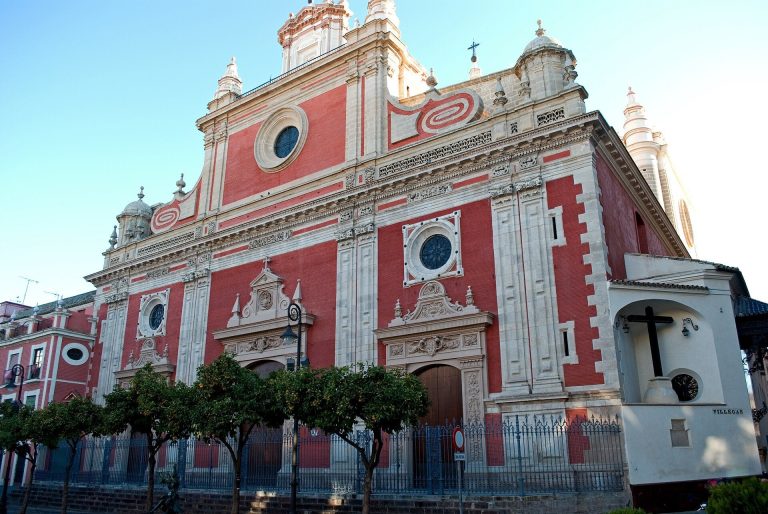
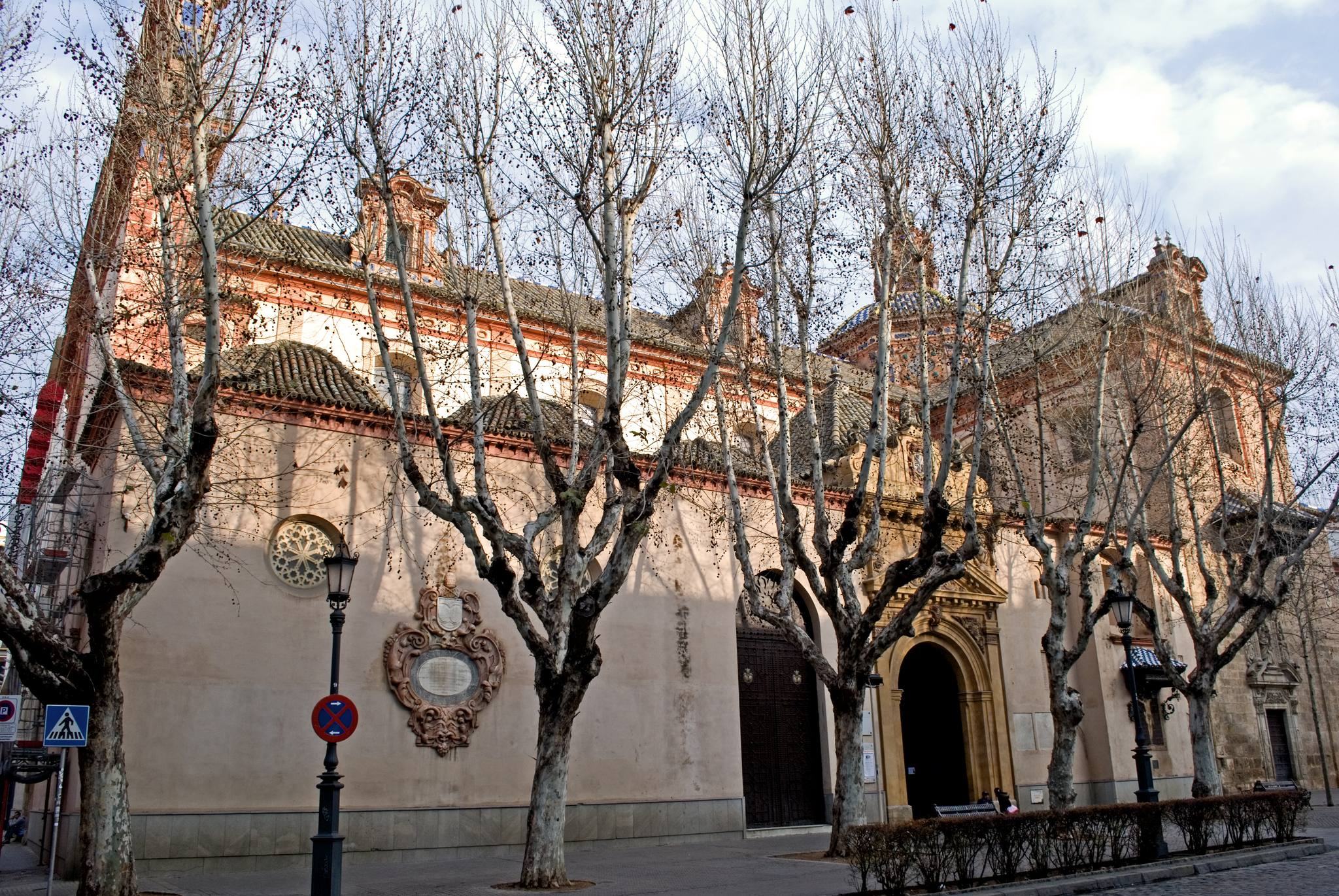
The stone entrance at the foot of the central aisle originally opened onto the convent’s entrance court and now faces Calle Cristo del Calvario. Its front has two vases, the Dominican coat of arms, and a bust of Saint Thomas Aquinas attributed to Pedro Roldán. A large rose window is surrounded by blue ceramic beads representing a rosary and a floral crown. Above it, a balcony arrangement is flanked by two bell gables. Three further doorways stand on the Epistle side, the side associated with the epistle reading: a plain entrance to the Quinta Angustia Chapel, a regularly used entrance bearing the Dominican arms and sculptures of Saint Ferdinand between Saints Isidore and Leander, and a transept entrance with a statue of Saint Dominic attributed to Roldán. Forged-iron brackets support a canopy above the last doorway. Blue and red decorative motifs also appear on the exterior.
Crossing, dome, and painted vaults
The dome
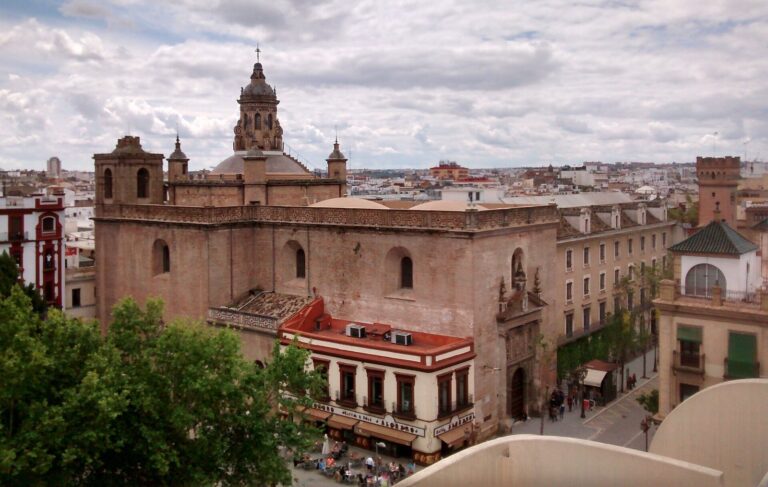
The crossing, where the long body of the church meets its cross arm, is covered by a dome on an octagonal base, the first dome of this type built in Seville. It has a lantern, a raised structure at the top that admits light, and an iron crown. Figures resembling Inca people decorate its exterior. Leonardo de Figueroa also designed similar domes for the Church of San Luis of the French and the Collegiate Church of the Savior.
Painted vaults and supports
Lucas Valdés painted the dome, its supporting piers, and the vault above the sanctuary. Medallions in the dome’s eight sections spell “Ave Maria,” accompanied by angels carrying symbols of the Marian litanies. The undersides of the crossing arches show the Catholic Church, Providence, Mercy, Wisdom, and divine Justice. Sixteen Dominican figures cover the four piers, among them Saints Antoninus, Peter Martyr of Verona, Pius V, Hyacinth, Raymond of Peñafort, Louis Bertrand, and Vincent Ferrer, as well as Blessed Gundisalvus of Amarante and Albertus Magnus.
Valdés’s “Triumph of Faith” fills the sanctuary vault with an image of Faith overcoming heresy across four continents. Faith appears between the archangels Michael and Raphael, angels, and musicians on two balconies. Below are Saint Dominic with a flaming sword and Saint Thomas Aquinas holding a palm and an open document, while figures representing heresy and abomination fall beneath them. Four medallions represent the continents.
High altar
The high altarpiece is dedicated to Saint Paul, patron of the former convent. Measuring 160 square metres and 18 metres high, it is the city’s second largest after the cathedral’s. The Baroque structure has a base and two main tiers, divided into three vertical sections by twisting columns. Its creation is placed between the church’s completion in 1709 and its consecration in 1724, and it is attributed to Leonardo de Figueroa and Pedro Duque Cornejo. Saint Paul occupies the central niche in the upper tier, with Saints Pius V and Benedict XI at the sides; Saints Francis and Dominic stand in the tier below. A relief shows the Conversion of Saint Paul, flanked by Saints Catherine of Siena and Rose of Lima. Most of the sculpture is attributed to Duque Cornejo and dated 1709–1724.
The lower central niche holds a statue of Saint Mary Magdalene, made by Felipe Malo de Molina in 1704 and transferred from the former parish church in the mid-nineteenth century. An Immaculate Conception occupies the lower section of the altarpiece. Marble-columned doorways flank it, with allegories of Hope and Charity on their lintels. An earlier high altarpiece, commissioned in 1577 by the convent prior and made by Juan Bautista Vázquez the Elder and Miguel de Adán, remained in the church until about 1700.
Transept chapels and altarpieces
Gospel side
On the Gospel side, the side associated with the Gospel reading, an eighteenth-century altarpiece in the Chapel of the Virgin of Antigua holds a statue made by Pedro Roldán in 1650–1651. The Chapel of the Virgin of Amparo has an eighteenth-century altarpiece attributed to Cristóbal de Guadix and a Virgin made by Roque Balduque around 1555. Nearby are a seventeenth-century altarpiece of Saint Anne and the Virgin as a child, with sculptures by Francisco Ruiz Gijón dated 1675–1678, and a seventeenth-century altarpiece of the Virgin of the Fevers. Its image of the Virgin is attributed to Juan Bautista Vázquez the Elder and dates to the mid-sixteenth century.
The altarpiece of Jesus Carrying the Cross on this side includes a figure sculpted by Gaspar del Águila in 1587 and painted in color by Antonio de Alfián. The figure holds a tortoiseshell cross with a silver frame and came from the former parish church. It was formerly called Christ Carrying the Cross or Christ of the Magdalena, and later became known as the Nazarene of the Fatigues.
Epistle side
The Chapel of Christ of Calvary on the Epistle side has an early eighteenth-century altarpiece with twisting columns and a contemporary grille. Its central group consists of Christ of Calvary by Francisco de Ocampo, dated 1612, the Virgin of the Presentation by Juan de Astorga, made around 1839, and Saint John the Evangelist, also by Astorga around 1839. Nearby are an eighteenth-century statue of Saint Catherine of Siena; an early eighteenth-century altarpiece of Saint Anthony of Padua, with a seventeenth-century Ecce Homo in its base; and eighteenth-century altarpieces and statues of the Virgin of Mount Carmel and Saint Joseph with the Child.
Quinta Angustia Chapel
Attached to the Gospel aisle, the Chapel of the Quinta Angustia dates from the late fourteenth or early fifteenth century. It was remodelled in the early eighteenth century and restored to an earlier form in 1917. It may originally have consisted of three separate chapels, each with a dome. Nature-themed wall paintings, three heraldic shields, two belonging to the Ayala family and one to the Medina family, and tiles installed in 1896 are among its features. The chapel contains Jesus of the Descent, attributed to Pedro Roldán and dated 1659, and the Virgin of the Quinta Angustia by Vicente Rodríguez-Caso, made in 1932. It also holds an oil painting of Saint Michael attacking Lucifer, dated 1659–1660 and brought from the main altarpiece of the former Convent of San Benito de Calatrava, and another painting by Juan de Valdés Leal commissioned for an altarpiece during that convent’s rebuilding in 1659–1661.
Sacramental Chapel
The Sacramental Chapel extends from the cross arm to a side entrance. Formerly the Chapel of the Virgin of the Rosary, it became the sacramental chapel after the parish moved to the church. Miguel Albín made its altarpiece in 1817. Four fluted Corinthian columns frame a projecting central niche, which contains an eighteenth-century Immaculate Conception beneath a small canopy. Two late-seventeenth-century archangels by Juan Bautista Patroni occupy the side sections, and a relief of the Holy Trinity by Manuel María Fernández fills the upper section. Patroni’s angels also stand on brackets at the ends. The altarpiece is painted to resemble marble and has gilded outlines. Its altar table has a column-and-flower design on the front and doors at the sides. A silver tabernacle from the late eighteenth century above it was altered by Fernando Marmolejo in 1954.
Chapels and altarpieces along the aisles
Baptismal chapel
At the foot of the Epistle aisle, the baptismal chapel holds the font transferred from the former parish church. It also contains Christ of the Gonfalon, a carving attributed to Nicolás de León and dated 1536. The work presents Christ on the cross, with the Virgin Mary and Saint John standing beside him. It belonged to the now-extinct Brotherhood of the Life of Christ and Gonfalon, which undertook works of mercy and religious devotion and was affiliated with a Roman brotherhood of the same name.
Rosary chapel
The Chapel of the Virgin of the Rosary stands at the foot of the Gospel aisle. Its altarpiece dates to the eighteenth century, and its statue of the Virgin was made by Cristóbal Ramos around 1787.
Assumption altarpiece
In the Epistle aisle, the altarpiece of the Assumption of the Virgin includes a central relief of the Assumption made by Juan de Mesa in 1619. A relief of the Coronation of the Virgin by the same artist occupies its upper section.
Paintings and wall decoration
Wall paintings and transept scenes
Lucas Valdés painted the church walls with scenes concerning the Dominican Order, the mysteries of the rosary, and the apostles. Most date from 1710–1715, and many are badly deteriorated. One shows Solomon making an offering in the Temple. On the right side of the cross arm, Valdés’s “Triumphal Entry of Saint Ferdinand into Seville between the Allegories of Fortitude and Liberated Seville” depicts the king entering the city with the Virgin of the Kings and a church procession that includes Saint Dominic and Saint Peter Nolasco. Saints Isidore and Clement look on from above.
On the left side, “Auto-da-fé in the Time of Saint Ferdinand” shows Dominican friars and the king, who carries wood for a pyre. An auto-da-fé was a public ceremony at which sentences of the Inquisition were announced. The painting draws on a legend that such a ceremony took place in Seville on 28 October 1703, when Diego López Duro of Osuna and others were executed for practicing Judaism. The scene also includes Dominican friars carrying condemned people on donkeys.
A painting of the Virgin of the Rosary protecting Spanish ships at the Battle of Lepanto reflects Dominican devotion to the rosary. It shows the battle below the Virgin on a cloud and is framed by gilded plasterwork. The battle took place on 7 October 1571, during the pontificate of Pope Pius V, a Dominican. Tradition holds that prayer of the rosary contributed to the Christian victory.
Paintings by Zurbarán
Two paintings by Francisco de Zurbarán are associated with the church. “Miraculous Healing of Blessed Reginald of Orléans” shows the Virgin appearing to the sick Reginald after Saint Dominic’s prayer and healing him by anointing his head. “Saint Dominic in Soriano,” also known as “The Miraculous Delivery of the True Portrait of Saint Dominic in Soriano,” dates to 1626. It depicts the Virgin, Mary Magdalene, and Saint Catherine presenting an image of Saint Dominic to a Dominican sacristan.
Processional monstrance
The Sacramental Brotherhood’s processional monstrance, a vessel used to display the consecrated Eucharistic host, is 2.25 metres high. Cristóbal Sánchez de la Rosa began it in 1678; Juan Laureano de Pina continued the work, and Blas Amat y Cortés completed it in 1790. Its eight-sided design has three tiers and ends in a base supporting a statue of Faith. Straight and twisting columns with plant ornament frame the lower tiers. The lowest has a balustrade with the four Evangelists, the next includes angels, and an Immaculate Conception stands at the center.
Surviving convent buildings
The Chapel of Montserrat on Calle Cristo del Calvario formed part of the former convent’s entrance court. Along with the church and sacristy, it is one of the surviving components of the Dominican complex.