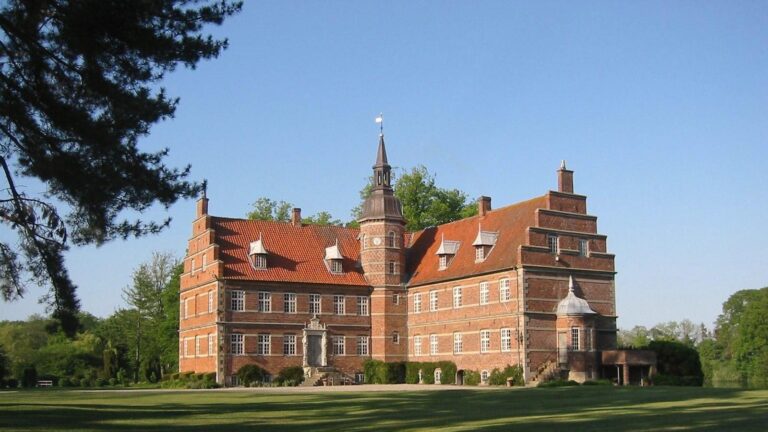
Allesø Church: A Medieval Church in Denmark
Site at a Glance
- Popularity
- Very Low
- Country
- Denmark
- Primary era
- Medieval
- Eras represented
- Medieval, Early Modern, Modern
- Civilizations
- Danish, Denmark–Norway
- Site type
- Religious
- Remains
- Church
On this page16 sections
History
Allesø Church is a medieval church in the village of Allesø, northwest of Odense, Denmark. Its earliest date is uncertain: the oldest brickwork may belong to the 13th century, while later alterations introduced Gothic features, part of a broad medieval European architectural style.
Medieval development
Allesø is first mentioned in 1383. The church appears in a land-aid tax assessment for 1524–26, where its liability was set at the low rate of 10 marks. Extensive alterations took place in the late Middle Ages, although their sequence is uncertain.
Church ownership and changing use
After the Reformation in Denmark, the 1536 transition from Catholic to Protestant church governance, the Crown owned the church. It was one of only four churches on Funen whose patronage rights the Crown retained throughout the 17th century. These rights included a role in appointing clergy and overseeing church affairs. Since 1536, Allesø has also served as a dependent church of Næsbyhoved-Broby Church.
In 1671, the church’s revenues were assigned to a philosophy teaching post at Odense Gymnasium, a school. They remained there until 1718, when the church tithes and the parish’s Crown estate were transferred to the Funen cavalry district, a royal military-administrative area associated with supporting cavalry.
Private ownership and restoration
When the cavalry estate was sold in 1764, the church passed to Jacob Lowson, a justice councillor. Ownership changed several times before farmer Jacob Mortensen of Beldringe acquired it in 1802. His family retained it until the church became independently owned in 1910.
A major restoration took place in 1913–14. Medieval and later wall paintings were uncovered in the nave and tower room in 1984.
Remains
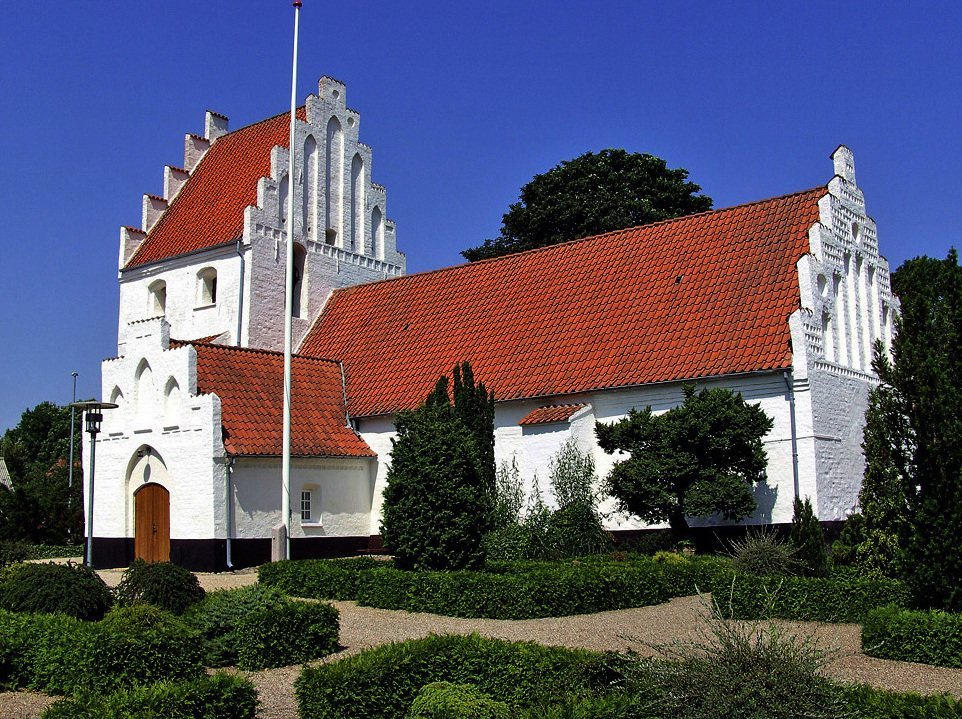
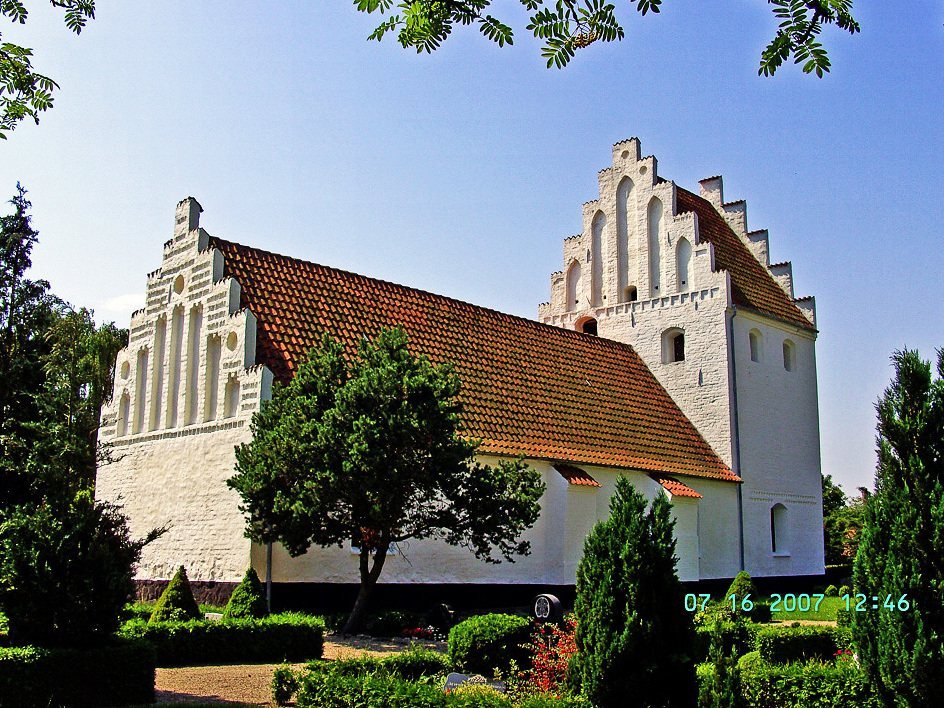
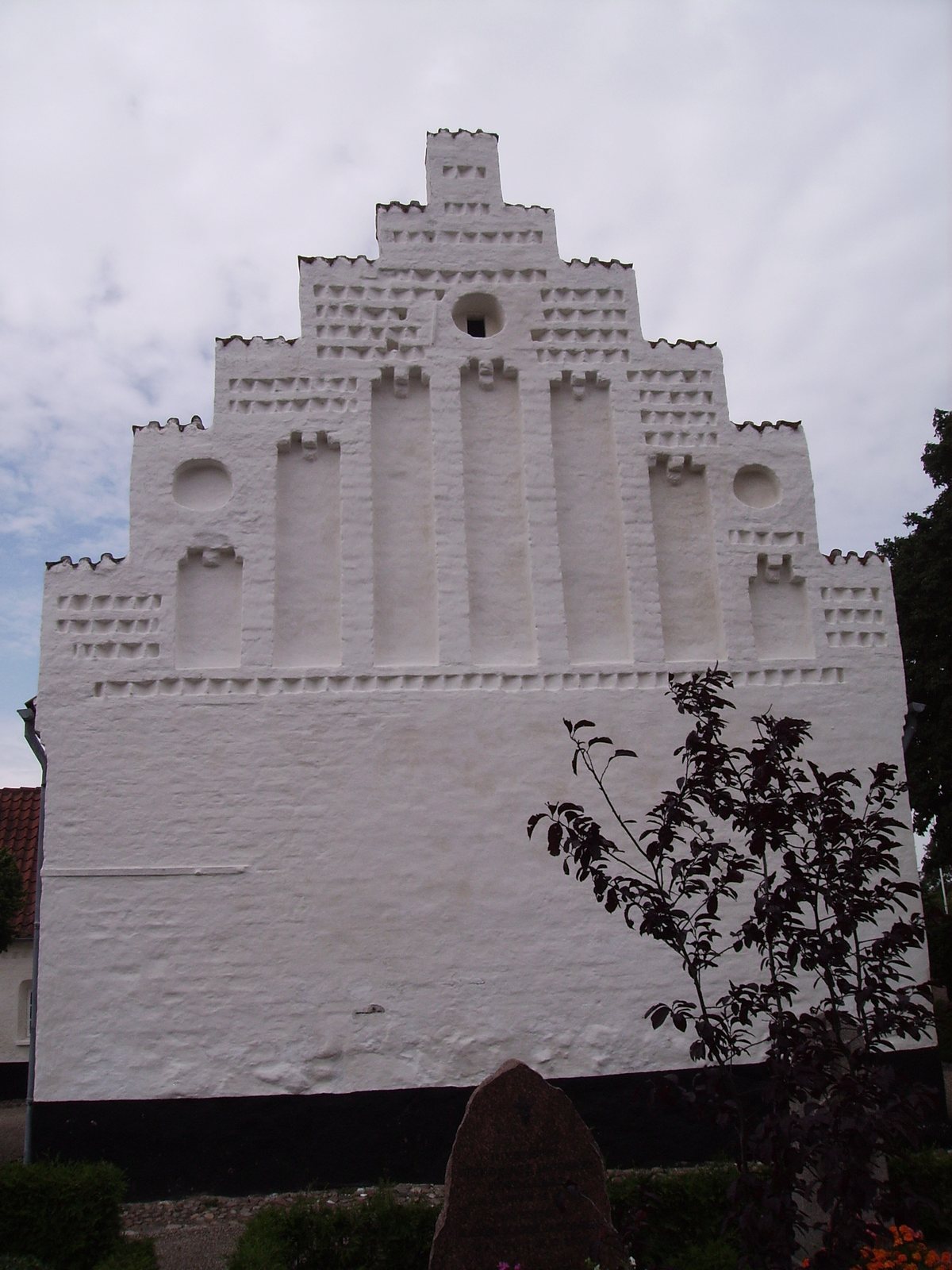
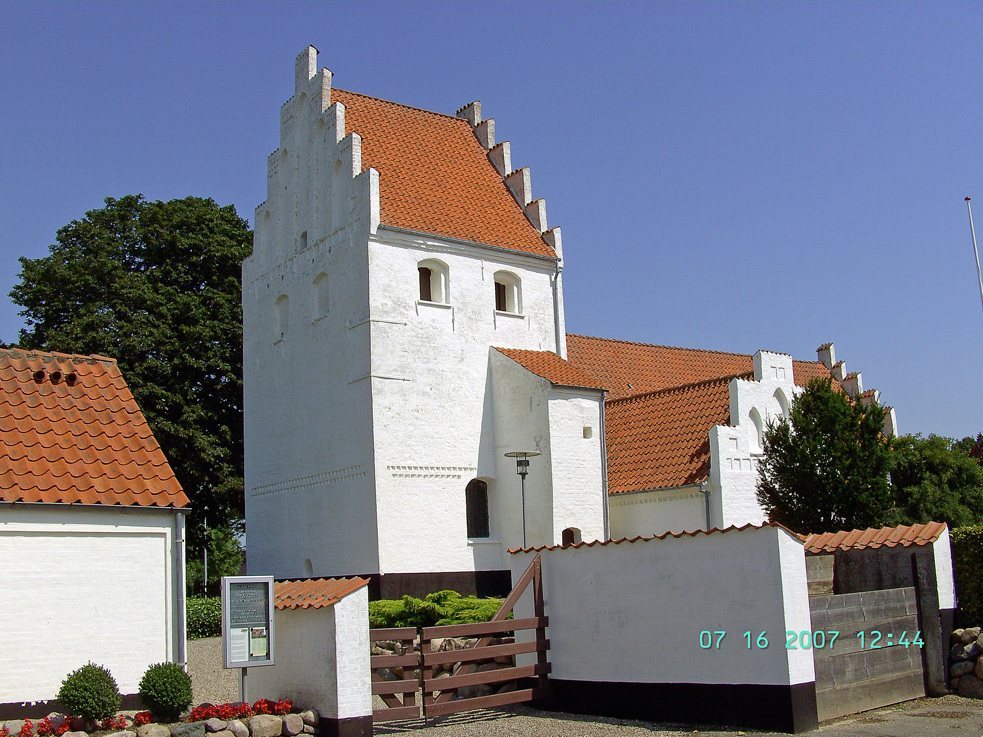
The church is a brick building arranged around a nave, the main body of the church, and a choir, the area at its eastern end. Late-medieval additions and alterations shaped its present plan, while vaulted ceilings cover the interior.
Church fabric and layout
Nave and choir
The oldest brickwork belongs to the nave and a narrower original choir. In the late Middle Ages, that choir was demolished and replaced by a longer Gothic choir. Tree-ring analysis dates the long choir’s roof timbers to around 1534, which may also indicate when the choir was built. The nave was vaulted, and the church has late-Gothic cross vaults, formed by intersecting vaulted sections.
Porch and tower
A porch stands outside the original south doorway. A tower was added at the west end and later joined by a stair turret. The tower room contains painted decoration described below.
Wall paintings
Nave paintings
Paintings in the nave date to about 1450–1500. Monochrome grey-black decoration runs along the vault ribs and the crosswise arch. In the eastern bay, a small cross, about 10 centimetres high, appears in the western vault section; each of the other three sections has a larger cross. The eastern vault section also bears crowned monograms of King Christian VII and Queen Caroline Mathilde, probably added during repairs in the 1760s.
Tower-room paintings
The tower-room paintings date to about 1480–90. Their makers, formerly linked with the Clog Painter’s circle, are now called the Brylle Workshop, after its work at Brylle Church. The red-and-grey decoration includes compass-drawn rosettes in the vault sections, chevrons along the ribs, and coarse masks around the drainage holes in the vault pockets.
Furnishings and memorials
Baptismal font and crucifix
The oldest furnishing is a granite baptismal font in the Romanesque style, a broad medieval European architectural style. It belongs to the Højby type, an art-historical grouping of fonts. A small crucifix from around 1500 survives as a remnant of a late-medieval winged altarpiece.
Altar furnishings and paintings
The altar candlesticks date from the 16th century. A baptismal dish of typical Nuremberg workmanship, decorated with a relief of the Annunciation, is also from that century and was bought by the church in 1702. Church owner Peter Eilschou donated the two oldest chandeliers in 1768, along with an altarpiece. The altarpiece’s painting was replaced in 1828 by The Prayer in the Garden of Gethsemane, painted by Niels Ernst Fich of Odense; that painting is now in Ry Church in the Diocese of Aarhus.
The 1913–14 restoration added Tony Müller’s Christ Blessing the Little Children, painted in 1914 as a copy of her 1910 work for Lumsås Church. The restoration also introduced new door leaves, pews, and a pulpit. The pulpit was a simplified version of one made for Hjadstrup Church the previous year.
Bell and organ
The church bell was cast in 1453. Its organ was built by Bruno Christensen & Sønner in 1979 and has seven stops.
Communion set and memorial stones
Clemens Pedersen of Odense made the communion set in 1802. Jacob Mortensen and Gertrud Olesdatter, then church owners, donated it. Three inscribed funerary memorials inside the church date from the 17th century. One commemorates parish priest Jakob Knudsen, who died in 1637, and his wife Elisabeth; another remembers parish priest Carl Pedersen, who died in 1682.