Bois-Couturier Gallery Tomb: A Neolithic Burial Monument in France
Site at a Glance
- Popularity
- Medium
- Country
- France
- Primary era
- Stone Age
- Eras represented
- Stone Age, Modern
- Civilizations
- French
- Site type
- Burial
- Remains
- Tomb
On this page13 sections
History
The Bois-Couturier Gallery Tomb is a Neolithic communal burial monument in the Bois de Morval at Guiry-en-Vexin, France. Radiocarbon analysis places it at the end of the Neolithic, in the late third millennium BCE, with a calibrated determination of 2028 ± 135 BCE. It is also attributed to the late Seine-Oise-Marne culture, an archaeological culture associated with late Neolithic communities in northern France, around 2000 BCE.
Discovery and investigation
An agricultural worker uncovered the tomb in October 1915 after striking stones while ploughing. An exploratory trench was halted when human bones appeared. Schoolteacher Romain Branchu and archaeologist Léon Plancouard began excavations, but bad weather interrupted their work. They resumed in early March 1916 and continued until October. Prehistorian and archaeologist Adrien de Mortillet returned to excavate the site in September 1919, estimating that the chamber had held about 200 burials.
Protection and restoration
The tomb received French historic-monument status, a statutory heritage designation, on 24 May 1958. This protection did not stop illicit digging and damage. In July 1960, bones remained visible at the rear of the chamber, and excavation was still incomplete. Excavation was completed and the monument restored in 1973.
Remains
The tomb lies partway up the slope of the Butte de Cléry, at an elevation of 102 metres, overlooking the Aubette valley in north-west Val-d’Oise. Its stone gallery follows the slope on a north-north-east to south-south-east alignment, with the entrance facing south-south-east. The burial structure comprises a long chamber and an antechamber.
Burial chamber
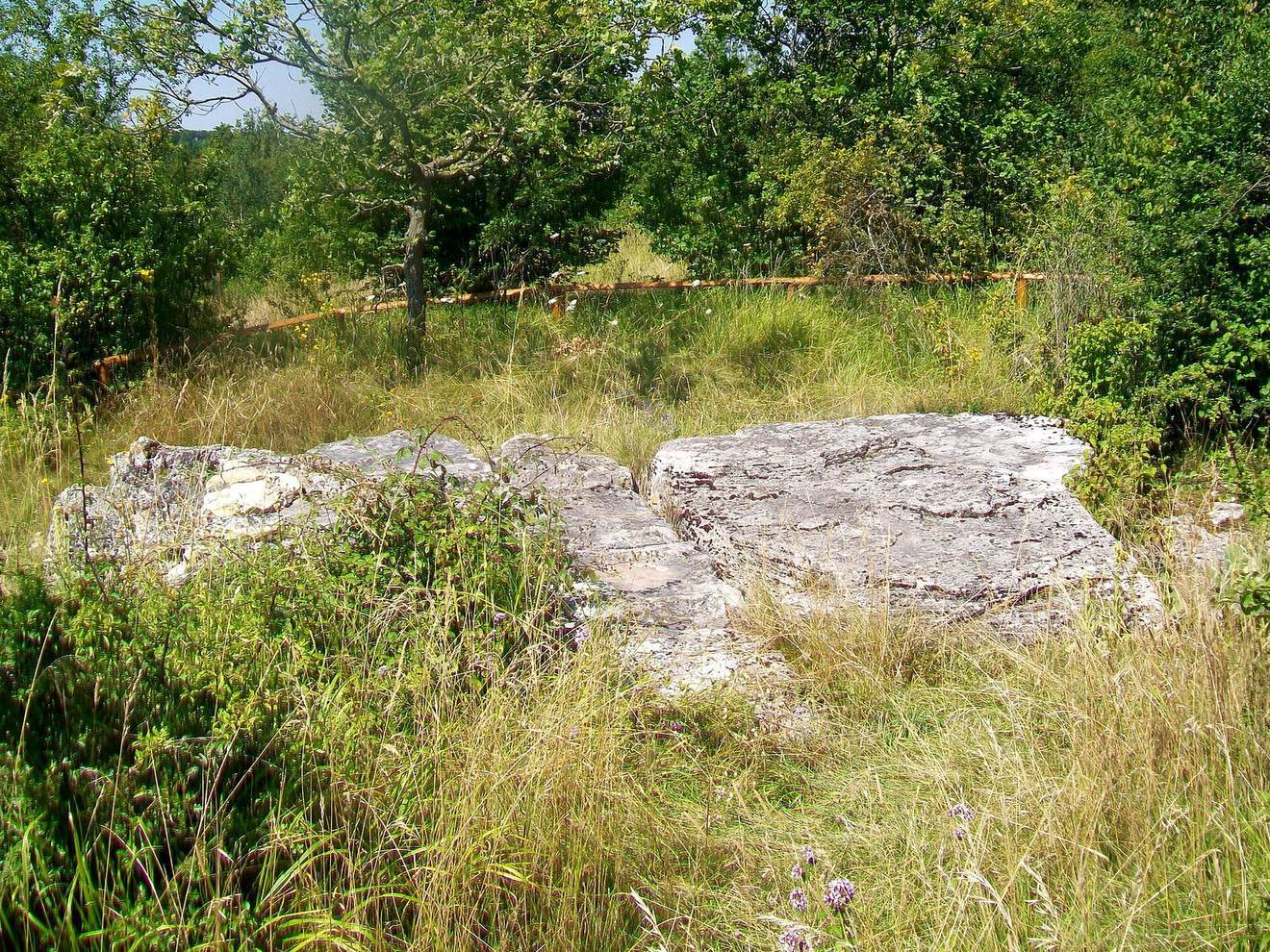
The gallery measures about 8 to 8.5 metres in length, while the chamber is 7 metres long and 1.3 metres high. It narrows from 2 metres across at the entrance to 1 metre at the rounded rear, where the corners curve slightly. Near the entrance, three upright slabs form the left wall for about a metre; they average 0.60 metres high. Flat-laid limestone slabs, 0.40 to 0.50 metres thick and set with earth, make up the rest of the side walls. Three capstones remain. The first is broken in two, while the other two measure 2.75 by 2 metres and 3.75 by 2.40 metres. A fourth capstone may have been removed in 1919. At discovery, soil 0.40 to 0.50 metres deep covered the first capstone.
Antechamber and entrance
Antechamber
The antechamber is 1 metre long and 1.85 metres wide. Two side slabs, respectively 1.75 metres wide by 1.73 metres high and 1.37 metres wide by 1.60 metres high, rest on flat stones at their bases. A transverse slab once closed its south end, leaving a passage about 0.75 metres wide. Removed in 1916, this slab was reused during restoration to complete the first capstone. The antechamber floor is unpaved.
Entrance slab and stopper
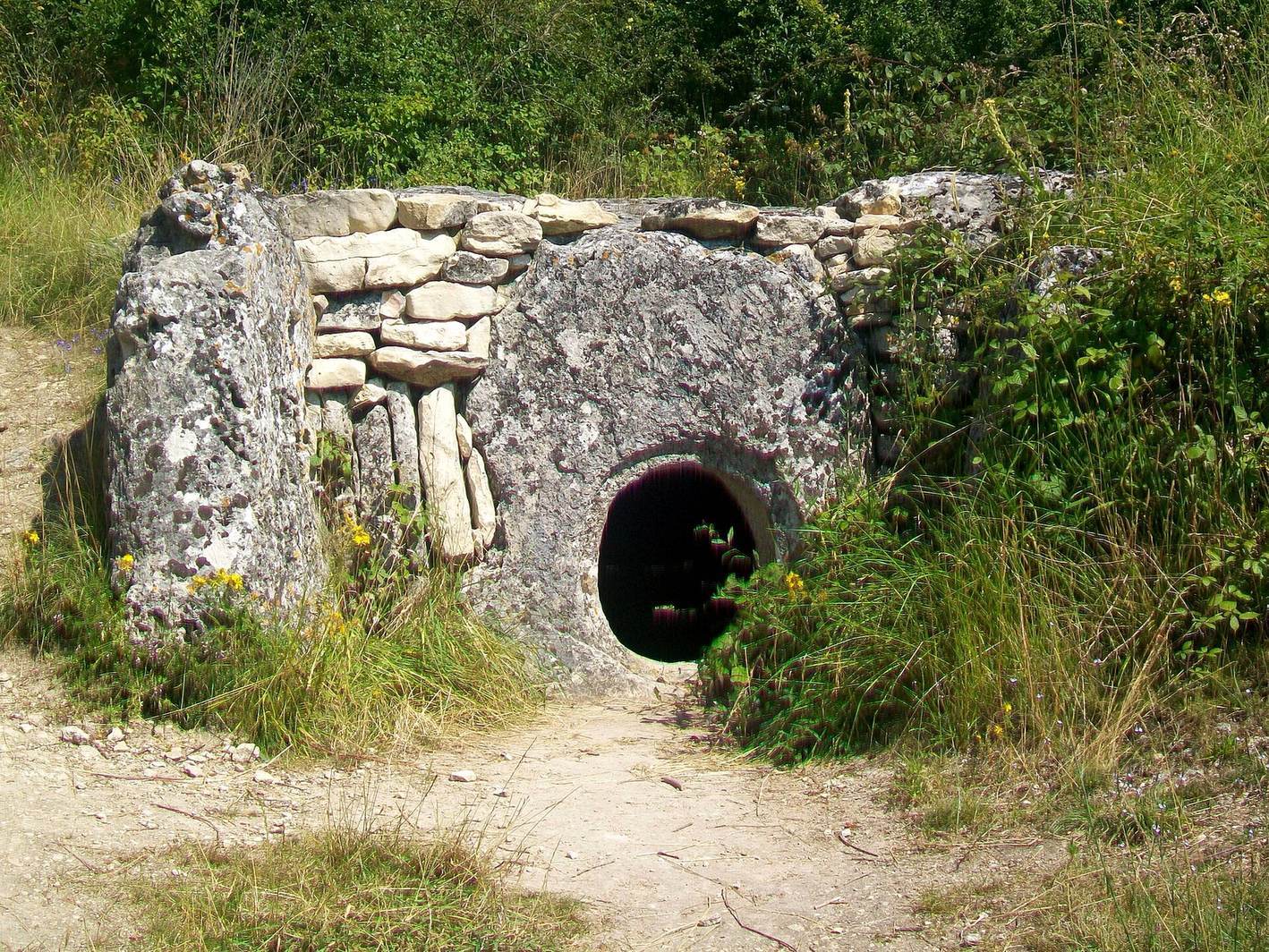
The entrance slab is 1.65 metres high, 1.38 metres wide and up to 0.20 metres thick. Low limestone-slab walls extend from it to the chamber’s side slabs. A nearly circular opening, 0.55 to 0.65 metres across, passes through the entrance slab. A recessed ledge, 7 to 9 centimetres deep, receives the rim of a fitted stone stopper measuring 0.53 to 0.59 metres across. The 158-kilogram stopper has a ring intended to secure it with a wooden crossbar. The original is held at the Musée archéologique départemental du Val-d’Oise in Guiry-en-Vexin; the one at the tomb is a replica.
Carved slabs
The two slabs bordering the antechamber carry relief carvings described as a “goddess of the dead” motif. Each shows a pair of breasts about 5 centimetres across beneath a necklace. One breast was damaged during excavation, and the necklaces are incomplete, with their upper ends continuing beyond the slab edges. Two concentric curves appear on the west slab and one on the east.
Archaeological finds and burials
Chamber finds
The chamber yielded 58 flint artefacts, including three transverse arrowheads, projectile points with cutting edges set crosswise to their length. Finds also include an axe fragment, a hammerstone, four scrapers and two sidescrapers, as well as sandstone and bone tools. The pottery included a large handle and 39 sherds tempered with shell grit, crushed shell mixed into the clay.
Antechamber deposits
An upper layer covered the entrance stopper after the side slabs had subsided. Beneath it lay a Neolithic fill about 0.50 metres thick, above three complete skeletons, a square hearth measuring 0.35 metres on each side, and a large skull identified as that of an elderly man. Scattered bones were attributed to about 20 people: one elderly woman, five adults including three women, and 14 young adults. Finds from the antechamber include a stone hammer and sherds of poorly fired pottery, one bearing traces of geometric decoration.
Human remains and study
Human bones and skulls recovered from the tomb were studied at the anthropology laboratory of the École des hautes études, a French higher-education and research institution. The average height calculated for the men was 1.62 metres, and for the women, 1.54 metres.