All Saints, Pavement: York’s Guild and Civic Church
Site at a Glance
- Rating
- 4.8
- Popularity
- Medium
- Country
- United Kingdom
- Primary era
- Medieval
- Eras represented
- Medieval, Early Modern, Modern
- Civilizations
- British, English
- Site type
- Religious
- Remains
- Church
On this page16 sections
History
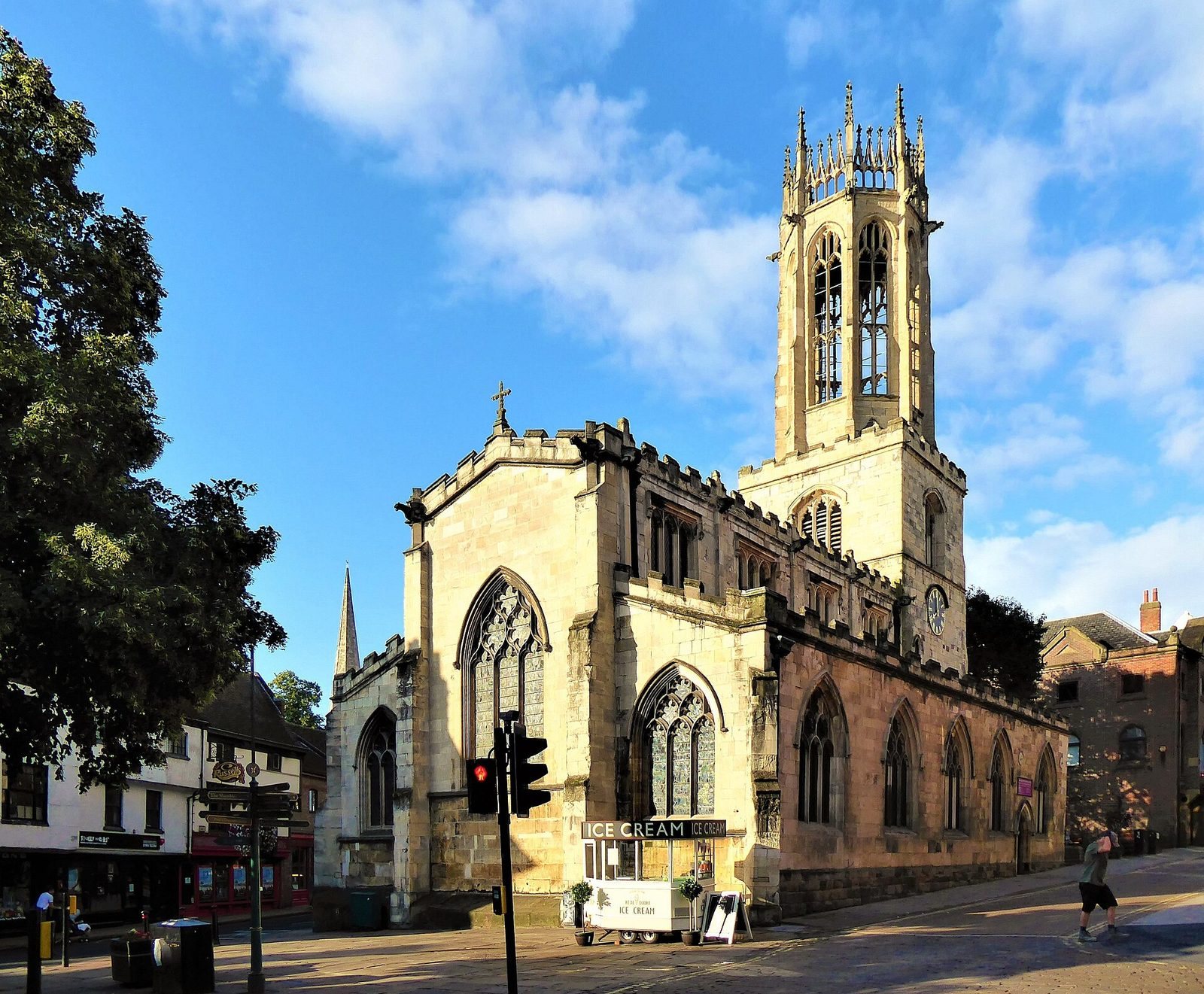
All Saints, Pavement is a Church of England church in York, England, developed from an early church on the site and largely shaped in its present form during the fourteenth and fifteenth centuries. It serves as York’s guild and civic church and as the regimental church of the Royal Dragoon Guards.
Early church and medieval development
A church stood here before the Norman Conquest, the Norman takeover of England in 1066. Tradition links its foundation to St Cuthbert of Lindisfarne and places it in 685, though that date is unsubstantiated. Archaeological evidence points to an early church aligned with York’s street grid during the Anglo-Scandinavian period, when Scandinavian influence shaped the city and its settlement.
The first church was probably demolished in the eleventh century and replaced by another on the site of the present building. The Domesday Book, William I’s 1086 survey of landholding and resources, lists a church here as the property of the Bishop of Durham, who had received it as a royal gift. It is uncertain whether the entry refers to the earlier church or its replacement.
The church was enlarged during the medieval period, and much of the present building dates from the fourteenth and fifteenth centuries.
Rebuilding and later changes
In the 1780s, the eastern chancel was demolished to make more room for Pavement marketplace. The north wall and west end were rebuilt in 1834. Three years later, architect George Edmund Street designed a new eastern end, and the tower lantern was rebuilt. A vestry was added between 1850 and 1855.
A restoration in 1887 included cleaning the stonework and repairing the pinnacles. Stained glass by Charles Eamer Kempe was installed in the central east window. The church was enlarged again in 1912.
Parish and civic role
In 1954, after St Saviour’s was declared redundant, All Saints was united with its parish. The church’s formal parish name is All Saints, Pavement with St Crux and St Michael Spurriergate, York. It belongs to the Church of England’s Diocese of York, with York archdeaconry and deanery as further administrative divisions. Its tradition is described as low church, which generally places less emphasis on elaborate ritual, and services follow the Book of Common Prayer.
All Saints is York’s guild and civic church and the regimental church of the Royal Dragoon Guards, a British Army cavalry regiment. The city’s two surviving merchant guilds, associations of traders, hold annual services there, and the City Council has a designated pew. Burial places associated with the church commemorate 34 York mayors. The building is Grade I listed, a high level of protection for historic buildings in England.
Remains
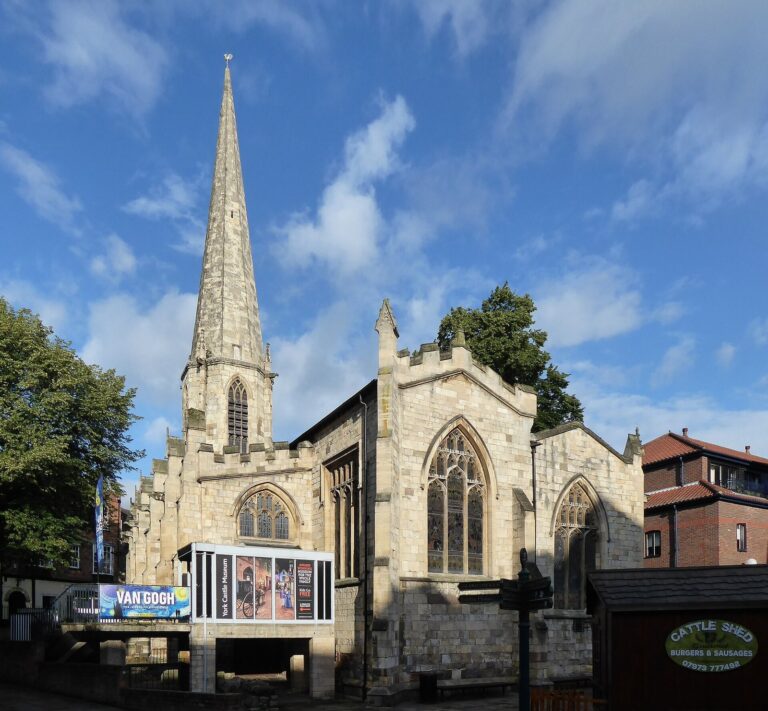
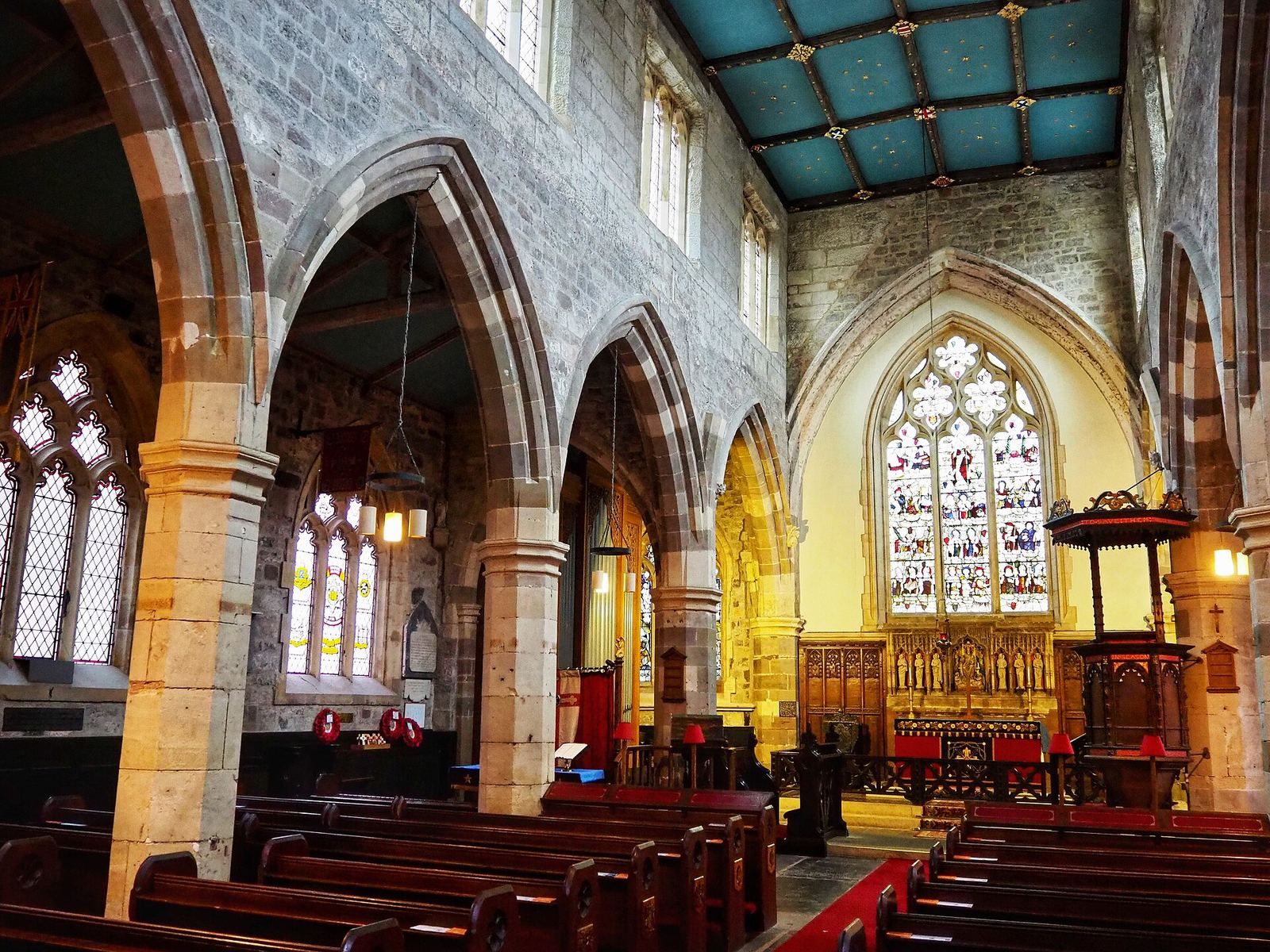
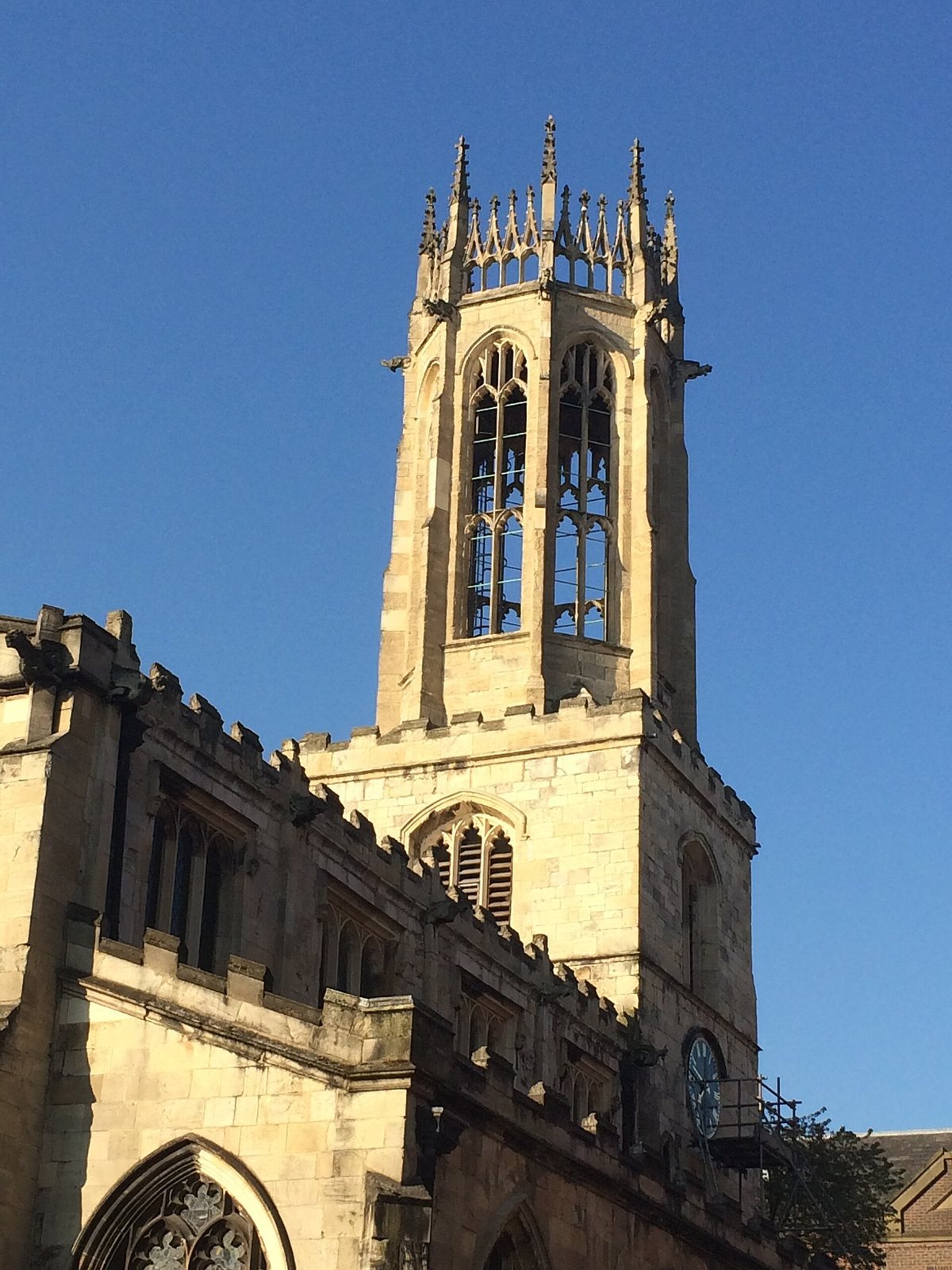
The church’s surviving form includes north and south side aisles, a square tower topped by an octagonal lantern, and an eastern end that occupies the original crossing, where the nave and transepts meet. Medieval fabric remains alongside later rebuilding.
Building fabric
Side aisles and tower
The north and south side aisles are part of the church’s medieval plan. The square tower dates to about 1400 and is in the Perpendicular style, an English Gothic style marked by strong vertical lines and window tracery. Its octagonal lantern crowns the tower. An upper clerestory, a windowed section rising above adjoining roofs, was added around 1443, probably with the battlemented parapet, a low wall with alternating raised sections and gaps.
A light once burned in the lantern at night to guide travellers. An 1848 description noted a hook and pulley inside it. Lenses that amplified the light were still present in the early twentieth century, although they no longer worked. The lantern’s design later served as a model for the lantern of St Dunstan-in-the-West in London, designed by John Shaw in 1831; that feature did not contain a beacon.
Eastern end
The present eastern end stands within the former crossing. Above the east window, a surviving fragment of a medieval round arch marks part of the demolished eastern section of the church.
Windows
West window
The west front contains a distinctive fourteenth-century Passion window made with coloured York glass. Its scenes depict episodes from Christ’s life. Medieval glass is also incorporated into the west window.
Kempe’s windows
Four nineteenth-century windows were designed by Charles Eamer Kempe. The central east window depicts Christ within a mandorla, an almond-shaped frame, surrounded by figures from the Old and New Testaments, Church Fathers, and saints. A south transept window dated 1896 commemorates antiquary and historian James Raine, showing St Aidan of Lindisfarne, St Paulinus of York, and St Cuthbert of Lindisfarne. The eastern window in the south transept depicts the Virgin and Child with Hannah and Samuel on one side and St Elizabeth on the other. Its counterpart in the north transept shows the Virgin and Child among angels and saints.
Regimental glazing
The Royal Dragoon Guards donated a window in 2002, and the regiment’s arms appear in a church window.
Interior and furnishings
Pulpit and parish furnishings
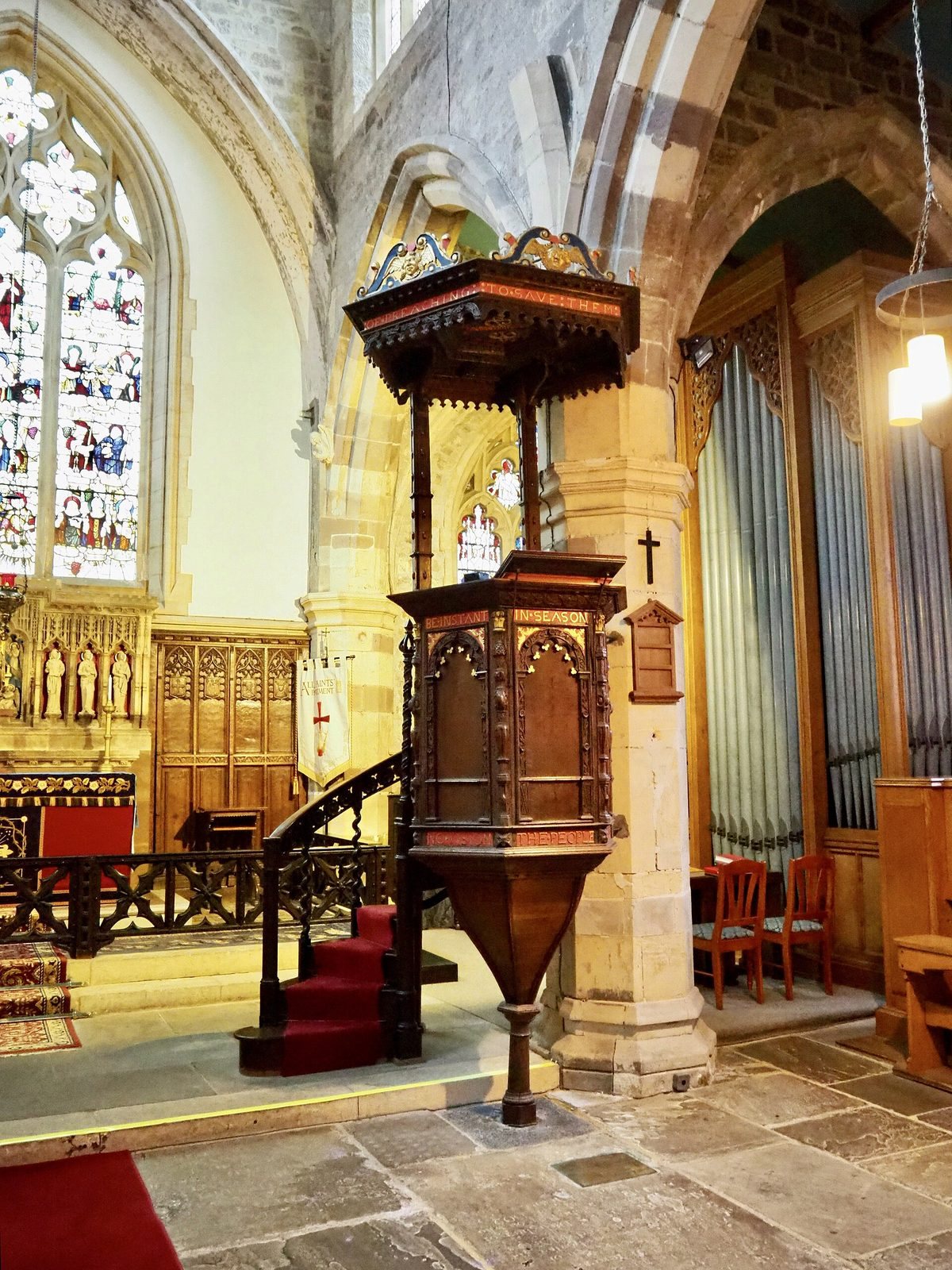
A hexagonal pulpit dated 1634 has a spiral staircase. The church also contains furnishings from St Saviour’s and St Crux, brought here after those congregations joined All Saints. A vestry forms part of the building.
Organ
Hopkins of York built the organ in 1903, and Wood, Wordsworth & Co of Leeds rebuilt it in 1964. It has 54 stops, which control ranks of pipes, three manuals or hand-played keyboards, and a pedal division played with the feet. Its action, the mechanism that operates the pipes, is electric.
Memorials and relic
Memorials commemorate Sergeant Major John Polety (died 1829), Charles Polety (died 1838), Tate Wilkinson (died 1803), Jane Wilkinson (died 1826), Sir Robert Crathorn (died 1482), Robert Askwith (died 1579), Roger de Moreton (died 1382), Isabella de Moreton (died 1412), Ursula Wyvill (died 1790), surgeon Robert Bishopricke (died 1814), and Henry Richards (died 1783). Askwith’s memorial came from St Crux, while Isabella de Moreton’s came from St Saviour’s. In 1386, a bowl at All Saints was revered as a Christian relic, an object associated with a saint or sacred event, believed to have held the severed head of John the Baptist.