Alcazaba of Bujalance: A Tenth-Century Fortress in Spain


Site at a Glance
- Rating
- 4.5
- Popularity
- Low
- Country
- Spain
- Primary era
- Medieval
- Eras represented
- Medieval
- Civilizations
- Umayyad
- Site type
- Military
- Remains
- Citadel
On this page6 sections
History
Foundation under the Caliphate
The Alcazaba of Bujalance, also known as the Castle of Bujalance, is a former military fortress in Bujalance, Córdoba, Spain, built around 935 during the Caliphate of Abd al-Rahman III in al-Andalus, the Muslim-ruled region of the Iberian Peninsula. Abd al-Rahman III proclaimed the Caliphate of Córdoba in 929, and his reign brought extensive state-building and military construction. The fortress was originally called Bury al-Hans, meaning “Tower of the Snake.”
The stronghold originally had seven towers. This configuration, together with the fortress’s earlier name, influenced the present name of Bujalance and the town’s coat of arms. The site later underwent several alterations and modernizations. The latest stated modernization took place in 1512, when Queen Joanna of Castile ordered that the expenses be paid.
Protection and archaeological study
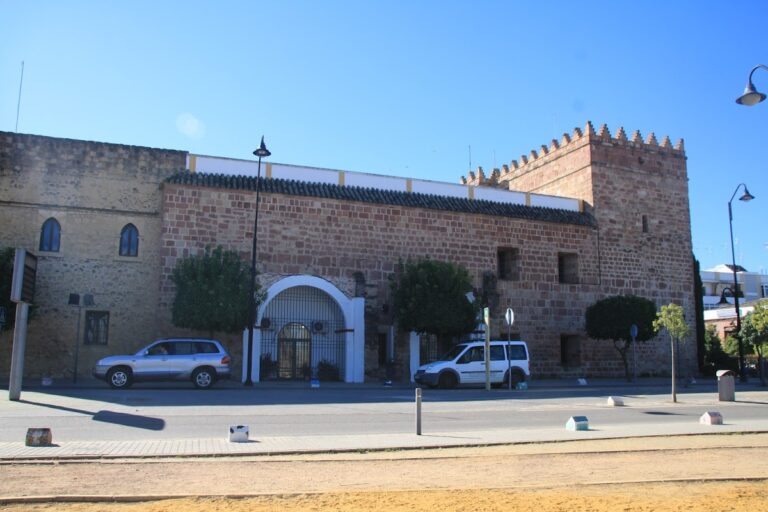
In 1963, the Ministry of Culture declared the fortress a Historic-Artistic Monument. It became a Property of Cultural Interest in 1985 and is owned by the Municipality of Bujalance. A center of interpretation was completed in February 2015 through the restoration and adaptation of an eighteenth-century manor house. Restoration of the north and east walls followed in 2021.
The fortress also contains evidence of the Roman road network that preceded its medieval history. In 2013, the Bursabolense Association of Archaeology, Art and History commissioned Ángel Ventura of the University of Córdoba to identify a Roman milestone incorporated into the structure. After authorization from the Andalusian Government, the stone was removed in September 2022 for further study by Ventura and the archaeologist María José Pérez Bermón.
Remains
Fortress layout
The Alcazaba is a rectangular fortress measuring 59 metres from north to south and 51 metres from east to west. Its surviving plan reflects the organization of a military stronghold, with a parade ground within the fortified enclosure. The north and east walls were restored in 2021, while an eighteenth-century manor house within the complex was adapted as the center of interpretation completed in 2015.
Towers and Roman milestone
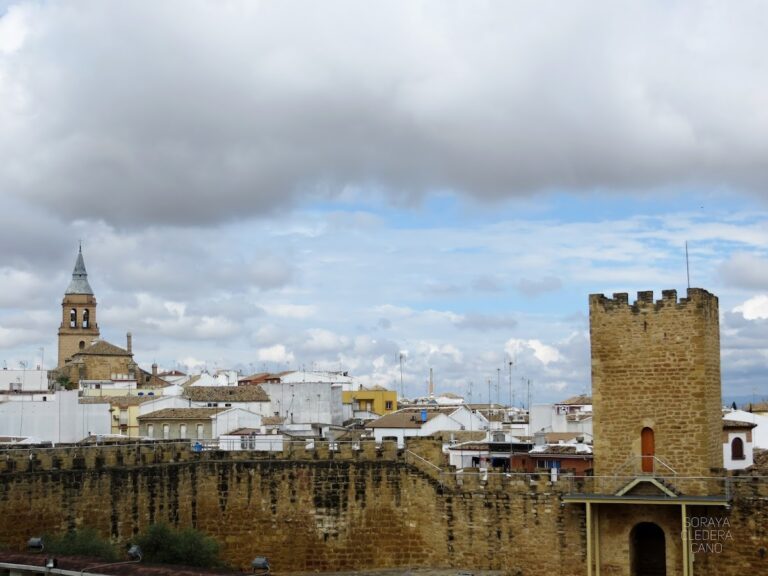
The fortress originally possessed seven towers, with three still standing: the Dungeon Tower, the Malvavisco Tower, and the Pigeons Tower. A Roman milestone, a stone marker used to record distances and commemorate road construction or repair, was incorporated into the fortress from its early history. It was reused as the hinge socket of a door and probably came from a Roman bridge that has since disappeared.
The milestone commemorates the restoration of the Via Augusta during the reign of the Roman emperor Claudius, who ruled from AD 41 to 54. The Via Augusta was a major road through Hispania linking the Iberian southeast with the area of Cádiz. Its inscription refers to the boundary between the Roman provinces of Baetica and Tarraconensis and to the Ocean at Cádiz, where the road ended. The stone was removed from the fortress in September 2022 for archaeological study.