Alcántara Bridge: A Roman Road Bridge over the Tagus in Spain


Site at a Glance
- Rating
- 4.8
- Popularity
- Medium
- Country
- Spain
- Primary era
- Classical
- External website
- Open
- Eras represented
- Classical, Early Modern, Modern
- Civilizations
- Crown of Castile, Order of Alcántara, Roman, Spanish
- Site type
- Infrastructure
- Remains
- Bridge
On this page10 sections
History
Alcántara Bridge is a Roman road bridge in Spain, built in the province of Lusitania around AD 103–104 during the reign of Emperor Trajan. It crosses the Tagus near Alcántara in Extremadura, close to the Portuguese border, and formed part of the Norba road, a route connecting territory north of the river with southern lands and roads leading toward Lusitania, Beira Alta, Cantabria, and Gallaecia. Its inscription and monumental form made it both a regional crossing and a lasting work of Roman civil engineering.
Roman construction and purpose
The bridge was built in a region valued for its metal deposits and was financed by twelve nearby municipalities rather than directly by the Roman state. Their names were preserved in an inscription. This arrangement reflected the Roman opus pontis, the financial and administrative responsibility for bridge construction and repair, which could be shared by neighboring municipalities for the benefit of a wider region.
Construction is conventionally dated to AD 103–104 from the imperial titles in the dedication, while completion is placed around AD 105–106. A competing interpretation proposes that an earlier bridge was begun under Augustus and that the present structure was extensively modified around 1480. Archaeological investigations have identified possible earlier arches, a vault, foundation platforms, and reused materials, but the principal fabric is understood as Roman and associated with the second century. The traditional attribution to Caius Julius Lacer, identified as the bridge’s designer and the builder of its temple, rests chiefly on the temple inscription. His role, and even the historical basis of the identification, remain debated.
The crossing joined communities north and south of the Tagus. The site was selected where two bends narrow the river and reduce the force of the current, although floods once reached considerable heights. The bridge therefore required an unusually tall structure. Its scale also gave the crossing a commemorative purpose, expressed through its dedication to Trajan and references to the municipalities that paid for the work.
Medieval settlement and conflict
During the twelfth century, Muslims established a settlement beside the bridge called Al-Qanṭarat, meaning “The Bridge.” The structure apparently remained intact until the thirteenth century, when it suffered its first of several destructions during the Christian Reconquista, the campaigns through which Christian kingdoms conquered Muslim-held territories in Iberia. After Alfonso IX of León captured Alcántara in 1213, responsibility for the damage remained uncertain.
Alcántara later became contested during wars between Castile and Portugal. In 1475, while the town was under siege, Alfonso V of Portugal withdrew rather than permit the bridge to be destroyed. He reportedly stated that he did not want Castile to possess the structure in a diminished condition. The Order of Alcántara, a medieval military-religious order of the Iberian Peninsula, established itself at Alcántara in 1480.
Under Juan de Zúñiga y Pimentel, the bridge underwent a major reform intended to celebrate Spain’s Roman heritage and the dynastic monarchy of Castile and Aragon. The central arch and commemorative plaques are generally associated with this intervention, although the plaque referring to Trajan may have been transferred from nearby Alcántara.
Repairs under the Spanish monarchy
During the reign of Charles V, Martín López carried out documented repairs between 1532 and 1543 under the supervision of Pedro de Ibarra and Esteban de Lezcano. The work repaired damage to the first western arch, added battlements to the central arch, and removed military structures connected with the bridge’s medieval strategic function. A further sixteenth-century intervention was assigned to Diego de Castañeda and completed by Pedro de Villegas and Sebastián de Aguirre in 1577.
Portuguese forces attempted unsuccessfully to blow up the second arch from the right bank during the War of the Spanish Succession, a European conflict over the Spanish throne, in 1707. The explosion damaged the arch facings and parapets, affected its masonry core, and cracked the honorary arch. Charles III ordered restoration in 1778.
During the Peninsular War, allied forces destroyed the same second arch in 1809 to prevent Napoleon’s troops from crossing. A wooden replacement restored carriage traffic in 1818, but Isabelline troops burned it in 1836 during the First Carlist War, when they sought to obstruct the forces of the Carlist commander Miguel Gómez Damas.
Between 1858 and 1860, under Queen Isabella II, Alejandro Millán Sociats and the Roads Engineers reconstructed the destroyed arch. The project followed a proposal by the Royal Academy of History and included masonry consolidation, restoration of the honorary arch after it had been removed because of fears that the central pier might collapse, repaving of the roadway, and construction of approach roads at both ends. An inscription and royal shield commemorated the work, while earlier imperial and municipal commemorations were moved inside the arch.
Modern protection and conservation
In 1924, the bridge, its triumphal arch, and the ancient temple were declared a National Monument of Spain and designated a cultural heritage monument. In 1969, construction of the Alcántara reservoir and dam about 600 metres upstream required the Tagus to be diverted through tunnels. The exposed riverbed revealed that one pier was being undermined, and it was repaired. The dam, built in the mid-twentieth century, subsequently reduced the former flood conditions at the bridge.
Alcántara Bridge has been praised by chroniclers, travellers, and scholars from the medieval period onward. Its inscription and architecture have made it an important example of Roman engineering used for both imperial and regional commemoration, and its design influenced later works including the smaller Segura Bridge. Since 1998, its inclusion on the UNESCO World Heritage List has been proposed. In 2019, the Parliament of Extremadura renewed efforts to place it on Spain’s national tentative list.
Remains
The surviving monument is a stone arch bridge about 194 metres long, 8.6 metres wide, and 58.2 metres high. Six semicircular arches of unequal height rest on five piers founded at different levels, while the roadway runs roughly 45 to 50 metres above the normal river. The piers are widely spaced, leaving only two within the active river channel. This arrangement, together with the bridge’s tall profile and regular roadway, reconciles the irregular ground with a strong horizontal line.
Bridge structure
The outer arches span about 13.8 metres, the adjoining arches about 21.4 metres, and the two central arches about 28.8 and 27.4 metres. These central spans rank among the largest known in a surviving ancient Roman bridge. The piers are solid rectangular masses faced with large rusticated ashlar blocks, a Roman method known as opus quadratum, in which regularly cut stones are laid in courses. The blocks measure approximately 60 by 120 centimetres and were arranged in alternating longitudinal and transverse courses.
The lower parts of the central piers are marked by a projecting horizontal course. Three central piers have triangular cutwaters, pointed projections that divide and deflect the upstream current. The two outer piers are rectangular and carry buttresses on both sides. These buttresses rise through the full height of the spandrels, the wall areas between the arches and roadway, strengthening the bridge’s pronounced vertical form. The two river piers rest directly on slate formations, with foundation platforms cut into the riverbed rock.
Roman builders assembled the ashlar masonry without mortar, using metal clamps in some areas, especially near the lower parts of the piers. The arch destroyed in the nineteenth century was reconstructed with mortared masonry. Repeated warfare and rebuilding altered parts of the structure, yet the Roman arches and much of the original engineering conception remain legible. The central piers and arches have withstood river erosion more successfully than the damage caused by warfare and traffic.
Honorary arch and inscriptions
An honorary arch about 14 metres high rises above the central pier and forms the bridge’s principal compositional axis. Its dedication to Trajan is repeated on both sides and identifies him as the son of Nerva while listing his imperial offices. These titles provide the basis for dating the bridge to AD 103–104. The wording is known through manuscripts that copied the inscription centuries ago. The dedication originally stood on the front of one jamb, and as many as three further inscriptions may once have supplemented the list of contributing municipalities or repeated the known text.
The arch also carries references to the municipalities that financed the crossing. Its commemorative fabric incorporates elements from several restoration phases, including the imperial shield added under Charles V and later plaques associated with Isabella II. Battlements on the central arch and the shield on the southern front belong to the sixteenth-century restoration. The roadway was later straightened and repaved, with approach roads constructed at both ends; earlier, it rose toward the centre.
Roman temple
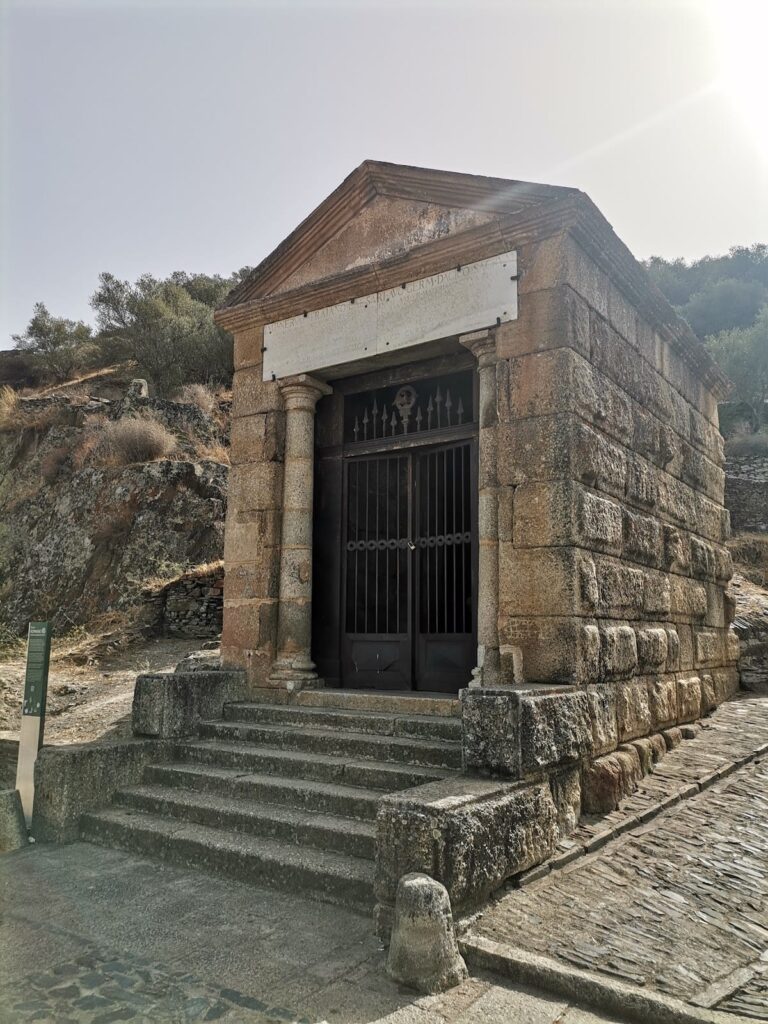
At the Alcántara entrance stands a small Roman temple built entirely of stone and covered by a two-sloped roof. Its facade has two plain Tuscan columns, a Roman column type with a simple shaft and capital. Interior remains indicate a division between the naos or cella, the principal inner chamber, and the pronaos, the porch in front of it. The temple stands at the southeastern side of the bridge and forms part of the monument’s entrance group.
The inscription above the entrance was substantially reworked in the seventeenth and nineteenth centuries over the original Roman text, including a nineteenth-century marble replacement according to one description. It dedicates the temple to Trajan and contains an epigram referring to the emperor, the Romulean gods, the bridge, and Lacer’s claim to have created a work intended to endure through the ages. The inscription ends with the name Caius Julius Lacer, and the temple is also described as containing his tomb. This text is the principal physical link between Lacer, the bridge, and the temple.
Medieval and later defensive remains
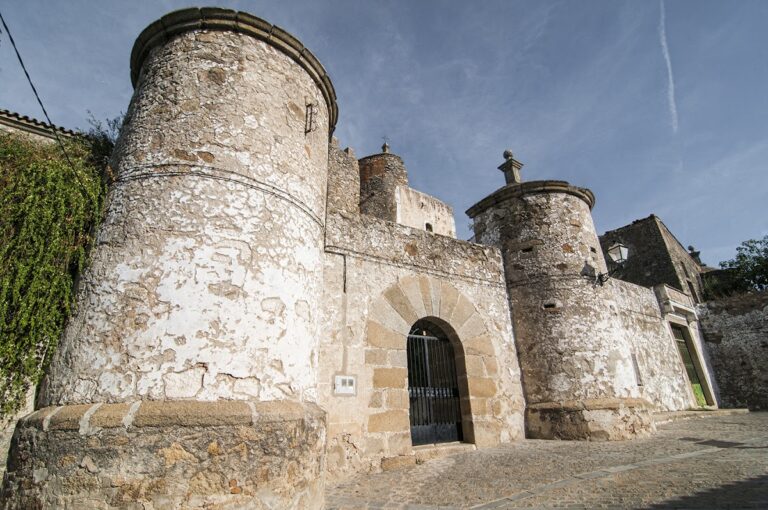
A surviving section of the medieval military installations is the Torre de Oro, or “Golden Tower.” It is associated with defensive works added on the Portugal-facing side during the reign of Charles V. The tower preserves part of the bridge’s later strategic setting, while the roadway, commemorative plaques, repaired arches, and rebuilt masonry show how the Roman crossing continued to be adapted after successive conflicts.