Čakovec Castle: A Medieval Water Fortress and Noble Palace in Croatia


Site at a Glance
- Rating
- 4.8
- Popularity
- Medium
- Country
- Croatia
- Primary era
- Early Modern
- External website
- Open
- Eras represented
- Medieval, Early Modern
- Civilizations
- Habsburg, Hungarian
- Site type
- Military
- Remains
- Castle
On this page14 sections
History
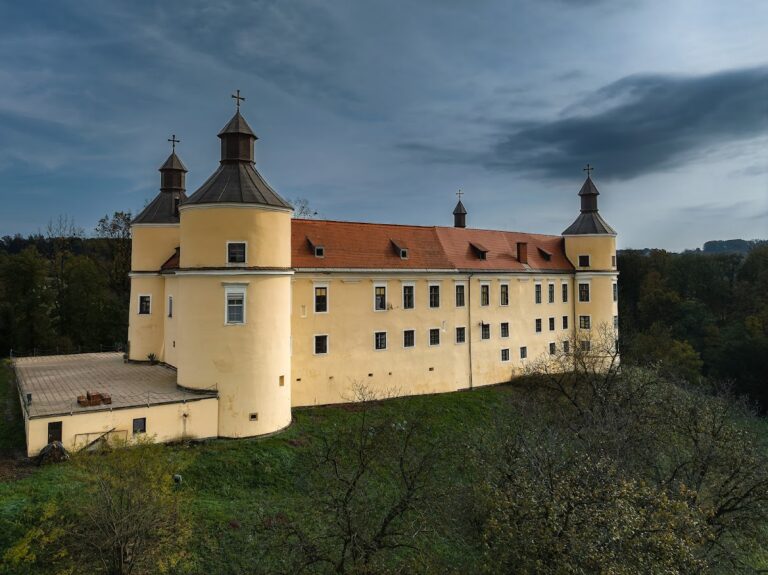
Čakovec Castle is a historic fortress and palace complex in Čakovec, Croatia, first mentioned in the thirteenth century and shaped successively as a medieval lowland fortress, a Renaissance noble residence, and a Baroque palace. Also known as Stari grad Zrinski, it became the principal seat of the Zrinski family and the residence of the Croatian ban during the family’s political and military prominence.
Medieval fortress and changing ownership
The earliest castle was a simple wooden tower or fortified residential tower attributed to the Hungarian count Dimitrije Čak, whose name gave Čakovec its name. The early complex was also associated with the Buzad-Hahold family. From 1270 it was held by Austria, before King Charles Robert recovered it in 1328. A royal document dated 27 June 1333 calls it a fortified settlement, or castrum, a term for a castle or fortified settlement.
Čakovec Castle and the surrounding Međimurje estate passed through the hands of several noble families and rulers. The Güssing family held it from the thirteenth century into the first half of the fourteenth century. Stephen I Lacković received Međimurje from King Louis I, beginning Lacković control from 1350 to 1397. The Kaniški family followed from 1397 to 1405, the Counts of Celje from 1405 to 1461, and King Matthias from 1461 to 1464. Friedrich Lamberg held it from 1464 to 1473, the Ernušt family from 1473 to 1540, and Petar Keglević from 1540 to 1546. After 1437, John Vitovec also possessed the castle with other former Celje estates, until his heirs lost them.
The Zrinski residence
In 1546, Croatian ban Nikola Šubić Zrinski acquired Međimurje and transformed the medieval castrum into a fortified Renaissance residence. The new defense system used walls, brick bastions, and water-filled moats. A document issued to the Pauline monks in 1559 records the obligation of local serfs to take part in the construction work. The Zrinski family retained the complex until 1691, and during the sixteenth and seventeenth centuries it served as their principal seat. Conferences of the Croatian ban were held there periodically.
The castle was especially associated with Nikola Zrinski of Čakovec, a seventeenth-century descendant of the earlier commander Nikola Šubić Zrinski. Born in 1620, he was a poet, statesman, and military leader. Foreign scholars, diplomats, and travellers visited the residence, including Evliya Çelebi in 1660 and Jakob Tollius in 1661. The family library, known as the Bibliotheca Zriniana, was kept there.
Nikola Zrinski wrote The Siege of Sziget at Čakovec Castle. He died there on 18 November 1664 from wounds received during a boar hunt, in circumstances that remain unclear. From the castle he also organized a movement directed against the Habsburgs and the Ottoman Empire. The Croatian ban was a senior governor and military officeholder responsible for administering and defending Croatia within the Hungarian Crown.
Confiscation and the end of the Zrinski line
In 1671, Nikola’s brother Petar Zrinski continued the movement of magnates dissatisfied with the Peace of Vasvár, the agreement that ended a war between the Habsburgs and the Ottoman Empire. Petar travelled to Vienna to defend himself. During his absence, the imperial general Spankau sacked the town and imprisoned Petar’s family. The imperial court confiscated the Zrinski property. Nikola’s widow was expelled, their son Adam Zrinski was placed under strict supervision in Prague by order of Emperor Leopold I, and John Zrinski died in prison after becoming mentally ill.
Adam later died fighting the Ottomans at Zalankemen on 19 August 1691, aged twenty-nine. His death brought the Zrinski family to an end. The complex passed briefly to the Royal Hungarian Chamber from 1691 to 1695, Hercule Joseph Louis Turinetti de Prié from 1695 to 1702, King Charles VI from 1702 to 1715, and Count Ivan Čikulin from 1715 to 1719.
Baroque reconstruction and later uses
The Althan family held Čakovec Castle from 1719 to 1791. After an earthquake on 30 April 1738, the family began building a Baroque palace on the old foundations. The reconstruction, carried out around 1743, created the basic Baroque form that survives today. The Viennese court architect Anton Erhard Martinelli designed this rebuilding, adding a second storey to the earlier single-storey palace.
The Althans sold their Međimurje estate in 1791 for 1.6 million forints to the Festetics family, who retained the castle until 1923. The Festetics were a Croatian-origin noble family that had become Magyarized. In the nineteenth century they used the complex partly for economic purposes and established a sugar-production plant there. During the 1848 revolution, Ferenc Hív-vári Meszéna reinforced the castle on behalf of General Mór Perczel.
After the Festetics withdrew in 1923, the castle passed to the Zagreb timber-trading company Slavonija d.d. From 1933 it belonged to the Čakovec Association of Craftsmen. Hungarian occupying authorities used the complex during the Second World War. Between 1946 and 1954 it housed an economic school and student dormitory. The newly established Međimurje Museum took over the castle in 1954 and continues to use it as its headquarters.
Čakovec Castle is partially restored and has undergone periodic renovation in recent decades. Formerly classified as a “zero-category” cultural monument, it has been designated a cultural asset of national significance since 19 November 2007, under designation N-23, and classified as secular architectural heritage. The castle is regarded as a symbol of Međimurje’s identity and tradition, while the museum presents archaeological, ethnographic, cultural-historical, and historical collections in the complex.
Remains
Fortifications and water defenses
Pentagonal walls and bastions
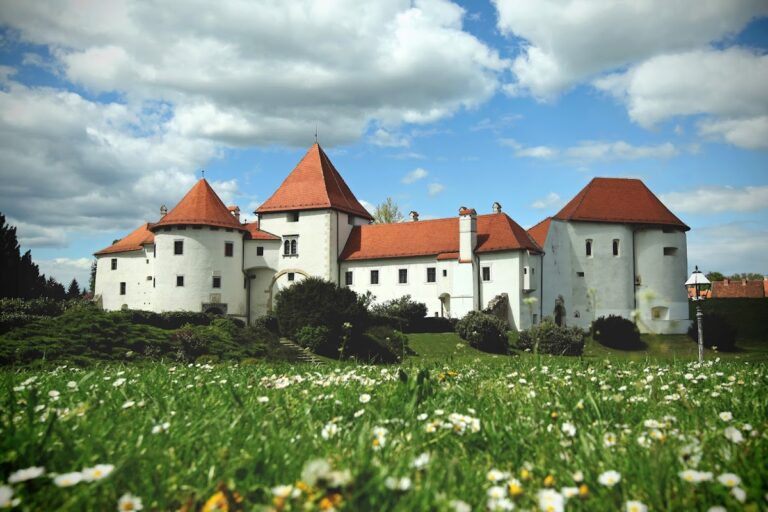
Čakovec Castle is organized as a medieval lowland water fortress with a central palace. Its outer walls and bastions form a pentagonal plan, most of whose present shape developed during the sixteenth and seventeenth centuries. The defenses are built from brick, dressed stone, and other masonry, with monumental walls reaching a thickness measured in metres in some places. The bastions are made of brick rather than earth, a construction feature described as unique in Croatia.
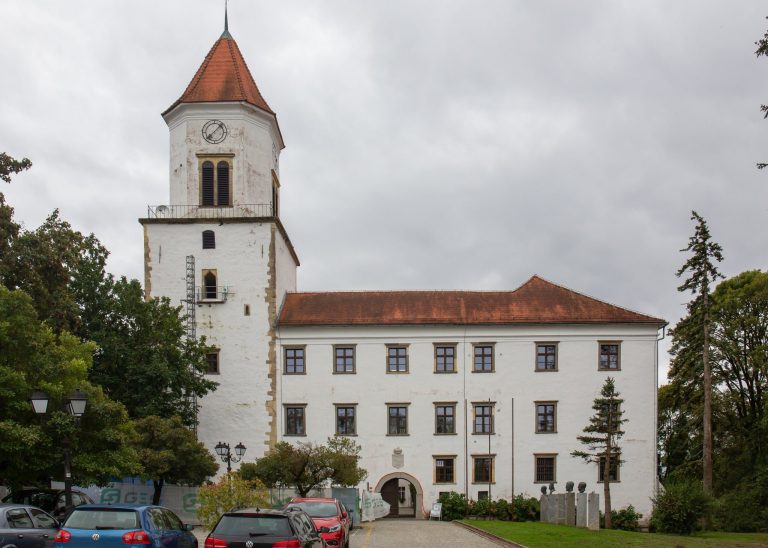
The outer walls enclose an external courtyard between the fortifications and the central palace. An entrance fortification includes the main outer gate tower, while a gun opening survives in the northwestern tower. A tower damaged in the earthquake of 1738 was moved from the palace to the principal external entrance tower during the Baroque reconstruction, where it remains.
Moats and bridges
Wide water-filled moats surrounded the castle walls for centuries. Their water came from the Trnava, a small Međimurje watercourse whose source lay several kilometres away in the hilly part of the region. The Trnava was later diverted so that it would no longer flow through central Čakovec.
After the Ottoman threat had ended, the moats gradually dried out. A lake on the northern side survived into the 1970s and was later drained. The former approach from the north crossed a long wooden bridge leading to the main entrance tower. A short stone bridge now occupies that position.
Central palace
Novi dvor
The inner palace, also called Novi dvor or New Palace, has a quadrangular plan. It was probably erected under the Ernušt family in the fifteenth or sixteenth century, rebuilt during the Zrinski period, and given its present form around 1743 under the Althans. The Renaissance residence was then converted into a monumental Baroque palace, and Martinelli added a second storey to the earlier single-storey building.
Novi dvor contains a paved inner courtyard, or atrium. Its principal elevated entrance is decorated with a series of arcades, while several secondary entrances open at ground level. The palace now houses the Međimurje Museum, including archaeological, ethnographic, historical, and cultural-historical collections, as well as an art-gallery exhibition space.
Park and commemorative features
Zrinski Park
The castle is surrounded by the maintained Zrinski Park, which contains varied trees, shrubs, flowerbeds, statues, busts, and memorials. The park and the castle form a landscaped architectural ensemble. Together with the palace, towers, entrance bastion, bell tower, defensive walls, and inner courtyard, the park forms part of the surviving complex.
Memorials
A monument to the Zrinski and Frankopan families stands in the castle courtyard. Memorial plaques commemorate Nikola Šubić Zrinski of Sziget and the three-hundredth anniversary of the executions of Petar Zrinski and Fran Krsto Frankopan. The latter plaque was installed on the entrance tower in 1971.