Ajmer Sharif Dargah: A Sufi Shrine and Mosque Complex in Ajmer
Site at a Glance
- Rating
- 4.6
- Popularity
- Low
- Country
- India
- Primary era
- Early Modern
- Eras represented
- Early Modern, Modern
- Civilizations
- British, Mughal
- Site type
- Religious
- Remains
- Tomb
On this page15 sections
History
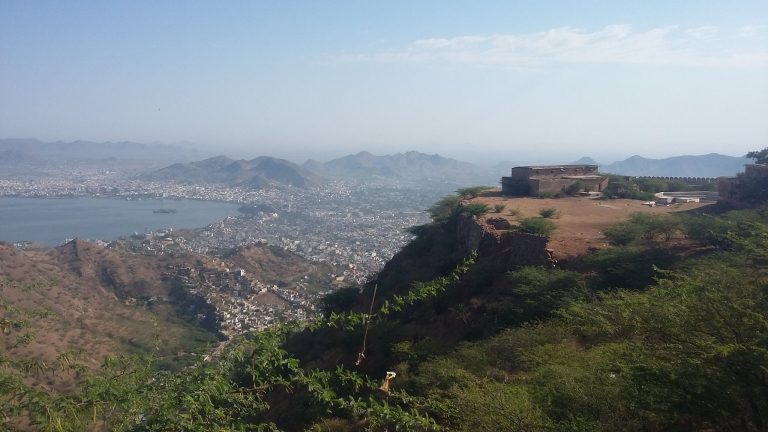
Ajmer Sharif Dargah is a Sunni Muslim Sufi mausoleum and mosque complex at the foot of Taragarh Hill in Ajmer, Rajasthan, India. Associated with the Chishti order, a major Sufi tradition in South Asia, the shrine’s listed completion date is 1236, although many of its structures belong to later construction and renovation phases. It is dedicated to Mu’in al-Din Chishti, a 13th-century saint, philosopher, preacher, and teacher whose tomb became one of the most important pilgrimage destinations for Sunni Muslims in the Indian subcontinent.
Mu’in al-Din Chishti and the early shrine
Mu’in al-Din Chishti was born either in Sanjar, in present-day Iran, or in Sistan. He came to Delhi during the reign of Sultan Iltutmish and later moved to Ajmer, where he became known as a charismatic and compassionate spiritual leader. He died in March 1236. During the following century, his tomb became deeply revered by Sunni rulers and by people from different social classes and religious communities.
Sultan Iltutmish visited the tomb in 1232. Later visitors included Razia Sultana, Nasiruddin Mahmud, Muhammad bin Tughluq, Sher Shah Suri, and a succession of Mughal rulers and members of the imperial family. The shrine’s reputation therefore developed through both devotional attachment and sustained patronage.
Sultanate and Mughal patronage
Akbar visited the dargah at least fourteen times. In 1566, he made a pilgrimage with Mariam-uz-Zamani in the hope of having sons. He donated a large deeg, or cauldron for communal cooking, in 1568 after his victory at the Battle of Chittorgarh, and reconstructed the shrine’s sanctum in 1579.
Jahangir, Shah Jahan, and Jahanara Begum later renovated or enlarged parts of the complex. Shah Jahan commissioned the Jami Masjid in 1637, while Jahanara Begum donated the Begumi Dalaan, the railing around the shrine, and the Begumi Chabutra platform. Aurangzeb added the Sandali Masjid. Further contributions came from Kumar Rao Scindia, Maharani Baiza Bai Scindia, Ajit Singh of Jodhpur in 1709, and the Maharaja of Baroda, who commissioned a covering over the dargah in 1800.
Continuing religious life
The dargah has also been venerated by Hindus since the medieval period, and pilgrims from Hindu, Sikh, Christian, and other communities continue to attend. The annual Urs, the saint’s death anniversary understood as his spiritual reunion with Allah, is celebrated rather than mourned. The six-day festival begins at the end of Jumada al-Thani and concludes on 6 Rajab. Its opening is marked by raising a flag on the Buland Darwaza, followed by prayers, nightly qawwali performances, and the final Qul prayer.
Approximately 500,000 people attend the Urs. Pilgrims wash the silver Bihisti Darwaza with rose water and offer chaddars, devotional cloth coverings, and rose petals at the shrine. The rose petals can total as much as seven tonnes per day. Daily practice includes the five obligatory Muslim prayers, the evening Dua-e-Roshni ceremony, devotional qawwali, and recitation of the Karka before the shrine is locked for the night. Pilgrims perform wudu, the ritual washing before prayer, while the dargah’s langar, or communal kitchen, continues the preparation of food in large cauldrons.
The shrine’s hereditary caretakers are known as khadims. Its ritual duties are associated with hereditary khadim families, while the complex and its charitable activities are administered by the Dargah Committee. The dargah is owned by the Government of Rajasthan and described as an international waqf governed under the Dargah Khwaja Saheb Act of 1955. The hereditary spiritual office of sajjada nashin, the spiritual head of a Sufi shrine or lineage, is held by Diwan Syed Zainul Abedin, described as a 22nd-generation direct descendant of Mu’in al-Din Chishti.
Modern challenges and contested claims
On 11 October 2007, during Ramadan, a device concealed in a tiffin carrier exploded in the courtyard after evening prayers. Seven people were killed and seventeen injured. In 2017, Bhavesh Patel and Devendra Gupta were sentenced to life imprisonment by a National Investigation Agency special court, alongside the conviction of Sunil Joshi, under the Unlawful Activities Prevention Act, the Explosives Act, and the Indian Penal Code.
The dargah was also involved in a major criminal scandal in 1992 concerning sexual assault and blackmail by members of a hereditary khadim family associated with the shrine. The case concerned approximately 250 female students and led to newspaper reporting and police investigations.
In 2024, the Ajmer Civil Court issued notices to the Archaeological Survey of India and other authorities after a petition sought a survey based on a claim that the dargah had been built over a Shiva temple. The Dargah Committee rejected the claim as divisive and harmful to communal harmony. The temple tradition remains a contested assertion rather than an established architectural fact.
Remains
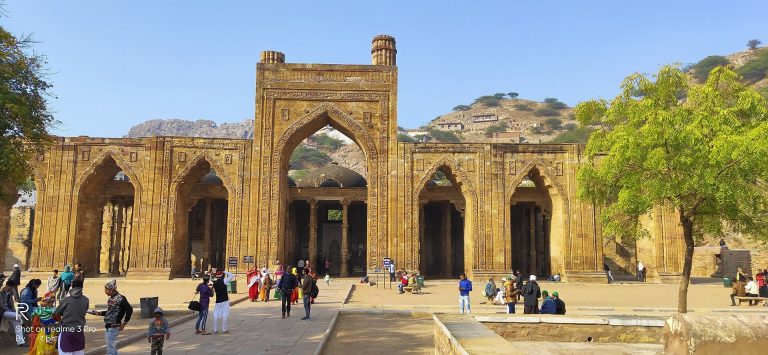
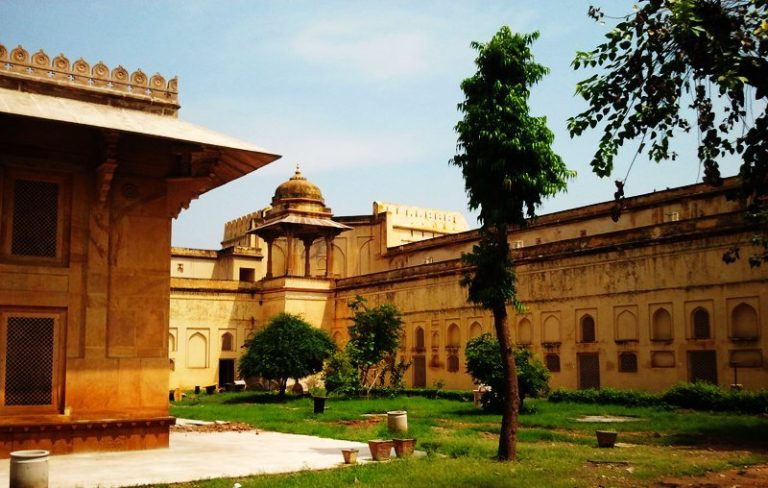
The complex is organized around the shrine of Mu’in al-Din Chishti, mosques, courtyards, tombs, gates, assembly spaces, water installations, and service buildings. Its Indo-Islamic architecture uses marble, brick, sandstone, silver, gold, and mother-of-pearl. The principal arrangement places the Jami Masjid west of the shrine, a large marble courtyard east of it, and the women’s enclosure south of it. The complex has a west-facing facade, one dome, and one minaret.
The central shrine and associated tombs
Sanctum and dome
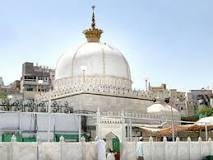
The white-marble dome over Chishti’s shrine dates to 1532, a date written in golden lettering on the northern wall of the dargah. It stands in the Ihaata Noorani, or Quarter of Light, and carries a lotus and a gold crown donated by Nawab Haider Ali Khan of Rampur. The sanctum has two doors. A mother-of-pearl-and-silver canopy commissioned by Jahangir can be seen from the cenotaph’s four silver posts. Gold etching covers the ceiling, and the walls were gilded in 1888.
Tombs and women’s enclosure
Eight tombs stand in addition to Chishti’s tomb. They include the tomb of his daughter Bibi Hafiza Jamal and the tomb of Nizam Sikka, a water-carrier credited with saving Humayun’s life. More than forty graves lie behind the Jami Masjid. Jahanara Begum’s Begumi Dalaan and Begumi Chabutra are associated with the shrine, while the southern Arhat-i-Noor enclosure is restricted to women and contains the tombs of Chishti’s daughter and granddaughter.
Mosques, courtyards, and assembly spaces
Jami Masjid and other mosques
The Jami Masjid, or Friday mosque, lies west of the dargah. Shah Jahan commissioned it in 1637, and its construction is in white marble. The Akbari Mosque is built of red sandstone and was probably commissioned by Akbar. Aurangzeb constructed the Sandali Masjid. A large marble courtyard lies east of the shrine.
Assembly halls and drum house
The Mehfil Khana is a square royal darbar structure constructed in 1888, with a patterned ceiling. The complex also contains a Mahfil Khana, used as an assembly hall for qawwali performances during the Urs. The Ahaat-e-Noor is a large courtyard used for religious functions and qawwali. Near the Nizam Gate, the Naqqar Khana, or drum house, formerly housed music played to welcome visitors.
Gates, water installations, and service buildings
Entrance gates
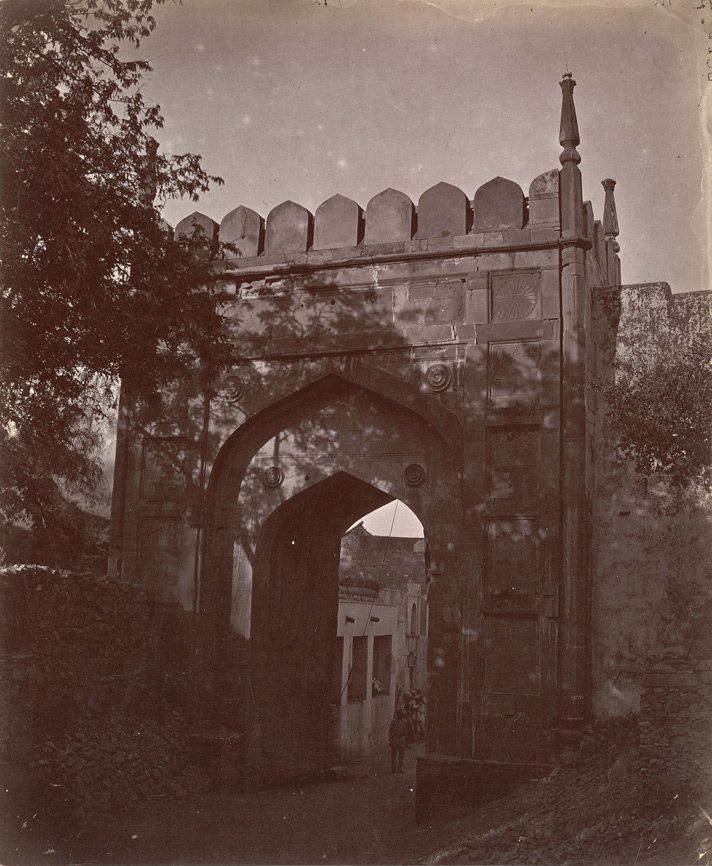
Eight gates provide access to the complex, with three in regular use. The principal entrance is the Nizam Gate, a yellow structure with floral designs donated by Mir Osman Ali Khan, the seventh Nizam of Hyderabad, in 1911. The Shahjahani Gate, donated by Shah Jahan, marks the expansion of the shrine complex beyond the Buland Darwaza, which Sultan Mahmud Khalji built. The Madar Gate and Delhi Gate are also part of the entrance system. The silver Jannati Darwaza, also called the Bihisti Darwaza, opens only on rare occasions.
Tanks and communal kitchens
The Jhalara is a natural water tank used by pilgrims. Other tanks were donated by Shah Jahan and Queen Mary in 1911. Service areas and spaces for preparing and distributing langar food form part of the complex. Akbar’s large deeg, donated in 1568, is made from an alloy of seven metals, including metal brought from Colombo, Sri Lanka. It measures approximately 6.1 metres in diameter. Its rim was designed to remain cool while food cooked over a fire beneath it. The cauldron was transported on elephants in three sections and reassembled at the dargah, where Akbar prepared and shared its first dish with fakirs.
Jahangir donated a smaller deeg in 1614. Both cauldrons remain in use for preparing degh ka khana, a dish of rice, ghee, cashew nuts, almonds, and raisins. The complex also contains the Sahn Chirag, a large chandelier commissioned by Akbar, and another large silver chandelier donated by the Golden Temple. Chaddars and rose petals placed at the shrine form part of the ritual and decorative features associated with pilgrim offerings.