Şahadet Mosque: An Ottoman Mosque in Bursa


Site at a Glance
- Rating
- 4.7
- Popularity
- Low
- Country
- Turkey
- Primary era
- Medieval
- Eras represented
- Medieval, Modern
- Civilizations
- Ottoman
- Site type
- Religious
- Remains
- Mosque
On this page9 sections
History
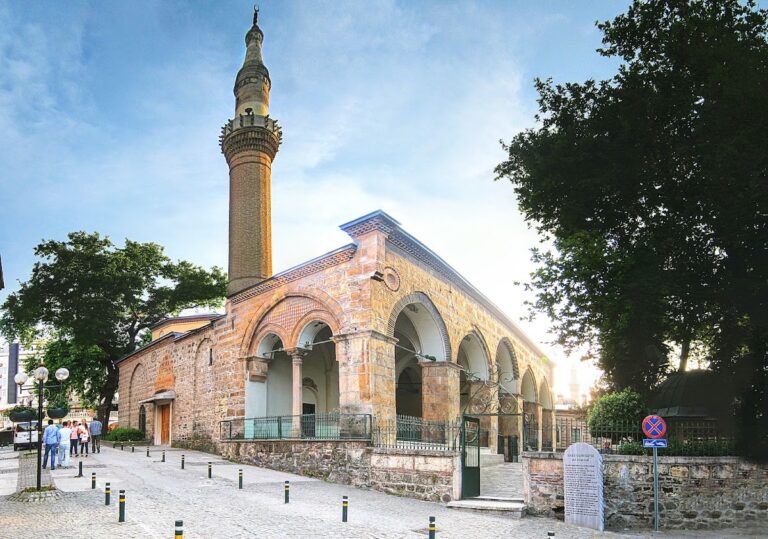
Şahadet Mosque is an Ottoman mosque in Bursa, Turkey, built by Sultan Murad I in 1365 in the period of early Ottoman expansion. Standing opposite the Bey Palace, it was the city’s largest mosque when constructed and originally followed the multi-domed plan of the Ulu Mosque.
Construction under Murad I
Murad I, the Ottoman sultan who ruled from 1362 until his death in 1389, commissioned the mosque as a three-part building with nine domes and numerous columns. Its plan was comparable to that of Murad’s mosque in Plovdiv. The arrangement made it the first public mosque described as having multiple columns and domes.
The building acquired several names from its position and associations. It was called Kale Mosque because it stood within Bursa Castle, and Palace Mosque because it faced the Bey Palace. Traditions connect the name Şahadet Mosque with Murad I’s death at the Battle of Kosovo in 1389. Another tradition says that Murad built the mosque so the public could testify that he had performed the prescribed prayers, following criticism that he did not attend them regularly. These traditions explain the name rather than establish a separate construction phase.
Earthquake and nineteenth-century rebuilding
The Bursa earthquake of 1855 destroyed the mosque. In 1890, Governor Celaleddin Pasha commissioned its renovation in the Neo-Renaissance and Neo-Gothic styles, nineteenth-century revivals based on Renaissance and Gothic forms. The rebuilt mosque was reduced to approximately two-thirds of the original structure. The main prayer hall retained part of the earlier building, while the front façade and side walls were renewed.
Later use and the inherited inscription
Şahadet Mosque was closed for worship during the Second World War. At the request of the Bursa Society of Friends of Ancient Monuments, it reopened in 1946 after simple repairs and resumed religious service.
The marble inscription above the eastern entrance came from an earlier mosque built in the Hisar by Orhan Gazi, Murad I’s predecessor and the Ottoman ruler associated with the conquest of Bursa. That mosque was destroyed in the 1855 earthquake and no longer survives, but its inscription was incorporated into Şahadet Mosque.
Remains
The surviving building combines the remains of Murad I’s mosque with the nineteenth-century reconstruction. Its original arrangement consisted of three sections covered by nine domes and supported by numerous columns. The present structure preserves the earlier central prayer-hall portion, while the renewed façade and side walls reflect the Neo-Renaissance and Neo-Gothic renovation of 1890.
Plan and surviving structure
Original multi-domed plan
The first mosque used a three-part plan related to the Ulu Mosque arrangement, a large Ottoman layout of several domed sections carried by many columns. Nine domes covered the original building, whose plan also corresponded to that of Murad I’s mosque in Plovdiv.
Present prayer hall
The main prayer hall that survives today is covered by two successive domes. This portion belongs to the earlier mosque, whereas the front façade and side walls were rebuilt during the 1890 renovation. The surviving form therefore preserves part of the fourteenth-century structure within a substantially renewed building.
Eastern entrance inscription
A small marble inscription is set above the eastern entrance. Written in naskh, a rounded and highly legible Arabic script, it originally belonged to Orhan Gazi’s mosque in the Hisar. The inscription is one of the surviving physical elements associated with that destroyed building.