Agios Eleftherios Church: An Orthodox Metropolitan Chapel in Athens
Site at a Glance
- Popularity
- High
- Country
- Greece
- Primary era
- Medieval
- Eras represented
- Medieval, Modern
- Civilizations
- Crusader, Greek
- Site type
- Religious
- Remains
- Church
On this page14 sections
History
Agios Eleftherios Church, also known as the Little Metropolis, is an Eastern Orthodox church in Athens, Greece. It was first dedicated to the Virgin Mary as Panagia Gorgoepikoos, a title meaning “quick to hear” a supplicant. The dedication was associated with a reportedly miraculous icon, regarded as the church’s most precious treasure.
Medieval predecessor and original dedication
A predecessor church belonged from the mid-seventh century to the monastery of Agios Nikolaos, which was subordinate to Kaisariani Monastery. The Ecumenical Patriarch of Constantinople, the leading bishop of the Orthodox Church of Constantinople, granted Kaisariani and its possessions to the Archbishop of Athens as an ecclesiastical endowment. The archbishop then lived at Agios Nikolaos and used its church as his private chapel. The later church was built over remains of a pre-Christian temple dedicated to Eileithyia, a Greek goddess associated with childbirth.
Construction date and competing interpretations
The church’s construction date is disputed. Proposals range from the ninth century, when local tradition attributed its foundation to Byzantine Empress Irene, to the thirteenth century. Many scholars, particularly in Greece, formerly favored an early-thirteenth-century date and associated the building with Michael Choniates, a medieval churchman who served as Athens’s metropolitan. The extensive reuse of older architectural material has also been cited in arguments against an earlier date.
During a visit to the Athenian Agora in 1436, the Italian antiquarian Cyriacus of Ancona recorded an inscription that is now incorporated into the church. Art historian Bente Kiilerich argued that the inscription’s presence in the Agora at that time points to construction after 1436, perhaps during early Ottoman rule. She connected this possibility with the Ottomans’ acquisition of the Parthenon, formerly the city’s cathedral, and its conversion into a mosque.
Archaeologist Olga Palagia questioned Byzantine and post-Byzantine datings. She argued that the abundance of ancient Greek reliefs suggests a style shaped by Frankish, or Western European, influence in medieval Greece. Palagia proposed that an Italian church commissioned by a humanist patron during the Florentine Renaissance, a cultural movement centered in Florence, was another possibility requiring further study. Mary-Lee Coulson noted that calendar friezes and clocks were common in medieval Latin churches. Athens was ruled from 1385 to 1458 by the Florentine Acciaioli family, who governed the medieval Duchy of Athens, a polity centered on the city.
Siege and changing use
During the 1827 siege of Athens in the Greek War of Independence, the monastery of Agios Nikolaos was destroyed and the adjoining buildings were demolished, while the church itself remained unharmed. After the war, the church ceased to serve as a place of worship. It became a public library in 1841, a predecessor of the National Library of Greece, and continued in library use into the 1860s.
A restoration in 1856 removed later additions, including a bell tower. In the 1860s the church was reconsecrated first to Christ the Saviour and then to Saint Eleftherios, the name by which it became known. Interior painting was still present in 1834 but was lost during the building’s use as a library.
Remains
Building and decoration
Plan and construction
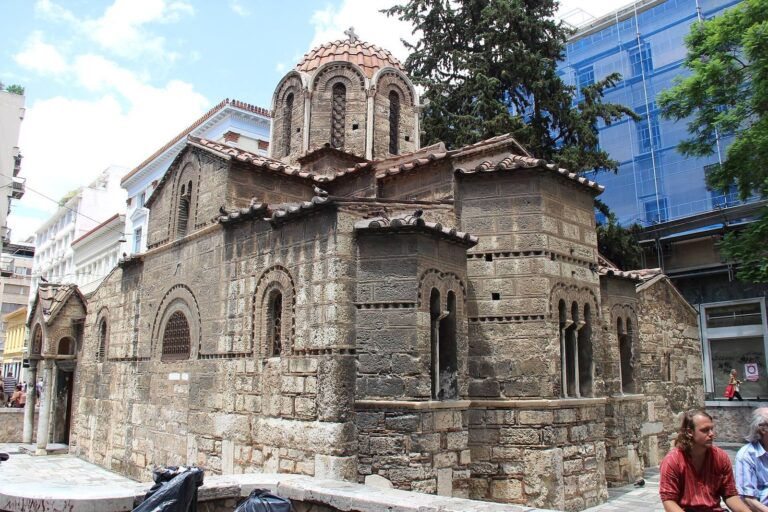
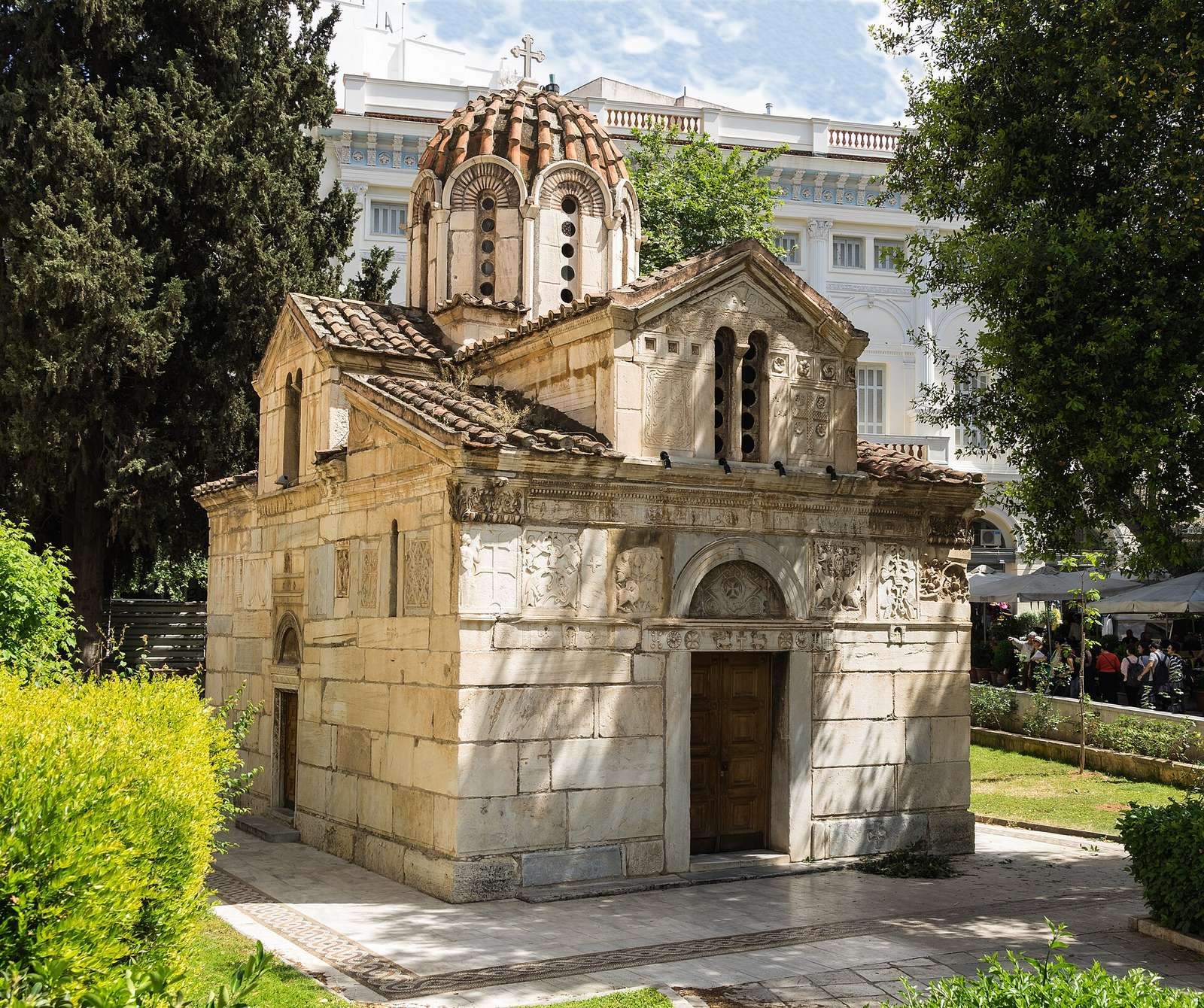
Standing in Mitropoleos Square beside the Metropolitan Cathedral, the church measures 12.20 by 7.60 metres. It has a cross-in-square plan, with a central domed space arranged within a square, four interior supports, and three aisles; the middle aisle is higher than the two side aisles. An octagonal dome rises from a drum, the raised section beneath it. Four columns originally supported the dome, before four piers replaced them during a nineteenth-century renovation. At the west end, a three-part narthex, or entrance hall, has a taller central section covered by a barrel vault, a ceiling shaped like a half-cylinder. Three doors connect it to the main church. The central west door is the principal entrance, with additional doors on the north and south sides. At the east end, three apses, rounded projections, have a larger central one. White Pentelic and bluish Hymettian marble, poros limestone, and brick form the building. Much of the material came from older structures; brick is confined to the dome.
Interior paintings
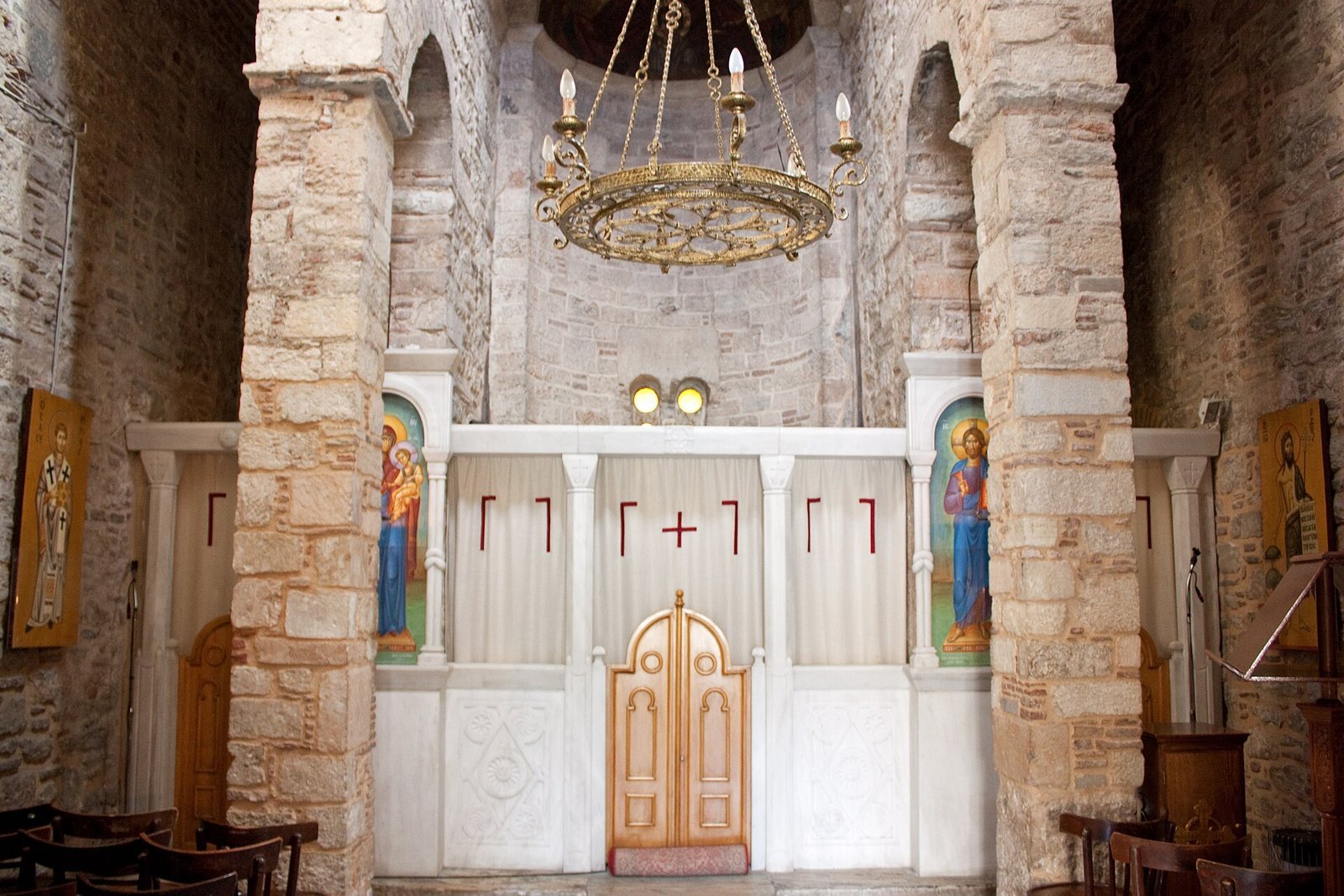
The interior was originally covered with frescoes. Among the surviving paintings is an image of the Virgin in the apse, dated to the thirteenth or fourteenth century.
Exterior reliefs
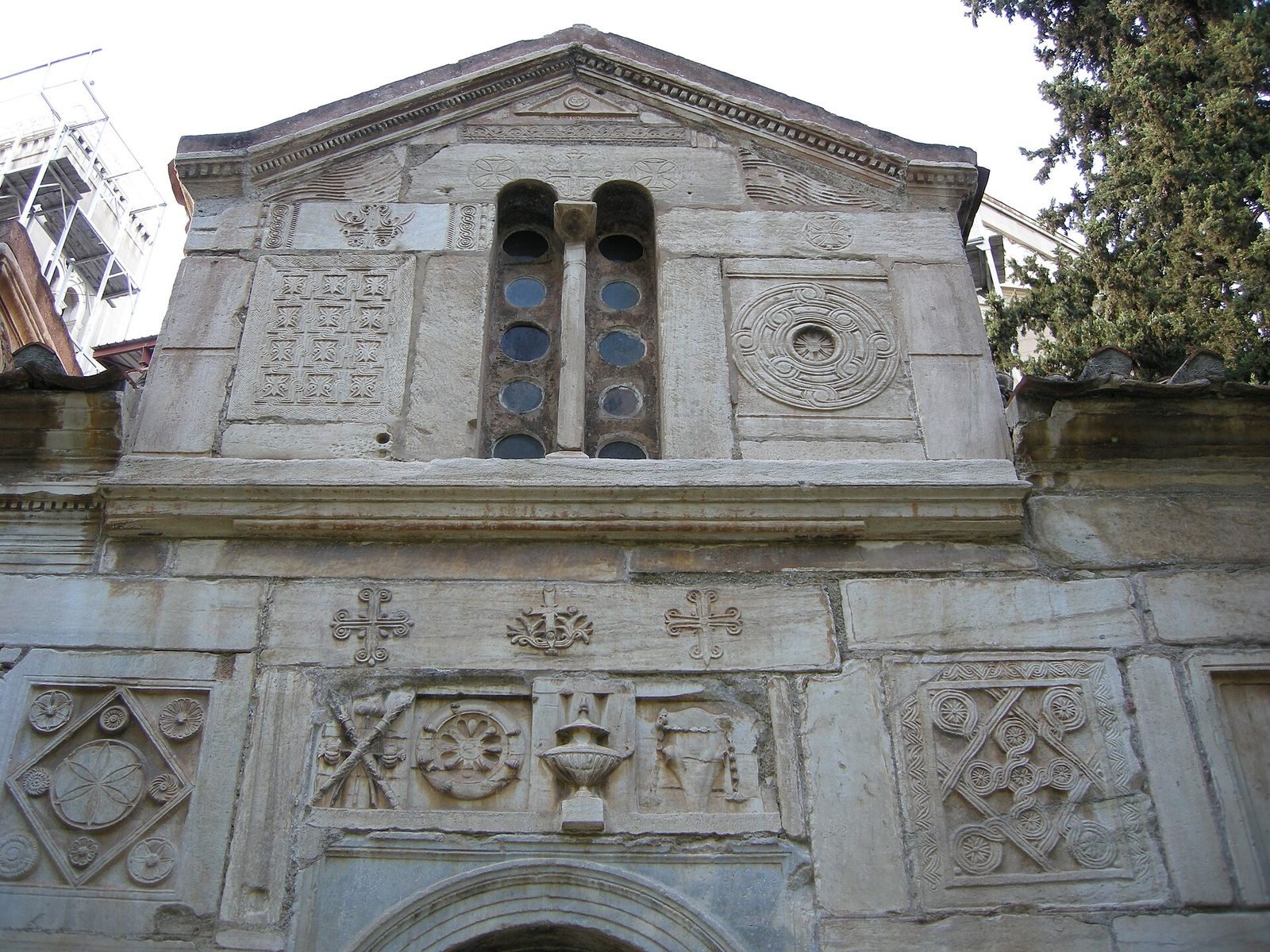
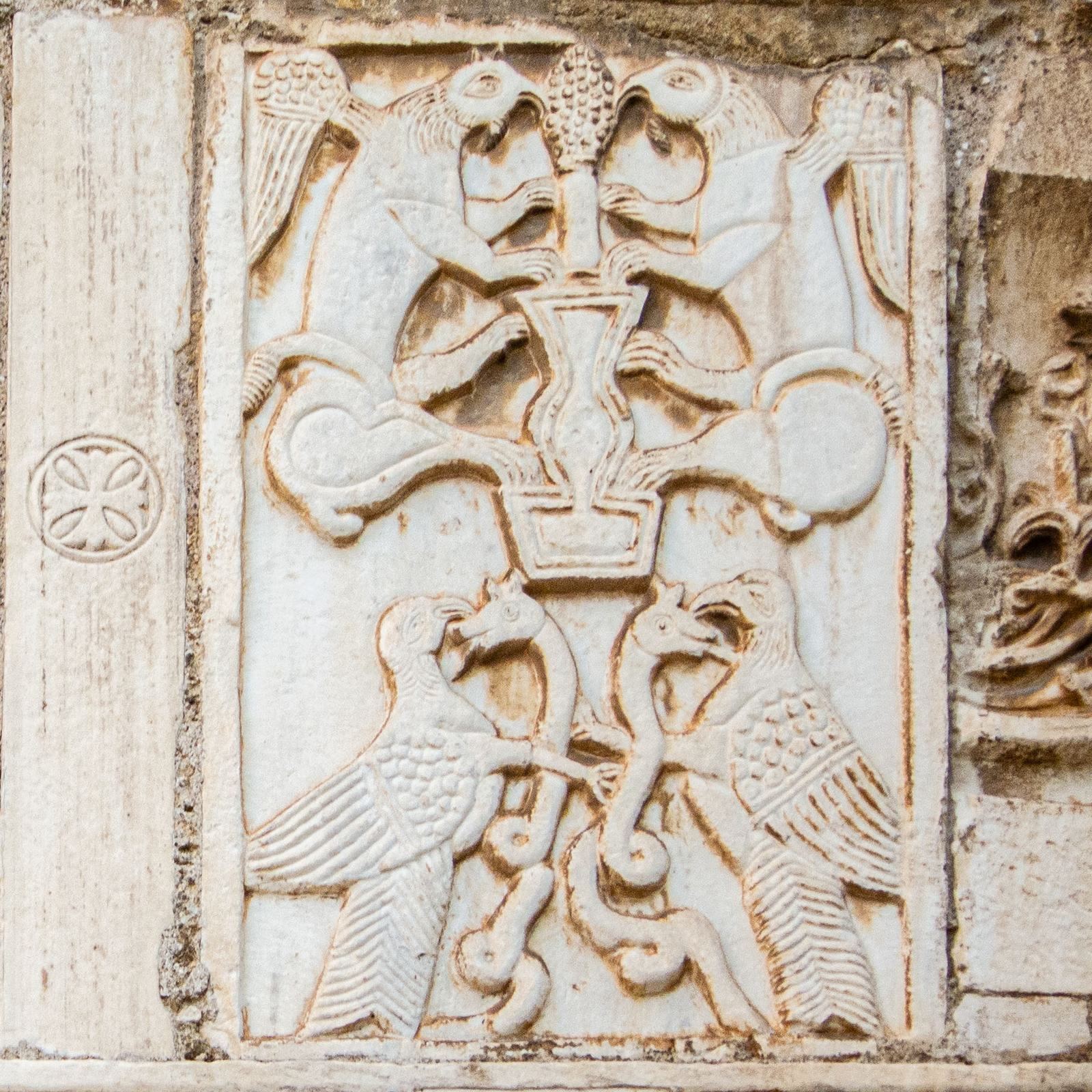
About 90 reliefs from different periods are built into the exterior. The reused carvings include classical pieces, some altered or reworked to fit the church. Together, their imagery combines Christian and pagan subjects with ancient Greek ornament.
West entrance
Four relief panels above the west entrance depict sphinxes and griffins; they have been identified as side panels from a Byzantine fountain. A Pentelic-marble frieze above the entrance shows zodiac signs and festivals or monthly activities associated with the Attic calendar. Its scene for Hekatombaion, the first month of the Attic year, includes a Panathenaic ship-cart carrying the sacred peplos, a draped garment worn by women in ancient Greece. The cart was part of the Panathenaia, a major Athenian festival, and this relief is the only known visual depiction of the ship. Two Maltese crosses added during Latin rule, a period of Western European Christian rule in the region, damage the scene.
North side
A north-side relief shows two handled vessels decorated with rosettes and set on shallow dishes. It has been interpreted as a possible reference to the Eucharist, the Christian rite involving consecrated bread and wine, and as a reused furnishing from an earlier church, perhaps from an altar area. Another relief, a post-classical Greek funerary work, depicts two mourning women. A separate reworked ancient carving retains a bearded man at its center, while crosses cut into the stone obscure motifs to either side. Ancient reliefs dedicated as offerings to deities are also incorporated on this side.
East side
Two reliefs on the east gable show festival victories and have been judged contemporary with the Parthenon frieze. In one, a victorious Attic tribe receives a prize beside a youth and rearing horses, possibly in a horse-racing scene. In another, Nike presents an unidentified object to a woman wearing a peplos; a related scene shows a vessel being presented. Elsewhere on the east side, an archaic frieze on a marble block depicts a funeral procession for people killed in battle. Other carvings show dancers and a lion catching a deer on a panel from a Byzantine fountain.
South side
Above the south entrance, an ancient relief panel arranges poppy seed capsules, an omphalos bowl with a rounded, navel-like center, a lidded two-handled vessel, and a garlanded bucranium, or sculpted ox skull. A Byzantine fountain panel on the south side shows an eagle catching a running hare.
Funerary inscription
Inscribed remains of a funerary monument for Flavius Paramonos, Aelia Abidiane, and Eisias are incorporated into the church.